
Two Types of Trump Supporters: Why “Billionaires or Idiots” Works as Satire—and Fails as Sociology
The slogan divides Donald Trump’s coalition into two insulting categories: people wealthy enough to benefit from his politics and people who allegedly support those benefits without sharing them. Its force comes from compression. Its weakness comes from pretending a complicated electorate can be reduced to one line.
Donald Trump remains president in June 2026, and arguments about who benefits from his second administration continue to shape American political culture. Tax reductions, federal spending cuts, immigration enforcement, tariffs and executive power have created sharply different interpretations of the same presidency.
Supporters describe Trump as a disruptive populist willing to confront institutions they distrust. Critics see a political project that uses populist language while protecting wealthy individuals, large businesses and concentrated power.
“Two Types of Trump Supporters: Billionaires and Idiots” belongs entirely to the second interpretation. It is not an attempt to interview voters or classify every person in the coalition. It is a hostile joke built around one question: who materially benefits, and who is being persuaded to defend those benefits?
The slogan is not powerful because it accurately describes every Trump voter. It is powerful because it turns economic resentment into a two-word accusation.
The Joke Begins With Class, Not Intelligence
The visible insult is “idiots,” but the deeper structure of the joke is economic. One category possesses extraordinary wealth. The other does not.
The slogan argues that support for Trump makes rational sense for billionaires because tax reductions, deregulation, access and business-friendly policy may increase their wealth or political influence.
Everyone else is accused of misunderstanding the transaction. The joke assumes that ordinary supporters are voting for cultural promises while the most concrete economic gains move upward.
That is why the wording feels more like class warfare than a generic partisan insult. “Billionaires or idiots” does not merely say Trump voters are wrong. It says the coalition is organized around unequal knowledge of who receives the reward.
The first group is portrayed as self-interested. The second is portrayed as manipulated. The joke depends on the belief that wealthy supporters understand Trump’s economic agenda more clearly than ordinary supporters do.
Why Billionaires Are the First Category
Trump’s political identity combines anti-establishment language with close relationships to wealthy donors, executives and investors. That contradiction has followed him since his first presidential campaign.
He presents himself as an outsider fighting elites while also using personal wealth as evidence of competence. Supporters can interpret that wealth as independence from traditional political control. Critics interpret it as proof that the administration belongs to the same class it claims to confront.
Distributional analyses of major tax-and-spending legislation enacted during Trump’s second term have strengthened the criticism. Independent budget analysis found that high-income households received substantial benefits from tax provisions, while lower-income households could lose resources when reductions in health, food or other assistance were included.
Those findings do not prove that every billionaire supports Trump or that every Trump policy benefits every wealthy person. They explain why the first half of the satire is recognizable: critics see a presidency whose economic architecture is unusually comfortable for those already holding the most.
The Second Category Is an Insult, Not Evidence
Calling millions of people “idiots” may communicate anger, but it does not explain why they vote.
Trump’s coalition includes wealthy business owners, lower-income workers, retirees, religious conservatives, immigration hardliners, gun-rights voters, anti-abortion voters, partisan Republicans, people who distrust Democrats and citizens primarily motivated by cultural conflict.
Some voters prioritize taxes. Others prioritize judges, borders, foreign policy, inflation, race, gender, religion or a desire to punish established institutions. A person can make a decision critics consider harmful without lacking intelligence.
The slogan deliberately refuses that complexity because complexity weakens the punch line.
Anger that working- and middle-class voters may defend an economic program whose largest gains flow toward people with far greater wealth.
Religion, party identity, immigration views, media ecosystems, regional culture and the many non-economic reasons people choose a candidate.
It creates instant solidarity among critics by transforming a complicated policy argument into one memorable line.
It can harden partisan identity by confirming supporters’ belief that political opponents despise them rather than disagree with them.
The Artwork Uses Classification as a Weapon
The design resembles a simple educational chart: a headline establishes the subject, and two categories provide the answer.
That structure gives the insult an artificial sense of certainty. There is no third box, exception or explanatory footnote. Every supporter is pushed toward one side.
This visual finality is the joke’s central device. Political identity becomes a forced-choice question whose answers are both hostile.
The composition is especially effective on dark garments because the white and red lettering reads with the bluntness of a protest placard. Navy makes the statement feel political and institutional. Black makes it harsher. Red turns the entire piece into confrontation.
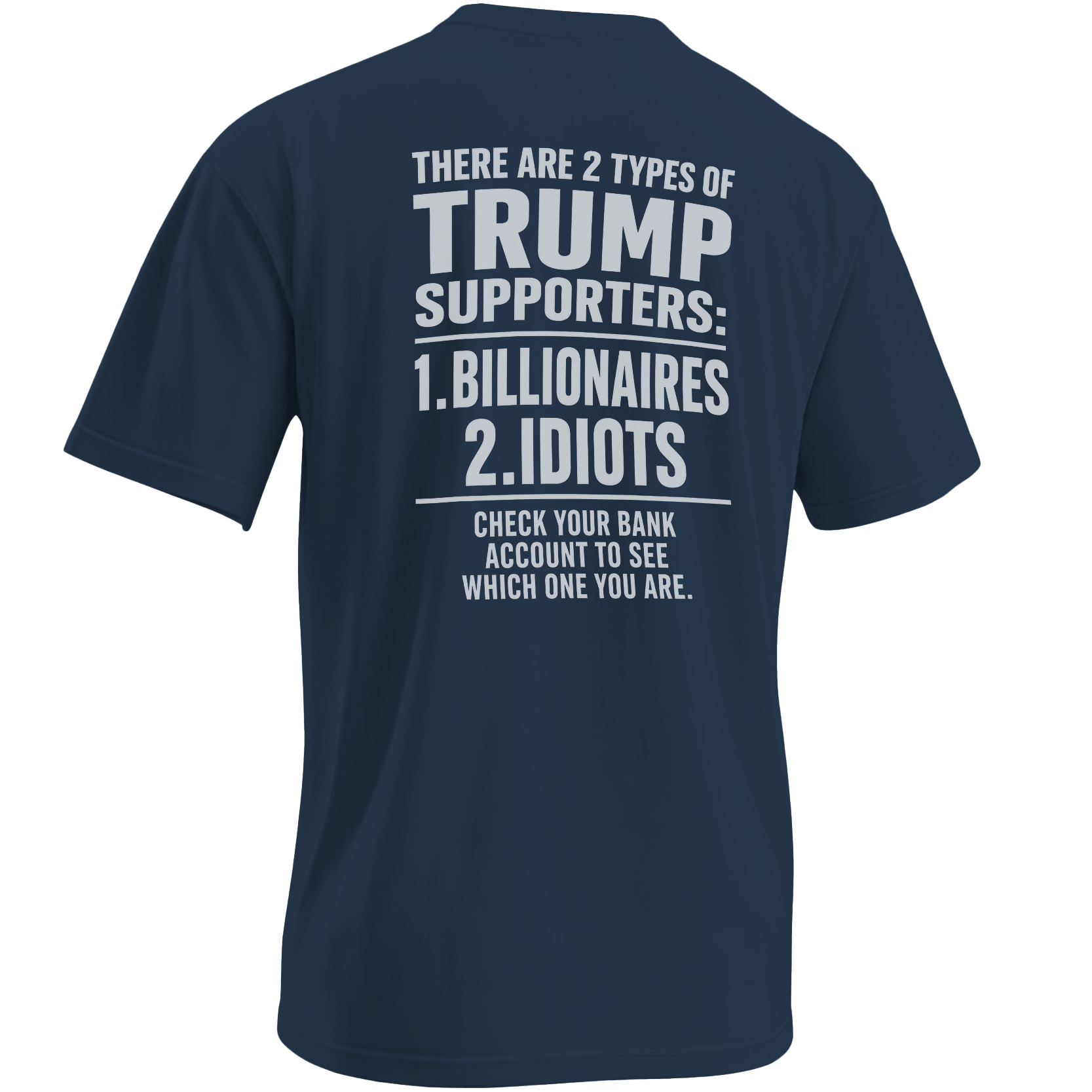
Three Garment Colors Change the Emotional Temperature
Navy resembles campaign branding and government color palettes, allowing the insult to arrive inside a visually disciplined political frame.
Black removes patriotic softness and makes the statement feel like a severe verdict rather than a campaign-season joke.
Red borrows the color most closely associated with Republican campaigning and repurposes it for an explicitly anti-Trump message.
The Slogan Reflects a Long Argument About False Consciousness
The idea behind the joke is older than Trump. Political writers have long debated why people sometimes support policies that appear contrary to their immediate economic interests.
One explanation is misinformation. Another is that voters value cultural or moral issues more than personal finances. A third is that people understand their interests differently from the analysts judging them.
A factory worker may accept economic risk because immigration enforcement matters more. A religious voter may prioritize judicial appointments. A small-business owner may expect deregulation to help even without belonging to the billionaire class.
“Billionaires or idiots” rejects all of those distinctions. It treats disagreement about interest as evidence of ignorance.
Trump’s Populism Makes the Joke More Potent
The slogan would be less effective against a politician who openly presented himself as the candidate of wealth. Trump’s rhetoric is populist: he speaks of forgotten citizens, corrupt establishments, unfair trade, dangerous borders and institutions that betray ordinary Americans.
Critics respond that the emotional language of working-class revolt coexists with tax priorities, donor relationships and executive decisions favorable to wealthy interests.
The shirt compresses that critique into a crude bargain. Billionaires receive the material policy. Everyone else receives the performance.
The Billionaire Category Is Also About Access
Wealth influences politics through more than tax rates. Billionaires can fund campaigns, support outside organizations, own media platforms, hire lobbyists and gain direct access to decision-makers.
That access does not guarantee every requested outcome. It gives wealthy participants a level of political proximity unavailable to most voters.
The design’s first category therefore represents not only money saved through policy, but the ability to help define which policies receive attention.
The Insult Can Strengthen the Coalition It Attacks
Political contempt often produces the opposite of persuasion. A supporter who sees this message may not reconsider tax distribution or federal spending. The supporter may simply conclude that anti-Trump culture despises ordinary people.
Trump has repeatedly used elite ridicule as evidence that he represents citizens ignored or mocked by professional institutions. Every broad insult can be absorbed into that story.
This does not make satire illegitimate. Satire is allowed to express anger rather than conduct outreach. It does mean the design should be understood as an identity signal for critics, not a likely conversion tool for supporters.
The graphic is effective at telling other anti-Trump viewers where the wearer stands. It is far less likely to persuade a Trump supporter who experiences the word “idiot” as proof of cultural contempt.
Trump Support Is Not One Economic Class
Republican support remains distributed across income levels. Wealth, education, religion, race, geography, age and home ownership interact with party identity in different ways.
Some affluent voters support Trump for taxes and regulation. Some lower-income voters support him for immigration, cultural identity or distrust of Democratic leadership. Some voters simply select the party they have supported for decades.
The coalition’s internal contradictions are real, but contradiction is not the same as stupidity.
A more accurate classification would require far more than two boxes.
Some supporters expect direct financial or commercial benefit from Republican economic policy.
Some voters accept economic trade-offs because cultural or moral concerns rank higher in their political priorities.
Some supporters want conservative judges, weaker federal regulation or a stronger executive willing to challenge established systems.
Many political decisions are relational: voters choose one side partly because they distrust or dislike the alternative.
The Phrase Is Designed for Recognition, Not Debate
Strong political graphics operate like passwords. A person who agrees understands the emotional logic immediately. A person who disagrees understands that the garment is not attempting neutrality.
The wording is too confrontational to be mistaken for generic humor. It announces an anti-Trump position before any conversation begins.
That quality gives the design usefulness at protests, political gatherings or public spaces where visibility is the purpose. The wearer does not need to explain an entire distributional analysis. The shirt identifies the side of the argument.
Why the Word “Idiots” Is More Dangerous Than “Billionaires”
“Billionaires” describes an economic category, even when used critically. “Idiots” makes a judgment about human ability.
That difference changes the moral temperature of the slogan. The wealthy group is criticized for self-interest. The ordinary group is denied competence.
Political satire often depends on cruelty, but the cruelty should still be visible. Readers do not need to pretend the line is a careful policy argument in order to appreciate its rhetorical force.
The honest reading is that the design insults Trump supporters while using economic inequality to justify the insult.
The Satire Is Strongest When Read Upward
The easiest interpretation points downward: ordinary supporters are foolish. The more interesting interpretation points upward: concentrated wealth has extraordinary ability to persuade people that its priorities represent the public interest.
In that reading, the primary target is not the voter. It is the system that allows wealthy interests to finance messaging, shape agendas and convert private gain into populist language.
The second interpretation gives the joke more political substance. It asks how the billionaire category gained enough cultural power to create the other category in the first place.
Why the Design Fits the Political Mood of 2026
Trump’s second administration has intensified arguments over presidential power, federal benefits, immigration enforcement, tariffs and the distribution of economic gains.
Public approval has remained deeply polarized, while many critics argue that the administration’s most durable economic accomplishments favor higher-income households and corporate interests.
Against that background, “Billionaires or Idiots” functions as a compressed opposition narrative. It does not address every policy. It offers one explanation for the entire coalition.
The explanation is unfairly complete—and that completeness is exactly what makes it wearable satire.
A Protest Artifact Rather Than a Demographic Claim
The Two Types of Trump Supporters graphic should be read as an anti-Trump cultural artifact, not as a research conclusion.
Its value lies in documenting how opponents describe the relationship between populist loyalty and elite economic benefit. The two categories are rhetorical characters inside that argument.
The navy, black and red versions allow the same message to move between campaign-style satire, dark political humor and open confrontation without changing a word.
Frequently Asked Questions
What does the “Two Types of Trump Supporters” design say?
It claims there are only two kinds of Trump supporters: billionaires who benefit from his policies and “idiots” who support those benefits without sharing them.
Is the graphic supportive of Donald Trump?
No. It is explicitly anti-Trump and uses a deliberately insulting classification to criticize his political coalition.
Is the slogan a factual description of every Trump voter?
No. It is political satire, not demographic research. Trump supporters come from different income levels and vote for many economic, cultural, religious and partisan reasons.
Why does the design mention billionaires?
The billionaire category reflects criticism that wealthy households, donors and businesses receive disproportionate benefits, access or influence under Trump-aligned economic policy.
Why is the word “idiots” controversial?
It dismisses millions of voters as unintelligent rather than addressing the varied reasons they support Trump, making the design expressive but unlikely to persuade its targets.
What colors are represented in the product imagery?
The graphic is shown on navy, black and red garments. Navy gives it a campaign-style tone, black emphasizes dark humor and red creates the most confrontational presentation.
What is the strongest interpretation of the satire?
Its strongest interpretation criticizes a political system in which concentrated wealth can present its own economic priorities as a populist movement serving ordinary citizens.
The Two Types of Trump Supporters piece preserves a sharp 2026 anti-Trump argument about wealth, loyalty and who truly benefits from populist politics.
Two Types of Trump Supporters Shirt delivers a blunt anti-Trump satire—“Billionaires and Idiots”—through bold protest typography offered in navy, black and red presentations.