
Jacob Misiorowski’s 15-Strikeout Shutout: The 95-Pitch Masterpiece That Redefined Power Pitching
Fifteen strikeouts. One hit. No walks. Twenty-seven batters faced. Ninety-five pitches. Jacob Misiorowski combined the violence of a 104.5 mph fastball with the efficiency of an old-school complete game and produced one of the most dominant starts in Milwaukee Brewers history.
Jacob Misiorowski began the night by throwing a 104.5 mph fastball past Kyle Schwarber, the fastest tracked pitch by a starting pitcher at that point in the Statcast era. Ninety-four pitches later, he ended the night with another triple-digit fastball and his fifteenth strikeout.
Between those two pitches, the Philadelphia Phillies produced only one hit. Schwarber singled to begin the fourth inning, then disappeared from the basepaths in a double play. Misiorowski did not walk anyone, did not allow another runner and faced the minimum 27 batters.
Milwaukee won 6–0. Misiorowski completed the first shutout and complete game of his major-league career on the first anniversary of his MLB debut. The result was simultaneously futuristic and traditional: velocity that appeared to exceed the sport’s normal limits, delivered with enough command to finish nine innings in only 95 pitches.
Misiorowski did not merely throw harder than almost any starter in history. He made unprecedented velocity look efficient enough to finish the entire game.
A Maddux Reimagined at Triple-Digit Speed
A complete-game shutout completed in fewer than 100 pitches is commonly called a “Maddux,” named for Greg Maddux and the efficiency associated with his command-first style.
Misiorowski reached the same destination through an entirely different visual language. Maddux became famous for movement, location and disrupting timing. Misiorowski repeatedly threw pitches faster than most hitters had ever faced from a starting pitcher.
The contrast made the performance historically unusual. He struck out 15 while remaining below 100 pitches, the highest strikeout total recorded in a Maddux since detailed pitch counts became available.
A high strikeout total normally requires deep counts and extra pitches. Misiorowski produced 15 strikeouts without losing efficiency, averaging fewer than 3.6 pitches for each of the 27 batters he faced.
The One Hit Made the Game More Complete, Not Less Dominant
No-hitters receive an automatic category in baseball history. A one-hitter can appear slightly less significant even when the overall performance is more overwhelming.
Schwarber’s fourth-inning single was Philadelphia’s only hit and only moment on base. A double play immediately erased him, allowing Misiorowski to face the minimum number of hitters possible across nine innings.
The Phillies never sent an extra batter to the plate. No walk extended an inning. No defensive error created additional pressure. The game moved through exactly 27 opposing plate appearances.
In functional terms, Misiorowski controlled the game almost as completely as a pitcher can without receiving credit for a perfect game.
The Graphic Treats the Box Score Like a Warning Label
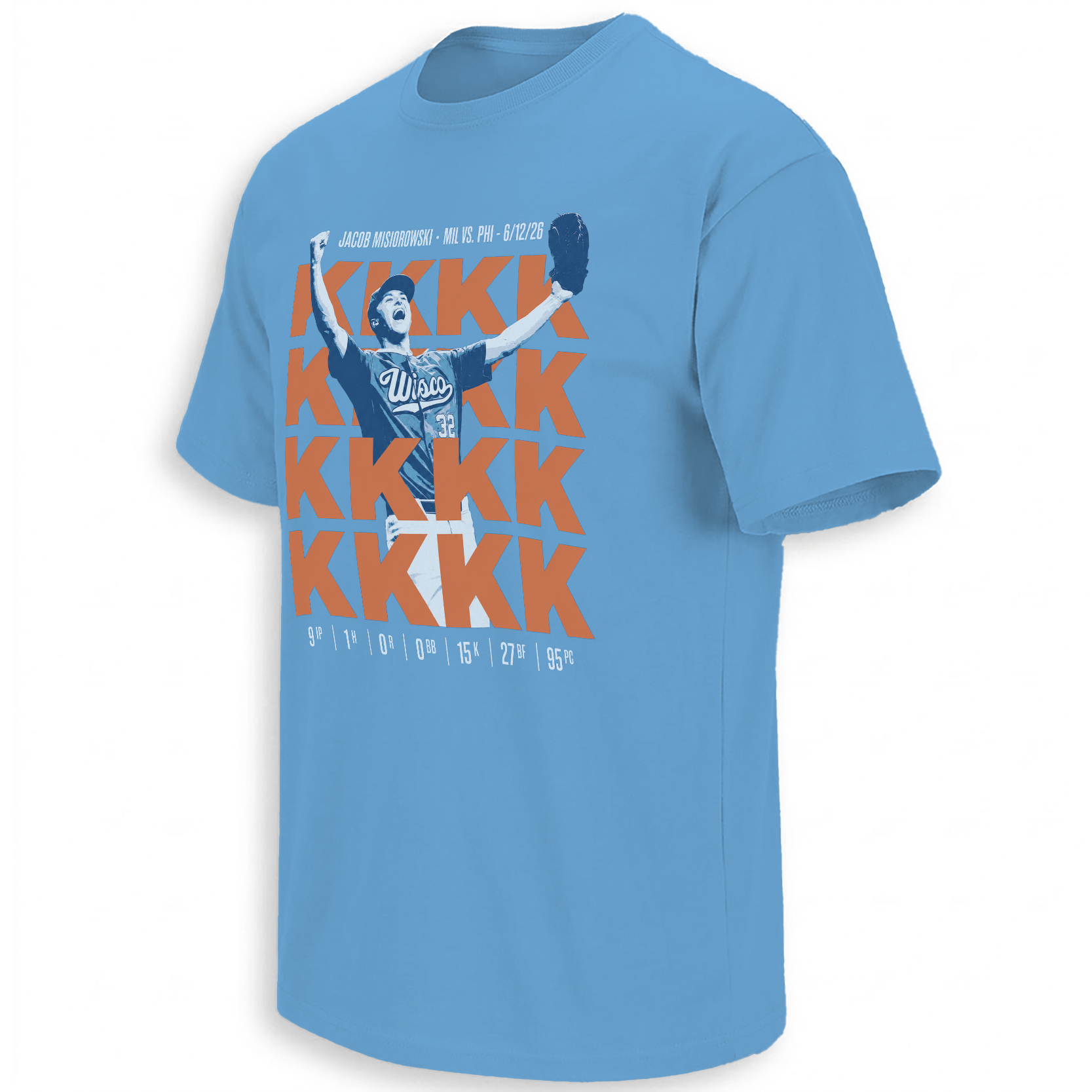
The 15 K Complete Game Shutout design is built around information that already sounds exaggerated. There is no need to invent a nickname or add a complicated slogan. The statistical line carries the drama.
Large lettering gives “15 K” immediate authority, while the complete-game and shutout language explains that the strikeouts were not produced during a short, high-effort appearance. Misiorowski controlled all nine innings.
Brewers colors connect the achievement to Milwaukee, while the pitcher’s image gives the numbers their human source: a 6-foot-7 right-hander whose release point, extension and velocity make ordinary reaction time feel unavailable.
Velocity Announced the Night Before Command Completed It
Misiorowski’s fastball naturally attracts attention because radar-gun readings provide an immediate spectacle. The 104.5 mph pitch to Schwarber established the visual stakes before the first inning had settled.
Velocity alone, however, cannot explain a 95-pitch shutout. A pitcher throwing that hard without command produces walks, long at-bats and an early visit from the manager.
Misiorowski paired the fastball with breaking pitches capable of changing a hitter’s eye level and timing. Philadelphia could not simply prepare earlier for velocity because the curveball and slider punished that commitment.
Triple-digit velocity shortened reaction time and allowed Misiorowski to challenge hitters inside and above the strike zone.
Slower, sharply moving pitches prevented Philadelphia from organizing every swing around the fastball.
Zero walks meant the Phillies could not wait for free baserunners or force Misiorowski into inefficient innings.
The Final Pitch Was Almost as Unusual as the First
Starting pitchers generally lose velocity as pitch counts rise. Fatigue changes mechanics, release timing and the ability to generate force.
Misiorowski finished the game by striking out Justin Crawford with a fastball measured above 103 mph. It was the hardest tracked pitch thrown that deep into a major-league start.
The first inning established that he possessed historic speed. The ninth demonstrated that the speed had survived the entire workload.
Misiorowski introduced the fastball immediately, struck out the side and established that Philadelphia would be forced to react at an extreme pace.
Schwarber singled, but a double play erased the runner and preserved the minimum-batters path through the game.
The Phillies continued striking out while Misiorowski avoided walks and kept his total low enough for a complete game to remain realistic.
A 103.1 mph fastball completed the shutout, confirming that the velocity had survived all 95 pitches.
The First Anniversary Made the Performance Feel Scripted
Misiorowski made his major-league debut on June 12, 2025. Exactly one year later, he delivered the best start of his career.
That symmetry gives the performance an unusually clean narrative. The first anniversary did not merely mark survival in the majors. It demonstrated how far he had moved from electric prospect to complete starting pitcher.
His debut had introduced the velocity. The anniversary game showed durability, command, pitch selection and the confidence to finish what he started.
Philadelphia Was Not an Easy Opponent to Overpower
The Phillies entered the series as one of the National League’s strongest clubs and had won seven of their previous nine games.
Their lineup included experienced hitters capable of controlling the strike zone, punishing mistakes and extending at-bats. Misiorowski did not accumulate 15 strikeouts against a lineup simply waiting for the inning to end.
That quality of opposition elevates the performance. Philadelphia understood the velocity, possessed modern scouting information and still could not generate sustained contact.
The Brewers Offense Allowed the Masterpiece to Remain Simple
William Contreras gave Milwaukee an early lead with an RBI double. Jake Bauers later added a three-run homer, while Jackson Chourio contributed another run.
The six-run advantage removed the need for Misiorowski to pitch around every small threat. He could attack the strike zone, trust the defense and keep the game moving.
Dominant starts are individual achievements constructed inside team conditions. Milwaukee’s offense created enough distance for Misiorowski’s efficiency to become the central story.
The Game Accelerated His Cy Young Case
By late June, Misiorowski had moved to the center of the National League Cy Young discussion. His ERA, strikeout total, WHIP and contact-suppression numbers placed him among baseball’s most productive starters.
Awards are accumulated across an entire season, but voters and fans remember defining performances. The 15-strikeout shutout gave his candidacy a game that could be named without additional explanation.
“The Phillies one-hitter” became shorthand for the combination of peak dominance and season-long development.
The Performance Changed the Meaning of “The Miz”
Misiorowski had already been known as “The Miz,” a shortened form of a surname broadcasters and fans initially had to learn.
After June 12, the nickname carried a different authority. It no longer belonged only to a fascinating young pitcher with unusual velocity. It belonged to the author of one of the greatest starts in Brewers history.
A nickname becomes culturally powerful when it can stand in for a shared memory. Milwaukee supporters can now say “Miz” and immediately recall 15 strikeouts, 104.5 mph and a scoreboard filled with zeros.
Why the Complete Game Matters in Modern Baseball
Modern teams manage pitchers carefully. Bullpens are specialized, third-time-through penalties are studied closely and even dominant starters are frequently removed before the ninth inning.
Misiorowski gave Milwaukee no strategic reason to make that change. His pitch count remained low, his velocity remained extreme and Philadelphia had not demonstrated a meaningful adjustment.
The complete game therefore felt both nostalgic and analytically justified. It was not a ceremonial attempt to recreate an earlier era. It was the logical conclusion of overwhelming performance.
Facing the Minimum Is the Hidden Perfect-Game Detail
Perfect games are defined by the absence of any baserunner. Misiorowski allowed one, but the double play ensured he still faced only 27 hitters.
That minimum-batters total captures how little disruption Philadelphia created. There was no stretch, no traffic and no inning in which multiple hitters could study him from the bases.
The Phillies technically avoided being no-hit. They never forced Misiorowski to work with an additional batter.
The Game Score Placed It Beside Modern Classics
Misiorowski received a game score of 100, placing the performance among the strongest outings of the modern era.
The measure combines innings, strikeouts, hits, walks and runs into one estimate of pitching dominance. His total stood near historic performances by pitchers such as Max Scherzer, Clayton Kershaw, Randy Johnson and Gerrit Cole.
That comparison does not make the starts identical. It confirms that Misiorowski’s combination of length, efficiency and suppression belongs inside elite historical company.
The 15 K Graphic Functions Like a Pitching Plaque
Some baseball graphics depend on a slogan, nickname or humorous reference. This one operates more like a statistical plaque.
Fifteen strikeouts identifies the force. Complete game identifies the endurance. Shutout identifies the result.
Together, the three elements explain why the performance deserves preservation without requiring the viewer to know every pitch sequence.
A New Landmark in the Brewers Pitching Archive
Milwaukee pitching history includes Cy Young seasons, postseason masterpieces and celebrated complete games. Misiorowski’s one-hitter immediately entered the conversation because of how many different extremes it combined.
It was the first complete game of his career, the most strikeouts of his career and a display of starting-pitcher velocity that pushed beyond previous tracking-era standards.
Within the broader MLB Shirts archive, the 15 K Complete Game Shutout graphic preserves a moment when one pitching line became sufficient to explain an entire night.
Why This Start Will Remain a Misiorowski Reference Point
Misiorowski may eventually throw a no-hitter, win a Cy Young Award or lead Milwaukee through a postseason series. Future achievements could become more important to his career.
The June 12 start will remain the first complete picture of what his ceiling looked like: elite velocity, controlled mechanics, no walks, changing speeds, nine innings and the confidence to finish at maximum intensity.
Prospects are described through possibility. A 15-strikeout complete-game shutout turns possibility into evidence.
Frequently Asked Questions
How many strikeouts did Jacob Misiorowski record?
Misiorowski struck out a career-high 15 Philadelphia Phillies hitters during Milwaukee’s 6–0 victory on June 12, 2026.
How many pitches did Misiorowski throw?
He completed all nine innings with 95 pitches, qualifying the performance as a Maddux-style shutout completed in fewer than 100 pitches.
Did Jacob Misiorowski throw a no-hitter?
No. Kyle Schwarber recorded Philadelphia’s only hit with a fourth-inning single, but he was erased by a double play.
How many batters did Misiorowski face?
He faced the minimum 27 batters because the Phillies’ only baserunner was eliminated on a double play.
What was Misiorowski’s fastest pitch?
He reached 104.5 mph against Kyle Schwarber in the first inning, setting a tracked starting-pitcher velocity record at the time.
Did he issue any walks?
No. Misiorowski completed the shutout without walking a batter, a major reason he was able to remain under 100 pitches.
Why was the date significant?
The performance occurred on June 12, 2026, exactly one year after Misiorowski made his major-league debut for Milwaukee.
What does the 15 K Complete Game Shutout design represent?
It commemorates Misiorowski’s career-high strikeout total, first complete game, first shutout, one-hit line and historic combination of velocity and efficiency.
The 15 K Complete Game Shutout piece preserves the night Jacob Misiorowski faced the minimum, reached 104.5 mph and delivered a Brewers pitching masterpiece.
15 K Complete Game Shutout Shirt celebrates Jacob Misiorowski’s historic Milwaukee Brewers one-hitter against Philadelphia, featuring 15 strikeouts, zero walks, 95 pitches and a 104.5 mph fastball.