Yesterday Is Dead: The Oklahoma Baseball Motto That Survived Defeat and Became a Championship
Oklahoma lost Game 2 of the College World Series finals and entered the next day with its season reduced to nine innings. Jaxon Willits answered with the phrase the Sooners had carried all year: “Yesterday’s dead.” One night later, Oklahoma defeated North Carolina 13–2 and raised the third national championship trophy in program history.
On June 21, 2026, Oklahoma lost Game 2 of the Men’s College World Series finals. The championship that had appeared one victory away was suddenly attached to a winner-take-all game against North Carolina.
During the postgame press conference, shortstop Jaxon Willits explained how the Sooners intended to process the loss. “Yesterday’s dead,” he said, describing a motto that had followed Oklahoma through the entire season. Once the press conference ended, the defeat was supposed to lose its authority.
On June 22, Oklahoma returned to Charles Schwab Field and defeated North Carolina 13–2. The Sooners captured their third national title and their first since 1994, converting a phrase about forgetting the past into one of the defining cultural lines of the championship.
The phrase did not ask Oklahoma to pretend the loss never happened. It asked the Sooners to stop allowing a finished game to control the next one.
The Motto Became Public at the Most Dangerous Moment
Team mottos are easy to repeat after victories. Their real value appears when the result creates doubt.
Oklahoma had won Game 1 of the championship series 9–3 and moved within one victory of the title. North Carolina answered in Game 2, forcing a decisive final.
The Sooners could have carried frustration, missed opportunities and the weight of a lost championship chance into Monday. Instead, Willits described a ritual of emotional separation.
The game was over. Its lessons could remain. Its emotional control could not.
“Yesterday’s dead” was not invented after Oklahoma won the title. Willits described it as a season-long motto immediately after the Game 2 loss, before the Sooners knew whether the phrase would lead to celebration or elimination.
The Skull Turns the Philosophy Into a Visual Object
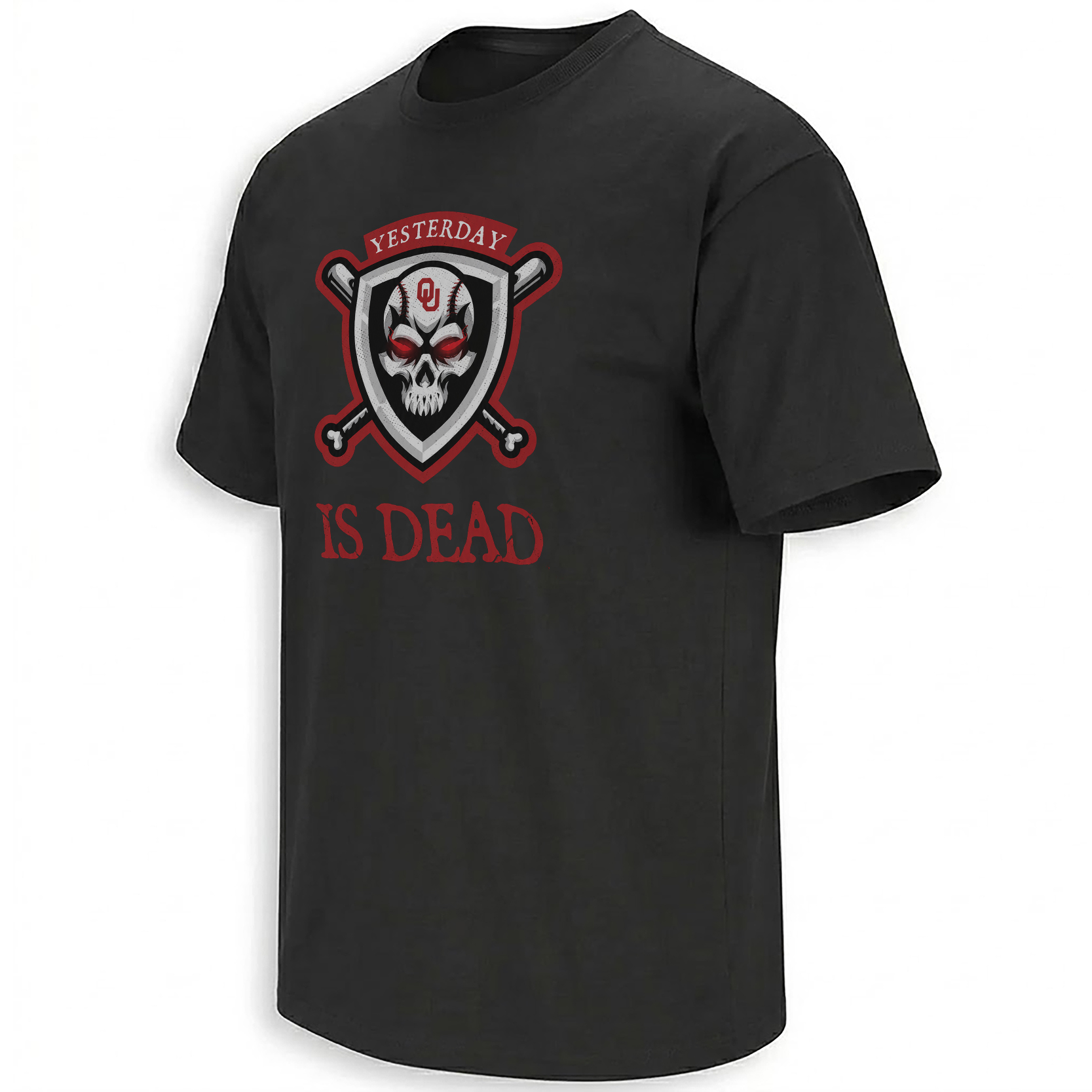
The Yesterday Is Dead artwork uses a skull because the phrase is not written as gentle self-improvement. It treats the past as something physically finished.
Crimson connects the message to Oklahoma. Dark shadows and distressed texture remove the polished appearance of ordinary championship branding. The skull supplies finality: yesterday is not sleeping, waiting or temporarily ignored. It is dead.
Baseball equipment surrounding the image keeps the design grounded in the team’s season rather than generic gothic symbolism. The result feels like a warning carried from the clubhouse into Omaha.
“Dead” Does Not Mean Forgotten
Competitive teams cannot function by erasing information. Pitchers must study the swings opponents produced. Hitters must remember sequencing. Coaches must identify why a game changed.
“Yesterday’s dead” does not reject analysis. It separates analysis from emotional attachment.
Oklahoma could learn from Game 2 without repeatedly playing it inside the mind. The distinction allowed the Sooners to prepare for North Carolina again without treating the previous result as a prediction.
Remember pitch patterns, defensive mistakes and the specific adjustments required for the next game.
Refuse to let frustration, fear or the missed opportunity from Game 2 become part of Game 3.
Reduce a national championship game to the next pitch, next at-bat and next defensive decision.
The Motto Fit a Team That Had Already Outrun Its Regular Season
Oklahoma did not enter the NCAA Tournament as an obvious national champion. The Sooners finished eleventh in the SEC and carried a 14–16 conference record.
Their postseason performance looked like a different season. Oklahoma won the Atlanta Regional, swept Kansas in the Super Regional and reached Omaha with an offense producing home runs at a dramatically increased rate.
That transformation required the team to stop treating the regular-season standings as a permanent definition.
In that sense, “Yesterday’s dead” applied to more than one finals loss. It allowed the Sooners to leave an uneven spring behind and become the hottest team in the tournament.
The Road to Omaha Was Built From New Beginnings
Oklahoma finished 14–16 in conference play and entered the postseason without the profile of a conventional title favorite.
The Sooners eliminated the meaning of their regular-season finish and began playing with greater offensive force and pitching confidence.
A sweep of Kansas returned the program to the College World Series for the first time since its 2022 runner-up finish.
Oklahoma advanced through an SEC-heavy bracket and entered the championship series with its postseason momentum intact.
The Sooners responded to the Game 2 loss with a 13–2 victory and the program’s third national championship.
Game 3 Made the Motto Look Like Strategy
Oklahoma did not begin the championship game cautiously. The Sooners created pressure early and continued expanding the lead.
L.J. Mercurius gave Oklahoma the pitching stability required in a winner-take-all setting. The offense repeatedly capitalized on North Carolina’s mistakes, and Kyle Branch’s late three-run home run removed the final possibility of a comeback.
The final score, 13–2, made the response appear emotionally clean. Oklahoma did not spend nine innings defending the memory of Game 2. It played a different game.
The Final Out Changed the Meaning of Every Previous Loss
Once Jackson Cleveland recorded the final strikeout, the Game 2 defeat stopped being a threat. It became part of the championship structure.
The loss now explained the motto. The decisive victory proved it. Without Game 2, “Yesterday’s dead” would have remained an internal team saying. Because Oklahoma lost and immediately recovered, the phrase became public evidence of how the champions thought.
This is one of sports’ central transformations: events that feel disastrous in the moment become necessary chapters once the final result is known.
The Phrase Reverses the Usual Meaning of Championship History
Championships are built to preserve yesterday. Scores, trophies, photographs and banners exist so the past can remain available.
Oklahoma’s motto argues for the opposite behavior during competition. History becomes valuable only after the work is finished. Before that point, the previous game can become a distraction.
The Sooners had not won a national title since 1994. They could respect that history without asking it to produce one pitch in 2026.
The current team had to make its own yesterday.
The Skull Prevents the Design From Becoming Generic Motivation
“Focus on today” could belong to any team, company or classroom. “Yesterday Is Dead” is more severe.
The skull keeps the phrase from becoming soft motivational language. It suggests that returning emotionally to the previous day is not merely unhelpful—it is an attempt to revive something that should remain buried.
That intensity matches postseason baseball, where one poor inning can end a season and one emotional carryover can become the beginning of another.
The Message Works After Victory Too
The phrase was most visibly useful after a loss, but it also applies after success.
Oklahoma won Game 1 of the finals and still had to play again. Celebrating too early would have given yesterday the same dangerous authority as regret.
A championship team must release both outcomes. Defeat cannot become fear. Victory cannot become entitlement.
The next pitch remains indifferent to what happened the day before.
The Championship Gave the Motto Permanence
Team sayings often disappear when a roster changes. Players graduate, coaches adjust language and the next season creates its own identity.
Oklahoma’s 2026 championship gives “Yesterday’s dead” a permanent reference point. Future Sooners teams can use the phrase while knowing exactly which group proved it under the greatest pressure.
The motto now belongs beside the 13–2 score, the trophy raised in Omaha and the return to Norman for the championship celebration.
A Different Kind of National Championship Graphic
Most championship designs show the trophy, title year or final score. This artwork preserves the mental rule behind the result.
The Yesterday Is Dead graphic is not simply evidence that Oklahoma won. It explains how the Sooners approached the moment when they still could have lost.
Within the wider NCAA Shirts archive, the skull design operates as a clubhouse artifact rather than a conventional locker-room celebration.
Why the Motto Can Outlast the 2026 Roster
College baseball teams change quickly. Draft selections, transfers and graduation ensure that the exact group will never exist in the same form again.
A useful philosophy can survive those changes because it does not depend on one player’s statistics.
Every future Oklahoma team will encounter a loss it cannot change, a victory it cannot continue celebrating and a game that demands full attention in the present.
The 2026 champions supplied the response: yesterday is dead; attack today.
Frequently Asked Questions
What does “Yesterday’s dead” mean for Oklahoma baseball?
It means the previous game is finished and should not control the team’s preparation, confidence or emotional state in the next game.
Who publicly explained the Oklahoma motto?
Oklahoma shortstop Jaxon Willits discussed the saying after the Sooners lost Game 2 of the 2026 College World Series finals.
Why was the timing important?
Willits repeated the motto before Oklahoma knew whether it would win the championship, making it a real response to adversity rather than a phrase added after the victory.
Who did Oklahoma defeat in the championship series?
The Sooners defeated the North Carolina Tar Heels in the best-of-three 2026 College World Series finals.
What was the final score of Game 3?
Oklahoma defeated North Carolina 13–2 in the winner-take-all championship game on June 22, 2026.
How many national championships has Oklahoma baseball won?
The 2026 title was the third national championship in Oklahoma baseball history and the program’s first since 1994.
Why does the artwork use a skull?
The skull gives literal visual form to the motto, representing the finality of the previous day and the refusal to emotionally revive a completed game.
Is Yesterday Is Dead only about forgetting losses?
No. The philosophy also discourages overconfidence after victories by requiring the team to return its attention to the next game.
The Yesterday Is Dead piece preserves the Oklahoma motto that buried one finals loss, cleared the path to a 13–2 victory and became part of the Sooners’ third national championship.
Yesterday Is Dead Shirt combines an Oklahoma Sooners baseball skull graphic with the season-long motto that helped the 2026 national champions move beyond a Finals Game 2 loss and dominate the winner-take-all finale.