“Truth Really Upsets Most People” Turns TRUMP Into an Identity Test
Five familiar words, one vertical acronym and a patriotic campaign palette create a political message that seems universal at first glance—but becomes unmistakably connected to Donald Trump as soon as the initials are read together.
In July 2026, Donald Trump remains at the center of American political attention as the sitting president, and his name continues to function as something larger than an identifying label. Printed on a sign, placed inside a slogan or reconstructed through an acronym, “Trump” can immediately communicate affiliation, opposition, grievance or provocation before a conversation has even begun.
“Truth Really Upsets Most People” works inside that environment because it presents itself as a general observation before revealing its partisan structure. Read horizontally, the sentence sounds like a familiar argument about honesty. Read vertically, its opening letters spell T-R-U-M-P.
That second reading changes the entire message. The phrase stops being an abstract comment about uncomfortable facts and becomes a defense of one political figure: the suggestion that resistance to Trump exists because he says truths others would rather avoid.
The slogan does not prove that a statement is true. It turns disagreement itself into evidence that the speaker must be telling an uncomfortable truth.
Why the Acronym Feels Like a Political Reveal
Strong political slogans often reward a second look. Their first layer needs to be understandable from across a room, while the second gives supporters a sense that they have decoded something others may have missed.
This design follows that structure precisely. The viewer first sees five bold words arranged like a campaign poster. Only after noticing the enlarged opening letters does the full identity message become visible.
That moment of recognition is the design’s real mechanism. The surname is never required as a separate headline because it is already embedded inside the sentence. Wordplay performs the same job that a portrait, campaign logo or ballot slogan would normally perform.
A Statement About Truth—and About Who Defines It
The sentence “truth really upsets most people” sounds broad enough to attract agreement across ideological lines. Most people have experienced moments when an unwanted fact produced discomfort, defensiveness or anger.
Political use makes the claim more complicated. Once the initials spell TRUMP, “truth” is no longer presented as a neutral concept. It becomes attached to a particular leader and to the belief that his statements should be understood as revelations rather than ordinary political arguments.
This is why the slogan functions as an identity signal rather than a factual claim. It does not identify which statement is true, offer evidence or name the people supposedly upset. Instead, it creates a complete emotional narrative: Trump speaks, critics react and their reaction is interpreted as confirmation.
Trump says things that established institutions, political opponents or cultural elites do not want acknowledged, so the anger directed at him is evidence of his honesty.
The phrase can protect a political claim from scrutiny by treating every objection as emotional resistance rather than a request for evidence, accuracy or context.
How the Artwork Makes Its Political Position Clear
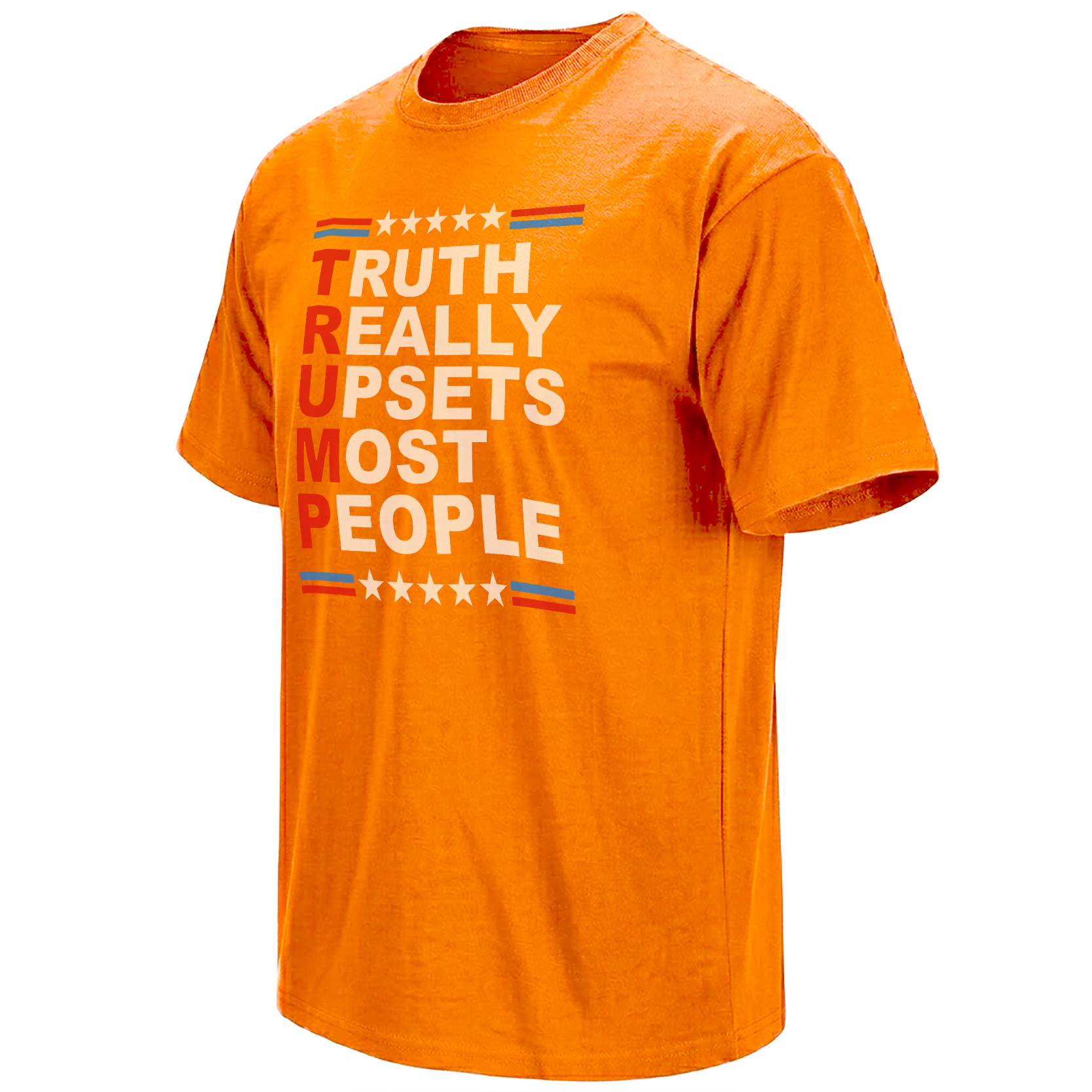
The Trump Truth Really Upsets Most People Shirt does not use Trump’s portrait, signature or a conventional campaign lockup. Its political meaning comes entirely from typography, initials and patriotic decoration.
Five large words are stacked down the center of the composition. The first letter of each line creates the vertical surname, while alternating red-and-white type gives the phrase a deliberate campaign-sign rhythm.
Rows of white stars and parallel red-and-blue stripes sit above and below the text. Those elements remove much of the slogan’s remaining neutrality. Even before the acronym is decoded, the artwork is already speaking in the visual language of American electoral politics.
Red, White and Blue Carry the Argument Before the Words Do
Political graphics rarely rely on text alone. Color determines how viewers classify the message before they have read every line, and red, white and blue immediately locate this artwork inside American patriotic culture.
Red supplies urgency and confrontation. Blue gives the composition institutional weight, while white keeps the condensed lettering readable. Together, the colors recall campaign placards, rally banners, election graphics and Fourth of July visual language.
The vivid orange garment introduces a less conventional background. Most Trump-related apparel uses black, navy, white or solid red. Orange creates stronger separation from the patriotic print while carrying an indirect visual association with the exaggerated orange tones commonly used in political caricature and internet commentary about Trump.
Forces the viewer to read vertically as well as horizontally, making the surname part of the structure rather than a separate logo.
Mirrors the five-word construction and gives the phrase the ceremonial authority of a patriotic emblem.
Allows the political reference to operate through recognition and wordplay without requiring a literal image of Donald Trump.
Why the Phrase Is Generally Read as Pro-Trump
Political slogans can acquire meanings through repeated use. This acronym has appeared on supportive Trump merchandise and has been documented in Trump-aligned conservative settings, where its meaning is straightforward: Trump tells difficult truths and opponents become angry because they cannot accept them.
The visual treatment reinforces that established use. Nothing in the artwork clearly reverses the message through parody, crossed-out text, altered spelling or an opposing caption. The stars, stripes and affirmative presentation all support a celebratory rather than hostile reading.
A viewer could personally wear the phrase ironically, but irony would depend on outside explanation. The image itself does not communicate satire clearly enough to override the slogan’s familiar supportive context.
Accurate search intent matters here: although the product is currently placed within Ellie Shirt’s Anti Trump category, the wording and patriotic design are more naturally understood as pro-Trump messaging. The collection placement supplies a broader political context, but it does not automatically reverse what the artwork communicates on its own.
When a Product and Its Collection Tell Different Stories
Collection placement normally helps readers interpret a design. Protest graphics inside an Anti Trump collection are expected to criticize policies, ridicule political behavior or express resistance.
This acronym creates an unusual exception. The collection implies opposition, while the artwork itself uses language historically associated with Trump supporters. That tension turns the product into a useful example of how ecommerce classification and cultural meaning can diverge.
From an editorial perspective, the safest interpretation is not to pretend the tension does not exist. The wider collection remains relevant as an archive of Trump-era protest, satire and political reaction, but this specific piece should be understood through its actual slogan and established audience.
Political Apparel as a Public Conversation Shortcut
A political shirt compresses an argument into a visual position that can be understood without conversation. It can signal community at a rally, provoke disagreement in public or create instant recognition between people who share the same political interpretation.
Acronym designs are particularly efficient because they make the wearer feel as though a familiar name contains a hidden explanation. The word already carries political power; the expanded phrase supplies a reason for that power.
In this case, the reason is truth. Supporters can read the shirt as a defense against criticism, while opponents may read it as an example of how political identity can redefine disagreement as proof of correctness.
The Slogan’s Most Powerful Word Is Not “Trump”
Although the initials create the recognizable surname, the word doing the most rhetorical work is “truth.” It gives the rest of the sentence moral authority before any specific political claim has been tested.
“Really” intensifies that authority. “Upsets” assigns an emotional reaction to disagreement. “Most people” widens the target until opposition appears nearly universal. By the time the acronym is complete, the sentence has built an entire worldview from five ordinary words.
That construction explains why the slogan survives independently of one speech, election or news cycle. It is not tied to a specific policy promise. It offers a reusable explanation for conflict itself.
A Timestamp of Trump-Era Message Culture
Political artifacts do not need to document a single event to preserve a historical mood. Some record the communication habits of an era: compressed slogans, identity-first arguments and phrases designed to travel through rallies, social platforms and apparel.
“Truth Really Upsets Most People” belongs to that category. It reflects a period in which political language is frequently evaluated through loyalty before evidence and in which a surname can operate simultaneously as a person, movement, brand and online trigger.
The graphic therefore works as a timestamp of American polarization. Supporters see affirmation. Critics see circular reasoning. Nearly everyone recognizes the reference before the full sentence has finished being read.
Frequently Asked Questions
What does TRUMP mean in “Truth Really Upsets Most People”?
The first letters of Truth, Really, Upsets, Most and People form the surname TRUMP, turning the five-word sentence into a political acronym connected to Donald Trump.
Is “Truth Really Upsets Most People” a pro-Trump slogan?
It is generally used as a supportive Trump slogan. The message suggests that Trump’s critics react negatively because he says uncomfortable truths they do not want to accept.
Why can the slogan be interpreted differently?
The individual sentence sounds like a universal observation about honesty, but the vertical acronym attaches it to Trump. Supporters may see affirmation, while critics may view it as circular political reasoning.
Why does the design use stars and red, white and blue stripes?
The patriotic decorations connect the wordplay to American campaign culture and make the Trump reference visible even before the viewer fully decodes the acronym.
Does the artwork show Donald Trump’s portrait?
No. The design communicates its political reference through the initials, stacked typography, stars and campaign-style color palette rather than a photograph or illustrated portrait.
Why is the product included in an Anti Trump collection?
The collection provides a wider archive of Trump-era political graphics, protest and satire. However, this particular acronym is more commonly understood as supportive Trump messaging, so the artwork and category do not communicate exactly the same position.
The Truth Really Upsets Most People design captures the slogan-driven language surrounding Trump, while Ellie Shirt’s wider Anti Trump political archive documents the resistance, satire and competing messages produced around the same presidency.
Trump Truth Really Upsets Most People Shirt turns the letters T-R-U-M-P into a bold five-line political acronym, using patriotic stars, campaign stripes and red-white-and-blue typography to capture the identity-driven language of contemporary American politics.