
Down 29, New York Created The Greatest Finals Comeback Ever
Game 4 looked finished at 81–52. By the final horn, the Knicks had beaten San Antonio 107–106, OG Anunoby had completed the rally with a last-second tip-in, and Madison Square Garden had witnessed the largest comeback in NBA Finals history.
For much of June 10, Madison Square Garden sounded less like the center of a championship dream than a building trying to understand how the night had escaped so quickly. San Antonio had pushed the score to 81–52 with 9:40 remaining in the third quarter, and the Knicks were staring at a 29-point deficit in the most pressurized series of their season.
Then the direction of the game changed. New York stopped treating the deficit as one impossible problem and began removing it possession by possession. A defensive stop became a transition chance. A three-pointer made the crowd louder. A whistle shifted the emotional temperature. By the fourth quarter, what had looked like a routine Spurs road victory had become a test of whether they could survive the Garden’s momentum.
The answer arrived with 1.2 seconds left. Jalen Brunson’s three-point attempt missed, OG Anunoby flew into the lane and redirected the ball through the rim. The Knicks moved ahead 107–106, completed the largest comeback ever recorded in the NBA Finals and took a 3–1 series lead they would convert into a championship three days later.
The Knicks did not erase 29 points in one heroic burst. They changed the emotional meaning of every possession until the impossible score became reachable.
The Night Started With San Antonio in Complete Control
San Antonio entered Game 4 trailing 2–1 in the series but played the opening half with the urgency of a team trying to reclaim home-court control. The Spurs moved the ball cleanly, made shots before New York’s defense could settle and repeatedly quieted the crowd.
Victor Wembanyama’s size and range distorted the floor, while San Antonio’s perimeter scoring forced the Knicks to defend multiple threats at once. New York looked a step late on rotations and increasingly dependent on Brunson to create difficult offense from a collapsing half court.
When the deficit reached 29, the number felt larger than an ordinary score gap. This was the NBA Finals. Every possession was slower, every mistake more visible and every missed opportunity carried the weight of a series that could have been tied 2–2.
At 81–52, the scoreboard did not merely say that New York was losing. It suggested that the entire shape of the series was about to change. The comeback mattered because the Knicks reversed that meaning before San Antonio could close the door.
The Comeback Began Before Anyone Believed It Was Possible
Historic comebacks are often remembered as sudden explosions, but the early stages rarely feel historic. They feel procedural: one stop, one rebound, one transition basket, one decision to continue playing the possession in front of you rather than reacting to the size of the deficit.
New York’s rally gained force when its defense began interrupting San Antonio’s rhythm. The Spurs had scored comfortably enough to believe the game could be managed. Once their shots stopped falling and the Knicks began creating easier offense, the emotional advantage shifted faster than the scoreboard initially showed.
The crowd understood the change before the comeback was complete. Each Knicks run produced a louder response, and each Spurs miss began to feel like evidence that the night was turning. Madison Square Garden did not simply react to the rally. It became one of the mechanisms sustaining it.
Stops reduced the deficit while preventing San Antonio from resetting the pace and restoring control.
The arena transformed every Knicks basket into emotional pressure on the next Spurs possession.
Once the score moved within reach, the comeback stopped feeling mathematical and became inevitable to the home crowd.
Brunson and Anunoby Carried Different Parts of the Miracle
Jalen Brunson finished with 36 points and seven assists, absorbing the responsibility of keeping New York’s offense organized while the game moved between desperation and opportunity. His scoring kept the Knicks connected long enough for the rest of the rally to develop.
OG Anunoby delivered the night’s other essential performance. He scored 33 points, repeatedly punished San Antonio from the perimeter and then made the play that converted the comeback from possibility into history.
The winning sequence captured the identity of both players. Brunson created the decisive shot under pressure. When it missed, Anunoby attacked the space above the rim rather than watching the ball fall away. His tip-in was not an isolated miracle disconnected from the previous 47 minutes. It was the final expression of a team that had spent the second half refusing to concede the possession.
The Artwork Treats the Score Like a Monument
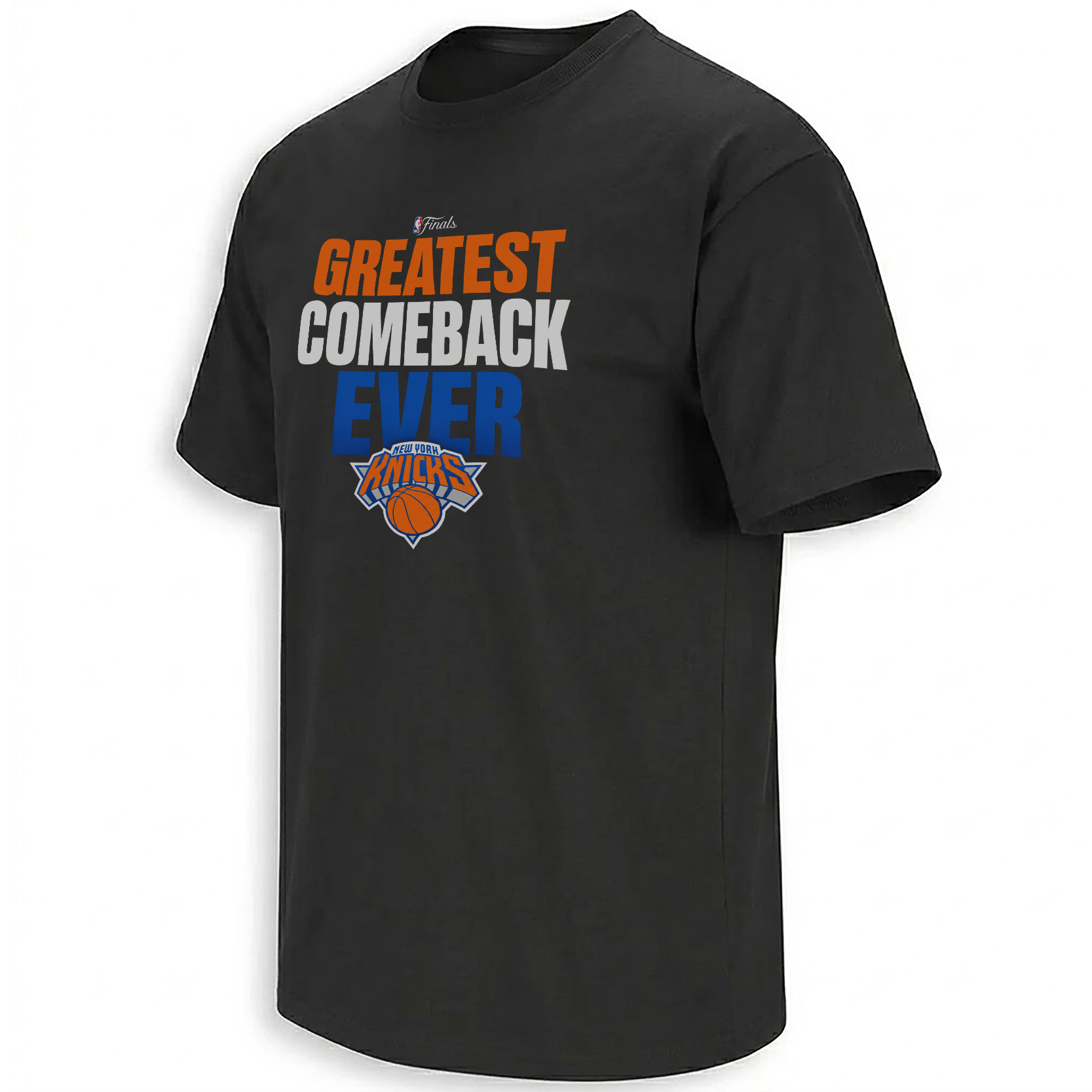
The Greatest Comeback Ever Shirt does not attempt to illustrate every stage of the rally. Instead, it organizes the night around the numbers and figures that turned Game 4 into a historical reference point.
“Greatest Comeback Ever” occupies the visual hierarchy like a newspaper banner written after the final horn. The 29-point figure becomes evidence, while player imagery anchors the slogan in New York’s blue-and-orange Finals identity.
That approach is effective because this game is already remembered through numerical shorthand. Fans do not need the full play-by-play to recognize “down 29,” “107–106” or “Game 4.” Each number opens the same emotional archive.
Why “Greatest Comeback Ever” Is Not Just Fan Exaggeration
Sports graphics often use superlatives because fan emotion naturally reaches for the largest possible language. In this case, the wording has a measurable foundation. No NBA Finals team had previously won after trailing by as many as 29 points.
That distinction separates the game from ordinary postseason rallies. A regular-season comeback may be statistically larger or tactically stranger, but a Finals comeback operates under a different level of pressure. The opponent has prepared specifically for the series, every possession is amplified and the consequences alter championship history.
New York also completed the rally in a one-point finish rather than gradually pulling away. The final margin preserved the tension of the comeback until the final second, which made Anunoby’s tip-in inseparable from the record itself.
The Graphic Uses Scoreboard Logic Instead of a Traditional Trophy Layout
Championship apparel often centers a trophy, ring or title year. This artwork belongs to a different category: the single-game memory piece. Its purpose is not to summarize the entire postseason but to preserve one sequence that changed the series.
The 29-point deficit functions like a historical statistic and an emotional trigger. It explains the scale of the night before the viewer reaches the player imagery.
“Greatest Comeback Ever” reads like the front page fans expected to see after leaving Madison Square Garden.
Knicks blue creates the authority of team identity, while orange supplies the urgency of the rally. White space keeps the composition readable and allows the central message to behave like a scoreboard headline rather than a crowded commemorative collage.
The result feels closer to a ticket stub, newspaper extra or arena poster than generic Finals merchandise. It records what happened, where the emotional center was and why the number 29 now belongs inside Knicks history.
Madison Square Garden Became Part of the Comeback
The Garden’s role cannot be reduced to background atmosphere. When a home team trails by nearly 30 points, the building usually moves through frustration, disbelief and resignation. Game 4 forced the arena to reverse those emotions in real time.
The first phase of the rally created curiosity. The middle phase restored belief. By the final minutes, the crowd was reacting to every possession as though it could permanently alter the series.
That progression explains why the game became a New York cultural event rather than only a league record. Fans inside the arena, viewers across the city and people following online experienced the same emotional movement from embarrassment to possibility to total disbelief.
The Tip-In Became the Cleanest Image of the Entire Rally
A 29-point comeback contains dozens of essential plays, but memory usually selects one image to represent the whole sequence. Anunoby’s tip-in became that image because it arrived at the exact point where the comeback could still have ended as an impressive loss.
Brunson’s missed three briefly left the night unresolved. Anunoby’s leap solved it before San Antonio could secure the rebound. The ball dropped through, the score changed and the Garden reacted before the Spurs could process what had happened.
In future retellings, that tip-in will function like the final punctuation mark. Everything before it explains how New York returned to the game. The tip explains how the Knicks won it.
From Game 4 Survival to the 2026 Championship
The comeback did more than produce a memorable result. It placed New York ahead 3–1 and forced San Antonio to carry the emotional damage of losing a game it had controlled by 29 points.
Three days later, the Knicks won Game 5 and completed the championship. That ending changed how Game 4 would be remembered. It was no longer an isolated miracle inside a losing series. It became the defining bridge between New York’s long title wait and the moment the wait finally ended.
The game now sits inside the wider New York Knicks Shirts collection as one of the clearest single-night artifacts from the championship run. Other designs preserve trophies, parade energy and individual players; this one preserves the moment the entire Finals turned.
Within the broader NBA Shirts archive , the piece also records a league-wide historical marker: the night a Finals team erased the largest deficit the championship round had ever seen.
Why Fans Remember Comebacks Differently From Dominant Wins
Dominant victories provide certainty. Comebacks provide emotional transformation. They force supporters to experience despair and celebration in the same night, often within minutes of each other.
That movement creates unusually durable memories. Fans remember where they nearly stopped watching, which basket first made them believe and how the room sounded when the lead finally changed.
Game 4 contained all of those stages at historic scale. The 29-point deficit is important because it measures the distance. The one-point final score matters because it shows how little room remained after New York traveled all the way back.
A Timestamp of the Night New York Stopped Accepting the Score
The strongest sports graphics do not merely celebrate a result. They preserve the language fans use to retrieve the emotion later.
“Greatest Comeback Ever” is direct because the game does not require metaphor. The score was 81–52. The final was 107–106. The comeback set a Finals record. Anunoby tipped in the winning basket. Every part of the claim can be located inside the night itself.
Years from now, the design will still point to the same question: how did a team down 29 points in Game 4 of the NBA Finals leave Madison Square Garden one victory away from a championship?
The answer is the same one the graphic gives. New York kept playing until the scoreboard told a completely different story.
Frequently Asked Questions
How large was the Knicks’ Game 4 comeback in the 2026 NBA Finals?
New York erased a 29-point deficit after trailing San Antonio 81–52 in the third quarter, completing the largest comeback victory in NBA Finals history.
What was the final score of Knicks versus Spurs Game 4?
The Knicks defeated the Spurs 107–106 at Madison Square Garden on June 10, 2026.
Who scored the game-winning basket?
OG Anunoby tipped in a missed Jalen Brunson three-point attempt with 1.2 seconds remaining to give New York the lead.
How many points did Jalen Brunson and OG Anunoby score?
Brunson scored 36 points and added seven assists, while Anunoby scored 33 points and delivered the winning tip-in.
Why was the comeback historically significant?
No team had previously won an NBA Finals game after trailing by 29 points, making New York’s rally the largest comeback in Finals history.
How did Game 4 affect the 2026 NBA Finals?
The victory gave New York a 3–1 series lead. The Knicks then won Game 5 to complete their first NBA championship since 1973.
What does the Greatest Comeback Ever design represent?
The artwork preserves the 29-point deficit, New York’s 107–106 victory and the Game 4 performance that changed the direction of the 2026 NBA Finals.
The Greatest Comeback Ever design preserves the record-setting Game 4 rally, while the wider Knicks championship archive follows the tip-in, the title run and the New York basketball memories created around the 2026 Finals.
Greatest Comeback Ever Shirt captures the Knicks’ record 29-point rally against San Antonio in Game 4 of the 2026 NBA Finals, ending with OG Anunoby’s winning tip-in and a 107–106 Madison Square Garden victory.