
Take Me Homaha: How Country Roads Carried West Virginia Baseball to Its First Omaha
A song about returning home became the perfect language for traveling farther than West Virginia baseball had ever gone. “Take Me Homaha” turns Country Roads into a highway sign pointing toward the Mountaineers’ first Men’s College World Series.
West Virginia entered June 2026 without a Men’s College World Series appearance in program history. It now owns an Omaha victory, a place in the tournament’s elimination drama and a new chapter in the cultural life of Country Roads.
The Mountaineers opened their Omaha debut by defeating Troy 7–5. Tyrus Hall delivered the go-ahead two-run single in the eighth inning, allowing WVU to record its first MCWS victory in the same game as its first appearance.
A 5–2 loss to North Carolina then moved West Virginia into the elimination bracket and created a rematch with Troy. The title remains undecided, but one part of the story can no longer be taken away: the road finally reached Omaha.
Country Roads usually brings Mountaineers home. In 2026, it became the song for traveling somewhere the baseball program had never been.
Take Me Homaha celebrates West Virginia reaching and competing in its first Men’s College World Series. It does not claim that the Mountaineers have won the 2026 national championship.
Why Country Roads Belongs to West Virginia Fans
Few popular songs have become as deeply embedded in a university identity as “Take Me Home, Country Roads” at West Virginia.
The Mountaineer Marching Band began performing the song in 1972, only one year after its release. It later became part of every home football game and developed into the familiar post-victory scene of players and supporters remaining together to sing.
The song also extends beyond football. It appears at university ceremonies, basketball games, alumni events and public celebrations. Its phrases—“almost heaven,” “take me home,” “country roads” and “the place I belong”—have become a shared vocabulary for West Virginia belonging.
That history gives the shirt more emotional weight than an ordinary song-title parody. The design takes language Mountaineers already use to close victories and redirects it toward a baseball breakthrough.
The Road Continued After the Morgantown Regional
West Virginia’s home crowd had already experienced what seemed like a complete postseason ending when the Mountaineers defeated Kentucky 6–5 to advance from the Morgantown Regional.
Players returned to the field and joined supporters in singing Country Roads. The scene contained everything associated with WVU victory culture: gold and blue, a home crowd and a familiar song turning the stadium into one collective voice.
Yet the season was not going home. The road continued into a Super Regional against Cal Poly.
West Virginia won the opener 12–2, then produced 19 hits and five home runs in a 17–1 clinching victory. The sweep completed the program’s final missing step and sent the Mountaineers to Omaha for the first time.
Morgantown supplied the song, the postseason supplied the road and Omaha supplied the destination. “Take Me Homaha” compresses the entire journey into one line.
Why “Homaha” Is More Than a Convenient Rhyme
The wordplay begins with sound. “Home” fits naturally inside Omaha, allowing the title of West Virginia’s most familiar song to become a tournament destination without losing its original rhythm.
The deeper connection lies in what both words represent.
Home describes emotional belonging. Omaha describes arrival at college baseball’s final stage. Combining them suggests that West Virginia fans carried their sense of home into a city nearly a thousand miles away.
This is particularly meaningful for a first appearance. Texas or LSU fans can speak about returning to Omaha through generations of tournament memory. West Virginia had to create that relationship for the first time.
“Homaha” makes the unfamiliar destination sound immediately owned.
The Highway Sign Turns the Pun Into a Story
A phrase alone could communicate the joke, but the highway-sign composition explains how the words are connected.
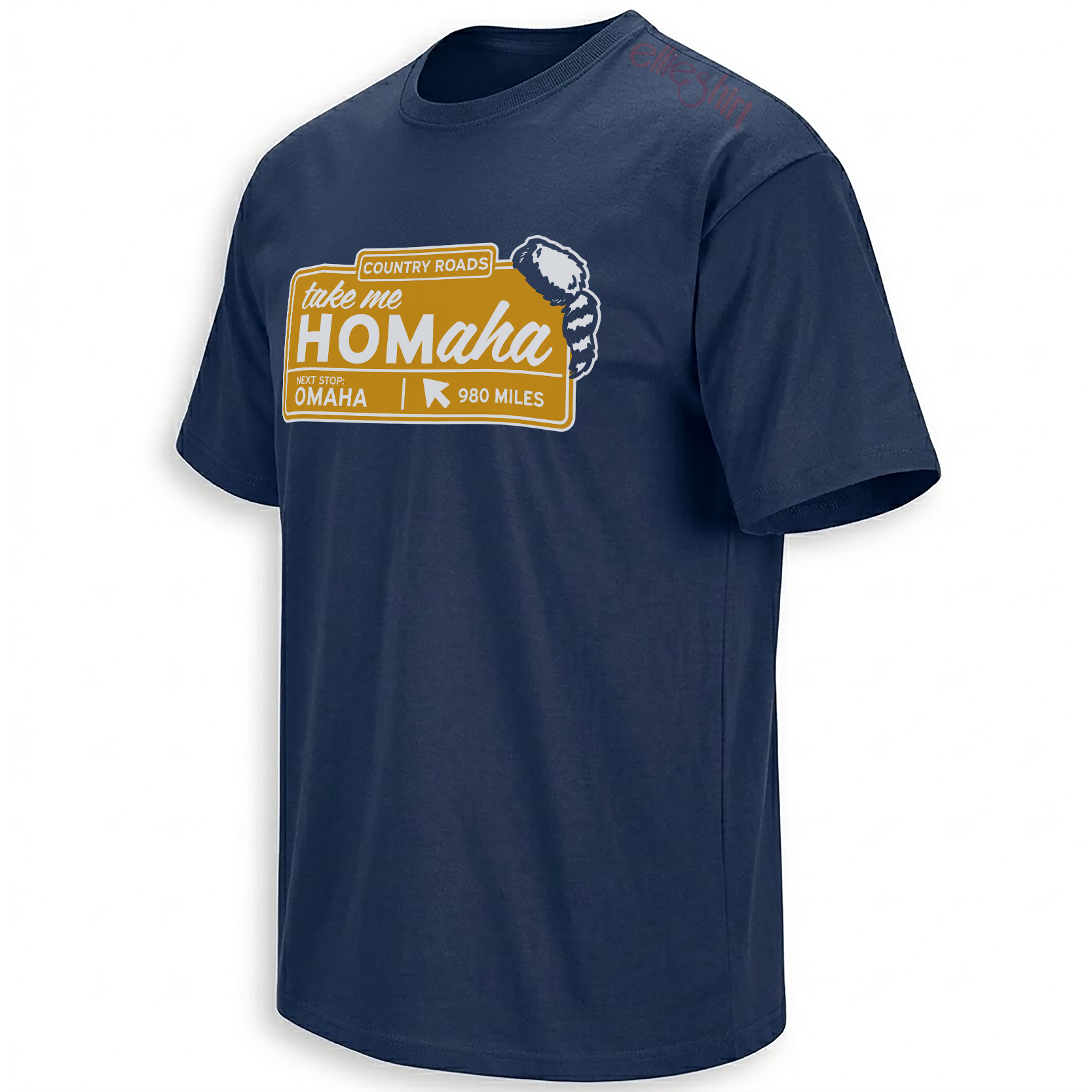
“COUNTRY ROADS” appears in a raised panel across the top, establishing the cultural source. “Take me HOMAHA” occupies the center in a mixture of script and bold block lettering, allowing “home” and “Omaha” to overlap visually.
The lower section reads “NEXT STOP: OMAHA” beside an arrow and the 980-mile marker. These details convert the slogan into travel rather than leaving it as abstract wordplay.
The irregular edges and mustard-gold coloring give the sign the feel of an older roadside marker or souvenir collected during a long drive.
Against navy fabric, the white and gold details remain readable while preserving the familiar atmosphere of West Virginia fan apparel.
Navy creates the Mountaineers base, mustard gold recalls both WVU colors and weathered highway signage, and the white coonskin cap identifies the fan culture without requiring a large institutional logo. The result feels like a road-trip souvenir from a journey that became program history.
The Coonskin Cap Supplies the Mountaineer
The design does not need a player portrait or oversized school initials because the coonskin cap performs the identity work.
Draped across the upper-right corner of the sign, it appears almost like an item packed for the journey. The cap connects the highway graphic to the Mountaineer mascot and to the broader Appalachian visual culture surrounding WVU.
Its placement also prevents the composition from becoming too clean. The cap overlaps the sign rather than remaining confined within it, giving the artwork a handmade souvenir quality.
This detail matters because “Take Me Homaha” is not a generic Road to Omaha slogan. It belongs to one fan base whose symbols traveled with the team.
West Virginia Won Its First Omaha Game Immediately
Programs making their first MCWS appearance can spend years celebrating arrival without ever earning a victory at the event. West Virginia removed that distinction in its debut.
The Mountaineers entered the eighth inning against Troy tied 5–5. Tyrus Hall then delivered a two-run single that pushed WVU in front.
The final outs secured a 7–5 victory and gave the program an Omaha record of 1–0 before the first night had ended.
That result strengthened the cultural meaning behind the design. Country Roads had not merely carried the Mountaineers to the stadium. The team had arrived capable of winning there.
North Carolina Introduced the Other Side of Omaha
The second game showed how quickly the tournament can change.
West Virginia fought back from an early deficit and tied North Carolina 2–2 by the fourth inning. The game remained even until the seventh, when defensive mistakes created the opportunity for the Tar Heels to regain control.
North Carolina scored three late runs and won 5–2, moving WVU from the winners’ bracket into an elimination game.
That loss does not weaken “Take Me Homaha.” It clarifies the phrase. Reaching Omaha is not a guarantee of a championship ending; it is the beginning of the hardest part of the journey.
The shirt records the destination honestly while allowing the tournament to determine what comes next.
A Rematch With Troy Turns the Road Back on Itself
West Virginia’s elimination opponent is the same Troy team it defeated in the opener.
The rematch creates a different emotional setting. The first meeting celebrated arrival and possibility. The second determines whether WVU’s first Omaha trip continues.
Both teams now possess direct information about each other. Troy understands how close it came to winning the opener. West Virginia knows its first victory does not carry forward automatically.
For supporters, Take Me Homaha now functions less like a qualification announcement and more like a statement of continued presence. The Mountaineers remain in Omaha, and the road is not finished until the final out says so.
Why First-Time History Produces Strong Fan Language
Fan slogans become especially powerful when they name something that has never happened before.
West Virginia supporters had previously used Country Roads to celebrate conference victories, rivalry wins, bowl moments and basketball achievements. Baseball’s first Omaha appearance created a completely new setting for the same cultural language.
That combination feels both familiar and unprecedented. The song provides continuity; the tournament provides the breakthrough.
A standard “Omaha Bound” graphic could identify the accomplishment. “Take Me Homaha” identifies who made the trip.
The Song Is Really About Belonging
Country Roads became globally popular partly because listeners do not need to know every West Virginia landmark to understand its emotional center.
The song expresses longing for a place that feels like home. That idea can travel with students, alumni and fans who no longer live in the Mountain State.
WVU’s own historical account describes how the song appears in distant countries, unexpected public spaces and moments of homesickness. Its meaning changes depending on who sings it and where the singing occurs.
Omaha offered another transformation. A song usually sung after returning to victory became the soundtrack for departure toward a national stage.
The design captures that reversal without losing the song’s original emotion.
The Mileage Makes the Dream Physical
“980 miles” may appear like a small decorative detail, but it keeps the artwork from becoming purely metaphorical.
Omaha is not simply an idea. It requires buses, flights, hotel rooms, tickets and supporters crossing several states to follow the team.
The mileage transforms the trip into measurable distance. It reminds viewers that players and fans physically carried West Virginia identity out of Morgantown and into Nebraska.
Road signs exist to reduce large journeys into one remaining number. On the shirt, that number also measures how far the baseball program had to travel to reach a place it had never occupied.
Where Take Me Homaha Fits Inside West Virginia Fan Culture
The 2026 run produced several useful identities. “Omaneers” transforms Omaha into a Mountaineers nickname. “Country Roads Take Me to Omaha” preserves the lyric more directly. “Take Me Homaha” creates the most compact combination of music and destination.
Each phrase approaches the same breakthrough through a different part of West Virginia culture.
Supporters can explore more baseball, Country Roads and Mountaineers designs through Ellie Shirt’s West Virginia Mountaineers collection .
The broader NCAA collection follows how college teams turn songs, mascots, tournament cities and postseason journeys into fan-created visual identity.
Frequently Asked Questions
What does “Take Me Homaha” mean?
It combines “Take Me Home” from the song “Take Me Home, Country Roads” with Omaha, the host city of the Men’s College World Series.
Did West Virginia reach the College World Series in 2026?
Yes. The 2026 tournament marked the first Men’s College World Series appearance in West Virginia baseball history.
How did West Virginia qualify for Omaha?
WVU swept Cal Poly in the Morgantown Super Regional, winning 12–2 and 17–1.
Did WVU win its first game in Omaha?
Yes. West Virginia defeated Troy 7–5 in its MCWS debut after Tyrus Hall hit a go-ahead two-run single in the eighth inning.
Why is Country Roads important to WVU?
The song has been part of WVU culture since the early 1970s and is traditionally sung after Mountaineers home victories and during major university events.
Why does the design use a highway sign?
The highway sign turns the Country Roads reference into a literal Road to Omaha journey, complete with an arrow, destination wording and mileage.
What does the coonskin cap represent?
The cap references the Mountaineer mascot and gives the road-sign artwork a specifically West Virginia identity.
Does the design claim West Virginia won the national championship?
No. It celebrates WVU reaching Omaha, making its first MCWS appearance and winning its tournament debut.
The Take Me Homaha highway-sign graphic preserves WVU baseball’s first College World Series journey, while the West Virginia Mountaineers collection follows more Country Roads, Omaneers and Omaha-themed fan culture.
Take Me Homaha Shirt transforms West Virginia’s Country Roads tradition into a navy-and-gold highway sign celebrating the Mountaineers’ historic first Men’s College World Series trip and opening Omaha victory.