RollMaha: How Alabama Baseball Carried Roll Tide Back to Omaha
Alabama’s first Men’s College World Series appearance since 1999 lasted only two games, but reaching Omaha restored the Crimson Tide to college baseball’s final stage and created a rallying cry built for the journey: RollMaha.
Alabama’s return to Omaha ended earlier than anyone wearing crimson wanted. The Crimson Tide lost 9–0 to Oklahoma in its opening game, then fell 14–2 to Texas in an elimination matchup two days later.
Those results closed the 2026 season at 42–21 and left Alabama without its first national baseball championship. They did not erase the accomplishment that came before the losses: the program had reached the Men’s College World Series for the first time in twenty-seven years.
RollMaha records that achievement rather than rewriting the ending. It takes Alabama’s most familiar rallying cry, redirects it toward college baseball’s most important city and preserves the moment the Tide finally carried its culture back onto the Omaha stage.
The season did not end with Alabama holding the trophy. It ended with Omaha once again belonging to the program’s living memory.
RollMaha celebrates Alabama reaching the 2026 Men’s College World Series. It does not claim a national championship or tournament victory. Alabama was eliminated after losses to Oklahoma and Texas.
Why RollMaha Works as Alabama Language
“Roll Tide” is unusually adaptable because it functions as more than a football chant. Alabama supporters use it as a greeting, response, celebration, sign-off and statement of affiliation across nearly every university sport.
That flexibility allows “Roll” to attach itself naturally to Omaha. Fans already understand the first half before they finish reading the second.
RollMaha sounds like a road-trip slogan, tournament hashtag and modified stadium chant at the same time. It tells supporters where the team is going without giving up the phrase that identifies who they are.
The wordplay is also concise enough to survive beyond a single game. It could appear on airport signs, hotel windows, tailgate banners, social captions or clothing throughout Alabama’s Omaha stay.
The Road Began in Tuscaloosa
Alabama earned the No. 7 national seed and entered the NCAA tournament with the benefit—and pressure—of hosting the early rounds at Sewell-Thomas Stadium.
The Crimson Tide survived Oklahoma State 9–7 to win the Tuscaloosa Regional, extending the season and earning the opportunity to host St. John’s in the Super Regional.
That matchup carried its own historical weight. Alabama had not hosted a baseball Super Regional since 2006 and had not reached Omaha since the team that finished as national runner-up in 1999.
The Tide secured the trip with a 7–2 victory over St. John’s. The final out released twenty-seven years of distance between Alabama baseball and the Men’s College World Series.
Alabama’s regional and Super Regional victories transformed the phrase from hopeful wordplay into a real itinerary connecting Tuscaloosa with Charles Schwab Field in Omaha.
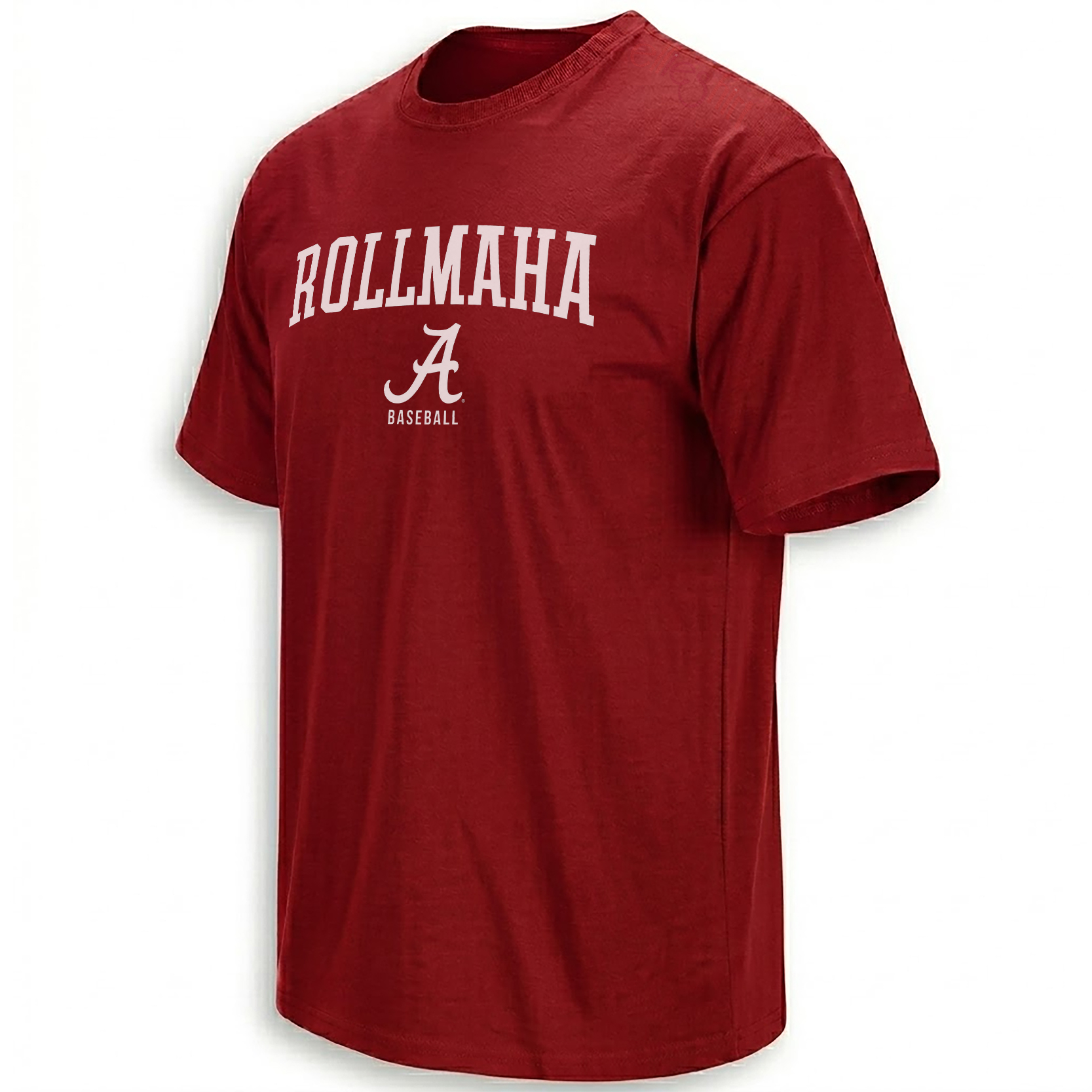
A Practice-Shirt Look Instead of a Championship Claim
The design avoids the crowded visual vocabulary commonly attached to tournament merchandise. There is no bracket, trophy, stadium illustration, player list or declaration of national supremacy.
“ROLLMAHA” appears in tall white collegiate letters across the upper chest. The phrase follows a gentle arch resembling a traditional university baseball wordmark.
Beneath it, the script-style Alabama A provides the immediate school identifier. A small BASEBALL line confirms the sport without interrupting the central joke.
Crimson and white complete the effect. The result resembles a travel-day tee, batting-practice shirt or unofficial team identity created specifically for the Omaha trip.
That restraint became even more appropriate after the tournament ended. The design celebrates qualification honestly without forcing an outcome Alabama did not achieve.
The Oklahoma Loss Changed the Meaning Immediately
Alabama opened against an Oklahoma team it had beaten twice during the regular season. That familiarity did not translate into tournament control.
Oklahoma left-hander Cord Rager held Alabama scoreless, and the Sooners won 9–0. The Tide collected only five hits and moved directly into the elimination bracket.
The result stripped away the celebratory comfort surrounding arrival. Omaha had become real, and the season could end in the next game.
This is where RollMaha shifted from travel slogan to loyalty statement. The phrase no longer meant only that Alabama had reached the destination. It meant the fans and program identity remained present after the welcome had become uncomfortable.
Texas Ended the Run With Historic Force
Alabama’s elimination game against Texas quickly became one-sided. The Longhorns scored three runs in the first inning and four in the second, creating a deficit the Tide never seriously threatened.
Adrian Rodriguez went 5-for-5, drove in seven runs and completed only the third cycle in Men’s College World Series history. His RBI total tied the tournament’s single-game record.
Alabama’s primary offensive response came from Johnny Lemm, who hit a solo home run. The Tide finished with six hits and two runs in the 14–2 defeat.
The combined score across the two Omaha games was difficult to absorb. Alabama had waited twenty-seven years to return and was eliminated without leading in either contest.
Yet tournament disappointment and season significance can exist together. The ending was poor. Reaching the final eight remained meaningful.
Why the Trip Still Matters
Omaha appearances influence programs long after the bracket closes. They alter recruiting conversations, validate coaching direction and give returning players a direct understanding of the standard required to reach the final stage.
Alabama’s trip also followed a second consecutive 40-win season under Rob Vaughn. The program did not stumble into Omaha through one isolated upset. It built a strong regular season, earned a national seed and won two postseason rounds at home.
The next challenge is transforming appearance into staying power. Alabama learned how quickly a strong season can disappear against elite pitching and an opponent producing historic offense.
RollMaha can therefore represent both achievement and unfinished business. It celebrates the return while leaving room for another version of the trip with a different ending.
Alabama earned the No. 7 national seed, won the Tuscaloosa Regional, defeated St. John’s 7–2 to claim the Super Regional, reached Omaha for the first time since 1999, lost 9–0 to Oklahoma and was eliminated 14–2 by Texas.
Why 1999 Followed the Team Everywhere
Every Alabama Omaha story in 2026 carried the same historical reference point: 1999.
That team reached the championship game before falling to Miami. For more than a quarter-century, it remained Alabama’s most recent appearance and the standard against which later postseason runs were measured.
Many current players were not alive when that tournament took place. Younger supporters knew the trip through archives and program history rather than personal memory.
The 2026 team changed that. Alabama now has a new Omaha roster, a new set of photographs and a new generation able to say it watched the Tide compete in the College World Series.
The outcome did not match 1999, but the historical gap finally ended.
Omaha Apparel Is Often About Arrival
College World Series fan graphics frequently celebrate the destination rather than the final championship. “Road to Omaha,” “Omaha Bound” and program-specific wordplay appear as soon as Super Regional victories become official.
That is because reaching Omaha is already a national accomplishment. Hundreds of Division I teams begin the year, but only eight remain when the event opens.
RollMaha belongs to that arrival tradition. Its purpose is not to predict the champion. It identifies Alabama as one of the programs that completed the road.
The absence of a date from the main wordmark also gives the phrase future value. Alabama supporters can revive it whenever the program returns.
From Football Language to Baseball Identity
Alabama’s national cultural identity is dominated by football. Nearly every other university sport must operate beneath the shadow created by decades of football championships and famous coaches.
RollMaha uses the strength of that larger identity without allowing baseball to disappear inside it.
“Roll” carries the familiar Alabama rhythm. “Maha” redirects the energy toward a destination unique to baseball. The small BASEBALL line completes the distinction.
The design shows how a university-wide rallying cry can be adapted rather than merely copied. This is recognizably Alabama, but it could only belong to the baseball postseason.
A Season Can Be Successful and End Badly
Sports culture often reduces seasons to their final game. Winning creates a successful year; losing supposedly makes everything before it irrelevant.
Alabama’s 2026 season resists that simplification.
The final two games were unquestionably disappointing. The Tide was outscored 23–2 and did not display the form that produced forty-two victories.
The larger season still included a national seed, a regional championship, a Super Regional victory and the end of a twenty-seven-year Omaha absence.
RollMaha preserves the accomplishment without denying the ending. That balance makes it a stronger historical artifact than a design pretending the tournament went differently.
Where RollMaha Fits Inside Alabama Fan Culture
Alabama supporters already carry a deep vocabulary of slogans, rivalry language and championship references. RollMaha adds a specifically baseball-centered phrase to that archive.
It belongs beside regional-clinching graphics, College World Series field designs and general Crimson Tide baseball apparel, but its wordplay gives it a more distinct identity.
Fans can explore more Alabama designs through Ellie Shirt’s Alabama Crimson Tide collection , where baseball pieces sit alongside the university’s wider football, basketball and postseason culture.
The broader NCAA collection follows the way college programs turn tournament destinations, chants and school traditions into fan-created identities.
Frequently Asked Questions
What does RollMaha mean?
RollMaha combines Alabama’s “Roll Tide” rallying cry with Omaha, Nebraska, the home of the Men’s College World Series.
When did Alabama reach the 2026 Men’s College World Series?
Alabama clinched its Omaha berth by defeating St. John’s 7–2 in the Tuscaloosa Super Regional on June 8, 2026.
How long had it been since Alabama’s previous Omaha appearance?
Alabama had not reached the Men’s College World Series since 1999, making the 2026 return the end of a 27-year absence.
How many times has Alabama baseball reached Omaha?
The 2026 tournament marked the sixth Men’s College World Series appearance in Alabama baseball history.
How did Alabama perform in Omaha?
Alabama lost 9–0 to Oklahoma in its opening game and was eliminated after a 14–2 loss to Texas.
Does the RollMaha design claim Alabama won the championship?
No. The design celebrates Alabama qualifying for and participating in the 2026 Men’s College World Series.
What appears on the RollMaha graphic?
The design features arched white RollMaha varsity lettering, a centered script-style Alabama A and a small Baseball wordmark on a crimson background.
Is RollMaha an official tournament or university name?
No. It is fan-created wordplay combining Roll Tide with Omaha and is not an official NCAA tournament title.
The RollMaha Alabama baseball graphic preserves the Crimson Tide’s return to college baseball’s final stage, while the Alabama Crimson Tide collection follows more tournament, team and fan-culture moments from Tuscaloosa.
RollMaha Shirt combines Alabama’s Roll Tide rallying cry with Omaha in a clean crimson-and-white varsity baseball graphic celebrating the Crimson Tide’s first Men’s College World Series appearance since 1999.