
KWO: How the Knicks World Order Took Over Basketball
Wrestling’s New World Order arrived to disrupt an established system. Three decades later, Knicks World Order turns that takeover language into a championship declaration for the New York team that finally climbed above the rest of the NBA.
The old NBA order ended on June 13, 2026. New York defeated San Antonio 94–90 in Game 5, completed a 4–1 Finals victory and claimed the Knicks’ first championship since 1973.
Jalen Brunson scored 45 points in the clincher and accepted the Bill Russell NBA Finals MVP Trophy. The Knicks had survived repeated double-digit deficits, completed the largest comeback in Finals history and turned a fifty-three-year wait into a five-game championship statement.
KWO begins after that transformation. “Knicks World Order” borrows the hostile, spray-painted language of wrestling’s New World Order and applies it to a basketball team that no longer needs to ask whether it belongs among the league’s elite. New York has the trophy. The takeover is complete.
KWO is not simply a wrestling-logo parody. It is the visual language of a fan base announcing that basketball now answers to New York.
The design is independent fan artwork inspired by wrestling-era takeover aesthetics. It is not presented as an official collaboration with WWE, WCW, the nWo, the New York Knicks or the NBA.
What KWO Means
The abbreviation is deliberately simple. Replace the “N” in New World Order with the “K” from Knicks and the entire slogan changes ownership.
KWO becomes Knicks World Order: a three-letter identity built to resemble the name of a faction rather than a conventional basketball team.
That distinction matters. Team graphics usually celebrate unity through official logos, player portraits or championship trophies. Faction graphics communicate allegiance. They divide the audience into people inside the movement and everyone standing against it.
Knicks fans already understand that emotional structure. New York basketball culture has long defined itself through conflict—with opposing teams, national media, hostile road arenas and decades of disappointment.
KWO converts that defensive identity into power. The Knicks are no longer fighting to be respected by the basketball order. They have replaced it.
The Wrestling Blueprint Behind the Graphic
The original New World Order entered professional wrestling in 1996 as an invading group built around Scott Hall, Kevin Nash and Hulk Hogan.
Its storyline presented the members as outsiders attempting to seize control of WCW. The group rejected polished wrestling presentation for black clothing, confrontational interviews, gang-like membership rituals and a logo that looked sprayed onto a wall.
The nWo aesthetic became inseparable from the idea of takeover. Its black-and-white mark did not resemble a traditional sports crest. It looked unofficial, disruptive and easy to reproduce anywhere.
That visual simplicity helped it move beyond wrestling. The logo appeared on shirts, signs, stickers and countless parodies. Fans could replace one word or letter while preserving the original attitude.
KWO belongs to that tradition. Its meaning depends on viewers recognizing not only the lettering but the behavior associated with it: arrival, disruption, recruitment and control.
The wrestling reference gives the Knicks graphic more aggression than a standard title logo. KWO suggests that New York did not simply join the league’s ruling class—it forced its way into control.
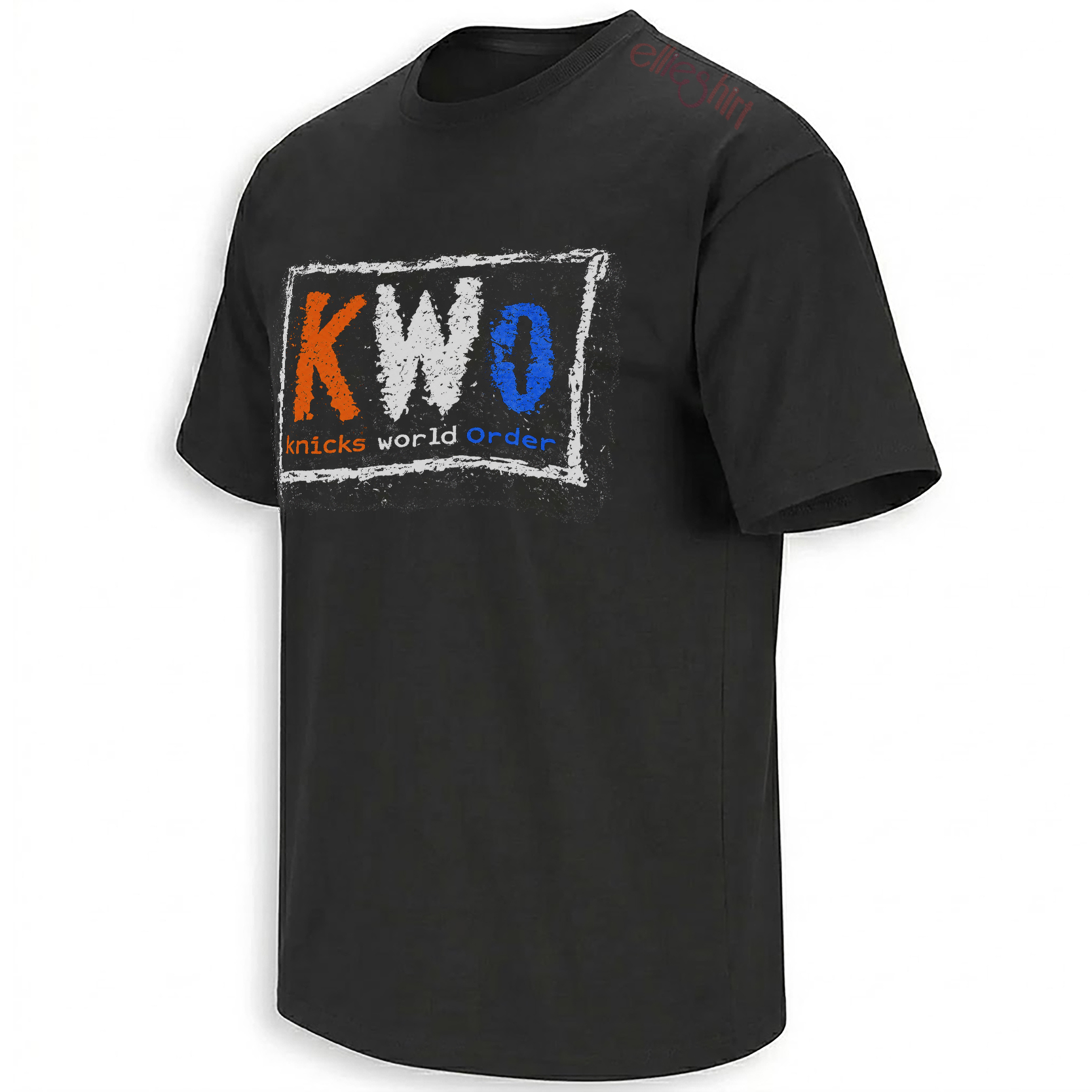
Why the Black-and-White Look Still Feels Dangerous
Most championship merchandise uses celebratory visual language: polished metallic gold, confetti, trophy illustrations, clean team marks and formal year lettering.
KWO deliberately resists that atmosphere.
Black and white make the central mark feel improvised rather than league-approved. Rough edges suggest spray paint, photocopied flyers and wrestling shirts sold during the most rebellious era of sports entertainment.
The Knicks colors then enter as controlled accents. Blue and orange do not overwhelm the wrestling foundation; they identify who now owns it.
That balance is important. A fully orange-and-blue composition would read as standard team apparel. A fully black-and-white design could lose the New York basketball connection. The crossover works because both systems remain visible.
The Knicks Did Not Look Like an Established Dynasty
Wrestling’s New World Order was powerful partly because it appeared to be invading a world that already had established institutions and heroes.
The Knicks entered the championship conversation with a similar sense of disruption. New York had not won the title since 1973. The franchise’s recent history included rebuilding cycles, coaching changes, failed superstar pursuits and repeated reminders that Madison Square Garden’s cultural importance exceeded the team’s modern résumé.
Brunson changed the direction without arriving as the league’s most advertised superstar. Josh Hart, Mikal Bridges and OG Anunoby became essential pieces through trades. Karl-Anthony Towns supplied size and offense after another major roster reconstruction.
This was not a dynasty defending inherited territory. It was a new group forcing its way through the league’s existing hierarchy.
That makes takeover language more convincing than royal language. The Knicks did not begin the season seated on the throne. They occupied it.
Brunson Became the Leader of the Faction
Every successful wrestling faction needs a central figure who gives the group direction. For KWO, that role belongs to Brunson.
His leadership does not resemble the theatrical speeches associated with wrestling villains. It appears through control: changing pace, accepting difficult possessions and maintaining emotional order while the scoreboard becomes dangerous.
In Game 5, that leadership became statistical domination. Brunson scored 45 of New York’s 94 points and controlled the fourth quarter as the Knicks closed the series.
The Finals MVP Trophy gave the faction its champion. It also allowed KWO to move beyond playful fan language. Every takeover needs proof of control, and Brunson carried the proof out of San Antonio.
The Five-Man Core Functions Like a Stable
Wrestling factions work because members possess different roles. One may speak, another may intimidate, another may interfere and another may hold the championship.
The Knicks’ starting five also developed through specialized identities.
Brunson controlled the closing possessions. Hart attacked rebounds and loose balls. Bridges provided length, defense and steady scoring. Anunoby supplied physical force and the historic Game 4 tip-in. Towns changed the floor through shooting, size and offensive versatility.
Together, they resemble a faction because the group is more recognizable through combined personality than through identical style.
Game 4 Was the Hostile Takeover
If KWO needs one game that visually resembles an invasion, it is Game 4.
San Antonio led by 29 points at Madison Square Garden. The Spurs appeared to have silenced the crowd and taken control of the series’ emotional center.
New York then produced the largest comeback in NBA Finals history. Brunson scored 36 points, the defense intensified and OG Anunoby completed the rally with the decisive tip-in.
The comeback reversed more than the score. It changed who appeared to control the arena, the series and the psychological direction of the Finals.
Wrestling takeover stories often depend on one segment where the invading group overwhelms the established order. Game 4 supplied the basketball equivalent.
Game 5 Made the Order Official
Game 4 created the mythology. Game 5 created the authority.
New York again faced a difficult road environment and another deficit. Towns struggled with foul trouble, Anunoby did not reproduce his previous offensive heroics and the Spurs remained close into the final possessions.
Brunson refused to allow the series to return to New York. He scored 15 points in the fourth quarter and carried the offense through its most pressured stretch.
The final score—94–90—did not resemble a ceremonial blowout. It felt like control earned possession by possession.
When the buzzer sounded, Knicks World Order stopped being a prediction. New York had the championship ring, the Finals MVP and the right to claim the basketball world.
Why “World Order” Works After a Championship
Before the title, KWO could have sounded aspirational. It might have represented fan confidence or a desire to see the Knicks dominate.
After the title, the phrase becomes retrospective evidence.
“World” connects the slogan to championship language. The NBA champion is traditionally described as the basketball world champion, regardless of the league’s primarily North American structure.
“Order” describes hierarchy. Once the Knicks defeated every remaining opponent, the league’s final order placed New York first.
KWO compresses those ideas into a faction name. It celebrates not only what the Knicks won but the new position they occupy.
New York Fans Already Understood Invasion Culture
Knicks fandom travels loudly. Road arenas often contain visible pockets of orange and blue, and chants can become audible when New York supporters sense an opportunity.
The 2026 run expanded that traveling identity. Fans crossed the country for Finals games, gathered around San Antonio and treated every available public space as an extension of Madison Square Garden.
KWO gives that behavior a name. A fan entering another arena in the shirt is not merely attending as an individual supporter. The graphic presents the arrival as part of a larger faction.
This is the same social power that made wrestling stable apparel effective. Wearing the mark implied membership.
The Design Is Built for Streetwear, Not Only Game Night
Traditional championship graphics often remain tied to the specific season. Dates, scores and trophy counts make them direct historical souvenirs.
KWO has a broader life because the abbreviation can function without a full explanation. It resembles a brand, crew or downtown sticker before the viewer notices the championship meaning.
The black base also moves easily beyond arena apparel. It fits wrestling culture, music merchandise and New York streetwear more naturally than a bright commemorative composition.
Championship details anchor the design in 2026, but the central identity can continue as long as Knicks fans want to describe themselves as part of the order.
Rough black-and-white lettering recreates the unauthorized look of a wrestling faction mark. Knicks blue and orange identify the new owners, while the championship language converts rebellion into completed basketball authority.
KWO Is More Aggressive Than “Go New York Go”
Knicks culture contains several kinds of slogans. “Go New York Go” is celebratory and communal. “New York Forever” expresses loyalty. “Once a Knick, Always a Knick” connects generations.
KWO performs a different emotional job.
It does not ask the crowd to support the team or promise permanent love. It tells the rest of the league that control has changed hands.
That aggression makes it useful after a long drought. Fifty-three years of waiting created enough stored frustration that a gentle championship statement could feel insufficient.
Knicks World Order gives the celebration an edge.
From Outsiders to the Center of the League
The original wrestling faction presented itself as a group operating outside the recognized order. Its power came from refusing to accept the organization’s existing boundaries.
The Knicks spent much of the modern era outside serious championship discussion. The franchise remained famous, profitable and culturally important, but those qualities did not produce postseason authority.
The 2026 title closed that contradiction.
New York now possesses both forms of power: the league’s largest basketball stage and the result required to justify occupying it.
KWO captures the exact moment when outsiders become rulers.
Where KWO Fits Inside the Knicks Championship Archive
The championship produced several visual languages. Trophy designs preserve the official achievement. Brunson graphics celebrate Finals MVP. Tip-in artwork records the defining comeback. Starting-five portraits preserve the lineup.
KWO preserves attitude.
It remembers the title as a takeover rather than a ceremony and gives fans a faction identity capable of surviving beyond the trophy presentation.
The design belongs inside Ellie Shirt’s New York Knicks Shirts collection , where championship graphics, player stories and New York cultural crossovers document the full 2026 run.
It also connects naturally to the NBA Shirts collection , where basketball teams, league mythology and fan-created identities extend beyond traditional game apparel.
Fans focused specifically on the title can continue through the 2026 NBA Finals Champions collection , which gathers New York’s trophy, roster, comeback and citywide celebration designs in one archive.
Frequently Asked Questions
What does KWO mean?
KWO stands for Knicks World Order, a New York basketball reinterpretation of wrestling’s New World Order faction name.
What inspired the KWO design?
The design draws from the black-and-white, spray-painted takeover aesthetic associated with the influential nWo wrestling faction.
Why does the phrase fit the 2026 Knicks?
New York defeated San Antonio 4–1 in the NBA Finals, won its first championship since 1973 and finished the season at the top of the league’s competitive order.
What did Jalen Brunson do in the championship-clinching game?
Brunson scored 45 points in Game 5 and received the Bill Russell NBA Finals MVP Trophy after leading the Knicks to a 94–90 victory.
Why is the design mostly black and white?
The monochrome foundation recreates the rebellious wrestling-faction aesthetic, while Knicks blue and orange accents identify the New York basketball reinterpretation.
Is KWO an official Knicks or wrestling group?
No. KWO is independent fan-created wordplay and is not an official team name, wrestling faction or collaboration.
Is the shirt officially affiliated with WWE, WCW or the NBA?
No. It is independently created fan-culture artwork and is not presented as an official product of WWE, WCW, the nWo, the Knicks or the NBA.
The KWO Knicks World Order graphic turns New York’s 2026 championship into a wrestling-style takeover statement. Explore more through the New York Knicks collection and the complete 2026 NBA Finals Champions archive .
KWO Shirt transforms wrestling’s New World Order takeover aesthetic into a Knicks World Order championship statement, combining rough faction lettering with New York blue, orange and 2026 NBA Champions energy.