
José Alvarado’s Puerto Rico Parade Moment: When the Underdog Image Became a Championship Symbol
A six-foot guard shooting over Victor Wembanyama was already an irresistible basketball image. After the Knicks won the 2026 NBA championship and José Alvarado carried that image into New York’s Puerto Rican celebrations, it became something larger: a portrait of Brooklyn confidence, Boricua pride and the fearless role player who changed the Finals.
New York’s championship celebration did not stay inside Madison Square Garden, the Canyon of Heroes or the official language of trophies and speeches. It moved into neighborhoods, onto parade floats and through communities that recognized pieces of themselves inside the Knicks’ first NBA title in 53 years.
José Alvarado became one of the clearest examples of that movement. The Brooklyn-born guard, who represents Puerto Rico internationally, appeared amid red, white and blue flags as the city was still processing the championship. His celebration connected two currents already running through New York: the emotional release of a Knicks title and the public expression of Puerto Rican identity that transforms the city every June.
The timing gave every image unusual force. The Knicks had just completed a historically dominant playoff run, including a 29-point comeback against San Antonio in Game 4 of the NBA Finals. Days later, New York held its first official Knicks championship ticker-tape parade, filling Lower Manhattan with blue-and-orange confetti, generations of fans and more than five decades of delayed emotion.
The image works because the height difference tells one story, while Alvarado’s expression tells another: he never believed size had the final word.
The Championship Moved From the Arena Into the Community
Championship culture is usually remembered through official images. There is the final buzzer, the trophy presentation, the champagne room and the parade bus. Yet a title becomes part of a city’s identity only when those controlled images give way to something less formal.
For the 2026 Knicks, that transition happened almost immediately. Fans poured into streets across the five boroughs after New York defeated the San Antonio Spurs. The National Puerto Rican Day Parade followed on June 14, filling Fifth Avenue with flags, music and tens of thousands of spectators while Knicks championship energy remained active across the city.
Alvarado’s presence made the overlap feel personal rather than promotional. He was not simply a professional athlete visiting a cultural event. He was a Brooklyn player of Puerto Rican heritage celebrating an NBA title among people who understood the path behind the moment.
Alvarado’s New York story begins in the city, giving his championship celebration the feeling of a hometown return rather than an ordinary player appearance.
The flag connects his Knicks role to the national team, the island and a wider basketball community that had followed his career before the championship.
His Game 4 impact placed the undersized guard inside one of the defining comebacks of New York’s title run.
The Graphic José Alvarado Chose to Wear
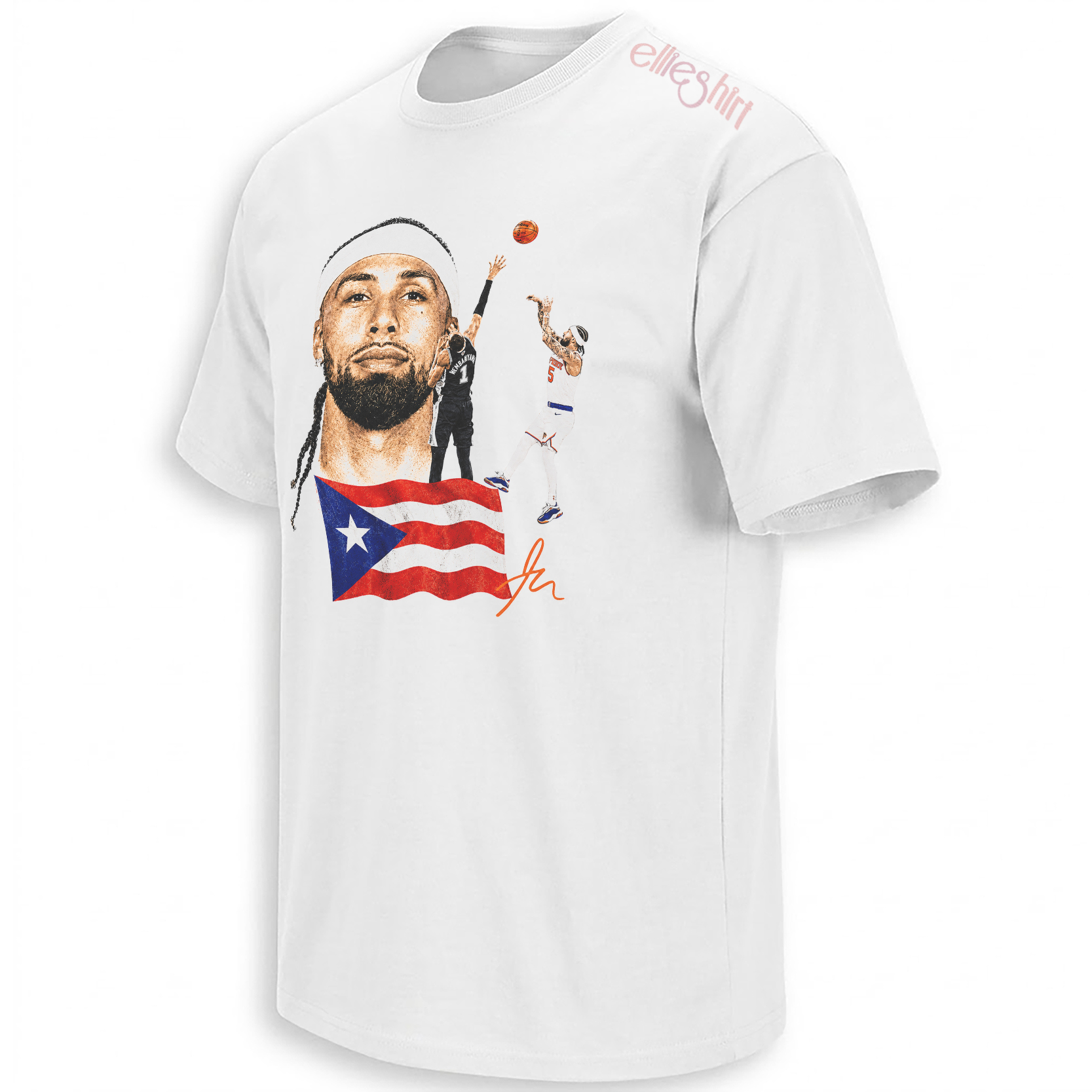
The personalized graphic Alvarado wore during the championship celebration did not place the Larry O’Brien Trophy at the center. It placed Alvarado himself there: a large headband portrait, the Puerto Rican flag, an orange signature and the impossible visual joke of a six-foot guard releasing a jumper over Victor Wembanyama.
That decision matters. Conventional championship graphics flatten a team into one official result. This design preserves the specific player story within the title. It asks viewers to remember not only that New York won, but also what Alvarado represented during the run: disruption, nerve, pace and a refusal to behave like the smallest player on the floor.
Why the Shot Over Wemby Became the Perfect Alvarado Image
Basketball photography is naturally drawn to contrast. A small guard and an exceptionally tall defender create a story before the viewer knows the score, the quarter or the possession. One player seems to occupy the sky. The other has to invent a path through it.
Alvarado’s shot over Wembanyama distills that contrast into a single frame. Wembanyama’s reach makes the attempt appear unreasonable. Alvarado taking it anyway makes the image feel completely consistent with the player fans know.
The moment also fit the emotional vocabulary of the series. New York’s championship run repeatedly turned impossible situations into momentum. The Knicks survived one-point games, recovered from massive deficits and built their identity around continuing possessions that appeared finished.
Alvarado’s image belongs to that same logic. The value is not only whether the ball falls. It is the visual refusal to disappear beside a defender almost a foot and a half taller.
The design uses scale as storytelling. Alvarado’s oversized portrait establishes ownership of the composition, while the smaller action scene converts the mismatch with Wembanyama into a memory panel. The Puerto Rican flag anchors both images inside a larger cultural identity.
Game 4 Changed the Way Fans Saw His Finals Role
Alvarado’s place in the championship story was secured most clearly during Game 4. San Antonio built a 29-point lead, and the Knicks appeared close to losing control of the Finals on their home floor. Instead, New York produced the largest comeback in NBA Finals history and escaped with a 107–106 victory.
Alvarado played nearly the entire fourth quarter. He scored eight points, made two three-pointers, added three assists and finished with New York outscoring San Antonio by 17 points during his fourth-quarter minutes. Knicks coach Mike Brown described him afterward as a player who changed the game.
His impact was not limited to one conventional category. He accelerated possessions, disrupted San Antonio’s rhythm and helped create the conditions in which Jalen Brunson and the rest of the offense could keep attacking. The Knicks needed emotional pressure as much as points, and Alvarado supplied it.
That performance transformed him from a colorful supporting character into one of the human symbols of the comeback. By the time New York completed the championship, the visual of Alvarado shooting over Wembanyama no longer looked like a random mismatch. It looked like a summary of his postseason role.
A Portrait, a Flag and a Basketball Mismatch
The composition reads in three stages, each one adding a different layer to the story.
- The portrait establishes personality. Alvarado’s headband, braids and direct gaze give the image the confidence of an individual player poster rather than a generic team collage.
- The flag establishes belonging. Puerto Rico is not used as a small decorative patch. It forms the visual foundation beneath the portrait, linking the player to the community surrounding the celebration.
- The action scene establishes the myth. Alvarado releases the ball above Wembanyama’s contest, turning one basketball possession into a David-and-Goliath image immediately understood by fans.
The amount of white space is equally important. Rather than surrounding the elements with a heavy championship frame, the design lets each symbol remain visible. The orange signature introduces a Knicks accent without overpowering the Puerto Rican red and blue.
The result feels closer to a player-made memory board than official league merchandise. It is personal, slightly playful and built from images that mean something specifically to Alvarado.
Why Puerto Rican Identity Is Central to the Design
Puerto Rican basketball culture has long existed across geographic borders. The island’s national team, New York’s Puerto Rican neighborhoods and generations of players moving between local courts, college programs and professional leagues form one connected conversation.
Alvarado carries that connection visibly. Born in Brooklyn and raised in New York basketball, he also represents Puerto Rico internationally. His involvement helped Puerto Rico qualify for the 2024 Olympic Games, further establishing him as a recognizable figure within the island’s modern basketball identity.
For that reason, the flag beneath his portrait is not an afterthought added for parade season. It identifies the audience with whom he is sharing the championship. It allows the Knicks title to be read simultaneously as a New York achievement and as a proud moment for Puerto Rican basketball supporters.
That dual identity is one reason the image traveled so naturally through fan spaces. Knicks supporters could read it as a title-run artifact. Puerto Rican fans could read it as a hometown player carrying the flag onto the championship stage. Brooklyn could claim both stories at once.
From the Puerto Rican Parade to the Canyon of Heroes
Four days after the National Puerto Rican Day Parade, Lower Manhattan became the setting for another enormous public celebration. On June 18, the Knicks moved through the Canyon of Heroes for the franchise’s first official championship ticker-tape parade.
Blue-and-orange confetti fell between the buildings as players, families, franchise legends and fans filled the route toward City Hall. The event transformed a championship that had already been celebrated in neighborhoods into an official piece of New York history.
Alvarado’s presence connected these different versions of the city. One celebration centered heritage and community. The other centered the Knicks and a 53-year wait. His personal graphic made sense in both spaces because it was built from the same ingredients: New York basketball, Puerto Rican identity and the belief that an overlooked player could become essential.
New York did not ask Alvarado to choose between Brooklyn, Puerto Rico and the Knicks. The championship allowed him to carry all three into the same frame.
How the Internet Turned the Height Difference Into a Meme
Fan conversation around the shot naturally focused on the mismatch. Wembanyama’s proportions make almost every smaller guard appear more vulnerable, but Alvarado’s reputation reverses the emotional balance. He is the player expected to create discomfort, chase a loose ball, irritate a star or attempt something that appears physically unreasonable.
That is why the image remained funny without becoming dismissive of Alvarado. The joke begins with the height difference, but the admiration comes from the fact that he still rises into the shot. After the championship, basketball brands and fan accounts continued circulating versions of the moment, treating the mismatch as one of the postseason’s most recognizable visual jokes.
Online, the image became shorthand for a broader idea: being dramatically smaller does not prevent a player from entering the biggest moment. That interpretation matched the Knicks’ Game 4 comeback and Alvarado’s entire career as an undrafted guard who repeatedly created a role through pressure, energy and belief.
A Personal Artifact From a Team Championship
The strongest championship pieces do not all need to look official. A title produces hundreds of possible memories: a final shot, a locker-room phrase, a role player’s unexpected run, a family member on the parade bus or a neighborhood celebration that feels more emotionally accurate than the trophy ceremony.
The José Alvarado Shot Over Wemby design preserves one of those personal memories. Its subject is not the entire Knicks roster. Its subject is how one player understood his own place inside the title.
Within the wider New York Knicks Shirts collection , the graphic adds a player-specific layer to the championship archive. Other pieces preserve the trophy, the full roster, Madison Square Garden or the final score. This one preserves a Puerto Rican flag, an underdog shot and a guard who made the celebration feel local.
The broader NBA Shirts collection follows the same cultural process across the league: a basketball moment happens, fans give it language, and graphic design turns that language into an object that can survive after the highlight cycle ends.
For pieces tied specifically to New York’s title run, the 2026 NBA Finals Champions archive maps the players, slogans, parade scenes and unlikely images that came to define the Knicks’ championship summer.
Frequently Asked Questions
Why was José Alvarado important to the Knicks’ 2026 championship?
Alvarado supplied defensive pressure, pace and crucial bench production during the title run. His most visible contribution came in Game 4 of the NBA Finals, when he scored eight fourth-quarter points and helped New York complete a 29-point comeback against San Antonio.
What does the Puerto Rican flag represent in the design?
The flag connects Alvarado’s Brooklyn upbringing and Knicks championship to the Puerto Rican community and national team he represents in international basketball.
Why did the shot over Victor Wembanyama become memorable?
The extreme height difference created an instantly recognizable underdog image. Alvarado taking the shot despite Wembanyama’s reach reflected the fearless style that defined his role throughout the Knicks’ playoff run.
Did José Alvarado wear this graphic during the championship celebration?
Yes. The design recreates the personalized shirt Alvarado wore as the Knicks’ championship celebration crossed into New York’s Puerto Rican parade culture.
How does the graphic connect Brooklyn, Puerto Rico and the Knicks?
It combines Alvarado’s New York basketball roots, Puerto Rican flag imagery and a Finals action scene, allowing all three parts of his identity to appear within one championship composition.
Why does the design feel different from a standard championship graphic?
Instead of leading with a trophy or complete team roster, it centers one player’s portrait, cultural identity and defining visual moment, making it a personal artifact within a larger team championship.
The José Alvarado Puerto Rico parade piece preserves the version of the Knicks’ title told through an underdog guard, a Brooklyn basketball story and the flag he carried into the celebration.
José Alvarado Shot Over Wemby Shirt captures the Knicks guard’s championship celebration through his headband portrait, Puerto Rican flag and fearless Finals jumper over Victor Wembanyama. The graphic connects Brooklyn basketball, Boricua pride and Alvarado’s pivotal role in New York’s historic 2026 title run.