NYC Is the Greatest Country in the World: How a Knicks Championship Turned City Pride Into Parade Language
The sentence is geographically wrong and emotionally precise. After the Knicks ended a 53-year championship wait, “NYC Is the Greatest Country in the World” sounded less like a joke and more like the only scale large enough to describe New York’s celebration.
By the morning after New York’s championship parade, Lower Manhattan looked less like a financial district than the capital of a temporary basketball nation. Blue-and-orange confetti clung to sidewalks, fans replayed Jalen Brunson’s City Hall speech, and photographs of people standing on scaffolding, trucks and rooftops continued moving across the internet.
The Knicks had defeated the San Antonio Spurs in five games to claim their first NBA championship since 1973. Five days later, on June 18, 2026, the franchise moved through the Canyon of Heroes in the first ticker-tape parade in Knicks history. The official route covered only a section of Lower Manhattan, but the emotion reached much farther.
That is the environment in which the phrase “NYC Is the Greatest Country in the World” makes sense. It is not a geography lesson and does not pretend to be one. It is New York hyperbole: a deliberately impossible statement built to communicate the belief that the five boroughs form a complete universe with their own languages, rivalries, food, music, fashion and basketball history.
The joke is that New York is not a country. The truth inside the joke is that New Yorkers have always experienced it like a world of its own.
The Parade Made New York Feel Like Its Own Nation
A championship parade temporarily changes the civic map. Streets built for taxis, delivery trucks and hurried commuters become ceremonial ground. Office windows turn into grandstands. People who have never met share chants, newspapers, stories and the understanding that normal city behavior has been suspended.
The Knicks’ parade amplified that feeling because New York had waited more than half a century to hold it. The franchise’s championships in 1970 and 1973 had not produced a ticker-tape parade through the Canyon of Heroes. The 2026 celebration therefore felt less like the return of an old tradition than the creation of one.
Fans arrived hours before the procession began. Some climbed onto sanitation trucks and construction equipment to improve their view. Others watched from office windows or crowded behind barriers along Broadway. Players moved toward City Hall beneath a storm of paper while Knicks legends, celebrities and generations of supporters occupied the same public frame.
That scene gave the exaggerated slogan a visual argument. For several hours, New York appeared to have its own flag colors, national team, anthem, public ceremony and founding myth. The Knicks were champions, and the city was behaving like a sovereign basketball republic.
Why “Greatest Country” Works as New York Humor
New York humor often begins with overstatement. The city is not merely busy; it never sleeps. Its arena is not simply famous; it is the world’s most famous. A slice is not just lunch; it becomes evidence in a civic argument. Even the most ordinary neighborhood preference can sound like a constitutional position.
“NYC Is the Greatest Country in the World” belongs to that tradition. The sentence is funny because everyone can identify the error immediately. It becomes meaningful because New York’s cultural scale makes the mistake feel intentional rather than uninformed.
A country normally contains regions with separate accents, cuisines and identities. New York compresses versions of that variety into five boroughs and hundreds of neighborhoods. A subway ride can move between languages, music scenes, architectural histories and entirely different ideas about what counts as the center of the city.
Knicks fandom is one of the forces capable of connecting those differences. The team belongs to Manhattan because it plays at Madison Square Garden, but its emotional territory extends through Brooklyn apartments, Queens restaurants, Bronx barbershops, Staten Island living rooms and New York communities far beyond the city limits.
New York feels too large, culturally complete and self-confident to be described as an ordinary city—especially when its basketball team has just won a championship.
The Graphic Turns a Civic Joke Into a Championship Seal
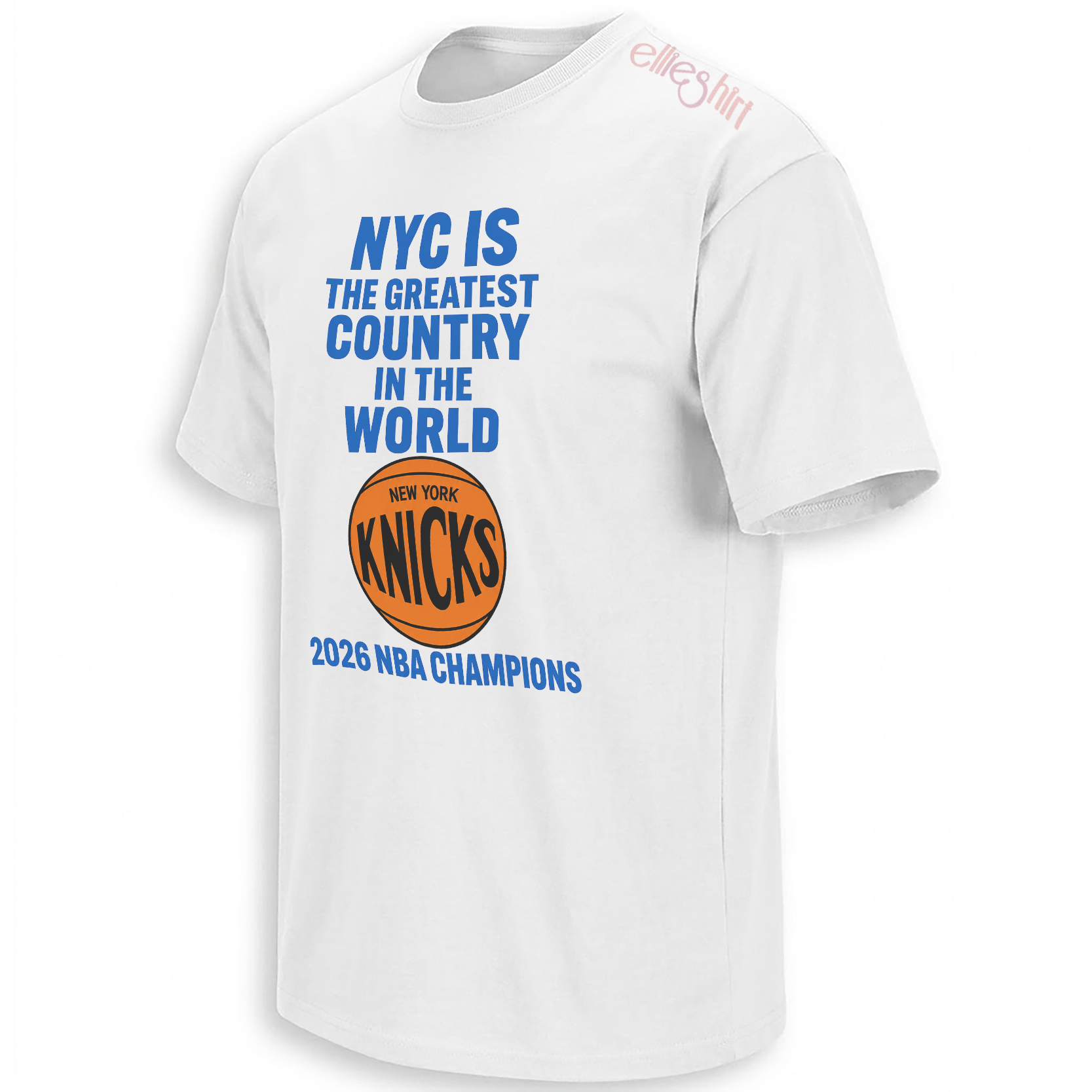
The design approaches the phrase like an official declaration. The letters are large, stacked and immediately readable. “NYC” occupies the most powerful position, while “Greatest Country in the World” converts a familiar form of New York exaggeration into a full civic slogan.
Behind the typography, the city skyline establishes place without needing a detailed map. The basketball and championship imagery identify the specific summer in which the statement gained its force. This is not generic New York tourism language. It is New York speaking after the Knicks finally finished the journey.
The central trophy treatment gives the composition the authority of a municipal seal, while the blue-and-orange palette keeps that authority playful. The piece imagines a fictional nation whose public colors belong to the Knicks and whose founding event is the 2026 championship.
How the Design Builds Its New York Identity
The artwork succeeds because it does not depend on a player portrait or one isolated highlight. Its main character is the city itself. The championship gives New York a reason to speak, and the typography becomes its voice.
- “NYC” functions like a national abbreviation. The three letters are treated with the authority normally reserved for a country code, government seal or international sports identity.
- The skyline creates instant recognition. New York’s architecture places the slogan inside a real urban landscape even while the sentence intentionally escapes geographic reality.
- Blue and orange turn civic pride into Knicks pride. The colors make the city and the basketball team feel inseparable during the championship celebration.
- The trophy establishes the exact historical moment. Without it, the phrase could belong to any era. With it, the statement becomes a record of New York in June 2026.
- The stacked layout reads like parade signage. It is designed to be understood from a distance, matching the visual language of banners, posters and street-level celebration.
Bold civic typography, championship symbols and Knicks colors transform an internet-ready joke into a fictional national emblem. The graphic does not argue that New York is literally a country; it preserves the week when the city felt emotionally large enough to become one.
Why the Knicks Can Make Five Boroughs Feel Like One Place
New York unity is often described more easily than it is experienced. The city is built from competition: borough against borough, neighborhood against neighborhood, old resident against newcomer, subway line against subway line. Even loyalty to the same city can take radically different forms.
The Knicks create one of the rare identities that can travel across those divisions. The team’s history is tied to Madison Square Garden, but its fan culture has never remained within Midtown. It is carried through families, playgrounds, local businesses, sports radio arguments and generations who inherited disappointment long before they inherited a championship.
That history explains why the 2026 title produced such an unusually broad emotional response. Older fans remembered the 1970s teams or the heartbreak of the 1990s. Younger supporters had grown up with Linsanity, rebuilding seasons and the long search for a roster capable of carrying May basketball into June.
The championship allowed those timelines to meet. Jalen Brunson, OG Anunoby, Karl-Anthony Towns, Josh Hart and the rest of the roster did not simply win one Finals series. They gave multiple generations of New Yorkers a shared ending to stories that began decades apart.
From Madison Square Garden to the Canyon of Heroes
Madison Square Garden had already become the emotional center of the playoff run. Celebrities sat courtside, former Knicks returned, and the arena produced the kind of noise that turned ordinary possessions into pieces of theater.
The championship parade carried that Garden atmosphere downtown. Broadway became an outdoor concourse. Chants moved through the Financial District. Confetti replaced arena lights, and City Hall became the final stage of the season.
Alicia Keys’ appearance reinforced the connection between basketball and New York’s musical self-image. Her performance gave the ceremony a familiar soundtrack, allowing the city to hear one of its modern anthems while the championship team stood in front of it.
Jalen Brunson’s speech supplied the emotional conclusion. After years in which the Knicks were questioned, dismissed or treated as incomplete contenders, the team could finally answer without projecting what might happen next. The result had already happened. New York was champion again.
For one parade morning, Broadway was the main avenue of a country whose borders ended wherever the Knicks chants could no longer be heard.
Why Championship Merch Becomes Street-Level Memory
The first championship images appear quickly because fans do not want to wait for memory to become history. They want to preserve the feeling while confetti remains in the gutters and parade photographs are still moving through group chats.
Some graphics preserve a score. Others preserve the trophy, roster or final shot. The NYC Is the Greatest Country in the World design preserves the emotional scale of the celebration.
It records the confidence that arrives when a city already famous for self-belief finally receives fresh evidence. New York did not suddenly become proud because the Knicks won. The title simply gave that pride a new public language.
Years from now, the sentence can still point back to this specific period: the five-game Finals victory, the first Knicks ticker-tape parade, the packed sidewalks and the week when blue and orange appeared to become official city colors.
The Wider Visual Archive of the Knicks’ Championship
No single design can contain everything the 2026 championship meant. The wider New York Knicks Shirts collection works as a running archive of the title through player moments, neighborhood references, parade language, trophy graphics and memories of the franchise’s earlier eras.
The 2026 NBA Finals Champions collection narrows that archive to the weeks when New York completed its playoff run and converted decades of expectation into a real championship.
Inside the broader NBA Shirts collection , the New York pieces also show how basketball design operates as cultural reporting. A phrase becomes popular, a moment acquires symbolic meaning, and a graphic preserves how fans interpreted the event before the conversation moved on.
“NYC Is the Greatest Country in the World” belongs in that archive because it captures something the box score cannot. The Finals result explains who won. The slogan explains how New York felt after winning.
Frequently Asked Questions
What does “NYC Is the Greatest Country in the World” mean?
The phrase is intentional New York hyperbole. It jokingly describes the city as a country to express how culturally large, self-contained and proudly different New York can feel.
Why does the phrase connect with the Knicks’ 2026 championship?
The Knicks’ first championship since 1973 produced a citywide celebration that made New York feel like one unified basketball nation, giving the exaggerated slogan a timely championship meaning.
When did the Knicks hold their 2026 championship parade?
New York held the Knicks’ championship parade on June 18, 2026, along the Canyon of Heroes in Lower Manhattan, followed by a ceremony at City Hall.
Was this the first ticker-tape parade in Knicks history?
Yes. The 2026 celebration was the first official Knicks ticker-tape parade through the Canyon of Heroes, despite the franchise having previously won championships in 1970 and 1973.
How does the design represent all five boroughs?
Rather than centering one neighborhood or player, the graphic makes NYC itself the subject, allowing Manhattan, Brooklyn, Queens, the Bronx and Staten Island to share one championship identity.
Why does the artwork use blue and orange?
Blue and orange connect the civic New York slogan directly to Knicks culture, turning the city’s championship pride into a recognizable basketball color system.
Why does the design feel like a city emblem?
Its oversized abbreviation, formal stacked typography, skyline and championship symbols resemble the visual structure of a seal, banner or national sports insignia.
The NYC Is the Greatest Country in the World graphic preserves the humor, civic confidence and five-borough energy surrounding the Knicks’ historic 2026 celebration.
NYC Is the Greatest Country in the World Shirt transforms New York humor into a Knicks championship emblem through bold civic typography, skyline imagery and blue-and-orange 2026 title energy. The design captures the five-borough pride surrounding New York’s first NBA championship and ticker-tape parade in 53 years.