Oklahoma Baseball’s Third National Championship: How 1951, 1994 and 2026 Became One Sooner Story
Oklahoma defeated North Carolina 13–2 in the deciding game of the 2026 Men’s College World Series, turning three distant championship years into one continuous baseball inheritance—and giving a new generation of Sooners its own Omaha banner.
When the final out settled into an Oklahoma glove on June 22, the celebration at Charles Schwab Field did not belong only to the players sprinting toward the mound. It traveled backward through 32 years of waiting, through the 1994 championship team and into the earliest era of Oklahoma baseball history.
The Sooners had defeated North Carolina 13–2 in the deciding third game of the Men’s College World Series championship round. The score gave the final night the shape of a coronation, but the journey had resisted anything that simple. Oklahoma won Game 1, lost Game 2 and entered Monday with the entire season compressed into one final evening in Omaha.
By the time the Sooners broke the game open, “three-time national champions” had stopped being a possible headline. It had become the new official grammar of the program: 1951, 1994 and 2026, three numbers separated by generations but now printed together as one championship line.
Oklahoma did not simply add 2026 to the record book. It brought 1951 and 1994 back into the present tense.
The Final Game Became a Declaration
Championship series are supposed to become tighter as the pressure increases. Oklahoma moved in the opposite direction. After splitting the first two games with North Carolina, the Sooners entered the decider and produced their most decisive performance of the series.
The 13–2 final score made the ending feel emphatic, but its cultural meaning came from the uncertainty that preceded it. Oklahoma had opened the championship round with a 9–3 victory, positioning itself one win from the trophy. North Carolina answered 6–2 in Game 2, removing every margin and forcing the title into a final Monday night.
That sequence is important because the championship did not arrive through a sweep or a weekend without resistance. Oklahoma had to feel the series turn, absorb the loss and return with a response large enough to erase all ambiguity.
In the deciding game, the Sooners did not play like a team attempting to protect itself from the moment. They attacked it. The offense transformed tension into separation, and the final innings became a countdown toward a celebration Oklahoma baseball had not experienced since 1994.
Three Titles, Three Different Baseball Eras
The phrase “three-time national champions” appears clean on a banner because typography removes the distance between years. History is less orderly. Oklahoma’s three championships belong to different versions of college baseball, different generations of athletes and different ways of experiencing a national title.
The First Oklahoma Baseball Championship
Oklahoma’s first national title came during the early history of the College World Series, establishing the Sooners as champions before the event had developed its modern television scale, Omaha mythology and season-long national visibility.
The Championship a Generation Remembered
The second title became the program’s modern historical reference point. For decades, 1994 served as proof of Oklahoma’s championship ceiling and as the season against which future Omaha runs were emotionally measured.
The Year the Timeline Reopened
The third championship ended a 32-year wait, connected Skip Johnson’s team to two distant title groups and gave current Oklahoma fans a championship memory created in real time rather than inherited through photographs.
The gaps make the accomplishment feel different from a dynasty built through consecutive seasons. Oklahoma’s championship history resembles a relay. Each winning team carried the program through its own era, then handed a standard forward to players who had not yet been born.
That is why the three dates carry more emotional information than an isolated “3X.” They show the distance the program traveled. They allow grandparents, parents and younger fans to locate themselves inside the same baseball story.
Why the Banner Format Fits the Moment
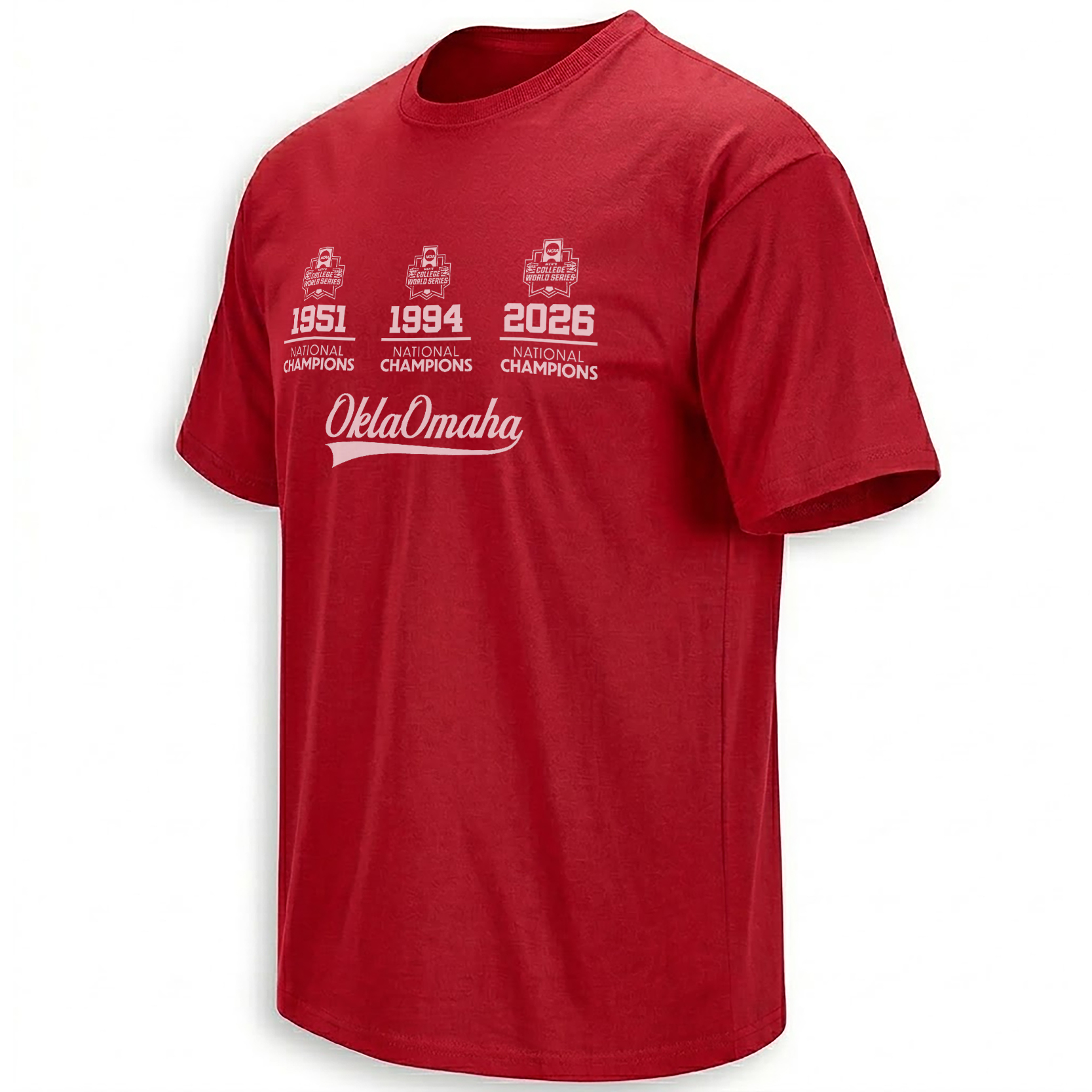
The 3X National Champions graphic is organized like a championship banner rather than a conventional player collage. The central language is institutional: Oklahoma, national champions and the three title years arranged as evidence.
A banner is one of sports culture’s most durable visual forms because it does not attempt to recreate every play. It reduces a season to what survives—the program name, the championship designation and the year that permanently changed the record.
Crimson gives the design immediate Oklahoma identity. Cream and worn gold soften the composition, making it feel connected to an older athletic archive rather than designed only for the week after the final game. The distressed finish is especially important because it allows 2026 to stand beside 1951 and 1994 without appearing visually detached from them.
2026 Was Not Supposed to Feel Inevitable
The strongest tournament stories often become cleaner in memory than they felt while unfolding. Once a team lifts the trophy, every earlier turn begins to look like a step toward destiny. Oklahoma’s route to the title was more volatile than that final interpretation suggests.
The Sooners entered the national tournament without the protective status of a top-eight national seed. They had to build their championship case through the bracket, survive regional pressure, sweep through the super regional stage and then carry an increasingly dangerous offense into Omaha.
By the championship series, Oklahoma had become one of the tournament’s defining power stories. Home runs changed games quickly. Hitters lower in the order produced major swings. Players who had not dominated national conversation during the regular season became central names in June.
That transformation is part of the mythology of college baseball. A team does not need to resemble the champion in February. It needs to become the champion across May and June, when regional games tighten, Omaha amplifies every weakness and confidence can move through an entire lineup.
The Sooners Found Their Power at the Right Time
Oklahoma’s postseason offense did not merely score enough to survive. It repeatedly changed the emotional temperature of games with power. The Sooners entered the championship series after a tournament stretch in which home runs had become one of their clearest competitive signatures.
Against Georgia in Omaha, Oklahoma advanced to the final after an 11–4 victory powered by a lineup capable of producing multiple home-run performances from unexpected places. That game reinforced a pattern already visible throughout the NCAA tournament: the Sooners were becoming more dangerous as the stakes increased.
College baseball power carries a particular theatrical force in Omaha. The dimensions, crowd noise and postseason pressure make every ball driven toward the wall feel like a referendum on the game. Oklahoma repeatedly created that feeling, forcing opponents to play with the knowledge that separation could arrive in one swing.
The 13-run championship finale became the fullest expression of that confidence. It did not leave the season balanced on a single defensive play or disputed strike. Oklahoma created enough distance for the final out to feel ceremonial.
Skip Johnson’s Championship Completed a Long Build
A national title usually compresses a coach’s work into one image: trophy overhead, confetti falling, players surrounding the stage. The deeper story is found in the seasons before that photograph becomes possible.
Skip Johnson had already taken Oklahoma to the championship series in 2022, when the Sooners finished as national runners-up. That run demonstrated that the program could move through Omaha and reach the final weekend, but it also created a new form of pressure. Once a team comes that close, the next return is measured against the ending it could not complete.
The 2026 championship changed the meaning of 2022. It no longer stood only as a missed opportunity. It became part of the construction process—the earlier proof that Oklahoma could reach the stage, followed four years later by the season in which it finished the work.
That distinction matters in championship memory. Fans rarely experience a title as one isolated year. They connect it to previous eliminations, recruiting classes, injuries, transfers, coaching decisions and the accumulating belief that a program is close to producing something permanent.
Omaha Turned Into a Sooner Memory Map
The Men’s College World Series is not simply a neutral tournament location. Omaha has developed into a symbolic destination inside college baseball, a city whose name can communicate an entire postseason ambition without additional explanation.
For Oklahoma fans, 2026 added a new set of Omaha images to the archive: crimson gathering around Charles Schwab Field, home-run celebrations, a championship series that required all three games and the final dogpile after a 13–2 victory.
Those images change how the city will be remembered within the program. Future Oklahoma teams will not travel toward Omaha only under the shadow of 1951 or 1994. They will carry a much newer reference—one visible in modern video, social feeds, player interviews and the memories of supporters who watched the final pitch live.
This is how a championship renews a historical relationship with place. Omaha stops being where Oklahoma once won. It becomes where Oklahoma won again.
Why 1951 Matters More After 2026
The oldest title in a program’s history can become abstract over time. Few living supporters remember every detail, and the visual record belongs to a different media era. The year survives, but it risks becoming a number repeated without emotional texture.
A new championship changes that. When Oklahoma won in 2026, the first title returned to conversation. Graphics placed 1951 beside the new date. Broadcasts and articles revisited the program’s championship history. Younger fans learned that the third trophy could only be called “third” because an earlier team had established the count 75 years before.
The banner design makes that relationship visible. It refuses to isolate the latest winners from the earliest ones. All three dates occupy the same space, allowing the oldest championship to receive fresh attention through the energy of the newest.
1994 Had Carried the Story for 32 Years
Before 2026, the 1994 team occupied a special position in Oklahoma baseball culture. It was the most recent title, the championship still accessible through modern highlights and the reference point repeated whenever a later Sooners team approached Omaha’s final stage.
Thirty-two years is long enough for a championship to become family mythology. Supporters who were young in 1994 reached 2026 with children or grandchildren of their own. Players on the newest team knew the year as program history rather than personal memory.
The third championship does not diminish 1994. It releases it from carrying the entire modern identity of Oklahoma baseball alone. The second title can now sit where it belongs—between the program’s first breakthrough and its newest return.
That is one reason three-date graphics feel so powerful. The viewer does not read the numbers separately. The eye moves across them as progression: origin, continuation, renewal.
2026 Gave Current Fans a Championship of Their Own
Inherited history is essential to college sports, but it differs from lived memory. Fans can admire an older championship, learn the roster and recognize its place in the record. A title experienced in real time attaches itself to different details.
It is remembered through where someone watched, who sent the first message, which inning finally felt safe and how long the final out seemed to remain in the air. The championship becomes connected to the exact age of the viewer and the people around them.
Oklahoma’s 2026 title created that ownership for a generation that knew 1994 primarily through stories. The Sooners did not ask those fans to imagine what a baseball championship might feel like in Norman. They gave them a full three-game final, a decisive ending and a trophy celebration unfolding in the current media landscape.
That is why merchandise, banners and commemorative graphics appear so quickly after a title. The urge is not simply to announce the winner. It is to create a physical timestamp before the emotion begins to settle into history.
The Artwork Functions Like a Stadium Banner
Championship banners are designed to outlive individual rosters. Player names may change, statistics may fade and the details of a final series may require explanation, but the year remains legible from a distance.
The Oklahoma graphic uses that principle at apparel scale. Its wide composition resembles something that could hang above a concourse or appear across the front of a commemorative newspaper. The central “3X” establishes the achievement immediately, while the years provide historical proof.
The distressed texture prevents the design from feeling too polished for its subject. College baseball is built from dirt, dugout rails, scuffed helmets, sun-faded caps and handwritten lineup cards. A perfectly smooth championship graphic would lose some of that tactile identity.
Here, the worn finish makes the design feel as though the banner already carries history—even though its newest date was added only days after the trophy was lifted.
“3X” Means More Than a Trophy Count
Numerically, “3X” is efficient. It tells the reader how many times Oklahoma has reached the top of Division I baseball. Emotionally, the phrase contains more than arithmetic.
It represents the first team that made Oklahoma a national champion, the second team that restored the title 43 years later and the third team that ended another wait of more than three decades. It includes everyone who maintained the program between those dates, even when a championship was not close.
The phrase also changes Oklahoma’s location within college baseball history. A third title creates a deeper championship profile than a single breakthrough. It demonstrates that the program has found a path to the trophy across radically different competitive eras.
No three championships are identical, and that is the point. The continuity comes not from repeating the same team but from producing different teams capable of reaching the same final image.
The Championship Expanded Oklahoma’s SEC Baseball Story
Oklahoma’s move into the Southeastern Conference placed the program inside the country’s most intense college baseball environment. The SEC schedule brought weekly exposure to deep pitching staffs, hostile road series and programs accustomed to treating Omaha as a regular expectation.
Winning the national championship in 2026 gave Oklahoma a powerful answer to the question of how its baseball identity would translate within that landscape. The Sooners did not merely adapt to the conference’s visibility. They finished the season as the last team standing nationally.
The title therefore belongs simultaneously to Oklahoma’s long history and its current competitive era. It connects championships won before SEC membership with a trophy earned after the program entered that environment.
In visual terms, the banner does not need to explain the conference transition. The dates do the work. They show that Oklahoma baseball existed as a championship program before its current league identity and remains one within it.
The Wider Championship Archive
The College Baseball Shirts archive follows how Omaha runs, regional breakthroughs and national championships become visual memory across programs. Oklahoma’s three-title banner belongs naturally inside that tradition because it turns an institutional achievement into one immediately readable composition.
The broader NCAA Shirts collection places the championship within the larger culture of college athletics, where school colors, old dates and regional identity give a title meaning far beyond the final score.
Within that ecosystem, the Oklahoma 3X National Champions design acts as the historical anchor. Other graphics can preserve a player, an Omaha slogan or one tournament moment. This piece records the full title count.
Why the Banner Will Still Make Sense Years From Now
Many sports graphics depend on the immediacy of a meme or one highlight. Their meaning is strongest while the surrounding conversation remains active. A championship banner works differently because the information becomes permanent.
The 13–2 score may require context years from now. The dramatic shift between Games 2 and 3 may become part of a documentary recap. Individual performances will remain important to those who followed the tournament closely.
But 1951, 1994 and 2026 will not need updating unless Oklahoma wins again. The dates are fixed inside the program’s identity. That stability gives the design the quality of an archive rather than a temporary reaction.
It answers one clear question for future fans: which Oklahoma baseball teams finished the journey? Three years provide the answer, and 2026 is now permanently among them.
Frequently Asked Questions
When did Oklahoma win the 2026 baseball national championship?
Oklahoma won the championship on June 22, 2026, by defeating North Carolina 13–2 in the deciding third game of the Men’s College World Series championship round.
How many national championships has Oklahoma baseball won?
Oklahoma baseball has won three NCAA national championships, with title seasons in 1951, 1994 and 2026.
Who did Oklahoma defeat in the 2026 Men’s College World Series final?
The Sooners defeated the North Carolina Tar Heels in a three-game championship series, winning Game 1 and the deciding Game 3.
How long had it been since Oklahoma’s previous baseball championship?
Oklahoma’s previous national championship came in 1994, so the 2026 victory ended a 32-year wait between titles.
What do the years on the Oklahoma 3X National Champions graphic represent?
The years 1951, 1994 and 2026 represent the three seasons in which Oklahoma won the NCAA Division I baseball national championship.
Why is the design styled like a vintage championship banner?
The banner layout and distressed texture connect three different baseball eras, allowing the newest championship to appear as the continuation of a historical Oklahoma program archive.
The 3X National Champions banner brings 1951, 1994 and 2026 into one crimson-and-cream artifact, while the wider college baseball archive follows the Omaha moments, championship runs and fan language surrounding the sport’s newest history.
3X National Champions Shirt commemorates Oklahoma Sooners baseball titles in 1951, 1994 and 2026 through a vintage crimson championship banner, preserving the program’s 13–2 College World Series finale and three-generation Omaha legacy.