
Alex Tuch Is Coming to Washington: Why King Tuch and No. 89 Already Feel Made for Capitals Culture
Washington did not treat Alex Tuch like a short-term scoring rental. The Capitals gave the 30-year-old power forward an eight-year commitment, handed him No. 89 and placed his size, finishing and edge at the center of a rapidly changing era.
Alex Tuch became a Washington Capital on June 24, and the scale of the move made the organization’s intention difficult to misread. Buffalo signed the forward to an eight-year, $84 million contract before sending him to Washington for David Kampf and a 2027 third-round draft pick.
The announcement arrived only one day after Washington acquired Jordan Kyrou from St. Louis, turning what could have been a cautious offseason into a rapid reconstruction of the Capitals’ attack. Tuch was not added merely to fill a lineup opening. He was acquired as a top-six forward expected to score, defend, reach the net and help define the team’s competitive personality for years.
Within days, Washington confirmed another detail that made the move feel culturally complete: Tuch would wear No. 89. The number immediately gave the new era a visual signature, while “King Tuch” and “Tuch Around and Find Out” turned the transaction into the kind of fan language that forms before a player has taken his first regular-season shift in the uniform.
Washington did not acquire Alex Tuch to decorate the next era. It acquired him to give that era weight, reach and a number fans could recognize from the far end of the ice.
A Contract That Defines the Role Before the First Game
Eight-year agreements do more than secure a player. They establish hierarchy. Washington’s $10.5 million average annual commitment identifies Tuch as one of the organization’s central forwards, not a complementary piece waiting to discover where he belongs.
The Capitals’ own description of the move emphasized the full profile: size, versatility, net-front pressure, goal scoring, defensive responsibility and leadership. At 6-foot-4 and 219 pounds, Tuch gives Washington a body type and playing style that already fit the franchise’s established preference for heavy, direct hockey.
His final Buffalo season made the financial argument easier to understand. Tuch scored 33 goals and produced 66 points in 79 games, led the Sabres in five-on-five points and contributed in shorthanded situations. He also blocked 90 shots, an unusually visible number for a high-scoring forward.
Tuch is not being paid only for finishing chances. Washington is investing in a forward who can play through contact, defend, kill penalties, drive toward the crease and remain involved when the game becomes physically uncomfortable.
Why Washington’s Hockey Culture Makes Sense for Tuch
The Capitals have spent years building a recognizable form of hockey around strength, shooting, board play and forwards willing to occupy difficult areas. Even as the roster evolves, Washington’s most successful identity has rarely depended on finesse without force.
Tuch enters that environment with a game designed for direct conflict. His skating allows him to move faster than his frame suggests. His reach changes puck battles. His size becomes particularly valuable when he attacks defenders downhill or protects possession below the circles.
That combination helps explain why the transition feels more natural than many high-profile offseason moves. Washington does not have to invent a cultural role for him. The organization already understands how a large, aggressive winger can become emotionally legible to its crowd.
Tuch also described the Capitals as a team he disliked facing because of how difficult they were to play against. That observation matters. Players often reveal organizational identity most clearly when describing the experience from the opposite bench. Washington’s appeal was not only contractual; it was attached to an existing reputation for resistance.
“King Tuch” Turns a Transaction Into a Coronation
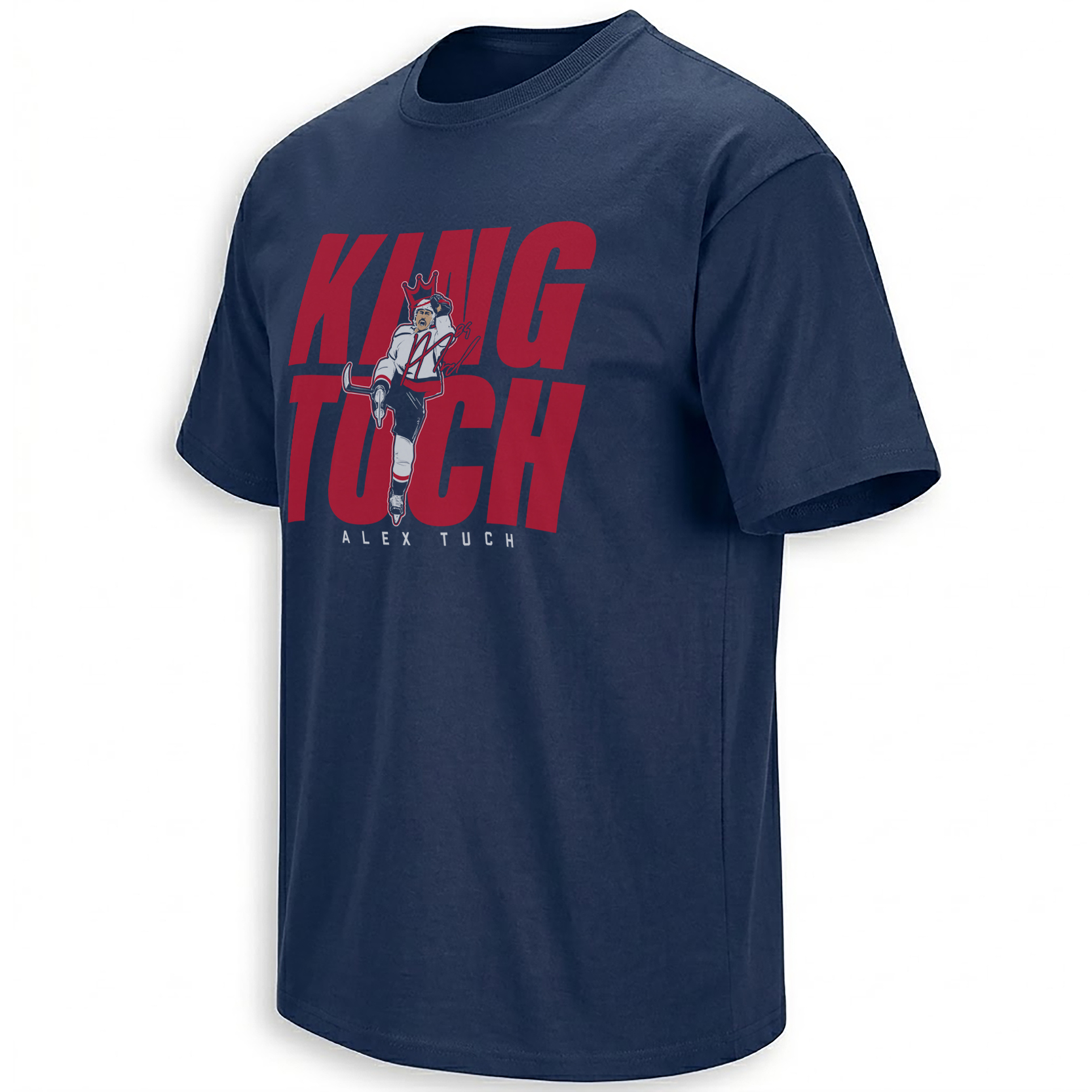
The King Tuch graphic exaggerates the arrival in exactly the way fan culture often does. A crown does not claim that Tuch has already conquered Washington. It visualizes the scale of expectation created by the contract.
Royal imagery works because the city already carries an atmosphere of formal power. Washington is filled with monuments, government architecture, ceremonial language and institutions designed to communicate authority. Placing a crown above Tuch’s portrait converts that civic vocabulary into hockey mythology.
The visual also gives his surname unusual graphic strength. “Tuch” is short, blunt and easy to enlarge. Combined with “King,” it becomes a title rather than simply a player identifier.
“Tuch Around and Find Out” Speaks a Different Language
The second design abandons ceremony for confrontation. “Tuch Around and Find Out” is built from internet-era warning language: compact, aggressive, immediately repeatable and perfectly suited to a player whose hockey identity depends on size and directness.
Its central visual element is No. 89. Unlike the crown, which imagines status, the number creates specificity. This is not a generic power-forward phrase placed beside any Capitals player. It belongs to Washington’s newly assigned version of Alex Tuch.
The slogan also feels compatible with the club’s established physical personalities. A Washington forward group involving Tuch, Tom Wilson and Aliaksei Protas would not need to manufacture the appearance of size. The scale would be visible before the opening faceoff.
That is why the phrase works as more than a pun. It gives fans a compressed description of the experience Washington hopes Tuch will create: challenge the forecheck, lose the wall battle, allow him to reach the crease and discover the consequence.
A ceremonial treatment of the Capitals’ major offseason arrival, built around portraiture, royal symbolism and the authority of an eight-year commitment.
Open the crown design →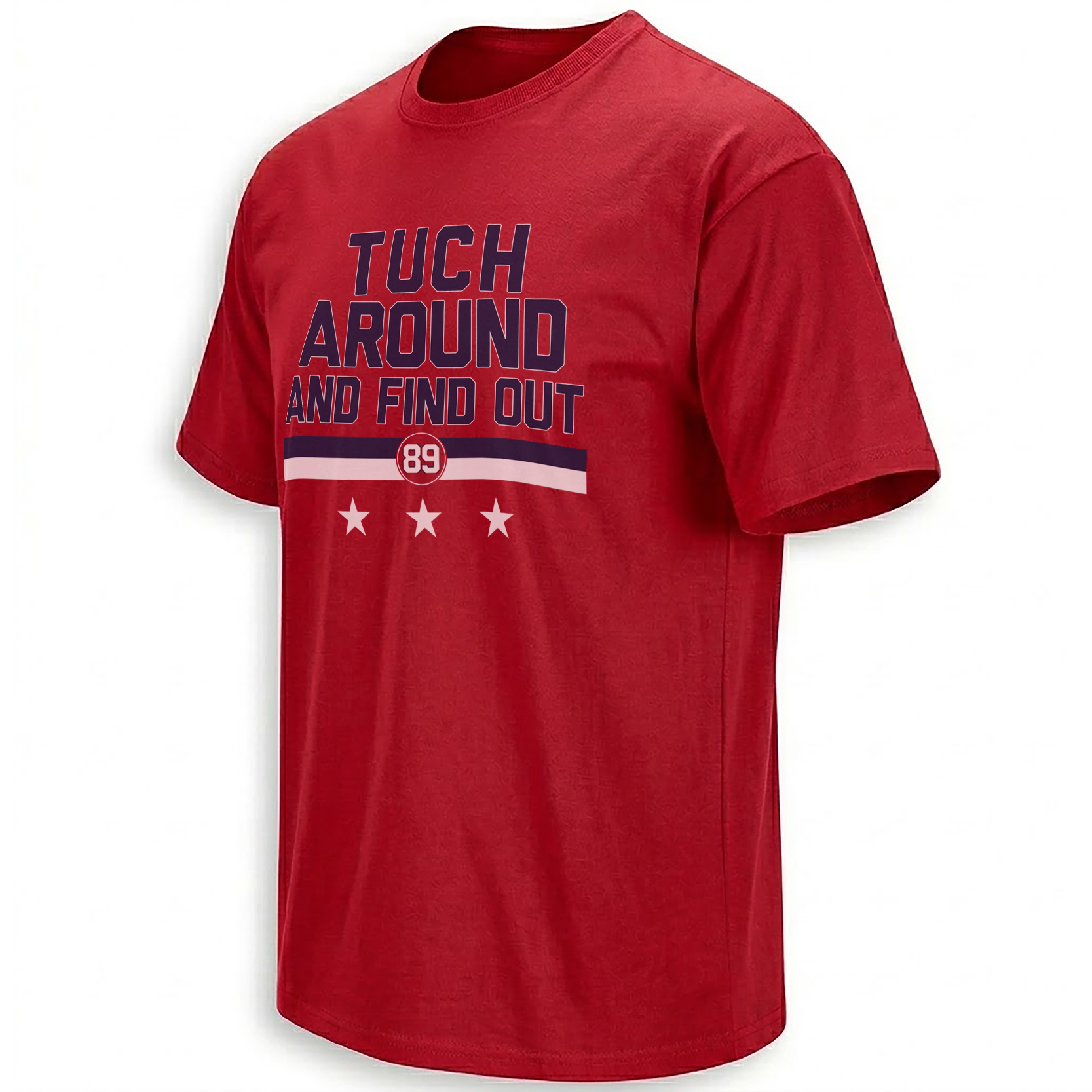
A sharper fan-language piece connecting Tuch’s surname, physical style and newly confirmed Washington number.
See the No. 89 piece →No. 89 Makes the New Chapter Immediately Visible
Numbers matter most during a player transition because they help fans separate the new uniform from the old memory. Tuch had already worn No. 89 during previous stages of his NHL career, so Washington’s confirmation gives him continuity inside a different visual system.
The number will now appear in Capitals red, white and blue rather than Buffalo’s navy-and-gold environment. That contrast is central to the artwork. A player arrival becomes culturally real when the familiar number begins to look native inside the new team colors.
Eighty-nine also provides an unusually strong design shape. The digits are large, asymmetrical and visually heavy, matching the physical quality of Tuch’s game. On the second graphic, they operate almost like a road sign or warning marker.
Before he records a goal in Washington, No. 89 already gives supporters a way to imagine him entering the lineup. The number is the first piece of the future that fans can see.
Washington Is Rebuilding Its Attack in Public
The timing of the Tuch trade intensified its meaning. One day earlier, Washington acquired Jordan Kyrou, another player with multiple 30-goal seasons on his résumé. Two major forward additions in two days changed the offseason from routine adjustment into a public declaration.
Washington retains experienced forwards capable of providing size, structure, scoring and institutional continuity.
Two proven goal scorers bring different forms of attack—Tuch through reach and net pressure, Kyrou through speed and skill.
Younger players give the Capitals a path toward renewal without abandoning the expectations of immediate competitiveness.
The contrast between Tuch and Kyrou is especially useful. Washington did not acquire two identical forwards. Kyrou adds transition speed, puck skill and open-ice threat. Tuch adds a larger frame, net-front presence and a more visibly punishing form of possession.
Together, they suggest that the Capitals are trying to widen their offensive vocabulary. The team wants to remain difficult to play against without becoming predictable.
The Ovechkin Question Gives Every Addition More Meaning
Alex Ovechkin had not announced his decision about returning for another season when Tuch arrived. That uncertainty placed the trade inside a much larger franchise transition.
Tuch openly said he hoped Ovechkin would return and described the possibility of learning from the NHL’s all-time leading goal scorer. The comment carried practical meaning—any incoming scorer would value time beside Ovechkin—but it also reflected the historical weight of joining Washington at this exact point.
The Capitals cannot replace Ovechkin through one transaction, and the organization does not appear to be pretending otherwise. The more realistic task is to build a forward group capable of sustaining competitive relevance as the franchise moves through the end of its defining era.
Tuch’s contract extends far beyond one decision or one season. Whether he shares the ice with Ovechkin briefly or enters Washington after the captain’s final NHL game, he has been positioned as part of what comes next.
The 2018 Save Makes the Story Strangely Circular
Tuch already occupied a permanent frame in Capitals history before becoming a Capital. During Game 2 of the 2018 Stanley Cup Final, Braden Holtby made the sprawling stick save that denied Tuch late in the third period and protected Washington’s 3–2 victory over Vegas.
The Capitals won the next three games and lifted the first Stanley Cup in franchise history. Tuch, then a Vegas rookie, remained on the opposite side of one of Washington’s most replayed moments.
Eight years later, that detail gives the acquisition an almost scripted quality. The player stopped by “The Save” now arrives in Washington still motivated by the Cup he did not win. Tuch joked that if he could not beat them, he might as well join them, but he also acknowledged that losing the 2018 Final continues to bother him.
That unfinished feeling may be one of the most important parts of the fit. Washington is acquiring a veteran with financial security, but not one who speaks as though the central competitive question has been settled.
Tuch’s first Stanley Cup Final ended with Washington’s defining save. His Capitals chapter begins with the possibility that he can pursue the same trophy from the other side of that memory.
Leaving Buffalo Adds Emotional Complication
Tuch’s departure was not a clean rejection of Buffalo. He grew up supporting the Sabres, became an alternate captain and helped the franchise return to the playoffs after a long absence. He described leaving as one of the hardest decisions of his life.
That history gives the Washington arrival more emotional depth than a standard free-agent relocation. Tuch is not moving because the previous city meant nothing. He is moving after choosing between personal attachment, contract opportunity and the belief that Washington offered the stronger path through the prime years of his career.
Sports fandom often prefers simple categories: loyalty or betrayal, hometown hero or departing star. The reality is more complicated. Tuch’s Buffalo chapter can remain meaningful while Washington becomes the place where he pursues the next competitive goal.
The designs focus on arrival rather than departure. They do not attempt to overwrite the Sabres years. They capture the moment his identity began changing from Buffalo alternate captain to Washington’s No. 89.
Why Capitals Fans Respond to Physical Characters
Washington supporters have long embraced players whose games become visible through contact. Physical forwards create an immediate relationship with the arena because their impact can be felt even when the puck does not enter the net.
A hard forecheck changes crowd volume. A protected puck extends a shift. A drive through a defender forces the next line to start in the offensive zone. These actions give fans reasons to react between goals.
Tuch’s profile offers that form of engagement while retaining legitimate scoring expectation. He has reached at least 33 goals in three of the past four seasons, including two 36-goal campaigns. Washington is not choosing between personality and production.
That duality explains why both graphics work. King Tuch treats him like a marquee arrival. Tuch Around and Find Out treats him like the player opponents will have to handle along the boards and around the crease.
The Crown and the Warning Sign Preserve Two Expectations
Viewed together, the two designs document the split personality of a major acquisition. One side is ceremonial. The contract is announced, the portrait is elevated and the player is introduced as a foundational figure.
The other side is competitive. No. 89 becomes a warning, the wordplay becomes sharper and the image asks what will happen when expectation turns into contact.
The crown represents what Washington has invested. The slogan represents what fans expect Tuch to deliver.
Neither graphic requires a completed season to make sense because both are anchored to the arrival itself. They record the brief period when imagination moves faster than results—when line combinations are still theoretical, the first goal has not happened and every new number carries possibility.
A New Entry in Washington’s Hockey Archive
The broader NHL Shirts archive follows how trades, player identities, playoff memories and fan phrases become visual records of hockey culture. Tuch’s arrival belongs inside that tradition because it was immediately larger than a transaction line.
The King Tuch graphic preserves the scale of the commitment, while Tuch Around and Find Out captures the physical expectation surrounding No. 89.
Together, they form an early visual archive of Washington’s 2026 offseason: a crown for the announcement, a warning for the games ahead and a number designed to become familiar at Capital One Arena.
Frequently Asked Questions
When did the Washington Capitals acquire Alex Tuch?
Washington acquired Alex Tuch from the Buffalo Sabres on June 24, 2026, in a sign-and-trade transaction involving David Kampf and a 2027 third-round draft pick.
What contract did Alex Tuch sign?
Tuch signed an eight-year, $84 million contract carrying an average annual value of $10.5 million before being traded to Washington.
What number will Alex Tuch wear for the Capitals?
Tuch will wear No. 89 with Washington, maintaining the number closely associated with his NHL identity.
How did Alex Tuch perform during the 2025–26 season?
He recorded 33 goals and 33 assists for 66 points in 79 regular-season games with Buffalo while also contributing at five-on-five and on the penalty kill.
What does the King Tuch design represent?
The crown graphic treats Tuch’s long-term Capitals arrival as a capital-city coronation, reflecting the status and expectations created by his eight-year contract.
What does “Tuch Around and Find Out” mean?
The phrase combines Tuch’s surname with internet warning language, translating his size, physical style and No. 89 identity into a confrontational Capitals fan slogan.
The King Tuch piece captures the scale of Alex Tuch’s arrival, while the No. 89 graphic records the physical fan language forming around Washington’s newest long-term forward.
Alex Tuch Capitals Shirt designs capture Washington’s major 2026 arrival through King Tuch crown imagery and a Tuch Around and Find Out No. 89 graphic, reflecting his eight-year contract, 33-goal season and power-forward identity.