
Oklahoma Did Not Just Win Omaha: The Sooners Redrew the Entire Bracket
The 2026 College World Series ended with Oklahoma above the field, North Carolina beneath a 13–2 final score and a crimson path running through Alabama, Georgia and the championship round. The bracket now reads less like tournament logistics and more like a map of how the Sooners took control of June.
By the time Oklahoma’s final out settled into the glove on June 22, the 2026 bracket no longer looked open. Every line led toward the same place: an Oklahoma dogpile, a third national championship and a 13–2 victory over North Carolina in the deciding game at Charles Schwab Field.
The Sooners had entered the postseason without the protected status of a national seed. They began in Atlanta as a regional No. 2, lost to host Georgia Tech and spent the next several weeks converting elimination pressure into momentum. The path eventually carried them through Kansas, Alabama, Georgia and a three-game finals series with North Carolina.
That route explains why the bracket became one of the strongest visual symbols of Oklahoma’s title. A scoreboard preserves one night. A trophy image preserves the celebration. A bracket preserves the structure of the entire tournament and shows where every opponent’s possibility ended.
The trophy records who won. The bracket records everyone Oklahoma had to move past before the trophy became possible.
Omaha championship archive • June 2026The Bracket Became a Map of Oklahoma’s Control
Tournament brackets begin as instruments of uncertainty. Every line represents a possibility, every pairing opens another route and every team enters with a version of the ending it believes it can reach.
Over time, those possibilities disappear. One name advances while another stops. Early-round symmetry gives way to a single vertical path, and the empty space around the champion begins to feel almost inevitable.
Oklahoma’s Omaha bracket carried that transformation clearly. The Sooners opened with a 9–0 victory over Alabama, moved past Georgia 4–3 and then defeated the Bulldogs again 11–4 to reach the championship series. North Carolina interrupted the final round once, but Oklahoma answered the 6–2 Game 2 loss with the most decisive result of the series.
Presented this way, the bracket does not reduce the tournament to abstract lines. It shows the emotional progression of the run: arrival against Alabama, survival against Georgia, separation in the rematch and completion against North Carolina.
A Championship Design Built Around the Shape of the Tournament
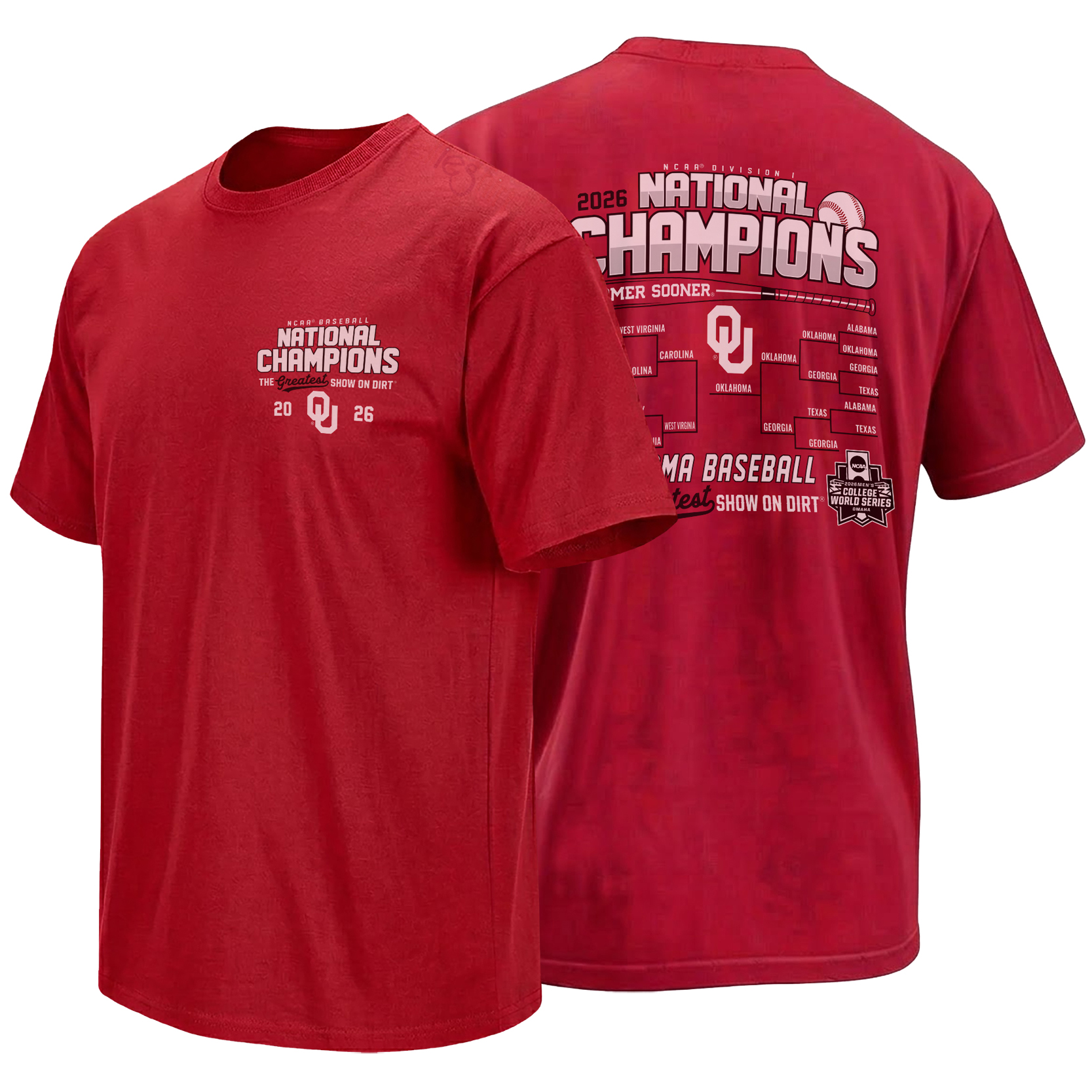
The 2026 National Champions Bracket design treats the College World Series field as part of the championship identity rather than background information.
The front works like the compact title mark on a team-issued piece. “National Champions” is stacked above the Oklahoma logo, the 2026 date and the line “The Greatest Show on Dirt.” The scale is restrained enough to feel archival, almost like a chest mark taken from a tournament staff shirt or clubhouse release.
The back changes the scale completely. Large block lettering announces the championship, a baseball cuts into the typography and the tournament bracket spreads beneath the Oklahoma mark. Instead of listing only scores, the design shows placement: the Sooners at the center of the field, advancing through a visual system built to eliminate everyone but one team.
Three Rounds, Three Different Oklahoma Teams
Oklahoma entered Omaha with a shutout that immediately changed the tone of its bracket. The Sooners did not need a late escape; they established control from the first game.
The first meeting demanded precision and late-inning nerve. The rematch produced distance, sending Oklahoma into the championship series without requiring an additional elimination game.
Oklahoma won the opener, absorbed a Game 2 response and then turned the deciding game into a 13–2 championship statement.
Those three stages make the bracket more revealing than a simple record. Each round required a different form of performance. The Alabama game rewarded pitching control. Georgia forced Oklahoma to win both a one-run test and a more open offensive game. North Carolina required the Sooners to respond after the bracket had finally pushed back.
Why the North Carolina Loss Strengthened the Final Line
Perfect brackets are visually clean, but imperfect championship runs often become more emotionally durable. Oklahoma’s 6–2 loss to North Carolina in Game 2 interrupted what had been an unbeaten Omaha stay and forced the championship into its most unforgiving form.
After that loss, the bracket stopped offering alternate routes. There was no loser’s side, no later rematch and no additional game. Both teams arrived on June 22 with one available outcome: win the national championship or watch the other dugout celebrate it.
Oklahoma responded by scoring early, extending the lead inning by inning and eventually producing a four-run eighth that removed the final trace of suspense. The bracket’s last line therefore carries more than advancement. It represents a direct answer to the only defeat Oklahoma experienced in Omaha.
The Game 2 loss belongs inside the championship story because it created the decisive game. Oklahoma’s 13–2 response gained its scale from the fact that the tournament had finally reduced the Sooners’ season to one remaining line.
The Road Began Before the Omaha Bracket Appeared
The back graphic focuses on the College World Series field, but Oklahoma’s championship route began before the team reached Nebraska. The Sooners entered the Atlanta Regional as a No. 2 seed and opened with an 8–3 victory over The Citadel.
A 9–3 loss to Georgia Tech moved Oklahoma into the elimination side of the regional. From there, the Sooners beat The Citadel 15–5, erased a six-run deficit to defeat Georgia Tech 15–8 and returned to beat the national No. 2 seed again, 8–7 in ten innings.
That regional comeback altered the emotional meaning of every later bracket. Oklahoma had already experienced what it meant to lose control of the tournament and recover it. When North Carolina extended the championship series, the Sooners were not encountering elimination pressure for the first time.
The Lawrence Super Regional added another chapter. Oklahoma went on the road against No. 15 Kansas and won 8–1 and 13–2, securing the program’s first Omaha appearance since its 2022 runner-up run.
Why Brackets Carry a Different Kind of Fan Memory
Scores isolate games. Brackets connect them. A supporter who sees “Oklahoma 13, North Carolina 2” remembers the championship night. A supporter who studies the bracket remembers how each earlier result changed the next opponent, the next pitching decision and the emotional shape of the week.
Brackets also preserve teams that disappeared before the final. Alabama and Georgia remain visible because they were part of Oklahoma’s route. Other Omaha programs remain around the outer edges, reminding viewers that the championship began as an eight-team field rather than a two-team series.
That structure turns the design into a memory map. Fans can locate where confidence grew, where the tournament became dangerous and where the field finally narrowed around Oklahoma.
The compact chest artwork feels like a team-issued tournament seal, leaving the larger historical record for the back.
Tall block lettering gives the back the visual authority of a clubhouse banner, sports-page headline or official postgame graphic.
The tournament lines explain the championship instead of merely decorating it, placing Oklahoma at the point where every route concludes.
Crimson Turns the Bracket Into an Oklahoma Document
The red garment base is not neutral. It converts the bracket from an NCAA diagram into an Oklahoma object. White and black lettering remain highly legible, while the crimson field connects every line, opponent and tournament mark to the Sooners’ visual identity.
The typography also balances two forms of sports memory. The front resembles a compact collegiate seal. The back uses heavier, more declarative lettering associated with championship banners and locker-room apparel. The baseball worked into the word “Champions” prevents the layout from becoming generic title typography.
Beneath the bracket, “Oklahoma Baseball” and “The Greatest Show on Dirt” give the design a program-specific voice. The phrase adds personality to what could otherwise read as a purely informational bracket, connecting the tournament route to the swagger surrounding a team that kept producing explosive offensive innings throughout the postseason.
From Open Field to One Name at the Center
Before the first pitch in Omaha, the bracket contained several plausible champions. National seeds, experienced programs and teams arriving with their own postseason momentum occupied every corner.
By June 22, only Oklahoma remained. The Sooners had gone 5–1 at the College World Series, defeated three nationally seeded opponents and completed a postseason in which they repeatedly answered elimination pressure with larger offensive performances.
The wider College Baseball Shirts archive reflects how every Omaha team translates that journey differently. Some graphics preserve destination slogans, others preserve final scores, while bracket pieces show the architecture of the tournament itself.
Within the broader NCAA Shirts collection, Oklahoma’s bracket design belongs to a long college-sports tradition: preserving not only the champion’s name, but the pathway through which a campus and fan community experienced the title.
Frequently Asked Questions
Who won the 2026 Men’s College World Series?
The Oklahoma Sooners won the 2026 Men’s College World Series by defeating North Carolina 13–2 in the deciding third game of the championship series.
Which teams did Oklahoma defeat in Omaha?
Oklahoma defeated Alabama once, Georgia twice and North Carolina twice during its 5–1 College World Series run.
What was Oklahoma’s only loss at the 2026 College World Series?
The Sooners lost 6–2 to North Carolina in Game 2 of the championship series before answering with a 13–2 victory in the deciding game.
Why is a bracket design different from a schedule design?
A schedule records games in chronological order, while a bracket shows how opponents, eliminations and advancement routes connected to produce the final championship matchup.
What does the front-and-back artwork represent?
The front presents a compact Oklahoma national championship seal, while the back expands the story through large title typography and the College World Series bracket.
How many baseball national championships has Oklahoma won?
Oklahoma has won three NCAA baseball national championships, claiming titles in 1951, 1994 and 2026.
The 2026 National Champions Bracket design preserves the structure of the Sooners’ Omaha takeover, while the broader college baseball archive follows the destinations, scores and visual language produced by the full tournament.
2026 National Champions Bracket Shirt maps the Oklahoma Sooners’ College World Series title through a compact front championship seal and an oversized back graphic showing the Omaha field, tournament progression and Oklahoma at the center of the bracket.