Oklahoma Has a New Flag to Fly: The 2026 Pennant Joins Sooner Baseball History
Oklahoma’s 13–2 championship victory over North Carolina did more than end the College World Series. It gave the Sooners a third national-title year, returned the program to the top for the first time since 1994 and created a new pennant for a fan base already turning Omaha into permanent memory.
The scoreboard inside Charles Schwab Field showed Oklahoma 13, North Carolina 2 when the 2026 season reached its final out. The Sooners finished 43–23, added a third baseball national championship to the titles of 1951 and 1994 and left Omaha with a result too large to be contained by one postgame photograph.
Within hours, the title had already acquired the visual language championships always produce. Crimson uniforms converged on the field. Players raised the trophy. “National Champions” appeared across celebration graphics, locker-room pieces and social timelines. The date moved quickly from a point on the calendar into a permanent part of Oklahoma baseball history.
The pennant design belongs inside that transition. Pennants have always made victory feel physical. They take a season that existed through innings, scores and nervous nights and reduce it to a shape meant to hang above a desk, inside a bedroom, over a stadium concourse or across the walls of a family room for decades.
A trophy records the achievement. A pennant gives the achievement somewhere to live after the stadium lights go dark.
Oklahoma baseball • National championship memory • 2026From One Final Out to a New Piece of Oklahoma History
Oklahoma entered the deciding game with no margin remaining. The Sooners had won the championship-series opener 9–3, lost Game 2 by a 6–2 score and returned the following night with one game separating a national title from an entirely different offseason.
Instead of allowing the pressure to shrink the field, Oklahoma expanded it. The Sooners built the lead inning by inning, produced 14 hits and turned a winner-take-all game into the most decisive victory of the championship series.
That result completed one of the most demanding postseason paths in the tournament. Oklahoma defeated Georgia Tech twice, Kansas twice, Alabama, Georgia twice and North Carolina twice. Each of those opponents carried a national seed, giving the Sooners’ route the feeling of a sustained challenge rather than one favorable weekend.
By the final out, the years 1951, 1994 and 2026 no longer belonged to separate conversations. They formed a three-point history of Oklahoma baseball at the national level.
Why the Pennant Became One of Sports’ Most Durable Symbols
A pennant is an unusually simple object. It has a narrow edge, a broad field and a pointed end that seems to push the viewer’s eye toward a name, year or destination. That shape has survived generations of changing sports graphics because it communicates movement and ownership at the same time.
Teams “win the pennant,” fans “fly the colors,” and stadiums display championship banners overhead. The language blends competition with territory. A title does not merely exist in a record book; it is raised, hung and claimed.
In baseball, the association feels especially natural. Vintage felt pennants once turned ballparks, players and championship seasons into affordable objects fans could carry home. Their triangular silhouettes appeared in souvenir stands, bedrooms and family collections long before social media created an instant archive for every postseason.
The 2026 Oklahoma design draws from that history while placing the Sooners’ newest championship inside it. The graphic is contemporary in timing but deliberately older in feeling, allowing the new title to look as though it already belongs beside the program’s earlier eras.
The Front Announces the Title; the Back Builds the Stadium Around It
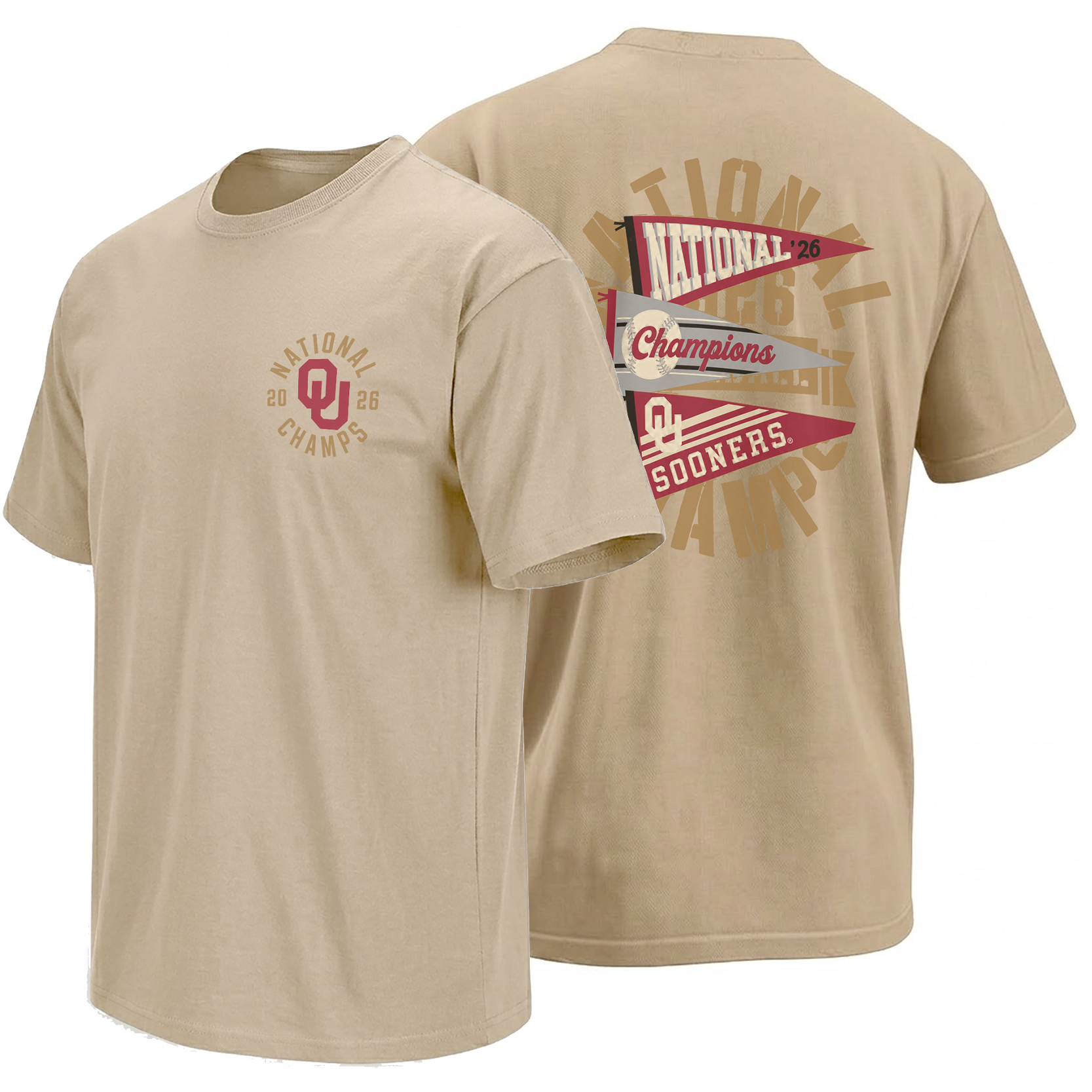
The 2026 National Champions Pennant design uses its two-sided layout to move between symbol and atmosphere.
The front presents the championship through a compact vintage pennant composition. The triangular form gives the Oklahoma identity a clear direction, while the national-championship language and 2026 date make the piece function like a souvenir from the first hours after the final.
The back expands beyond the pennant itself. Stadium architecture, championship lettering and Oklahoma baseball imagery create the sensation of entering the place where the title became real. The design no longer reads as one isolated emblem; it becomes a scene shaped by lights, stands, field geometry and the visual scale of championship night.
A Stadium Is Where the Abstract Idea of a Championship Becomes Real
Before the final game, “national championship” is an objective. It exists in predictions, bracket projections and the private language a team uses to explain why its season matters. Inside the stadium, the idea becomes measurable.
It becomes the distance between home plate and the outfield wall. It becomes the sound after a two-out strike. It becomes the bullpen gate opening, a runner advancing, a lead growing and thousands of people realizing at slightly different moments that the outcome may no longer change.
That is why the stadium treatment on the back carries emotional weight. It restores place to a title that could otherwise be reduced to typography. The stands and field make the design feel tied to Omaha rather than to a generic championship template.
The lights, seating bowl, field lines and scoreboard frame the emotional space in which Oklahoma’s third title became permanent. The stadium imagery turns the back graphic into a remembered location rather than a detached announcement.
Three Years, Three Generations of Sooner Memory
Oklahoma’s first national title arrived in 1951, when college baseball occupied a very different media landscape. The championship survived through record books, university history, photographs and stories transferred between generations.
The 1994 title became the reference point most frequently revived during the 2026 run. Thirty-two years is enough time for a championship to move from lived experience into inherited memory. Some Oklahoma fans remembered it directly. Others knew it through relatives, archival footage and the knowledge that the program had once reached the summit.
The 2026 championship belongs to another environment entirely. The final out, dogpile, interviews and trophy presentation circulated immediately. Fans did not wait for the next morning’s paper to establish the dominant images. The visual archive formed while the team was still celebrating on the field.
Oklahoma’s original national championship established the program’s place in the early history of the College World Series.
For thirty-two years, 1994 remained the most recent championship reference carried through Oklahoma baseball culture.
The newest title arrived through live video, instant celebration graphics and a fan conversation unfolding before the trophy ceremony ended.
The pennant format connects those eras because it belongs comfortably to all three. It would not look out of place in an old photograph, on the wall of a 1990s fan room or inside the contemporary stream of championship artwork produced in 2026.
Why Vintage Design Fits a Championship That Happened Yesterday
Championship graphics often use distressed textures, aged colors and archival shapes almost immediately after the event. That might appear contradictory. Nothing about Oklahoma’s 2026 title is old yet.
The vintage treatment works because fans experience championship nights in two timeframes at once. They are intensely present, watching every pitch and reacting in real time. At the same moment, they understand that the final image is already becoming something they will revisit years later.
The softened tones and pennant form anticipate that future memory. Rather than pretending the design was produced decades ago, they place the new championship into the visual tradition of the older objects through which sports history has always been preserved.
The vintage language does not make the 2026 title feel distant. It gives the moment historical weight immediately, allowing a new championship to enter the same symbolic world as old pennants, scorecards, ticket stubs and ballpark photographs.
The Design Moves From a Small Emblem to a Large Public Memory
The contrast between front and back mirrors two ways fans carry a championship. The smaller front graphic is personal. It resembles a badge, a patch or a compact souvenir that can be recognized without explaining the full postseason.
The larger back artwork is public. It speaks in the visual scale of banners and stadium walls. The championship lettering must be legible from farther away, while the architectural background gives the title a setting large enough to match its importance.
Together, the two sides avoid repeating the same information at different sizes. The pennant identifies the tradition. The stadium explains the emotional magnitude.
Oklahoma’s Postseason Made the Pennant Harder to Earn
The final design appears clean because championship symbols are supposed to simplify. The postseason beneath it was anything but simple.
Oklahoma entered the NCAA Tournament as a regional No. 2, lost to host Georgia Tech and then won three straight elimination games to escape Atlanta. The last two came against the No. 2 national seed, including an extra-inning regional final.
The Sooners then traveled to Kansas and swept the No. 15 national seed in the Lawrence Super Regional. In Omaha, they defeated No. 7 Alabama, beat No. 3 Georgia twice and took two of three from No. 5 North Carolina.
That sequence gives the pennant more meaning than the word “champions” can communicate on its own. It represents a team that repeatedly entered environments where the seed, venue or bracket structure favored someone else and kept advancing anyway.
How the Internet Turned the Final Out Into an Immediate Archive
Across Oklahoma fan spaces, the conversation quickly moved among several emotional registers: disbelief at the size of the deciding-game victory, relief after the Game 2 loss, appreciation for the program’s first title since 1994 and pride in the difficulty of the postseason route.
The reaction did not require one universal phrase. It appeared through the repetition of images: the final strike, the players leaving the dugout, the dogpile, the trophy and the championship wordmark placed beside the Oklahoma logo.
Pennant graphics fit naturally into that circulation because their shape is instantly readable at small scale. Even inside a fast-moving feed, the pointed silhouette communicates vintage sports culture before every word is visible.
That immediate recognizability helps explain why the form continues to return. It belongs to baseball history, but it also works inside the visual speed of contemporary fandom.
A New Pennant Inside the Wider College Baseball Archive
Oklahoma’s championship joins a broader visual language produced every June. Omaha teams arrive with destination slogans, city references, regional memories and design systems built around the College World Series. Only one program leaves with a national-championship year.
The wider College Baseball Shirts archive follows those different forms of fan memory: bracket graphics, schedule backs, championship declarations, team-specific Omaha phrases and pieces that preserve the final score.
Within the broader NCAA Shirts collection, Oklahoma’s pennant also belongs to the long tradition of college athletics turning school colors, campus identity and postseason achievement into objects that travel far beyond the stadium.
The new design therefore does not stand alone. It becomes one artifact inside the larger record of how Oklahoma supporters experienced June 2026: first as a dangerous bracket, then as a championship series and finally as a new flag flying beside 1951 and 1994.
Frequently Asked Questions
Who won the 2026 Men’s College World Series?
The Oklahoma Sooners won the 2026 Men’s College World Series by defeating North Carolina 13–2 in the deciding third game of the championship series.
How many baseball national championships has Oklahoma won?
Oklahoma has won three NCAA Division I baseball national championships, with title seasons in 1951, 1994 and 2026.
Why is a pennant associated with baseball championships?
Pennants have long been used as baseball souvenirs and symbols of league or tournament victory. Their triangular shape became closely connected with ballparks, team identity and championship displays.
Why does the Oklahoma championship artwork use a vintage style?
The aged palette and pennant form connect the new 2026 title with older baseball memorabilia, allowing the championship to feel immediately at home beside Oklahoma’s 1951 and 1994 history.
What does the stadium artwork on the back represent?
The stadium scene restores the physical atmosphere of championship night, using field, stands and lighting imagery to connect the title with the place where Oklahoma completed its Omaha run.
What does the front-and-back composition communicate?
The front presents the championship as a compact vintage pennant, while the back expands the memory into a larger stadium scene built around Oklahoma baseball and the 2026 national title.
The 2026 National Champions Pennant design connects the Sooners’ Omaha victory with the visual tradition of vintage baseball memorabilia, while the wider college baseball archive preserves the brackets, scores and fan language that shaped the tournament around it.
2026 National Champions Pennant Shirt captures the Oklahoma Sooners’ third baseball title through a vintage front pennant and an expansive stadium back graphic tied to the 13–2 championship victory, Omaha atmosphere and the program’s 1951, 1994 and 2026 legacy.