Every Win Has a Place: Oklahoma’s 2026 Road Through Omaha
The Sooners’ national championship can be reduced to one final score, but the full meaning of the title lives in the route: Alabama, Georgia, Georgia again and a three-game championship test against North Carolina.
When Oklahoma’s players rushed the field in Omaha on June 22, the 13–2 score over North Carolina supplied the clean ending. It identified the champion, settled the best-of-three finals and placed 2026 beside 1951 and 1994 in the Sooners’ baseball history.
The celebration, however, was carrying more than one night. It held every earlier stop in the College World Series run: the shutout that announced Oklahoma’s arrival, the one-run game that tested its nerve, the semifinal victory that opened the championship door and the loss that forced the Sooners to prove themselves one final time.
That is why the schedule on the back of this championship design matters. It does not function like a list of old fixtures. It reads as a route map. Each opponent and score marks a stage in the process by which Oklahoma changed from an Omaha participant into the 2026 national champion.
The front names the champion. The back explains how Oklahoma became one.
A six-game Omaha record rendered as championship memoryThe Final Score Was an Ending, Not the Whole Story
Championship culture naturally favors the last image. The final strike. The dogpile. The trophy presentation. Those visuals are powerful because they compress an entire season into a few seconds that can be replayed forever.
Yet a schedule-based championship graphic works differently. Instead of preserving only the climax, it restores sequence. It reminds the viewer that the final celebration was built through several distinct versions of Oklahoma baseball.
Against Alabama, the Sooners controlled the game through pitching and prevention. The 9–0 result established authority without requiring late drama. It was the kind of opening that changed the way the field had to discuss Oklahoma.
The first game against Georgia created the opposite emotional experience. A 4–3 score left almost no room between control and collapse. Oklahoma had to protect the smallest possible advantage while every pitch carried the weight of the winner’s bracket.
The 11–4 rematch with Georgia then widened the story. Oklahoma was no longer simply surviving close margins. It could produce separation, absorb pressure and finish an opponent that had already seen its pitching and approach earlier in Omaha.
A Front-and-Back Design Built Like a Championship Program
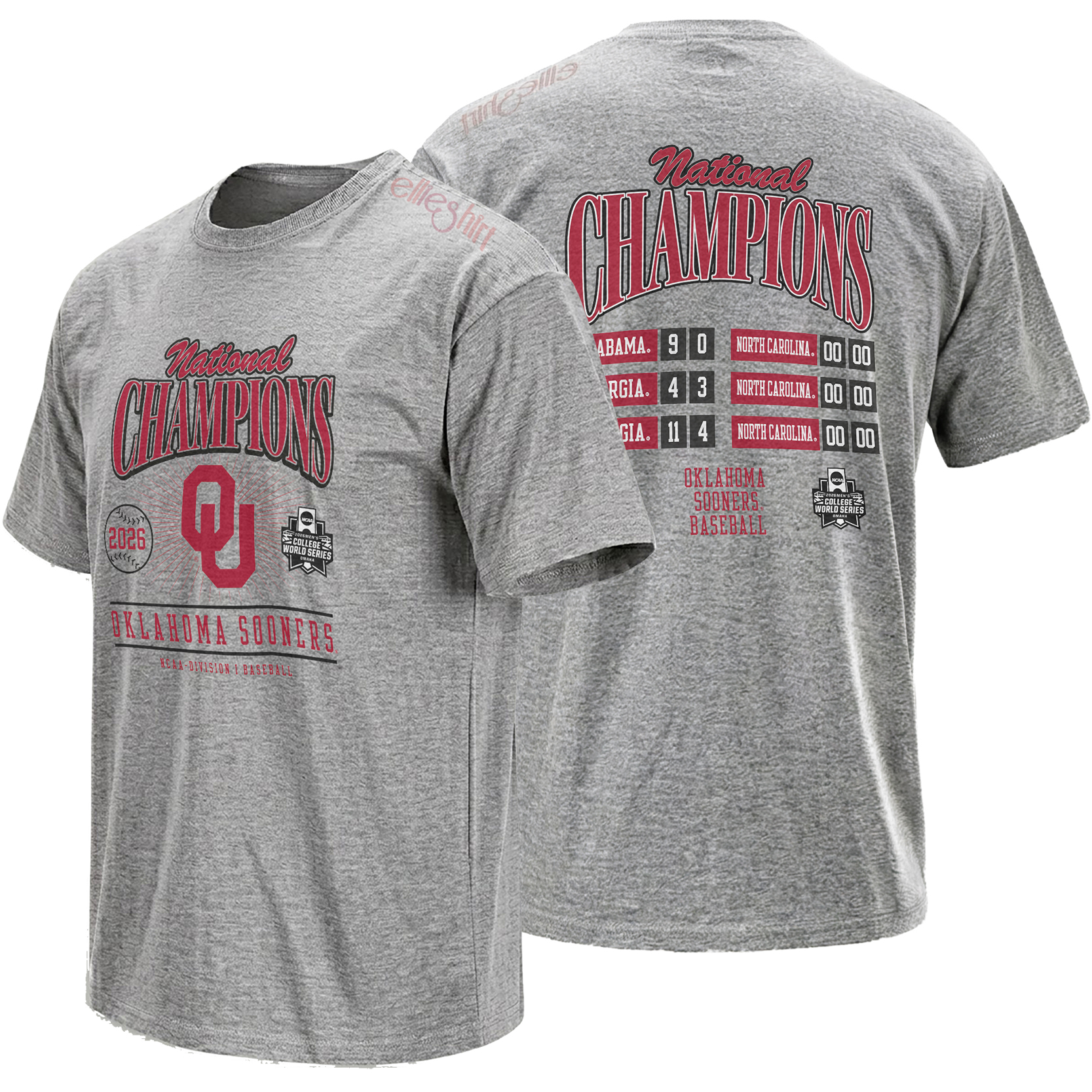
The 2026 National Champions Schedule design divides the title into two editorial functions. The front is the headline. The back is the record.
On the front, “National Champions” carries the dominant visual weight. The arched lettering echoes the language of collegiate athletic departments, locker-room apparel and old tournament programs. Oklahoma’s interlocking mark sits below the title, surrounded by the year and College World Series imagery.
The back enlarges the championship declaration but then adds the feature that gives the piece its identity: the Omaha results. The opponents and scores turn the composition into something closer to a commemorative scorecard than a standard title graphic.
Six Games, Six Different Forms of Pressure
A shutout gave Oklahoma the cleanest possible entrance into the College World Series and immediately established that the Sooners had brought championship-level pitching to Omaha.
The one-run victory forced Oklahoma to manage pressure rather than dominate it. In a tournament built on narrow margins, protecting the lead became part of the championship identity.
The semifinal rematch showed that the Sooners could change the texture of a matchup. A close first meeting became a seven-run victory that moved Oklahoma into the finals.
Oklahoma opened the championship series by taking command, creating the sense that its Omaha momentum had carried directly into the final stage.
The loss prevented the run from becoming too clean. It forced the championship into a deciding game and removed every form of protection from Oklahoma’s season.
In the only game where there could be no recovery from defeat, the Sooners produced their largest offensive statement of the championship series and completed the route.
Why the Loss Belongs on the Championship Back
A championship schedule that includes only victories would be easier to read, but it would tell a weaker story. Oklahoma’s loss to North Carolina in the second finals game belongs in the visual archive because it created the emotional conditions of the deciding night.
Before that loss, Oklahoma still had margin. After it, the season became binary. One more win meant a national championship. One more loss meant the College World Series run would be remembered through the opponent’s celebration.
The 2–6 result therefore acts like a hinge on the back graphic. It interrupts the line of victories and makes the 13–2 response feel larger. The title was not awarded to a team that moved through Omaha untouched. It was won by a team that encountered resistance, returned the next day and delivered its most decisive performance when no alternative remained.
The most honest sports archives preserve the interruption as well as the triumph. Oklahoma’s Game 2 loss does not weaken the title story; it explains why the Game 3 response became the defining performance of the run.
The Visual Language of an Old College Scorecard
The heather-grey presentation is essential to the design’s character. Crimson and black sit on the neutral base with the slightly softened contrast associated with old athletic-department apparel, tournament programs and shirts kept through several generations of fans.
The typography also moves between eras. “National” uses a script treatment that feels celebratory and human, while “Champions” appears in tall collegiate lettering with a shadowed outline. The combination creates a visual hierarchy similar to a newspaper sports section: emotional language above, official result below.
On the back, the individual scores resemble blocks from a stadium board or printed bracket. That modular structure gives every game equal physical presence while allowing the championship result to complete the sequence.
Oklahoma’s primary color carries the title, team mark and winning scores, making program identity visible before every detail is read.
The heather ground softens the composition and gives the design the atmosphere of a championship piece already moving into memory.
Opponents and results create a visual rhythm that resembles a tournament ledger, allowing the back to document rather than merely decorate.
Why Fans Remember the Route Differently From the Trophy
Trophies produce a shared memory. Everyone sees the same lift, the same team photograph and the same championship headline. The route produces more personal memories.
One fan may remember the Alabama shutout as the moment belief became serious. Another may return to the 4–3 Georgia game because the tension made every late pitch feel permanent. Someone else may identify the loss to North Carolina as the moment doubt returned.
Schedule graphics allow those memories to coexist. A single score can reactivate an entire evening: where the game was watched, who was in the room, which inning changed the mood and when a fan first began to imagine the dogpile at the end.
In that sense, the back of the design is not simply statistical. It is emotional indexing. Each line offers a way back into the tournament.
From Omaha Bracket to Permanent Oklahoma History
Oklahoma’s 2026 title became the program’s third baseball national championship, connecting the new team with the champions of 1951 and 1994. Those seasons occurred in different media environments, but all three now share the same destination inside the university’s athletic memory.
The difference in 2026 is the speed at which the route became an archive. Scores moved through broadcasts, social feeds, group chats and celebratory graphics while the tournament was still active. By the final out, fans had already been collecting fragments of the run for nearly two weeks.
The wider College Baseball Shirts collection reflects how Omaha produces a different visual language for every fan base: destination slogans, elimination-game memories, championship scores and team-specific interpretations of what it means to arrive.
Within the broader NCAA Shirts archive, Oklahoma’s schedule piece also belongs to the tradition of college sports graphics that preserve not only who won, but the sequence through which a campus, alumni network and fan community experienced the run.
Frequently Asked Questions
Who won the 2026 Men’s College World Series?
The Oklahoma Sooners won the 2026 Men’s College World Series by defeating North Carolina 13–2 in the deciding third game of the championship series on June 22, 2026.
What teams did Oklahoma play during its 2026 Omaha run?
Oklahoma played Alabama, Georgia and North Carolina in Omaha. The Sooners defeated Alabama once, Georgia twice and North Carolina twice while losing one championship-series game to the Tar Heels.
What was Oklahoma’s record at the 2026 College World Series?
Oklahoma finished its Omaha schedule with six games and five victories, including the deciding championship win over North Carolina.
Why is the North Carolina loss included on the championship design?
The loss forced a decisive third game and became an important part of the title narrative, because Oklahoma answered it with a 13–2 championship victory the following day.
What does the front-and-back layout represent?
The front presents Oklahoma’s national championship identity, while the back documents the Omaha opponents and scores that created the title.
Why does the design resemble a vintage college sports piece?
Its heather-grey base, crimson collegiate lettering, outlined typography and scoreboard-style results reference old tournament apparel, athletic programs and commemorative scorecards.
The Oklahoma 2026 National Champions Schedule design preserves both sides of that story, while the broader college baseball archive follows the scores, slogans and Omaha moments that defined the tournament around it.
2026 National Champions Schedule Shirt records the Oklahoma Sooners’ complete Omaha run through a front championship graphic and a back scoreboard featuring Alabama, Georgia and the three-game finals series against North Carolina.