Oil Stolen, Capitalism Secured: The Iraq War Satire Behind a Mock American Victory Poster
George W. Bush, burning oil fields, military spectacle and the complicated legacy of the 2003 invasion of Iraq converge in a provocative piece of political visual culture.
At first glance, the image seems to belong to a patriotic military victory poster. An American flag fills the background. A smiling president appears alongside armed soldiers, a desert tank and an enormous explosion. The typography is metallic, dramatic and deliberately triumphant.
Then the words change the meaning of everything surrounding them: Oil Stolen. Capitalism Secured.
Those four words frame military intervention as a transaction rather than an act of liberation. Their sarcastic force comes from a long-running political argument about American foreign policy, particularly the 2003 invasion of Iraq under President George W. Bush.
The slogan is not an established factual verdict on the invasion. It is an exaggerated criticism, compressing decades of debate about petroleum, war, strategic power and official messaging into the visual language of a victory announcement.
What happened during the 2003 invasion of Iraq?
On March 20, 2003, a United States-led coalition began its invasion of Iraq. The administration of George W. Bush presented the campaign through arguments involving weapons of mass destruction, the threat posed by Saddam Hussein’s government and broader national-security objectives.
The initial military campaign moved rapidly. But removing Saddam Hussein’s government did not produce the swift and stable outcome that early victory imagery suggested.
The war developed into a prolonged and devastating conflict, while the intelligence assessments used to justify it faced increasingly serious scrutiny.
Subsequent investigations found that the prewar assertions about Iraqi stockpiles of weapons of mass destruction were deeply flawed. The Iraq Survey Group did not find the active stockpiles that had featured so prominently in the public case for invasion.
These historical developments matter because the phrase “Capitalism Secured” draws its humor from the gap between official narratives of military success and the political questions that persisted afterward.
Its satirical argument is blunt: what happens when triumphant announcements obscure unresolved questions about a war’s purpose and consequences?
Why did oil become central to arguments about the Iraq War?
Iraq possesses major petroleum reserves, making its oil infrastructure economically important both domestically and internationally. During the invasion, oil installations were also strategically significant military and economic sites.
For critics of the war, petroleum became a symbol of the possibility that strategic and economic interests influenced American decision-making alongside publicly stated security concerns.
That criticism became part of a much wider debate about intervention in the Middle East, the relationship between government and private industry, and the political power associated with access to natural resources.
However, the existence of petroleum interests does not establish that the United States literally invaded Iraq to steal its oil. The distinction between historical evidence and political interpretation is essential.
The phrase “Oil Stolen” is best understood as a deliberately provocative accusation expressed through satire, not as a finding that the slogan itself proves.

The photograph provides a concrete historical contrast to the graphic’s exaggerated language. Oil fields were real locations in the conflict. Soldiers guarded infrastructure, fires burned and petroleum facilities had to be secured.
The political interpretation of those events remains more complicated than any four-word slogan can communicate.
How did Mission Accomplished become a lasting political image?
On May 1, 2003, President Bush delivered a nationally televised address aboard the aircraft carrier USS Abraham Lincoln. Behind him was a large banner reading “Mission Accomplished.”
He announced that major combat operations in Iraq had ended, while also acknowledging that further work remained.
The image became controversial as the war continued. A carefully staged visual of achievement remained associated with an outcome that proved far less conclusive than its triumphant appearance.
That contrast helps explain the humor of the Oil Stolen, Capitalism Secured slogan. It borrows the form of a mission-complete announcement and replaces the conventional language of national victory with a cynical economic punchline.
By presenting economic exploitation as a military victory, the slogan turns the language of patriotic achievement against itself.
The satirical effect depends on recognizing that the speaker is not necessarily endorsing the message. The design imitates the appearance of victorious propaganda in order to question the assumptions underneath it.
The original May 1, 2003 presidential address remains an important primary source for understanding how the administration publicly framed that stage of the war.
Why the poster looks like a military action movie
The graphic does not rely on text alone. Its imagery combines recognizable political history with an intentionally excessive visual treatment.
George W. Bush occupies the central portrait, visually anchoring the composition to his presidency and the Iraq invasion. Behind him, the American flag provides the familiar patriotic backdrop.
A beret-wearing commander, a desert tank and a tactical soldier introduce the language of military cinema and action video games. The commander’s appearance is reminiscent of the General Shepherd aesthetic associated with Call of Duty: Modern Warfare 2, though the graphic operates as a broader military-action collage.
Orange flames make the composition feel explosive, while blue, red and silver chrome-style lettering resembles the bold typography of retro action posters.
Everything visually signals success, domination and spectacle. Yet the text introduces a hostile interpretation of what that success supposedly achieved.
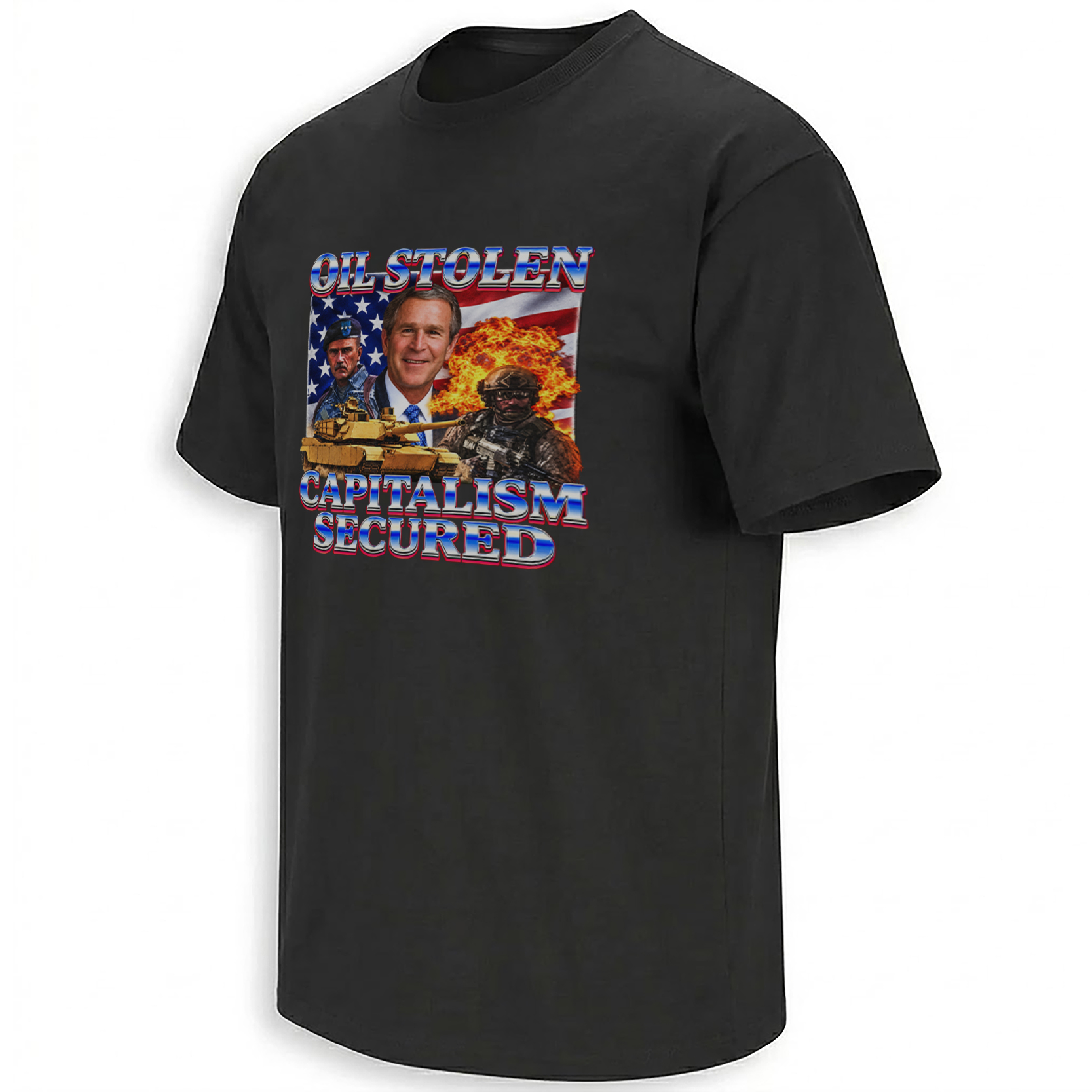
A Bush-era military-action collage uses patriotic visual language to deliver a cynical commentary about oil, capitalism and intervention.
Examine the graphic →The black background helps the imagery resemble a self-contained poster rather than a conventional campaign slogan. It also emphasizes the clash between celebratory presentation and critical meaning.
The design’s commercial appeal is inseparable from that contradiction. Someone who reads the words without understanding the imagery misses part of the joke; someone who recognizes the Bush-era context understands why the poster looks deliberately excessive.
Why war propaganda aesthetics work in political memes
Propaganda often depends on simple visual relationships: a leader, a flag, military strength and a clear declaration of success. Such compositions offer little space for ambiguity because their purpose is to create immediate emotional certainty.
Political parody reverses that process. It retains familiar symbols but changes the message, encouraging viewers to question why the original visual language felt persuasive.
The internet has made this technique especially adaptable. Historical images can be rearranged into mock posters, fictional achievement screens and exaggerated slogans that communicate skepticism before an audience reads a lengthy explanation.
That does not make every provocative graphic a reliable historical account. It makes satire a way of expressing an argument through visual contrast.
The Oil Stolen, Capitalism Secured design uses exactly that method. Its military imagery appears to celebrate an intervention, while its text criticizes the potential economic motives associated with interventionist foreign policy.
Why the Iraq War remains a reference point for political humor
More than two decades after the invasion, the Iraq War remains relevant to discussions about intelligence, executive power, military accountability and the language governments use to justify force.
Its imagery also belongs to a specific media era: televised speeches, desert warfare footage, enormous flags and highly produced declarations of national purpose.
For people who remember those images, a fictional victory poster can recall an entire historical atmosphere. For younger viewers encountering the war through documentaries, archives or political memes, the same imagery becomes a way to explore the arguments surrounding that period.
The EllieShirt Politics collection includes designs that use slogans and recognizable political imagery to express competing ideas about contemporary and historical events.
Readers interested in the specific political figure can also browse George W. Bush-related designs, while the Newest collection provides a broader view of current graphic references.
For this particular design, the enduring context is the history of the Iraq War rather than an independently verified new viral event in October 2026.
Frequently Asked Questions
What does Oil Stolen, Capitalism Secured mean?
It is a sarcastic political slogan criticizing the idea that military intervention serves economic and resource-related interests.
Is Oil Stolen, Capitalism Secured connected to the Iraq War?
Yes. Its George W. Bush imagery and references to American military power evoke debates surrounding the US-led invasion of Iraq in 2003.
Does the slogan prove that America stole Iraqi oil?
No. The wording presents a provocative political criticism, not a conclusively established historical finding.
Why is George W. Bush featured in the design?
George W. Bush was president during the 2003 invasion of Iraq, making his image central to the graphic’s historical and political reference.
What was the Mission Accomplished moment?
It refers to Bush’s May 1, 2003 address aboard USS Abraham Lincoln, delivered in front of a Mission Accomplished banner after the initial invasion phase.
Why does the design resemble military propaganda?
The American flag, troops, tank, explosions and triumphant lettering imitate victory-poster imagery to create an ironic contrast with the critical slogan.
Is Oil Stolen, Capitalism Secured a pro-war or anti-war meme?
Its exaggerated celebration is primarily satirical and can be read as criticizing militarism, economic interests and American intervention.
When the victory poster becomes the criticism
Oil Stolen, Capitalism Secured works because its image and its wording seem to disagree. The imagery celebrates force and national triumph; the slogan suggests a more cynical accounting of what military power might accomplish.
That tension belongs to a long tradition of anti-war satire, where familiar patriotic symbols are rearranged to challenge official narratives.
The poster does not settle the historical arguments surrounding Iraq. Instead, it preserves one recognizable perspective within those arguments, using the visual grammar of military spectacle to question the relationship between warfare, economics and political power.
Oil Stolen, Capitalism Secured is an Iraq War-inspired political satire design featuring George W. Bush, military imagery and retro victory-poster typography. Its provocative slogan reflects longstanding criticism of oil interests, capitalism and American intervention.