Stan for Something: How South Park Turned Stan Marsh Into the Face of STANground
One yellow wristband. One stubborn fourth grader. One motivational campaign so absurd that it became one of South Park’s sharpest jokes about celebrity activism.
Long before every online argument seemed capable of producing its own slogan, merchandise and celebrity spokesperson, South Park had already imagined a boy becoming famous for refusing to remove a wristband.
That boy was Stan Marsh. The episode was A Scause for Applause, which aired on October 31, 2012. What begins as a joke about public disillusionment develops into a remarkably precise parody of how easily personal conviction becomes a marketable identity.
The phrase at the center of the joke is deceptively simple: Stan for Something. Nearly fourteen years later, its meaning remains understandable because the distinction between having a cause and performing commitment to one has hardly disappeared.
What happened in South Park’s A Scause for Applause?
Season 16, Episode 13 opens with an outrageous fictional doping scandal. In the story, the Shroud of Turin becomes evidence in a controversy involving Jesus and performance-enhancing drugs. People who once displayed their loyalty with yellow What Would Jesus Do wristbands begin removing them.
Stan refuses to follow the crowd. He keeps his bracelet, initially making an ordinary personal decision rather than organizing a movement.
But South Park’s residents interpret his refusal as something extraordinary. Instead of allowing Stan’s decision to remain personal, they turn it into a public symbol of courage.
A new phenomenon emerges: STANground, a campaign built around Stan’s name, his supposed principles and the increasingly ridiculous idea of taking a stand simply for the sake of standing.
The cleverness lies in the escalation. A bracelet becomes an identity. An identity becomes a cause. The cause becomes a brand. Eventually, Stan receives the kind of commercial attention normally reserved for famous athletes.

Why did Stan’s bracelet become a movement?
South Park was parodying a familiar cultural pattern: when public figures or organizations become associated with a cause, supporting that cause can become inseparable from displaying its symbols.
The episode draws on the recognizable language of charity wristbands, athletic endorsements and reputation scandals. Its fictional campaign echoes the visual culture surrounding LIVESTRONG-style bracelets, while the doping storyline adds another layer to the joke.
Stan’s problem is that a simple choice gets translated into a grand moral position. The town doesn’t merely admire him for keeping his bracelet. It needs him to become inspirational.
And once the marketing machinery begins, the actual reason for wearing the bracelet becomes almost irrelevant.
Stan becomes a symbol of standing up for something before anyone can establish exactly what that something is.
That contradiction is the episode’s central insight. People can become so invested in demonstrating loyalty that they stop asking whether the campaign still serves its supposed purpose.
What does STAN for Something actually mean?
The wordplay is exceptionally economical. Replace the first four letters of stand with the name Stan, and a familiar motivational phrase suddenly becomes a character-specific commercial slogan.
In the episode’s fictional Nike-style advertisement, Stan is presented as a heroic figure whose central achievement is literally standing. The campaign plays variations on the same idea: STAN for something, STAN up and STAN ground.
Everything about the commercial imitates the emotional grammar of sports advertising: determination, isolation, personal sacrifice, dramatic poses and the promise that conviction makes someone exceptional.
Except the cause is circular. Stan stands because he stands. The seriousness of the presentation makes the emptiness of the message funnier.
That is also why the phrase works without requiring a long explanation. It can appear to be sincere encouragement until the viewer recognizes the South Park character and understands the pun.
The original STANforsomething commercial clip, available through South Park’s clip archive where regional access permits, makes the advertising parody especially clear.
Why Stan Marsh is the right character for the joke
Stan is often portrayed as one of the more grounded children in South Park. Alongside Kyle Broflovski, he frequently reacts to the town’s impossible situations with the confusion or skepticism that viewers themselves might feel.
That reputation gives this storyline an extra comic dimension. Stan doesn’t begin as a cartoonishly ambitious celebrity. The celebrity image develops around him.
His eventual involvement in the campaign also exposes the limits of his supposedly independent stance. South Park allows even its comparatively reasonable characters to become susceptible to recognition and self-importance.
The episode therefore avoids a simplistic division between honest individuals and dishonest corporations. Its target is the entire system that turns belief into publicity, including the people who discover they enjoy being symbols.
This is an important distinction for understanding the character. Stan is neither a straightforward inspirational hero nor merely an innocent victim of marketing. He becomes part of the absurdity.
How the Stan for Something graphic preserves the joke
When a television reference is reduced to a small graphic, every visual choice has to carry meaning. The Stan for Something design succeeds by using a compact cartoon figure and an unusually direct statement.
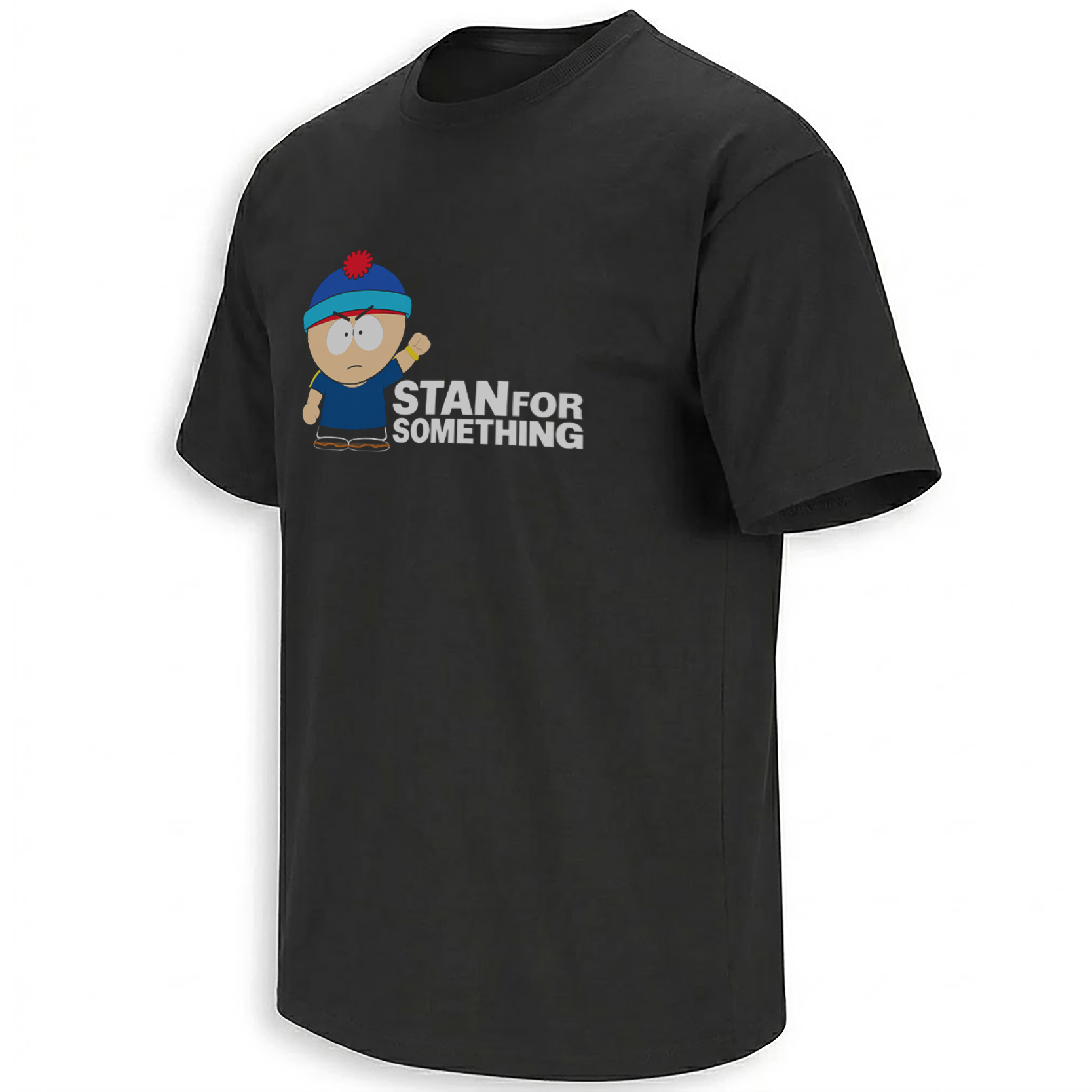
The raised fist, unmistakable winter hat and oversized phrase translate South Park’s fake motivational campaign into a concise cartoon graphic.
View the design →Stan’s blue winter hat, red pom-pom and turquoise trim establish his identity immediately. His raised fist communicates conviction, although the original episode makes that conviction the subject of comedy.
The small yellow wristband is especially significant. Without it, the artwork could be mistaken for a general Stan Marsh portrait. With it, the character becomes connected to the specific STANground storyline.
The bold white lettering has its own role. Set beside the character on a black background, it resembles the uncomplicated typography of a motivational campaign rather than a crowded television poster.
There is no need for a mountain landscape, supporting cast or elaborate frame. The essential ingredients are already present: Stan, the pose and the phrase.
Why this 2012 satire still feels familiar
The episode belongs to a pre-TikTok era, but its ideas translate naturally into today’s internet culture.
Modern online communities still recognize the relationship between causes, visible allegiance, merchandise and celebrity identity. A slogan can communicate belonging as effectively as a long explanation, while a symbol can become detached from the issue that first gave it meaning.
That does not mean STANground was a newly viral 2026 trend. Its contemporary value is as a recognizable piece of South Park history whose central joke remains relevant.
For viewers returning to the episode, the humor has several layers: the pun, the fake sports advertisement, the wristband culture and the increasingly uncomfortable question of whether public commitment is being mistaken for genuine action.
Within EllieShirt’s Pop Culture Characters collection, the design belongs to a wider tradition of graphics that become meaningful when a viewer recognizes the story behind a character.
Readers looking for other South Park references can also follow the South Park product archive or browse Stan Marsh-inspired designs. The real connection is the joke, not simply the character’s presence.
Frequently Asked Questions
What episode is Stan for Something from?
The reference comes from South Park Season 16, Episode 13, A Scause for Applause, originally aired on October 31, 2012.
What is STANground in South Park?
STANground is a fictional campaign built around Stan Marsh after his refusal to remove a wristband turns him into a public symbol of conviction.
What is the Stan for Something joke?
It replaces “stand” with Stan Marsh’s name, parodying inspirational slogans and the commercialization of personal causes.
Why does Stan wear a wristband?
Stan keeps his WWJD wristband after a fictional doping scandal leads other South Park residents to remove theirs.
Is Stan for Something a real motivational campaign?
No. It is a fictional South Park parody of motivational advertising, celebrity endorsements and cause-related branding.
Why is the Stan for Something shirt associated with STANground?
Its raised-fist Stan Marsh artwork, yellow wristband detail and wordplay refer directly to the campaign portrayed in the episode.
The joke that survived its own campaign
At first glance, Stan for Something seems almost earnest. Then the viewer remembers that South Park built an entire fictional movement around a boy who simply refused to take off a bracelet.
That second realization is what makes the reference last. The phrase sounds like a statement of principle, the graphic looks like an endorsement campaign, and the episode reveals how easily both can become a performance.
Stan for Something revisits South Park’s STANground storyline from A Scause for Applause. The Stan Marsh raised-fist graphic captures the show’s parody of wristband activism, motivational advertising and celebrity-driven causes.