Freddy Peralta Hits 99.4 MPH: Fastball Freddy Returns in the 2026 ALCS
A nickname born in Milwaukee in 2018 found a remarkable new chapter in Tampa Bay, where Freddy Peralta used his fastball to overpower Cleveland on October’s biggest stage.
The Cleveland Guardians knew the fastball was coming. So did the crowd at Tropicana Field. Even the pregame introductions made Freddy Peralta’s reputation impossible to miss.
On October 13, 2026, the Tampa Bay Rays right-hander turned that familiarity into an advantage. Facing Cleveland in American League Championship Series Game 2, Peralta delivered six scoreless innings as the Rays earned a 3-1 victory and evened the series at one game apiece.
It was a performance built around his signature pitch. Of 99 total pitches, 71 were four-seam fastballs. One reached 99.4 mph, the fastest recorded pitch of his major league career. Suddenly, the nickname Fastball Freddy sounded less like baseball nostalgia and more like a live scouting report.
What happened during Freddy Peralta’s 2026 ALCS Game 2 start?
Peralta entered the matchup with a simple but dangerous approach: trust the four-seamer, attack the strike zone and challenge a Cleveland lineup that had arrived in the ALCS with postseason momentum.
He allowed four hits and two walks while striking out six. Yet the most striking detail wasn’t his strikeout total. It was how frequently he returned to the same offering without letting hitters control the game.
His four-seam fastball accounted for approximately 72 percent of his pitches, the highest usage rate for that pitch in one of his starts since June 2019, according to MLB’s reporting.
He also reached at least 97 mph on 29 pitches, surpassing the career high of 20 he had established earlier in the postseason against the New York Yankees.
The defining radar-gun reading came in the fifth inning. Cleveland’s Jo Adell fouled off a four-seamer clocked at 99.4 mph, establishing Peralta’s new career high.
This was not merely a veteran throwing hard. It was a veteran returning to the characteristic that first made him remarkable.
Eight years after his Milwaukee debut, Freddy Peralta was still winning with the pitch that gave him his name.
Why is Freddy Peralta called Fastball Freddy?
The origin of the nickname stretches back to May 13, 2018, when a 21-year-old Peralta made his major league debut for the Milwaukee Brewers against the Colorado Rockies at Coors Field.
His family was in attendance for an extraordinary introduction to big league baseball. Peralta struck out 13 hitters in 5⅔ scoreless innings, establishing a Brewers rookie strikeout record.
But it was the pitch distribution that attracted particular attention.
Statcast initially classified 90 of his 98 pitches as four-seam fastballs. That meant approximately 92 percent of his entire outing appeared to come from one pitch type.
Peralta later explained that his fastball had different variations, including movement resembling a cutter. Even with relatively modest early-career velocity, the offering proved exceptionally difficult to square up.
His success was therefore about deception and movement as much as speed. The nickname Fastball Freddy captured his extraordinary reliance on a pitch that hitters theoretically knew was coming.
MLB documented the unusual approach in its 2018 analysis of Peralta’s major league debut.
How Milwaukee’s number 51 became part of his identity
For years, Peralta’s story belonged to Milwaukee. Wearing number 51, the Dominican right-hander developed from an intriguing fastball specialist into one of the Brewers’ most recognizable starting pitchers.
As his career progressed, his arsenal expanded. Sliders and other secondary pitches gave him additional ways to attack hitters, while his fastball remained the signature element connecting his early years to his established identity.
He earned All-Star selections in 2021 and 2025. His impressive 2025 season included 17 wins, a 2.70 ERA and 204 strikeouts.
Those achievements made the fastball nickname familiar well beyond one sensational debut. For Brewers supporters, Peralta #51 became shorthand for a particular era of Milwaukee pitching.

Freddy Peralta wearing a Milwaukee Brewers cap during a July 27, 2025 FanDuel interview. The photograph documents the same Milwaukee playing era represented by the #51 artwork.
Source: FanDuel video still, via Wikimedia Commons. CC BY 3.0; original image unmodified.His Milwaukee chapter ended when the Brewers traded him to the New York Mets in January 2026. Later that summer, the Mets sent him to the Tampa Bay Rays.
That sequence is important to the cultural meaning of the nickname. The 2026 ALCS version of Fastball Freddy is a Tampa Bay pitcher, even though the name became famous during his Milwaukee years.
Why did the nickname come back into focus with Tampa Bay?
Postseason baseball has a way of making familiar player identities feel newly relevant. A nickname that has existed for years can suddenly appear in fresh headlines when a performance perfectly expresses its meaning.
Peralta’s October 13 outing created exactly that connection.
The Rays were facing a Guardians team that had fought its way into the ALCS after a dramatic Division Series comeback against the Chicago White Sox. Tampa Bay needed an answer after losing ALCS Game 1.
Peralta supplied one with a fastball-heavy start. His velocity increased, the pitch generated swings and misses, and the Rays’ bullpen completed the job.
The result created a particularly compelling baseball storyline: a nickname established when Peralta succeeded without extreme velocity now attached to a career-high 99.4 mph reading.
That evolution makes Fastball Freddy interesting beyond one game. His original identity came from fastball movement, deception and unusual pitch usage. His 2026 postseason performance added raw power to the same story.
The official MLB Game 2 feature documents the pitch distribution, velocity milestone and the Rays’ reaction to his performance.
How the radar-gun graphic tells the Fastball Freddy story
Sports graphics often commemorate wins with scores, opponents and dates. The Fastball Freddy design takes a different approach: it translates the pitcher’s signature weapon into a recognizable visual object.
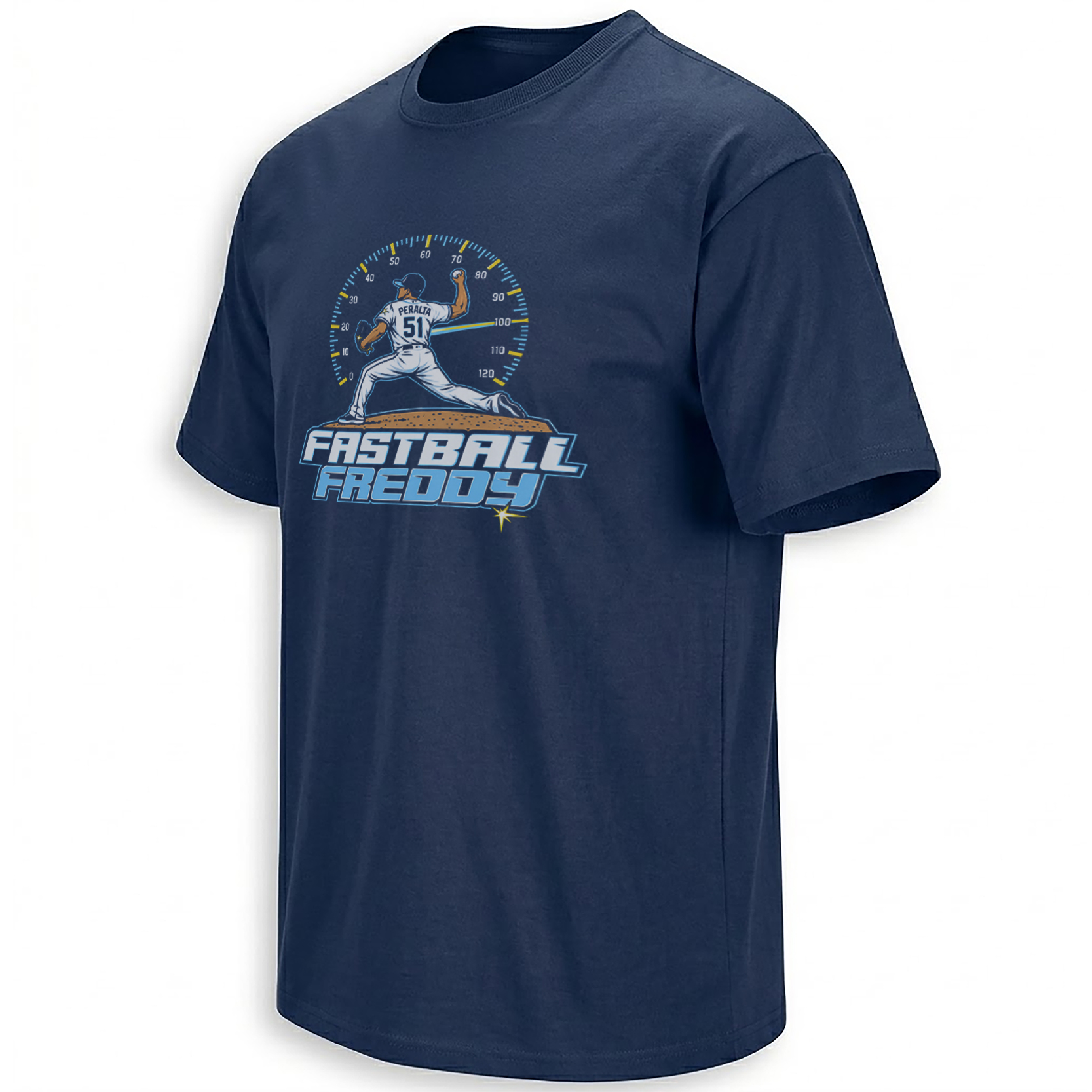
A Milwaukee-era pitching silhouette, circular speedometer, navy background and racing-style typography turn Peralta’s famous nickname into a velocity-inspired graphic.
View the artwork →The illustration shows Peralta from behind in a pitching stride, wearing a white Brewers uniform with PERALTA and 51 across the back. A circular speedometer rises behind him, with blue and yellow markings moving toward a high-velocity range.
The gauge is symbolic rather than a reproduction of an exact Statcast reading. Its purpose is to make the idea of speed immediately visible.
Beneath the illustration, italicized Fastball Freddy lettering gives the design the feeling of a vintage racing poster. The deep navy background and yellow accents preserve a Milwaukee-inspired visual identity.
That artistic choice also distinguishes the historical reference from current team affiliation. This is a Brewers-era portrait of Peralta, not a claim that he was pitching for Milwaukee in October 2026.
One nickname, two baseball chapters
The relationship between Milwaukee and Tampa Bay is what gives the design its unusual timing. The artwork preserves the player who emerged with the Brewers, while the 2026 ALCS has brought the old nickname back into current baseball conversation.
Milwaukee supporters can revisit that history through EllieShirt’s Milwaukee Brewers collection, while his current postseason journey belongs to the Tampa Bay Rays collection.
The broader MLB baseball archive connects player milestones, postseason memories and nickname-driven artwork. Readers seeking other references to the pitcher can browse Freddy Peralta designs.
The crossover matters because baseball identities frequently outlast trades. A uniform changes, but the memory of how a pitcher first became recognizable can remain attached to his name.
Frequently Asked Questions
Who is Fastball Freddy?
Fastball Freddy is the longtime nickname of MLB pitcher Freddy Peralta, who began his major league career with the Milwaukee Brewers in 2018.
Why is Freddy Peralta called Fastball Freddy?
The nickname reflects his exceptional four-seam fastball, particularly the fastball-heavy, 13-strikeout major league debut he delivered against Colorado in 2018.
How fast did Freddy Peralta throw in the 2026 ALCS?
Peralta reached 99.4 mph on a four-seam fastball against Cleveland on October 13, 2026, establishing a new MLB career high.
How many fastballs did Peralta throw in ALCS Game 2?
He threw 71 four-seam fastballs among 99 total pitches, approximately 72 percent of his outing.
Does Freddy Peralta still pitch for Milwaukee?
No. Peralta moved from Milwaukee to the New York Mets in January 2026 and subsequently joined the Tampa Bay Rays in August 2026.
Why does the Fastball Freddy shirt show Brewers number 51?
The design pays tribute to Peralta’s Milwaukee playing era, where his number 51 uniform and famous nickname became closely associated.
Did the Rays win Freddy Peralta’s ALCS Game 2 start?
Yes. Tampa Bay defeated Cleveland 3-1 on October 13, 2026, tying the American League Championship Series at 1-1.
The radar gun has the final word
Few baseball nicknames tell a player’s story as directly as Fastball Freddy. It began with a rookie relying on one remarkable pitch, developed through years of Milwaukee success and found renewed relevance in a high-stakes October matchup.
At 99.4 mph, the fastball acquired another milestone. The uniform in the graphic remembers where the story started; the 2026 ALCS explains why the nickname is being discussed again.
Freddy Peralta’s Fastball Freddy nickname returned to the spotlight when he reached 99.4 mph for Tampa Bay in the 2026 ALCS. This Milwaukee Brewers #51 radar-gun graphic recalls the pitcher whose fastball identity began with a remarkable 2018 debut.