
Guardians’ Knight of the Day: How Austin Hedges Turned a Medieval Tradition Into Cleveland’s Playoff Identity
A spring training night at Medieval Times became a season-long celebration, and Austin Hedges brought the ritual into the Guardians’ dramatic 2026 postseason run.
There was no medieval castle in Cleveland’s clubhouse on October 10, 2026. There was no royal court, no armored cavalry and no ancient battlefield.
There was, however, Austin Hedges holding a ceremonial sword above his head after the Cleveland Guardians completed one of the most dramatic comebacks of the MLB postseason.
Following a 2-0 victory over the Chicago White Sox in Game 5 of the American League Division Series, Hedges gathered his teammates and announced a familiar honor. The night’s new Knight of the Day was Gavin Williams, whose dominant pitching performance had helped Cleveland advance to the ALCS.
It was a peculiar scene, full of theatrical joy. Yet behind the medieval costumes and playful language was a tradition that had grown into a meaningful part of Cleveland’s clubhouse culture.
Why do the Cleveland Guardians have a Knight of the Day?
The story began during spring training in Scottsdale, Arizona. Hedges, the veteran catcher and a central figure in the Guardians’ clubhouse, helped organize a team outing to Medieval Times.
Players dressed as knights and wizards, enjoyed the experience together and brought home a few unexpected souvenirs.
Pitcher Tanner Bibee purchased a knight’s helmet. Kyle Manzardo acquired a ceremonial sword. What might have remained a funny spring training memory instead became the foundation for two connected traditions.
The helmet became a dugout celebration worn after home runs. The sword became part of a postgame recognition ceremony led by Hedges.
Under that ceremony, a teammate who contributed to a Cleveland victory could be announced as Knight of the Day. Hedges typically recounted important moments from the game before presenting the honor.
It was a small but inventive way to make a long baseball season feel like a shared adventure.
Purchased by Tanner Bibee and worn by Guardians hitters after home runs in the dugout.
Purchased by Kyle Manzardo and used by Austin Hedges to recognize an important contributor after a victory.
The distinction matters. The two props belong to the same medieval theme, but the helmet and Knight of the Day title are not identical celebrations.
MLB documented the original Guardians knight-helmet celebration in March 2026, when Chase DeLauter was among its earliest and most frequent recipients.
Why Austin Hedges became Cleveland’s master of ceremonies
Not every important baseball contribution is visible in the box score. A catcher may guide a pitching staff, help younger players prepare or establish a sense of trust that develops over an entire season.
That is part of why Hedges became associated with the medieval celebration. His influence extended beyond his own batting statistics.
In recent seasons, the Guardians had already used a championship-style belt to recognize outstanding contributions following wins. Hedges helped lead that ceremony, bringing the enthusiasm of professional wrestling introductions into the clubhouse.
For 2026, the sword replaced the belt. The symbolism changed, but the underlying purpose remained: recognize someone whose effort mattered to the team.
According to MLB’s October 12 report, the Knight of the Day was not necessarily the player with the most impressive numbers. The honor could go to a teammate whose contribution was especially important or whose effort deserved acknowledgment.
That detail separates the tradition from an ordinary player-of-the-game award.
One player receives the honor, but the ritual belongs to the entire clubhouse.
Cleveland even began keeping a visual record of the recipients on parchment-style sheets displayed inside the clubhouse.
It was a fitting extension of the concept. Instead of allowing each victory to disappear into the schedule, the team created a playful history of the people who helped make it possible.

How the 2026 ALDS comeback gave the ritual new meaning
The Guardians’ medieval celebrations were already established by the time postseason baseball arrived. But the team’s Division Series against the Chicago White Sox created an unusually dramatic setting for them.
Cleveland lost the first two games of the best-of-five series and faced elimination. To survive, the Guardians needed three consecutive victories.
They fought back to force Game 5 at Progressive Field on October 10.
That night, Gavin Williams produced a remarkable outing, striking out 12 White Sox hitters and carrying a no-hit bid into the sixth inning.
José Ramírez supplied the decisive offense with a two-run home run, while Cleveland’s pitching staff combined for 21 strikeouts in a 2-0 victory.
The Guardians completed the series comeback and advanced to the American League Championship Series against the Tampa Bay Rays.
As the team gathered afterward, Hedges raised the sword and named Williams the new Knight of the Day. The celebration transformed a remarkable pitching performance into a shared clubhouse memory.
The difference from an ordinary postgame award was the language. Williams was not simply recognized for winning. He was ceremonially welcomed into the team’s fictional order of knights.
That slightly ridiculous distinction was precisely what made the celebration memorable.
Why Knight of the Day works as a Guardians graphic
The phrase Knight of the Day makes sense only when the viewer understands Cleveland’s medieval storyline. That gives the design a specificity that generic baseball slogans cannot reproduce.
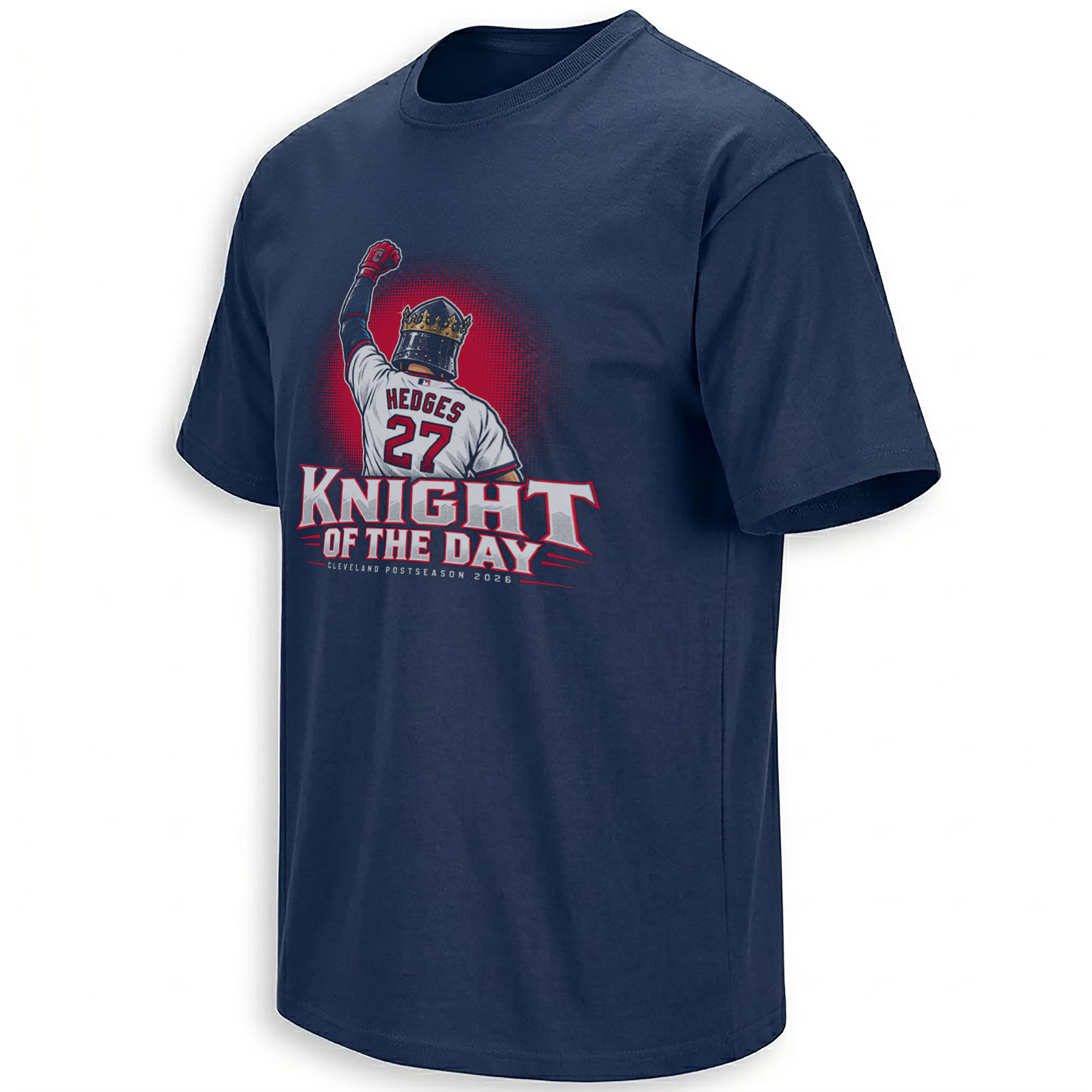
A navy Cleveland postseason design translating the clubhouse’s medieval celebration into a player-centered sports illustration.
Austin Hedges appears from behind in a white Cleveland-inspired uniform, his name and number 27 visible across the back. His raised fist gives the image the feel of a victory celebration.
Instead of a traditional baseball cap, he wears a medieval-style helmet decorated with gold crown details. A red circular halftone background creates a sense of energy behind the figure.
The words Knight of the Day appear beneath the illustration in large white-and-red sports lettering. Smaller text references Cleveland Postseason 2026.
The combination brings two worlds together: professional baseball and the playful storytelling of medieval pageantry.
Strictly speaking, the illustration compresses related traditions into a single visual. The helmet represents Cleveland’s home-run celebration, while the Knight of the Day title refers to Hedges’ postgame sword ceremony.
That combination is an artistic shorthand for the full 2026 Guardians clubhouse identity rather than a depiction of one precise photograph.
Why the Knights of Cleveland captured the team’s personality
Sports rituals are rarely important because of the object alone. Teams have celebrated with jackets, belts, props and elaborate handshakes for years.
What matters is the story players attach to those objects.
For the 2026 Guardians, the medieval theme began as shared spring training entertainment. Over months of games, it developed into something teammates could anticipate, participate in and remember.
The ritual also fit a postseason team whose success depended on collective contributions. Cleveland’s comeback against the White Sox required starting pitching, relief work, timely hitting and the confidence to survive consecutive elimination games.
By the time the Guardians reached the ALCS, their medieval pageantry had become recognizable enough to inspire a fan retelling titled King Vogt and the Guardians of the Round Table, published by the Cleveland baseball site Covering the Corner.
That fan-created story shows how naturally the clubhouse tradition translated into a fictional language of quests, knights and heroic battles.
The official MLB feature on Hedges and Knight of the Day provides the primary account of how the ceremony evolved.
What comes next for Cleveland’s medieval postseason story?
As of October 14, 2026, the Guardians and Rays are tied 1-1 in the ALCS following Tampa Bay’s Game 2 victory.
The outcome of the series remains unwritten. Cleveland’s Knight of the Day ritual, however, has already given the postseason an unusual visual identity.
That memory fits alongside other player-driven moments in EllieShirt’s Cleveland Guardians collection.
The broader MLB collection records different ways teams and their supporters turn baseball events into recognizable graphics, while the Austin Hedges archive offers a player-specific connection.
This design’s appeal is not that it predicts Cleveland’s eventual finish. It records the clubhouse personality of a team that brought medieval theater into one of baseball’s most demanding months.
Frequently Asked Questions
What is Knight of the Day for the Cleveland Guardians?
It is a postgame recognition ceremony in which Austin Hedges honors an important contributor to a Guardians victory using a ceremonial sword.
Who started the Guardians’ medieval celebration?
Austin Hedges organized a spring training visit to Medieval Times, and teammates Tanner Bibee and Kyle Manzardo acquired the helmet and sword that inspired the traditions.
Why do Guardians players wear a knight’s helmet?
The helmet is Cleveland’s 2026 home-run celebration prop, worn by a player after hitting a home run.
Is the knight helmet the same as the Knight of the Day award?
No. The helmet is associated with home runs, while Knight of the Day is a separate postgame honor presented with a ceremonial sword.
Who received Knight of the Day after 2026 ALDS Game 5?
Gavin Williams received the recognition after his 12-strikeout performance helped Cleveland beat the Chicago White Sox 2-0 and advance to the ALCS.
Why is Austin Hedges associated with Knight of the Day?
Hedges is a Guardians catcher and clubhouse leader who developed and regularly leads the medieval-themed postgame ceremony.
What does Cleveland Postseason 2026 mean on the design?
It connects the medieval celebration to the Guardians’ 2026 playoff run, including their ALDS comeback and ALCS appearance.
Every victory deserves its own legend
Austin Hedges did not need a medieval sword to explain why the Guardians cared about winning together. The players had already demonstrated that commitment on the field.
But the sword made it visible. It created a moment for teammates to stop, acknowledge each other and transform an ordinary postgame ritual into a shared story.
That is the lasting meaning of Cleveland’s Knight of the Day. A joke from a spring training outing grew into a clubhouse tradition, and a postseason comeback gave it an unforgettable chapter.
Knight of the Day celebrates Austin Hedges #27 and the Cleveland Guardians’ medieval-themed 2026 clubhouse ritual. Inspired by the team’s knight helmet, ceremonial sword and dramatic ALDS comeback, the design preserves a memorable piece of Cleveland postseason culture.