
Mune, Miggy and Colson Are Strokin’ The South Side Finally Has a Power Trio
Munetaka Murakami, Miguel Vargas and Colson Montgomery have turned consecutive home runs, first-time All-Star recognition and a surprising playoff race into a new language for White Sox baseball.
The sound arrived in three parts. Munetaka Murakami sent the first ball out. Miguel Vargas followed with a 372-foot drive. Colson Montgomery completed the sequence with a 440-foot shot that made the entire inning feel less like a rally and more like an announcement.
Back-to-back-to-back home runs are memorable because they remove the normal pauses from baseball. There is no need to rebuild tension through baserunners or wait for the lineup to turn over. One hitter leaves the batter’s box, another steps in and the same impossible outcome repeats.
For the 2026 White Sox, the sequence provided a visual summary of the team’s changing identity. Murakami represented international star power arriving in Chicago. Vargas represented a young player turning development into All-Star-level production. Montgomery represented the homegrown prospect whose power had finally reached the major leagues.
Three swings turned the White Sox rebuild into something fans could hear: contact, crowd, fireworks — then the entire sequence again.
Why This Trio Changed the Tone Around the White Sox
Rebuilding teams often produce isolated sources of optimism. One prospect arrives, one pitcher develops or one veteran creates an unexpectedly strong month. Those stories matter, but they can still leave the lineup feeling temporary.
Murakami, Vargas and Montgomery changed the scale because their strengths overlap. All three can alter a game with one swing. All three are young enough to belong to the club’s future. Each also arrived through a different route, making the trio feel broader than one development success.
Their production gave Chicago a middle-of-the-order identity. Opposing pitchers could no longer treat the lineup as one dangerous hitter surrounded by recovery time. Power began to appear in layers.
The Night They Went Back-to-Back-to-Back
The April sequence became one of the earliest signs that the White Sox offense could create its own momentum. Murakami began the run, Vargas followed and Montgomery finished with the longest drive of the three.
The order mattered visually. Murakami’s left-handed power created the first shock. Vargas kept the inning alive without allowing the opposing pitcher to reset. Montgomery’s 440-foot finish gave the sequence an exclamation point large enough to survive well beyond the final score.
It was Chicago’s first back-to-back-to-back home-run sequence since 2020, connecting the new trio with an older South Side memory while making clear that this version belonged to a different generation.
The Graphic Treats the Trio Like a South Side Band
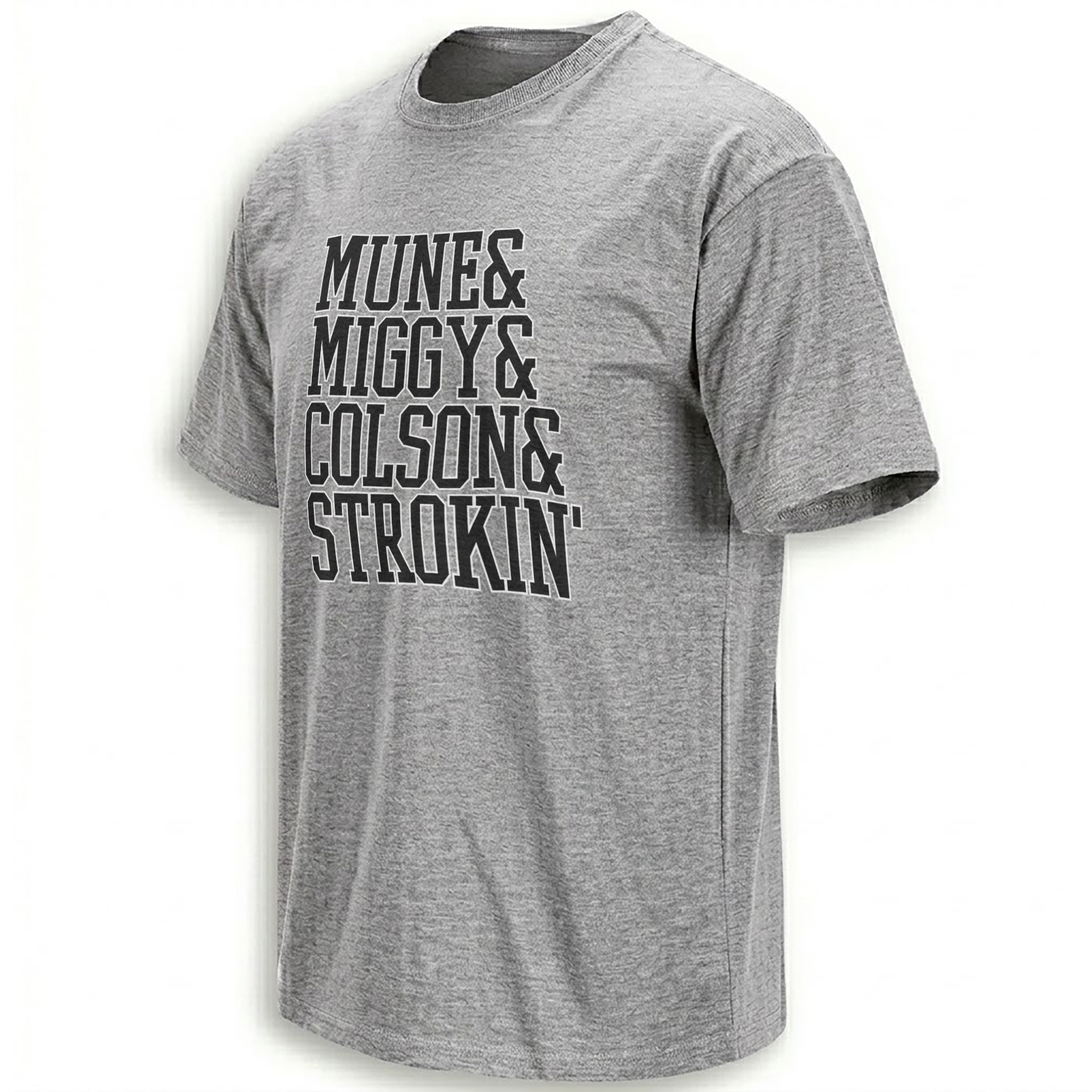
The Mune Miggy Colson Strokin’ graphic uses the rhythm of the names as much as the players themselves. “Mune, Miggy, Colson” reads like an introduction shouted before a performance, while “Strokin’” turns their home-run swings into the shared action that connects them.
Three Players, Three Different Forms of Power
Murakami arrived from Japan carrying elite home-run history and immediately gave Chicago the kind of left-handed threat capable of changing a game before the crowd had settled.
Vargas combines power with a broader offensive game, defensive improvement and the steadiness that earned him his first All-Star selection in 2026.
Montgomery brings unusual home-run strength to shortstop, pairing long-distance contact with the defensive range expected from one of Chicago’s former top prospects.
Murakami Made International Expectation Feel Immediate
Murakami did not arrive as an unknown prospect. His record-setting power in Japan had already created an international audience, and Chicago understood that every early at-bat would be measured against enormous expectations.
His response was immediate. The home runs arrived quickly enough to shift the conversation from adaptation to impact. A five-game homer streak, 454-foot blasts and a place in the Derby gave the White Sox a player whose relevance reached far beyond the South Side.
Injury interrupted the first half, but even the absence revealed his importance. Chicago’s offense was discussed through the question of how Vargas, Montgomery and others could replace the power temporarily removed from the lineup.
Vargas Became the Team’s Most Complete Breakthrough
Vargas entered 2026 with talent that had not yet settled into one clear major league identity. His White Sox season gave the skills structure. He controlled the zone, added meaningful power, improved defensively and became one of the most productive third basemen in the American League.
The All-Star selection validated the transformation. Vargas was no longer being discussed only as a former prospect or part of a transaction. He had become a player chosen by his peers to represent the club.
His All-Star Game home run extended the story. The South Side’s “Miggy” did not merely attend the event; he supplied another national image for a season already defined by his arrival.
Montgomery Gave the Trio Its Homegrown Foundation
Montgomery’s path carried a different emotional weight because White Sox fans had watched the entire development arc. He had been drafted by Chicago, struggled in the minors, returned to Arizona for a reset and rebuilt his swing before reaching the majors.
His rookie power in 2025 established that the changes were real. His 2026 production showed that the first run had not been a temporary surprise. Even with swing-and-miss risk, his combination of shortstop defense and home-run strength gave the organization a rare profile.
Within the trio, Montgomery serves as the link between years of prospect patience and the current team. Murakami arrived from international stardom. Vargas arrived through another organization. Colson grew inside the White Sox system.
“Mune, Miggy and Colson” sounds personal rather than corporate. The shortened names reflect how fans speak after seeing the same hitters repeatedly change games, while “Strokin’” connects them through one shared motion.
South Side Baseball Needed a New Offensive Myth
Chicago baseball culture has always responded strongly to recognizable groups. A lineup feels larger when fans can describe its center through a collective name, shared visual or repeated sequence.
The White Sox had spent recent seasons surrounded by frustration, roster turnover and the emotional fatigue of rebuilding. The trio offered a more direct reason to watch. Any one of the three could create the loudest moment of the night, and their appearances often arrived close enough together to build anticipation.
That change matters even before the final standings are settled. Fan culture does not wait for a completed five-year plan. It reacts when the team finally produces an image worth preserving.
From Rebuild Language to a Playoff Conversation
The 2026 White Sox entered the summer in a position few expected after the difficult seasons that preceded it. The club had played meaningful baseball, remained within the Wild Card conversation and produced multiple first-time All-Stars.
That does not erase the uncertainty around a young team. Injuries, strikeout rates and pitching depth can change the second half quickly. But the cultural direction is already different.
Chicago is no longer asking fans to imagine a lineup built around future power. Murakami, Vargas and Montgomery have already occupied the same inning, the same scoreboard and the same visual archive.
The Artwork’s Bootleg-Slugger Energy
The graphic avoids the polished symmetry of a formal team poster. Player images, oversized names and compressed spacing create a bootleg-style composition closer to a neighborhood tee or concert lineup.
Black, white and restrained red preserve the White Sox identity without forcing every visual element through an official logo. The result feels fan-created: a response to what the three hitters did rather than a campaign prepared before the season.
That distinction gives the artwork value as a timestamp. It records the stage when Chicago supporters first began viewing the trio as one unit rather than three separate roster stories.
The Wider Baseball Archive
The broader MLB collection follows the same culture across baseball: nickname trios, rookie arrivals, consecutive home runs, All-Star breakthroughs and the phrases fans use when a lineup develops its own personality.
Baseball’s long schedule continually breaks teams apart into individual statistics. Graphics like this perform the opposite task. They reunite the players into the emotional unit fans believed they were watching.
Frequently Asked Questions
Who are Mune, Miggy and Colson?
The names refer to Chicago White Sox hitters Munetaka Murakami, Miguel Vargas and Colson Montgomery.
Did the three White Sox hitters go back-to-back-to-back?
Yes. Murakami, Vargas and Montgomery hit consecutive home runs during a White Sox game in April 2026.
Why does the design use the word “Strokin’”?
The phrase refers to the trio’s powerful swings and turns three individual hitters into one shared South Side slugger identity.
Which members of the trio became 2026 All-Stars?
Miguel Vargas and Munetaka Murakami were selected for the 2026 American League All-Star roster.
Why is Colson Montgomery important to the trio?
Montgomery provides homegrown shortstop power and connects the White Sox prospect-development process with the current major league lineup.
The Mune Miggy Colson Strokin’ graphic preserves the power trio through fan-language typography, while the wider MLB visual archive follows the lineup combinations and breakout swings that define each baseball season.
Mune Miggy Colson Strokin’ Shirt turns Munetaka Murakami, Miguel Vargas and Colson Montgomery into a unified Chicago White Sox power graphic inspired by their back-to-back-to-back home runs and 2026 South Side breakthrough.