Kyle Schwarber Did Not Win the Derby But Philadelphia Still Got Its Schwarb Run
Thirty home runs across three rounds, eleven in the final and a stadium growing louder with every swing turned Kyle Schwarber’s runner-up finish into one of the defining images of Philadelphia’s 2026 All-Star Week.
Citizens Bank Park had spent the entire evening waiting for the sound. Not simply the crack of Kyle Schwarber’s bat, but the roar that would follow when one of Philadelphia’s most recognizable power hitters sent another baseball into the seats during a Home Run Derby staged in his own stadium.
By the final round, the event had stopped feeling neutral. Schwarber had survived the opening stage, eliminated former Cubs teammate Willson Contreras in the semifinal and arrived one round away from giving the home crowd the conclusion it had imagined all night.
He then hit 11 home runs in the final. The first left the bat at 109 mph and traveled 444 feet. Six of his first eight swings left the yard, and every successful launch pushed the stadium closer to a celebration that appeared inevitable.
Schwarber lost the trophy by one home run, but the night still belonged to the relationship between his swing and the city waiting to explode behind it.
The Final Was Designed Like a Philadelphia Sports Tragedy
Philadelphia sports memory rarely separates joy from tension. Even the most beloved victories seem to require a moment when the outcome feels vulnerable, when the crowd must decide whether to believe louder or prepare for another painful ending.
Schwarber’s final round created exactly that structure. Eleven home runs looked large enough to survive. Jordan Walker began slowly enough to make the lead feel secure. The stadium had already started imagining Ryan Howard presenting a Liberty Bell-themed winner’s chain to another Phillies slugger.
Then Walker hit six consecutive home runs and reached 12. Schwarber could only watch as a second Home Run Derby final ended with the opposing hitter producing a late sequence strong enough to pass him.
The ending echoed 2018, when Schwarber reached the final as a member of the Chicago Cubs and lost to Bryce Harper at Nationals Park. In 2026, the roles around him had changed — Harper was now his Phillies teammate, Philadelphia was now Schwarber’s home and Citizens Bank Park was now the crowd pulling for him — but the final result still arrived one home run beyond his reach.
Thirty Home Runs Made the Run Larger Than the Result
Schwarber missed on his first five swings, then found his timing and hit four consecutive home runs before finishing with 10.
He edged Willson Contreras 9–8, surviving when Contreras popped up on the final swing with one home run needed to tie.
Schwarber opened with six homers in eight swings and finished with 11 before Walker’s final streak changed the winner.
Across all three rounds, Schwarber hit 30 home runs, averaged 417 feet and reached a maximum distance of 461 feet. Those totals turned his appearance into a full evening of power rather than one failed final.
That distinction matters because Home Run Derby culture has always valued spectacle as much as victory. Fans remember unusual distances, prolonged streaks and the sound a crowd makes when a hometown hitter appears capable of controlling the entire event.
Schwarber gave Philadelphia all of those images. What he did not receive was the last one: the chain around his neck.
Why “Schwarb Run Derby” Is Better Than a Normal Event Name
“Schwarb Run Derby” works because it sounds like language that could only exist around Kyle Schwarber. It modifies the official event name without needing to explain the joke, turning “home run” into the player-specific “Schwarb run.”
Philadelphia has already built an entire vocabulary around Schwarber’s power. “Schwarbomb” is used when the baseball disappears deep into the stands. “Schwarberfest” has described stretches when the home runs arrive repeatedly. The Derby supplied another variation because the entire evening was organized around the expectation that his swing would transform the park.
The wordplay also softens the disappointment of finishing second. A championship graphic would require the trophy. A Schwarb Run Derby graphic needs only the unmistakable combination of Schwarber, Philadelphia and an event filled with balls leaving the yard.
The Graphic Preserves the Hometown Version of the Derby
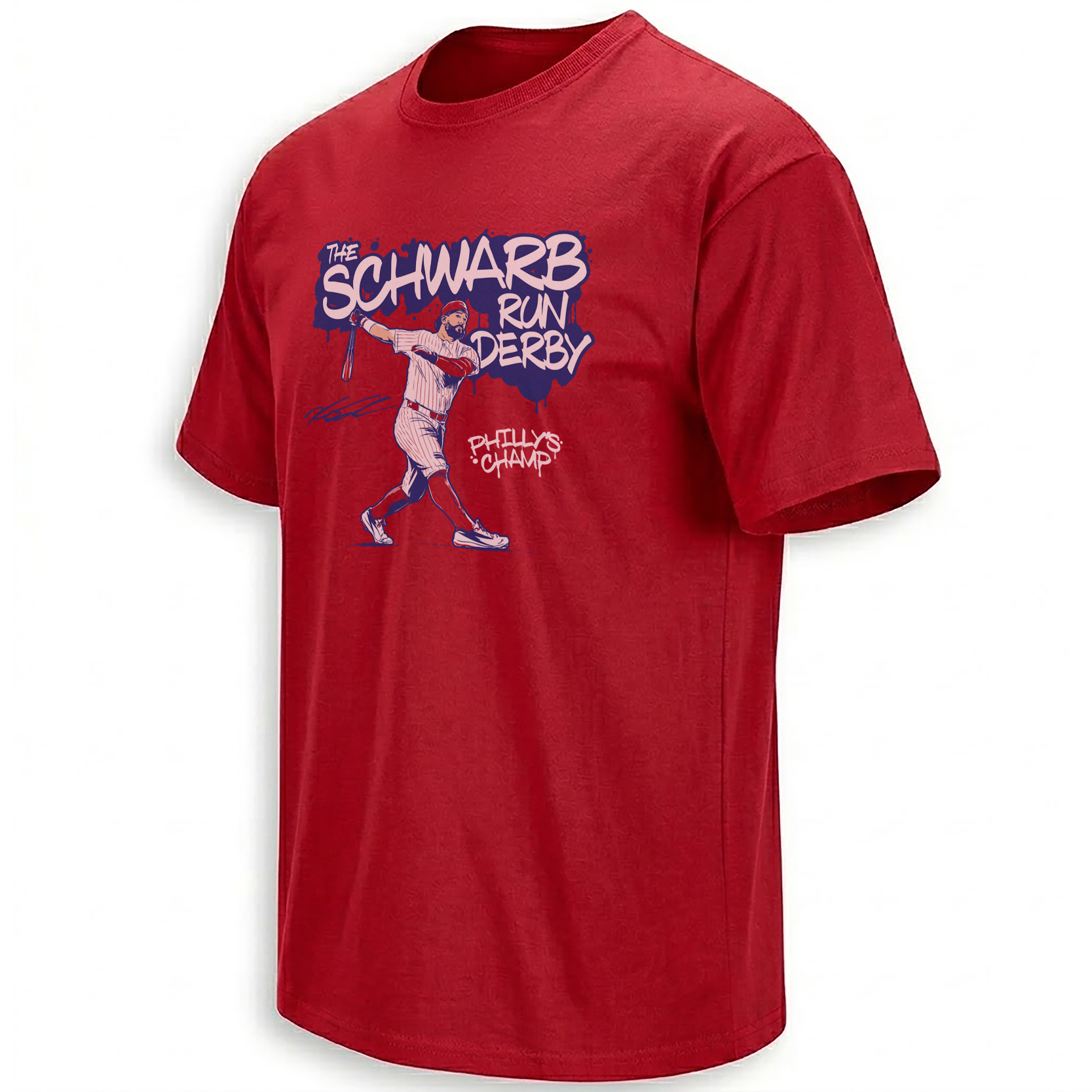
The Schwarb Run Derby Shirt does not need to frame Schwarber as the official champion. Its cultural subject is the run itself: the hitter, the park, the hometown crowd and the expectation of enormous contact.
Reading the Design as a Ballpark Poster
“Schwarb Run Derby” replaces generic competition language with the nickname vocabulary Philadelphia already uses around Schwarber’s power.
The action pose emphasizes rotation, force and follow-through, focusing on the physical act that generated 30 Derby home runs.
Red carries both team identity and the emotional intensity of Citizens Bank Park as the home crowd followed each flight.
The composition resembles an event poster or stadium giveaway, giving one night the visual permanence of an established baseball tradition.
Why Philadelphia Has Adopted Schwarber So Completely
Schwarber’s connection with Philadelphia is not based only on home-run totals. The city responds to players whose public identity matches its emotional style: direct, physical, self-aware and capable of handling the pressure attached to a loud fan base.
His swing supplies the obvious visual. Few hitters make a home run look as forceful or as immediate. But his standing in the city has also grown through postseason moments, clubhouse leadership and the willingness to accept both praise and criticism without pretending Philadelphia is an ordinary baseball environment.
The Derby made that relationship unusually visible. Schwarber said afterward that the crowd had been behind him from introductions through the final swing. He could feel the volume affecting his tempo early, then learned to settle into it as the night continued.
That admission captures the truth of the hometown advantage. The noise can create energy, but it can also create weight. Schwarber had to manage both while trying to win an event built around repetition and rhythm.
The crowd’s reaction resembled a postseason night because the emotional structure was familiar: one beloved hitter, one opposing threat and thousands of people attempting to influence an outcome through volume alone.
The Derby Extended a Season Already Built on Power
Schwarber entered All-Star Week leading Major League Baseball with 32 home runs. His participation therefore did not require fans to imagine whether his power could translate to a Derby setting. The regular season had already supplied months of evidence.
He had also produced a 460-foot home run earlier in the year and continued adding to a Citizens Bank Park total that placed him among the most prolific home-run hitters in the stadium’s history.
The Derby compressed those season-long patterns into one evening. Instead of waiting through four plate appearances for another Schwarbomb, Philadelphia watched the swing repeat every few seconds.
That concentration is what made the event feel almost unreal. Fans were seeing the same familiar power, but without the pauses, pitching changes and game situations that usually control how often it can appear.
Why Runner-Up Can Still Become a Stronger Memory
Championships provide simple stories. The winner raises the trophy, the result enters the record book and every image points toward the same conclusion.
Schwarber’s Derby created a more complicated memory. He was dominant but not first. He delivered the performance the city wanted but not the final score. He produced 11 home runs under maximum pressure and still watched someone else reach 12.
That tension may actually make the night more recognizably Philadelphia. The city did not receive a clean celebration. It received effort, noise, hope and an ending painful enough to be discussed long after the competition.
The design can therefore preserve something a champion-only shirt could not: the atmosphere of nearly winning at home and the feeling that the crowd’s connection with Schwarber became stronger despite the loss.
The 2018 and 2026 Finals Now Form a Strange Derby Pair
In 2018, Schwarber entered the final at Nationals Park and watched Bryce Harper produce a late run to beat him. Eight years later, he reached another final, this time in his own park, and watched Jordan Walker create another closing sequence.
The parallel is unusual enough to become part of Schwarber’s Derby identity. He has twice produced finalist-level power and twice been overtaken at the end by a hitter riding the emotional momentum of the final swings.
Yet the two losses feel culturally different. Harper was the hometown star in Washington in 2018. Schwarber was the hometown star in Philadelphia in 2026. The player who once stood opposite a home crowd had become the player an entire home crowd was trying to push across the finish line.
That reversal demonstrates how completely Philadelphia has become part of Schwarber’s baseball identity.
The Phillies Collection as a Running Power Archive
The wider Philadelphia Phillies collection follows the same emotional vocabulary through player nicknames, postseason memories, clubhouse personalities and the home-run imagery that has defined the current era at Citizens Bank Park.
The broader MLB collection places the Schwarber moment inside the wider culture of Derby nights, All-Star spectacle, city-specific baseball language and performances that remain memorable even when they do not end with the trophy.
Frequently Asked Questions
Did Kyle Schwarber win the 2026 Home Run Derby?
No. Schwarber finished as the runner-up after Jordan Walker defeated him 12–11 in the final round.
How many home runs did Schwarber hit during the Derby?
Schwarber hit 30 home runs across three rounds, including 11 in the final.
Where was the 2026 Home Run Derby held?
The event took place at Citizens Bank Park in Philadelphia, giving Schwarber a hometown crowd throughout the competition.
What does “Schwarb Run Derby” mean?
The phrase replaces “home run” with Schwarber-inspired fan language, connecting the Derby directly to Philadelphia’s “Schwarbomb” culture.
Has Schwarber finished second in the Home Run Derby before?
Yes. He also finished as runner-up in 2018, when Bryce Harper defeated him in the final at Nationals Park.
Why did the runner-up performance matter to Phillies fans?
Schwarber reached the final at his home stadium, hit 11 final-round homers and created a postseason-like atmosphere even though he finished one home run short.
The Schwarb Run Derby graphic preserves the swing, hometown noise and 30-home-run spectacle of Philadelphia’s Derby night, while the wider Phillies visual archive follows the power moments and fan language defining the current era at the Bank.
The Schwarb Run Derby Shirt captures Kyle Schwarber’s 30-home-run performance, 11-homer final and hometown connection with Citizens Bank Park during Philadelphia’s dramatic 2026 Home Run Derby.