
Jordan Walker Walked Through the Boos and Left Philadelphia as Derby Champion
Six consecutive home runs, one swing remaining and a hostile crowd transformed the 2026 Home Run Derby into the night Jordan Walker’s breakout season became national baseball theater.
The crowd at Citizens Bank Park did not need to pretend it was neutral. Kyle Schwarber was the hometown favorite, Jordan Walker was the obstacle, and every swing in the final round carried the emotional imbalance of a road game disguised as an All-Star exhibition.
Walker entered his final sequence needing something close to perfection. He then hit six consecutive home runs, erased Schwarber’s advantage and secured the title with one swing still available. The ending was so clean that it made the tension before it feel almost scripted.
Yet the moment became larger after the baseballs stopped flying. Asked what it felt like to be booed by roughly 40,000 people, Walker answered with the line that immediately escaped the interview and entered fan culture: “You don’t boo nobodies.”
The six home runs won the trophy. “You don’t boo nobodies” explained why the trophy suddenly felt like the beginning of something larger.
The Final Six Swings Changed the Meaning of the Derby
Home Run Derby drama usually comes from quantity. The screen counts balls leaving the park, the clock or swing total creates pressure, and the audience tracks whether the next hitter can survive the arithmetic.
Walker’s final sequence created a different kind of suspense because each home run reduced the event to a single repeated action. Swing, launch, reset. Swing, launch, reset. By the fourth consecutive homer, the crowd could see the possibility. By the sixth, resistance had become part of the spectacle.
The sequence also rewarded the new swing-based format. Walker did not simply accumulate enough total distance over several minutes. He produced a visible run of precision at the exact point when the competition demanded it.
Walker entered the decisive stretch with Schwarber ahead and Philadelphia already prepared for a hometown celebration.
Six straight home runs turned the act of catching up into a sequence fans could count, anticipate and remember.
Walker became the first Cardinals hitter to win the Derby, placing one breakout night into franchise history.
Why “The J-Walk Derby” Works as Championship Language
The phrase “J-Walk” turns Walker’s surname into motion. It suggests confidence, rule-breaking and a path taken without asking permission. Inside the Derby context, it also describes the way he moved through the bracket: past larger names, through the home crowd’s expectations and directly into Cardinals history.
The wordplay gains force because Walker’s win was not passive. He did not survive because another hitter failed dramatically. He created the decisive moment through six uninterrupted swings.
That is why the championship design can function as an artifact rather than a simple announcement. It preserves the nickname fans can attach to the event, not only the official title recorded in the results.
Two Graphics, Two Different Memories of the Same Night
The two Jordan Walker designs divide the Derby into its most important cultural layers. The first records the action and the championship. The second records the quote that converted the action into personality.
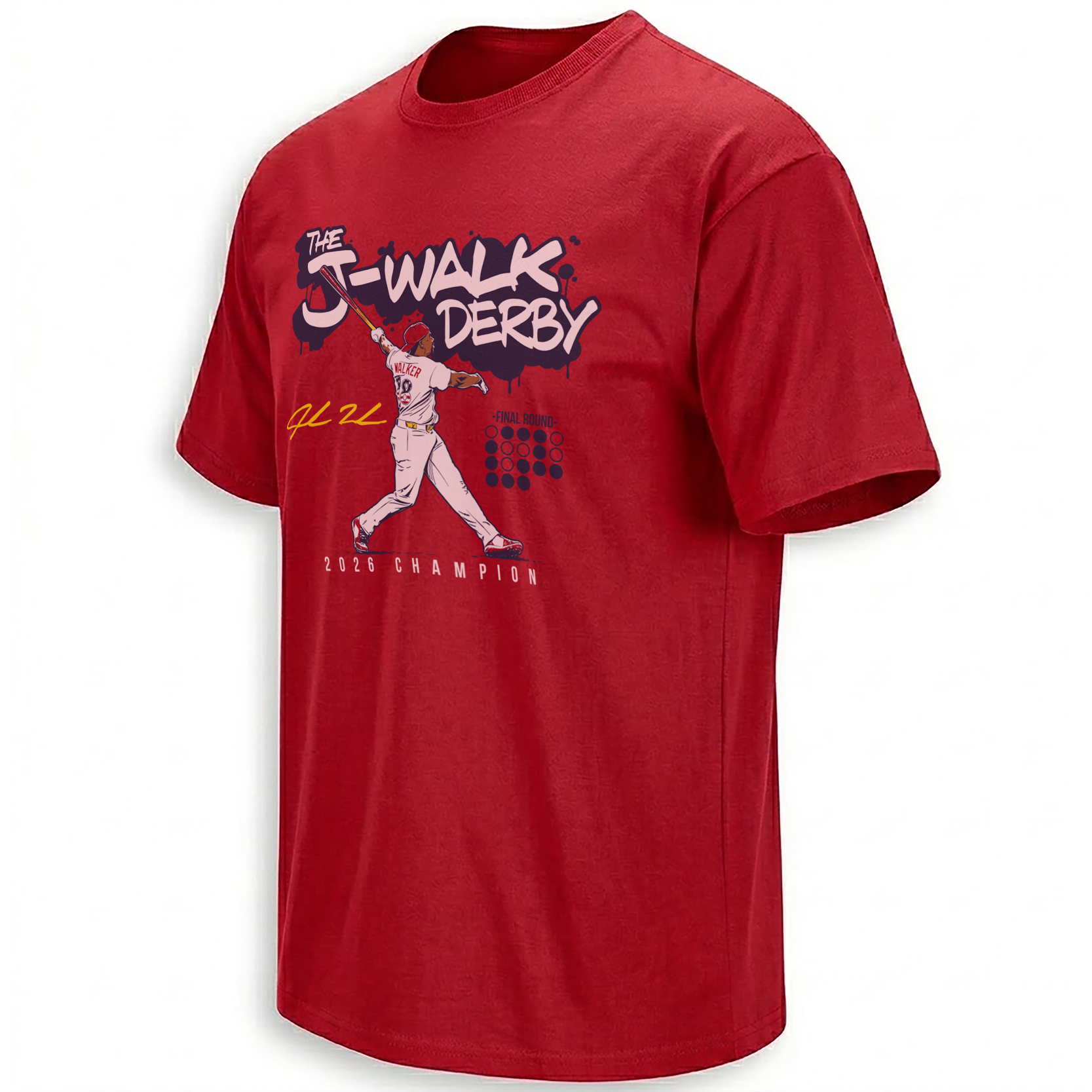
A trophy-night composition built around Walker’s swing, Cardinals color and the championship language created by his six-homer finish.
View the Derby piece →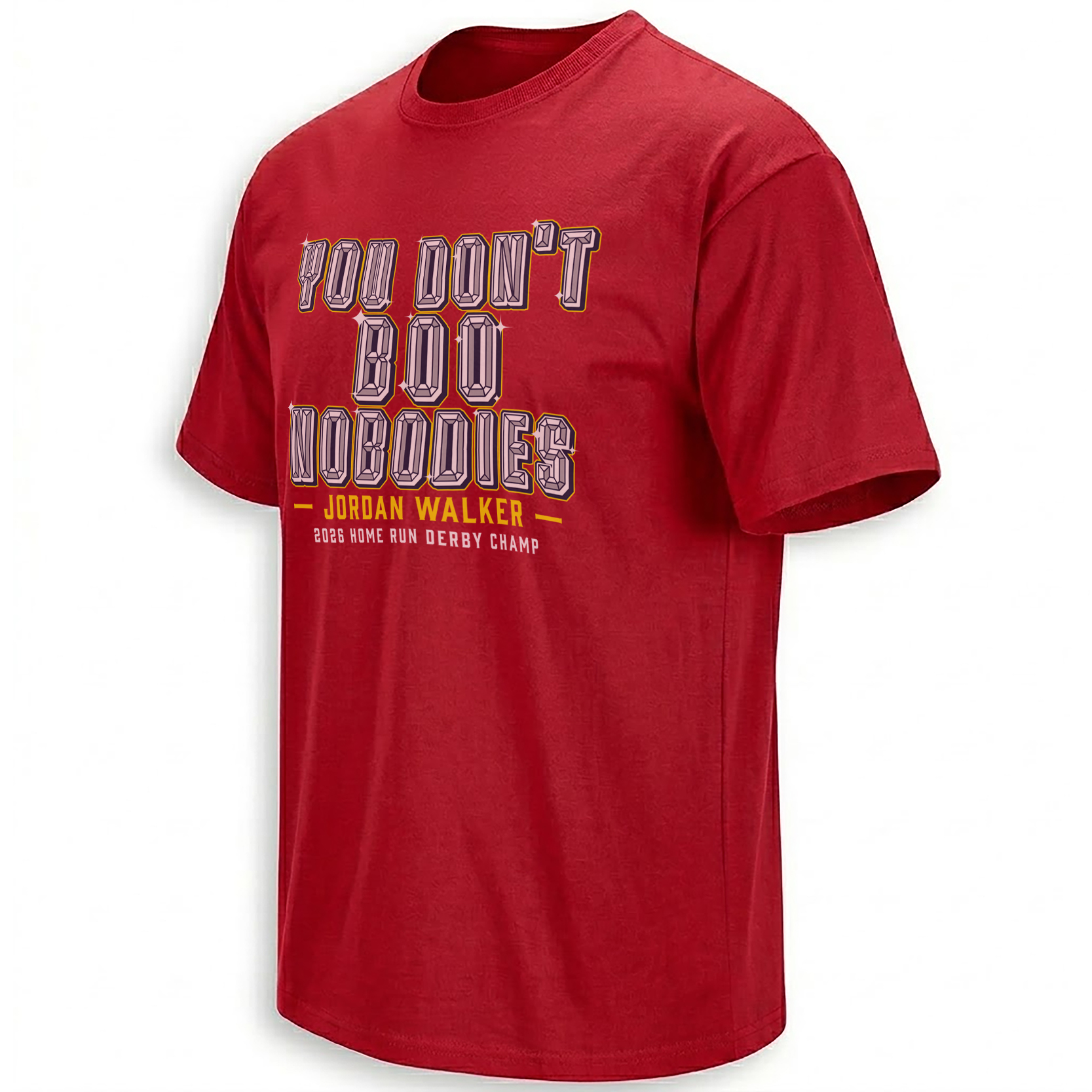
The post-Derby answer becomes the headline, preserving the confidence Walker showed after winning in front of a hostile Philadelphia crowd.
Open the quote design →The Championship Graphic Captures the Physical Event
The J-Walk Derby design centers Walker in the movement that made the title possible. The visual language is celebratory but still athletic: player action, bold championship typography and a structure that resembles an event poster produced immediately after the final swing.
Cardinals red provides the primary emotional signal. It removes the win from the neutral All-Star environment and brings it back to St. Louis, where the significance is not merely that a player won a national competition, but that no Cardinal had done it before.
The composition also allows “J-Walk” to act like an event name. Rather than reading only as Jordan Walker’s personal nickname, it becomes a title for the entire journey through the Derby bracket.
The Quote Graphic Captures the Psychological Event
“You don’t boo nobodies” is effective because it reverses the meaning of hostility. The crowd intends the noise as rejection. Walker interprets it as evidence that he matters enough to resist.
That idea extends beyond one stadium. Athletes are often told to ignore criticism, but Walker’s answer did not deny that he heard it. He converted the sound into recognition.
The graphic therefore operates more like a cultural quote poster than a conventional champion design. The trophy establishes why the line was spoken, while the typography gives the words enough authority to survive after the specific interview clip leaves the immediate news cycle.
The Derby win gave fans the highlight. The quote gave them a caption. Within hours, the phrase could be used for Walker’s breakout season, Cardinals confidence and any situation in which opposition becomes proof of relevance.
Why the Moment Arrived at the Right Point in Walker’s Career
Walker entered professional baseball carrying the expectations attached to elite prospect status. His physical tools were obvious, but his first major league chapters included adjustment, defensive questions and periods in which potential remained more visible than production.
The first half of 2026 changed that relationship. Walker arrived at the All-Star break as one of the National League’s most productive power hitters, pairing home-run strength with run production and the kind of daily presence that makes a young player feel established.
The Derby did not create the breakout. It gave the breakout one unforgettable national image. Fans who had not followed every Cardinals game could understand the season through six swings.
Philadelphia Made the Win More Memorable
A neutral crowd might have applauded Walker’s comeback and moved on. A Philadelphia crowd created a narrative opponent. Schwarber represented the city, and Walker’s success delayed the celebration the stadium wanted.
That tension gave the event the energy of actual competition. The boos were not a side note added afterward; they became part of the soundscape through which the final round will be remembered.
Walker’s answer completed the relationship. The crowd identified him as the obstacle. He accepted the role and treated their hostility as confirmation that he had become important enough to spoil the night.
A New Cardinals Power Memory
St. Louis baseball culture contains generations of power hitters, postseason swings and recognizable red-clad stars. Yet the organization had never produced a Home Run Derby champion before Walker’s 2026 run.
That “first” matters because it gives the current era an accomplishment that does not belong to older championship teams. It is not borrowed nostalgia. It is a new franchise reference point created by a player still building his place in Cardinals history.
The broader MLB collection records similar moments across baseball: breakout players, All-Star spectacle, quote-driven fan language and the single nights that transform seasons into visual memory.
Frequently Asked Questions
Who won the 2026 MLB Home Run Derby?
Jordan Walker of the St. Louis Cardinals won the 2026 Home Run Derby in Philadelphia.
How did Jordan Walker win the final round?
Walker hit six consecutive home runs during his decisive final sequence to overcome Kyle Schwarber and claim the title.
Was Jordan Walker the first Cardinals Home Run Derby champion?
Yes. His victory made him the first player in St. Louis Cardinals history to win the event.
What did “You don’t boo nobodies” mean?
Walker used the phrase to suggest that the Philadelphia crowd’s hostility was evidence that they viewed him as a meaningful threat.
What is the difference between the two Jordan Walker designs?
The J-Walk Derby design emphasizes the championship and swing sequence, while the You Don’t Boo Nobodies design preserves Walker’s post-victory quote and attitude.
The J-Walk Derby championship piece and the You Don’t Boo Nobodies graphic preserve both sides of Walker’s Philadelphia night, while the wider MLB visual archive follows the performances and phrases that become part of baseball culture.
Jordan Walker’s 2026 Home Run Derby designs preserve his six consecutive winning homers, the Cardinals’ first Derby title and the “You don’t boo nobodies” response that transformed Philadelphia hostility into breakout-star confidence.