
The Five Who Brought New York Home: Brunson, Bridges, Towns, Hart and Anunoby’s Championship Road
Jalen Brunson supplied the captain’s scoring and the Finals MVP trophy. OG Anunoby delivered the Game 4 tip-in. Mikal Bridges defended and answered pressure. Karl-Anthony Towns gave New York scale. Josh Hart carried the connective energy. Together, they became the five faces of a championship New York had awaited since 1973.
The New York Knicks did not merely reach the 2026 NBA Finals. They survived a 29-point Game 4 deficit, closed the series in five games and ended a 53-year championship drought that had shaped generations of New York basketball identity.
Jalen Brunson became Finals MVP and the emotional center of the title. Yet the visual memory of the run belongs to a five-man core: Brunson, Mikal Bridges, Karl-Anthony Towns, Josh Hart and OG Anunoby.
They appeared together on the floor, on parade floats and in the city’s championship imagery. Three connected designs preserve that story from different angles: the Finals Five walking as one group, Brunson’s unapologetic MVP back print and the Garden Road Champions moving toward the title together.
Brunson won the Finals MVP. The five-man image explains why the trophy belongs to an entire city rather than one stat line.
Five Different Jobs Created One Championship Identity
Captain, primary creator, closer and Finals MVP.
Point-of-attack defense, length and timely scoring.
Interior size, rebounding and floor-spacing pressure.
Rebounding, transition force and emotional connectivity.
Defensive versatility and the championship-altering Game 4 finish.
The group worked because each player solved a different problem. Brunson controlled the ball. Bridges and Anunoby handled difficult perimeter assignments. Towns changed the geometry of the offense. Hart turned loose possessions into extra chances.
Their strengths were not identical, and that was the point. New York’s five became powerful through combination rather than duplication.
Brunson Became the Name New York Could Finally Place Beside the Trophy
The explicit phrase “Jalen Fuckin Brunson” expresses something polished championship language cannot. It records the release of a city watching a second-round draft pick become the best player on an NBA champion.
Brunson’s size had long been used as an argument against his ceiling. The 2026 postseason converted that doubt into historical comparison. He joined the rare group of smaller guards to lead a championship team in scoring and win Finals MVP.
The phrase is not designed for formal ceremony. It captures the uncontrolled fan response produced when Brunson’s patience, footwork and fourth-quarter control finally ended New York’s 53-year wait.
Three Designs Preserve Three Stages of the Same Road
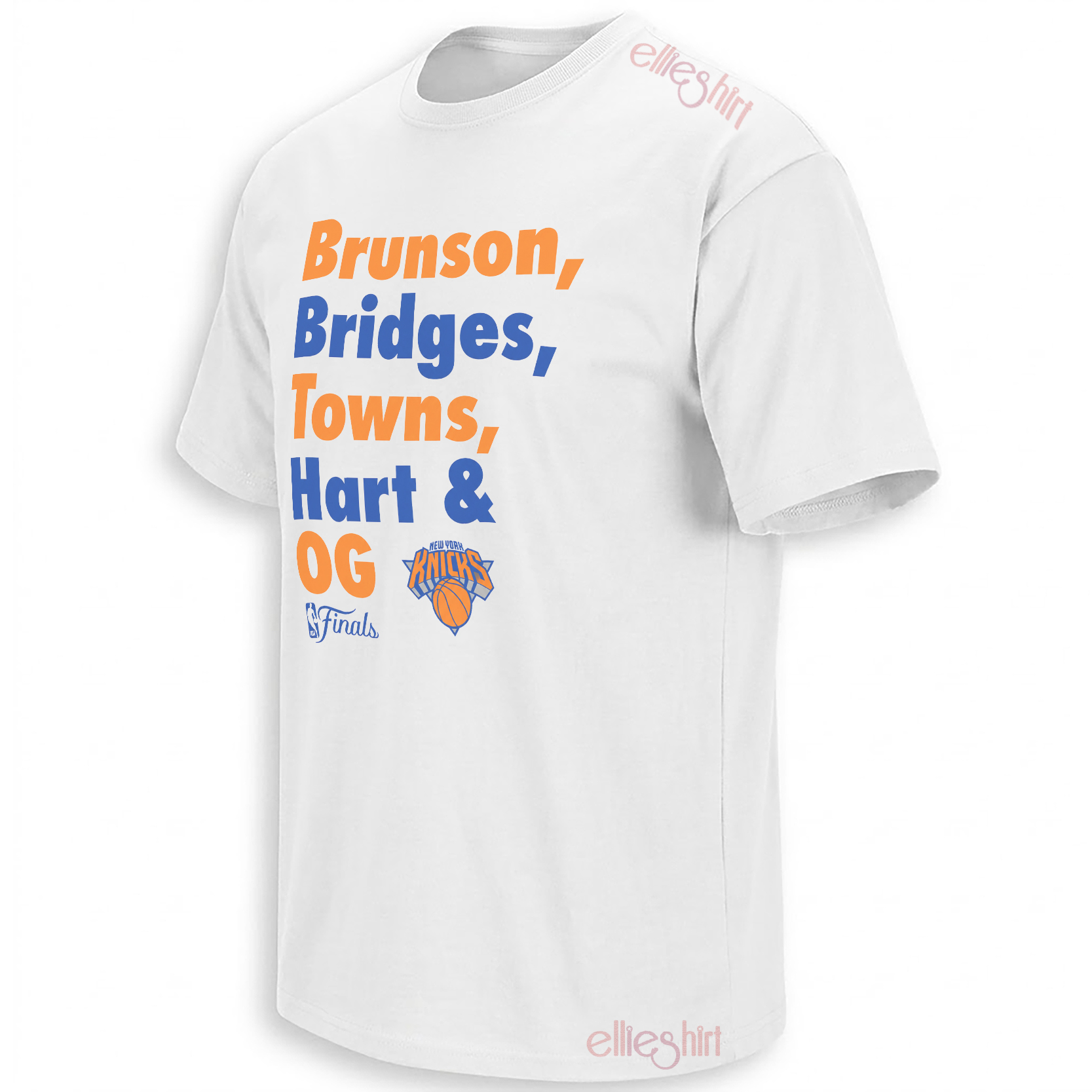
The starting-five image treats Brunson, Bridges, Towns, Hart and Anunoby as one championship unit rather than five isolated stars.
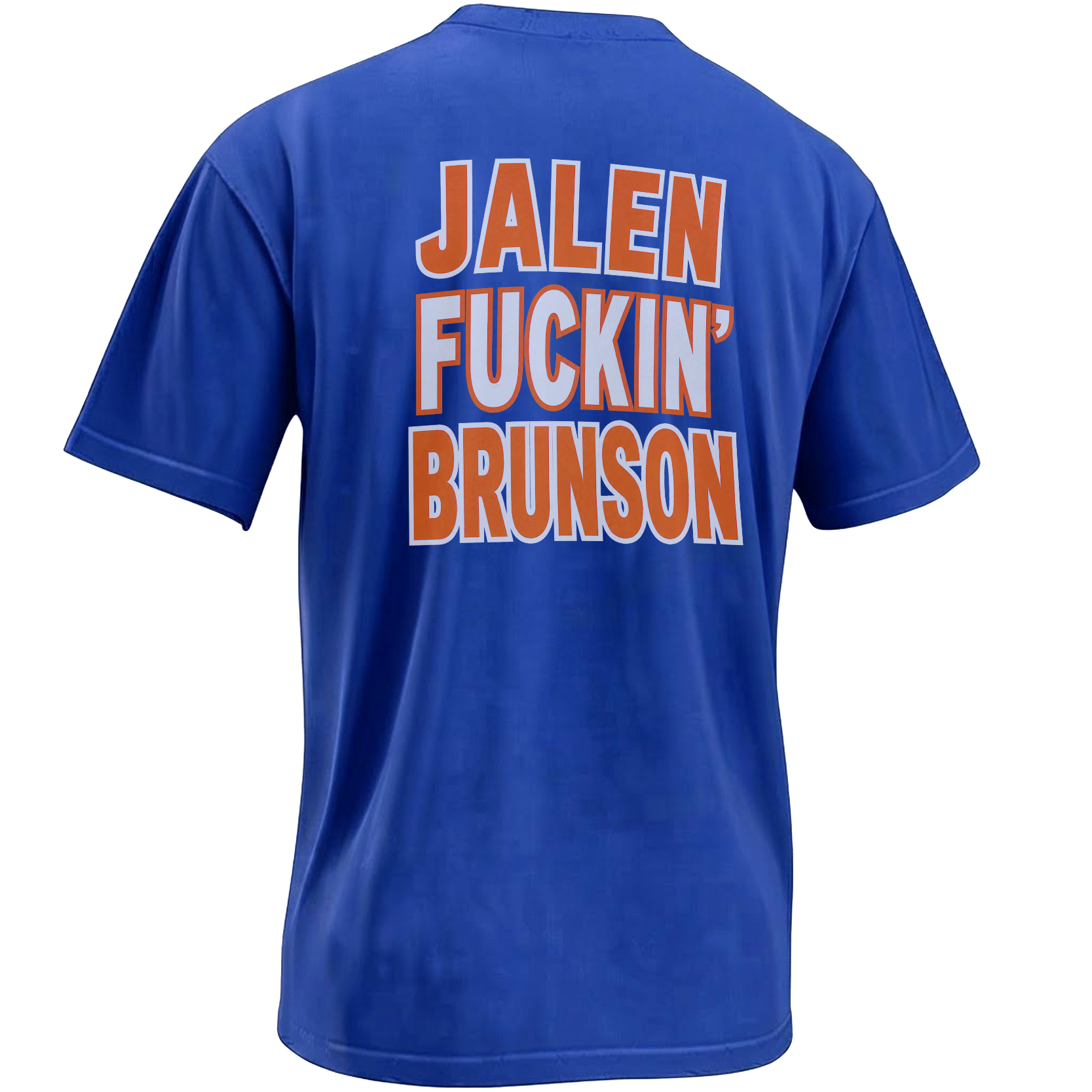
A back-print declaration centered on the captain whose scoring, leadership and Finals MVP run placed him permanently inside Knicks history.
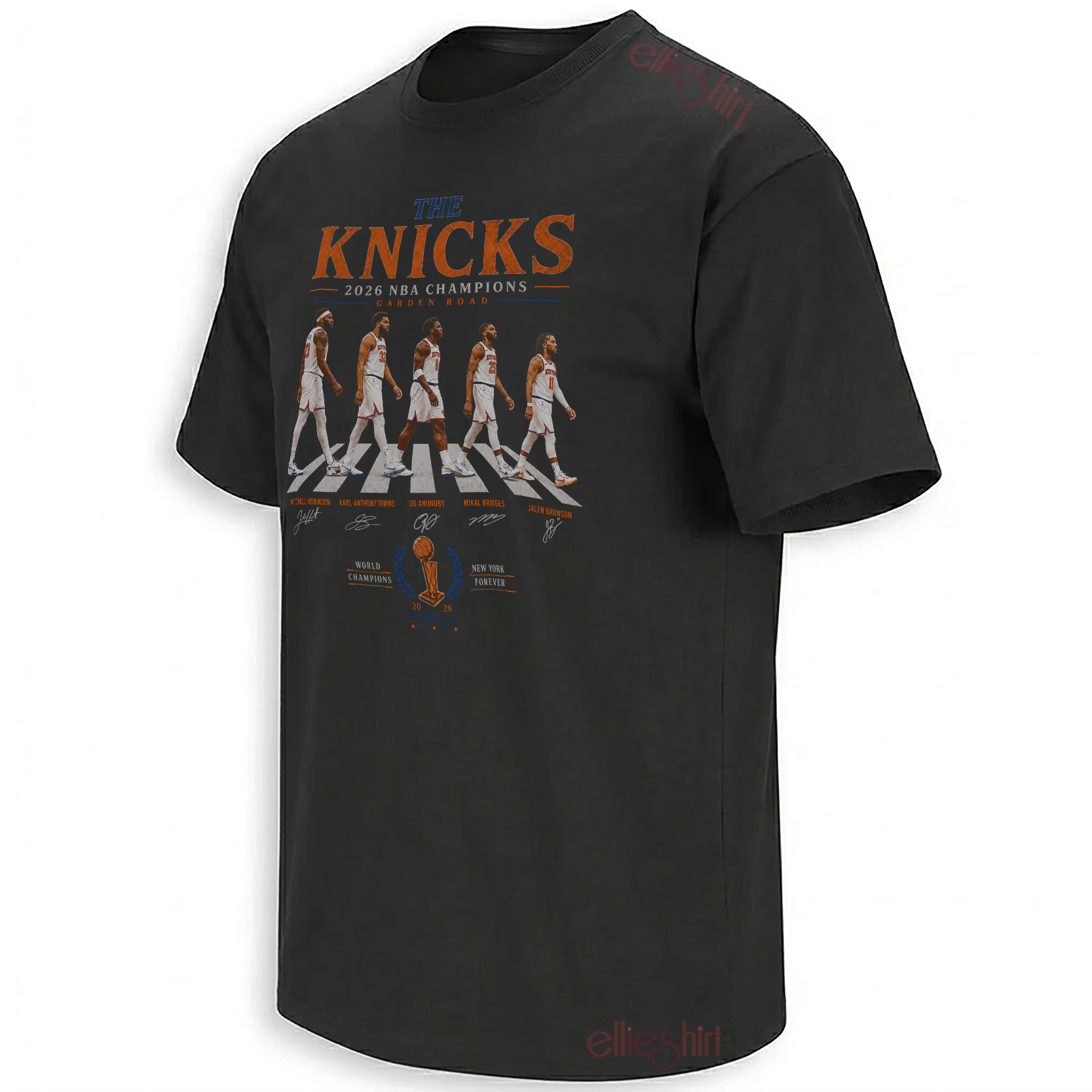
The five-player walking composition turns the championship into a journey from Madison Square Garden pressure to the trophy parade.
Game 4 Turned the Five Into Championship Mythology
The Knicks trailed San Antonio by 29 points in Game 4. A deficit that large normally becomes evidence of tactical failure or exhaustion. New York converted it into the defining comeback of the Finals.
Brunson drove the recovery with 36 points and seven assists. The finish belonged to Anunoby, whose late tip-in completed the reversal and moved New York within one victory of the championship.
That sequence explains why the team-centered graphics matter. Brunson created the pressure. Anunoby supplied the final touch. The other three helped keep the game alive long enough for both moments to exist.
The Walking-Five Composition Turns Basketball Into a Procession
A lineup walking together carries a different emotional meaning from a traditional action collage. Nobody is shown shooting, dunking or celebrating alone.
The image suggests arrival. Five players move in the same direction, their jersey numbers and silhouettes becoming a roster roll call.
After the title, that movement can be read backward and forward. It recalls the road through the playoffs while also anticipating the parade through lower Manhattan.
Bridges’ Championship Completed a High-Risk New York Bet
New York paid a historic draft-pick price to acquire Bridges. That cost followed him through uneven regular-season stretches and every postseason mistake.
The championship changed the argument. His defense, availability and critical plays became part of the evidence that New York’s aggressive roster construction had produced the outcome it was built to chase.
Towns Gave the Core a New Physical Scale
Towns allowed the Knicks to pair size with perimeter shooting. Defenses had to account for a center capable of stretching beyond the arc while still demanding attention around the basket.
His presence changed the visual balance of the five. Brunson remained the controlling figure, but New York no longer looked small around him.
Hart Became the Connection Between Every Version of the Lineup
Hart’s value often appeared between conventional categories. He rebounded above his position, pushed the ball after misses and gave possessions another life.
He also helped make the roster culturally coherent. The friendship and public chemistry surrounding the Knicks gave supporters access to personalities rather than only performances.
Anunoby Supplied the Quietest Style and One of the Loudest Moments
Anunoby rarely performs emotion for the camera. His game is built through positioning, length and efficient decisions.
That restraint made the Game 4 finish even more powerful. The championship-altering tip-in belonged to a player whose importance had always exceeded the volume of his public persona.
The Road Ended at the Canyon of Heroes
The five learned to perform beneath the weight of New York expectation and a drought dating to 1973.
Game 4 transformed a 29-point deficit into the series’ defining emotional victory.
The captain became the official individual face of a collective championship run.
Brunson, Bridges, Towns, Hart and Anunoby carried the completed story into the streets of New York.
Why These Designs Belong Together
The Finals Five graphic identifies the group. The Brunson back print identifies the leader. Garden Road Champions identifies the journey.
Together, they form a compact archive of the title: who carried it, who received the MVP trophy and how the team’s movement toward the championship became a citywide procession.
The collection does not reduce the championship to one buzzer-beater or one final score. It preserves the structure behind the result.
Frequently Asked Questions
Which players are represented as the Knicks Finals Five?
Jalen Brunson, Mikal Bridges, Karl-Anthony Towns, Josh Hart and OG Anunoby form the five-player championship core.
Who won the 2026 NBA Finals MVP award?
Jalen Brunson won Finals MVP after leading New York to its first championship since 1973.
What happened in Game 4 of the Finals?
The Knicks erased a 29-point deficit, with Brunson leading the comeback and Anunoby completing it with the decisive tip-in.
Why does the Garden Road design show the five walking together?
The walking composition presents the championship as a shared journey from roster construction and playoff pressure to the trophy parade.
What does the Jalen Fuckin Brunson design represent?
It captures the unfiltered fan reaction to Brunson becoming the captain, leading scorer and Finals MVP of a Knicks championship team.
How long had New York waited for another NBA championship?
The 2026 title ended a 53-year drought dating to the Knicks’ previous championship in 1973.
The Finals Five, Jalen Brunson MVP and Garden Road Champions pieces preserve three connected perspectives on the Knicks’ 2026 championship.
Knicks Finals Five collection celebrates Jalen Brunson, Mikal Bridges, Karl-Anthony Towns, Josh Hart and OG Anunoby through championship roster art, a Brunson Finals MVP back print and a Garden Road walking-five design.