
Hate ICE, Love Gay Hockey: How Heated Rivalry Turned Romance Fandom Into Protest Language
One word describes the frozen surface beneath hockey skates. The same three letters identify a federal immigration-enforcement agency. “Hate ICE, Love Gay Hockey” converts that collision into a compact political statement shaped by queer fandom, protest signs and the cultural success of Heated Rivalry.
Heated Rivalry became more than a television romance after Shane Hollander and Ilya Rozanov brought a secret relationship between rival hockey stars into millions of homes. The series gave queer viewers a professional-sports fantasy built from ambition, danger, tenderness and the fear that visibility could destroy two careers.
That story found an audience precisely because hockey has historically treated heterosexual masculinity as part of its uniform. The series’ central tension—two elite players who believe nobody can know—felt fictional in plot but recognizable in culture.
By 2026, fans were carrying Heated Rivalry references into political demonstrations. Signs moved the series’ humor away from the rink and into anti-ICE protest language: ice should belong under hockey players, not to an agency associated by critics with detention, deportation and family separation.
The joke works because it gives “ice” one approved use: beneath two gay hockey players whose love story refuses to remain hidden.
One Word Carries Two Completely Different Systems
In hockey, ice is infrastructure. It makes speed possible, carries every cut of the skate and gives the sport its visual identity.
In American political language, ICE refers to Immigration and Customs Enforcement. Critics use “Abolish ICE” and related slogans to oppose the agency’s detention practices, deportation operations and role in federal immigration policy.
The design places those meanings in direct conflict. It rejects ICE as an institution while celebrating ice as the stage for queer hockey romance.
“Hate ICE” is a partisan protest statement directed at the federal agency, not at frozen water, winter sports or hockey itself. The second line resolves the pun by identifying exactly which form of ice the wearer wants to keep.
Heated Rivalry Made Gay Hockey Legible to a Mass Audience
The series follows Hollander and Rozanov from a secret encounter into a relationship stretched across years of professional rivalry. Their public identities depend on competition; their private lives depend on trust.
That structure turns the locker room, hotel corridor and rink into places of surveillance. Desire is not the only source of danger. The possibility of being known threatens sponsorships, teammates, national expectations and the carefully managed image of elite male athletes.
The show’s popularity proved that audiences did not need queer hockey to be softened into a generic romance. They responded to the specific tension between public aggression and private intimacy.
The Graphic Converts Fandom Into a Demonstration Sign
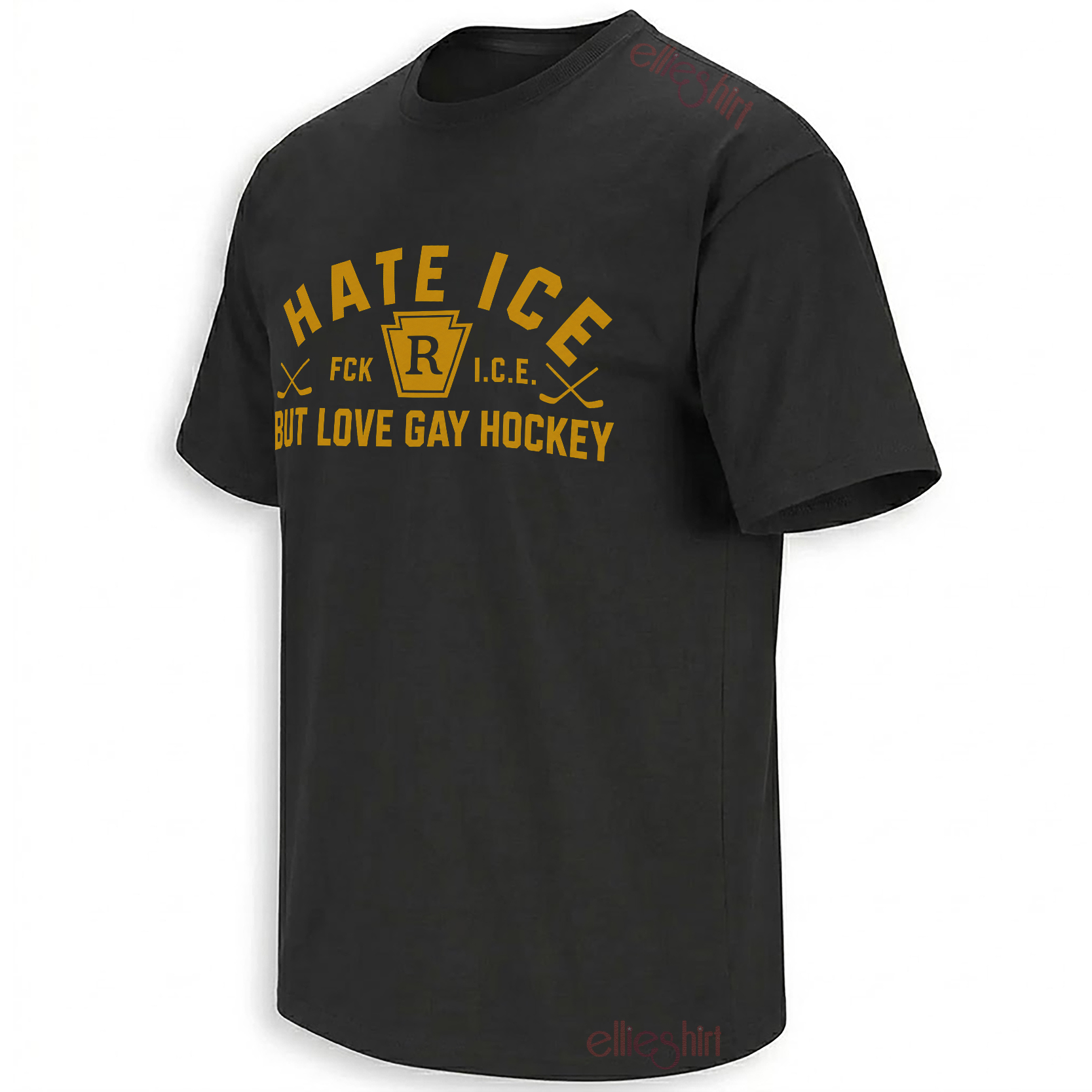
The artwork resembles language designed to be read in motion. The words are large, blunt and immediately divisive: hate on one line, love on another.
That visual hierarchy mirrors protest communication. A sign carried through a crowd has seconds to establish its position. It cannot depend on a paragraph of explanation.
The Humor Does Not Make the Politics Neutral
Wordplay can make a statement approachable, but it does not remove its position. The design is explicitly anti-ICE and explicitly supportive of queer representation.
That clarity matters because fandom merchandise often attempts to remain culturally visible without becoming politically specific. This graphic does the opposite. It assumes that entertainment, identity and state power can occupy the same sentence.
People who recognize Heated Rivalry understand that “gay hockey” refers to a specific romance culture, not a generic sports slogan.
“Hate ICE” places the wearer against the agency and alongside contemporary immigration-rights protest language.
The shirt treats queer desire as something that belongs visibly in sports culture rather than something players must hide.
Hockey’s Culture of Silence Gives the Joke More Weight
Professional hockey has promoted inclusion campaigns, yet the sport remains associated with silence around openly gay male players at its highest levels.
Heated Rivalry dramatizes that silence through two stars who believe public honesty could become a competitive liability. The series therefore operates as fantasy and criticism at the same time.
“Love Gay Hockey” answers that anxiety with deliberate simplicity. It does not ask queer players or stories to prove that they are acceptable. It begins from affection.
Why Fans Carried Fiction Into Real Protest
Popular stories provide language people can borrow when existing political vocabulary feels exhausted. A familiar character or romance can make a demonstration sign more personal and more shareable.
Heated Rivalry offered an especially flexible reference because its story already concerns secrecy, borders, nationality, public identity and institutional pressure.
The anti-ICE pun does not claim the series is about American immigration enforcement. It uses the emotional loyalty created by the show to redirect attention toward a real political dispute.
The Shirt Is Also a Refusal of “Stick to Sports”
Sports fandom is often described as an escape from politics. That boundary has never been complete. National anthems, public funding, labor disputes, gender rules, immigration status and athlete speech all shape the sporting world.
Queer hockey makes that overlap impossible to ignore. The question of who can be publicly loved inside a professional league is already political.
The graphic accepts that reality and places it on the chest rather than pretending the rink exists outside society.
Frequently Asked Questions
What does “Hate ICE, Love Gay Hockey” mean?
It opposes U.S. Immigration and Customs Enforcement while using “ice” as a pun to celebrate queer hockey romance and Heated Rivalry fandom.
What is Heated Rivalry?
Heated Rivalry is a queer hockey romance series about rival professional stars Shane Hollander and Ilya Rozanov and their secret, years-long relationship.
Is the graphic politically neutral?
No. It is explicitly anti-ICE and supportive of LGBTQ+ visibility in hockey and popular culture.
Why does the slogan work as a protest message?
It uses one short word with two meanings, allowing a political position and a fandom reference to be understood in seconds.
How does Heated Rivalry connect to hockey inclusion?
The series dramatizes the fear that elite male hockey players could face career consequences if their same-sex relationship became public.
The Hate ICE, Love Gay Hockey piece preserves the moment Heated Rivalry fandom moved from streaming conversation into visible queer protest culture.
Hate ICE Love Gay Hockey Shirt combines Heated Rivalry fandom, queer hockey romance and anti-ICE protest language in a bold political design built around visibility, resistance and LGBTQ+ sports culture.