
The Knicks Are Champions Again — and 53 Years Just Collapsed Into One Night
New York’s 94–90 Game 5 victory in San Antonio ended one of basketball’s longest emotional waits, transforming a locker-room celebration into a citywide release of memory, disbelief and blue-and-orange joy.
Before the final celebration became champagne, championship caps and a trophy raised above exhausted shoulders, it was still a basketball game refusing to release its tension. New York entered the fourth quarter trailing in San Antonio. The Spurs had controlled long stretches of the night. The title was close enough to imagine, but not yet close enough to touch.
Then the shape of the evening changed. The Knicks outscored San Antonio 29–18 in the final period, Jalen Brunson finished with 45 points, and a 94–90 victory closed the NBA Finals in five games. When the clock reached zero on June 13, 2026, New York had its first NBA championship since 1973.
That gap explains why the reaction could never remain confined to one arena in Texas. This was not only the resolution of a playoff series. It was the end of a story inherited across generations: from fans who remembered the Willis Reed era, to those formed by the heartbreak of the 1990s, to younger supporters who had never seen the Knicks reach basketball’s final stage before this run.
The championship arrived through tension, not inevitability
Championship stories are often cleaned up after the fact. The trophy photos make the path appear orderly, as though the winners were always moving toward the same destination. Game 5 resisted that kind of simplicity.
San Antonio led by as many as 16 points and carried a seven-point advantage into the final quarter. Victor Wembanyama remained a disruptive presence around the rim, while the Spurs played with the urgency of a team trying to send the series back to Madison Square Garden. New York had to recover possession by possession rather than wait for history to arrive on schedule.
Brunson became the center of that recovery. His 45-point performance included 15 points in the fourth quarter, but the importance of the night extended beyond a single scoring total. He gave the Knicks somewhere emotionally stable to stand when the game became uncertain. Every difficult finish, controlled dribble and late-clock decision narrowed the distance between a 53-year wait and a championship present tense.
When Brunson was named Finals MVP, the honor completed a postseason image that already felt deeply New York: a smaller guard repeatedly walking into larger bodies, refusing to surrender the pace or emotional temperature of the game.
Why the locker room became the defining visual
The court delivers the official image: confetti, the Larry O’Brien Trophy and players gathered around the presentation platform. The locker room delivers something less polished and often more revealing. It is where the public performance of competition gives way to disbelief, laughter and the private language of teammates who have survived the same pressure.
That is why championship locker-room graphics carry a particular kind of cultural authority. They borrow from the clothing worn at the exact point when a season becomes history. The design does not need to recreate every possession. Its role is to preserve the emotional afterimage: dark fabric, metallic trophy imagery, blunt championship language and the sense that the wearer has stepped inside the first minutes after the win.
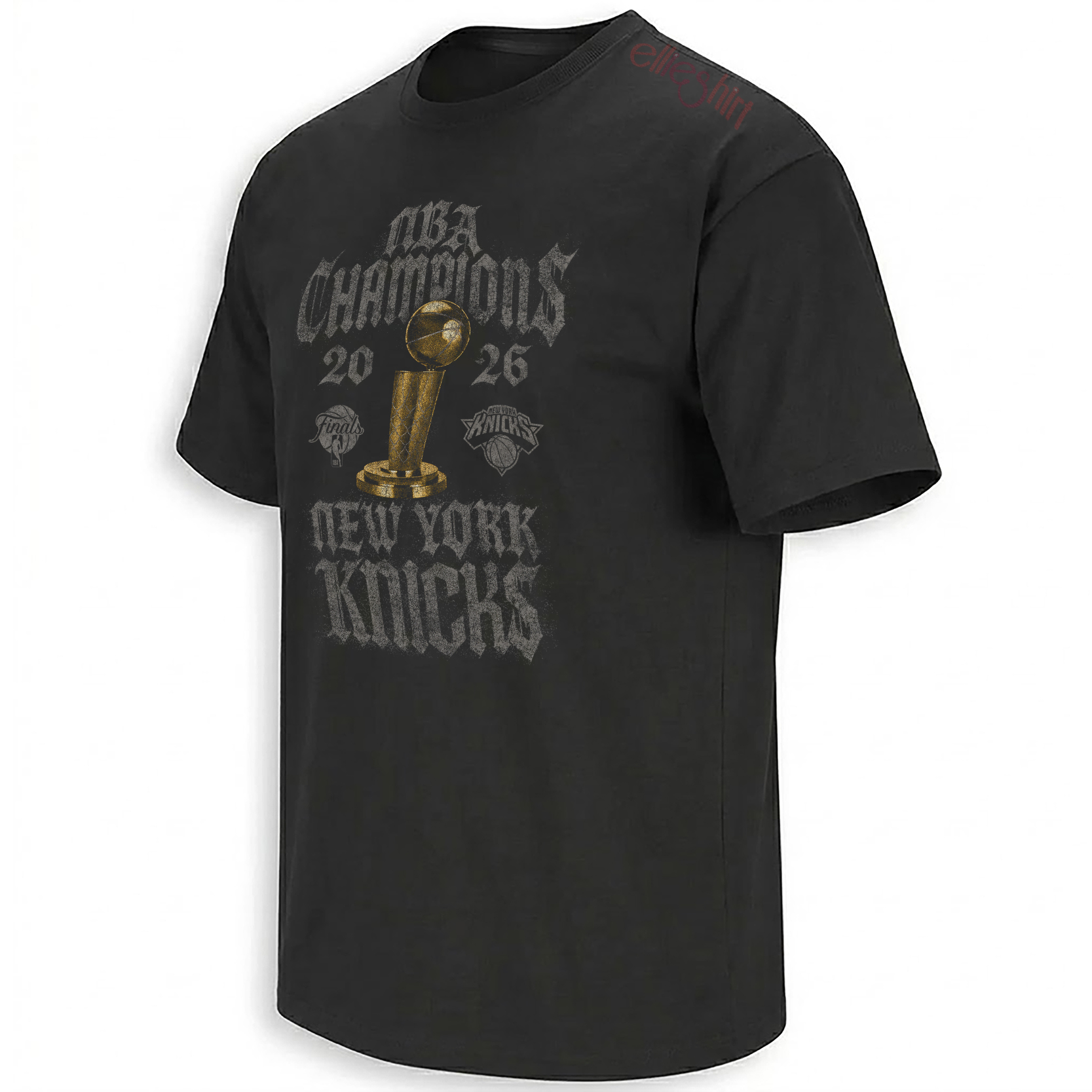
In that context, the 2026 NBA Finals Champions Shirt functions as a visual timestamp of the Knicks’ title night. It belongs to the part of the story after the tension has broken but before the scale of the achievement has fully settled in.
The graphic speaks in the language of earned history
The strongest element of the design is its refusal to look overly polished. The gray lettering is distressed, uneven and deliberately aged. That treatment matters because a 2026 championship does not arrive in New York as a clean new beginning. It arrives carrying the weight of 1973, the bruising playoff identities of the 1990s and decades of jokes, collapses, rebuilds and false starts.
The gothic typography brings a harder streetwear register to the usual championship format. Instead of the smooth geometry associated with corporate event graphics, the letterforms resemble music merchandise, neighborhood bootlegs and commemorative pieces that gain meaning through repeated wear. “NBA Champions” and “New York Knicks” appear less like promotional copy and more like words finally carved into the visual record.
The dark base gives the piece a locker-room and late-night quality, matching the private hours after a title rather than the brightness of a daytime parade.
The trophy is the only warm metallic focal point, allowing the championship itself to cut through the weathered gray typography.
The worn surface makes the graphic feel archived from the moment, echoing the age and emotional mileage of New York’s wait.
The composition is vertically stacked like a concert poster: achievement at the top, trophy in the middle, city identity below. That hierarchy tells the story without requiring a player portrait. The championship belongs first to the collective — roster, city, arena and generations of people who continued to speak Knicks basketball even when the ending remained uncertain.
A championship shared by several versions of New York
For older supporters, the title reconnects the present to the franchise’s early-1970s championship foundation. For the generation shaped by Patrick Ewing, John Starks and the confrontational rhythm of 1990s playoff basketball, it closes a wound that remained culturally active long after those teams disappeared.
For younger fans, the emotion is different. They did not spend 53 years personally waiting, but they inherited the wait through parents, relatives, old broadcasts, arena stories and the constant reminder that New York’s basketball importance had not recently been matched by a championship result.
Those generations met inside the same final buzzer. The celebration belonged to people who remembered 1973, people who remembered 1994 and 1999, and people whose earliest Knicks memories came from seasons when simply imagining this night required an unusual degree of faith.
That is also why the online conversation moved so quickly from analysis to memory. The score mattered, Brunson’s 45 mattered and the fourth-quarter comeback mattered. Yet the dominant emotional question became personal: Who were you when you first started waiting for this?
Across fan spaces, images of the trophy circulated beside family stories, old jerseys, newspaper covers and references to relatives who had passed the team down through generations. The championship became a way to measure time, not only basketball success.
From San Antonio to the streets of New York
The geography of the win added another layer to the night. The championship was secured at Frost Bank Center rather than Madison Square Garden, but the emotional center immediately shifted north. Supporters gathered in New York, blue and orange filled city streets, and the team prepared to return home with the trophy.
Winning away from home did not weaken the city connection. It sharpened it. The court in San Antonio became the place where the result was completed; New York became the place where its meaning expanded.
That movement — from final possession, to locker room, to flight home, to city celebration — explains the power of championship apparel in the first hours after a title. It travels with the event. A graphic seen in one photograph can become part of a parade crowd, a subway ride, a neighborhood bar or a family picture taken years later.
A growing visual archive of the 2026 title run
One design cannot contain every emotional angle of this postseason. Game 4 produced its own language of disbelief, comeback energy and individual heroics. Game 5 transformed that momentum into finality. The parade and celebration will create another set of images again.
The wider New York Knicks Shirts collection works as a running map of those moods, moving from player moments and Finals tension toward the visual certainty of “Champions.” The broader NBA Shirts archive places the run inside the larger culture of playoff slogans, rivalry graphics and moments that outlive their original broadcast.
For pieces centered specifically on the final result, the 2026 NBA Finals Champions collection gathers the different ways New York’s title can be remembered: through the trophy, the roster, city symbolism and the language that took over once the waiting ended.
Frequently asked questions
When did the New York Knicks win the 2026 NBA championship?
The Knicks clinched the championship on June 13, 2026, defeating the San Antonio Spurs 94–90 in Game 5 and winning the NBA Finals series 4–1.
Why was the 2026 Knicks championship historically significant?
It was New York’s first NBA championship since 1973, ending a 53-year title gap that connected several generations of Knicks supporters.
Why is the locker-room visual important to championship culture?
Locker-room imagery captures the first private moments after competition ends. The trophy, championship lettering and dark celebratory apparel become immediate visual markers of the exact night a team’s season turns into history.
What gives the 2026 NBA Finals Champions Shirt its archival feeling?
Its black foundation, distressed gothic lettering and centered gold trophy resemble a weathered commemorative piece rather than a polished event poster, matching the historical weight of New York’s long championship wait.
The 2026 NBA Finals Champions Shirt preserves the title through the visual language of the locker room: dark fabric, worn championship typography and a gold trophy standing at the center of a night New York waited 53 years to reach.
2026 NBA Finals Champions Shirt captures the New York Knicks’ first championship since 1973 through distressed locker-room typography, a gold trophy centerpiece and the emotional release of a 53-year wait.