
New York Waited 53 Years. Then the Knicks Made the Ending Feel Inevitable.
Jalen Brunson’s 45-point closeout, four comeback victories and a citywide release of blue-and-orange emotion turned the Knicks’ 2026 NBA championship into something larger than a final score: the repair of a broken timeline.
New York did not celebrate the 2026 NBA championship like a city discovering success for the first time. It celebrated like a city finally receiving something it had been promised by memory.
On June 13, the Knicks defeated the San Antonio Spurs 94–90 in Game 5 of the NBA Finals, closed the series 4–1 and ended the franchise’s 53-year championship drought. Jalen Brunson scored 45 points, including 29 after halftime, and left San Antonio with the Finals MVP trophy. By the final possession, the night already felt too large for one arena.
Screens filled with the same emotional geometry: Brunson holding the trophy, teammates collapsing into each other, supporters spilling into New York streets, and generations of fans trying to compress 1973, 1994, 1999 and 2026 into a single reaction. The title was new. The feeling behind it had been accumulating for decades.
The Knicks did not simply add 2026 to their history. They changed the shape of that history.
New York’s championship timeline finally moved againThe “Comeback Knicks” Became the Final Identity of the Season
Championship teams are often remembered through dominance: the clean sweep, the wire-to-wire lead, the feeling that resistance was temporary. These Knicks built a different mythology. They became champions by repeatedly looking vulnerable and then refusing to stay that way.
New York trailed by double digits in every one of its four Finals victories. In Game 4 at Madison Square Garden, the deficit reached 29 points before the night turned into the largest comeback in NBA Finals history. OG Anunoby’s late tip-in completed the reversal and sent the Knicks back to San Antonio with a 3–1 lead.
Game 5 followed the same emotional script in a smaller frame. The Spurs built another substantial advantage. Brunson took over after halftime. New York tightened the game possession by possession until the pressure moved entirely onto the younger team trying to extend the series.
That pattern is why “Comeback Knicks” became more than a convenient postseason label. It described the games, but it also described the franchise. The team’s identity mirrored the city’s relationship with it: frustration survived, belief returned and the old ending was finally rewritten.
Why 1970, 1973 and 2026 Belong in the Same Image
Before this season, Knicks championship history could be written with two dates. The 1970 and 1973 teams existed as banners, documentary footage, family stories and grainy photographs of a New York basketball ideal that later generations inherited but never personally experienced.
Those years carried names such as Willis Reed and Walt Frazier, but they also carried a deeper idea: that the Knicks had once represented the center of professional basketball culture. The longer the drought lasted, the more those championships became sacred objects rather than reachable history.
The 2026 title breaks that distance. It gives the franchise a living championship generation and places Brunson’s team beside the heroes who had occupied the rafters alone for more than half a century.
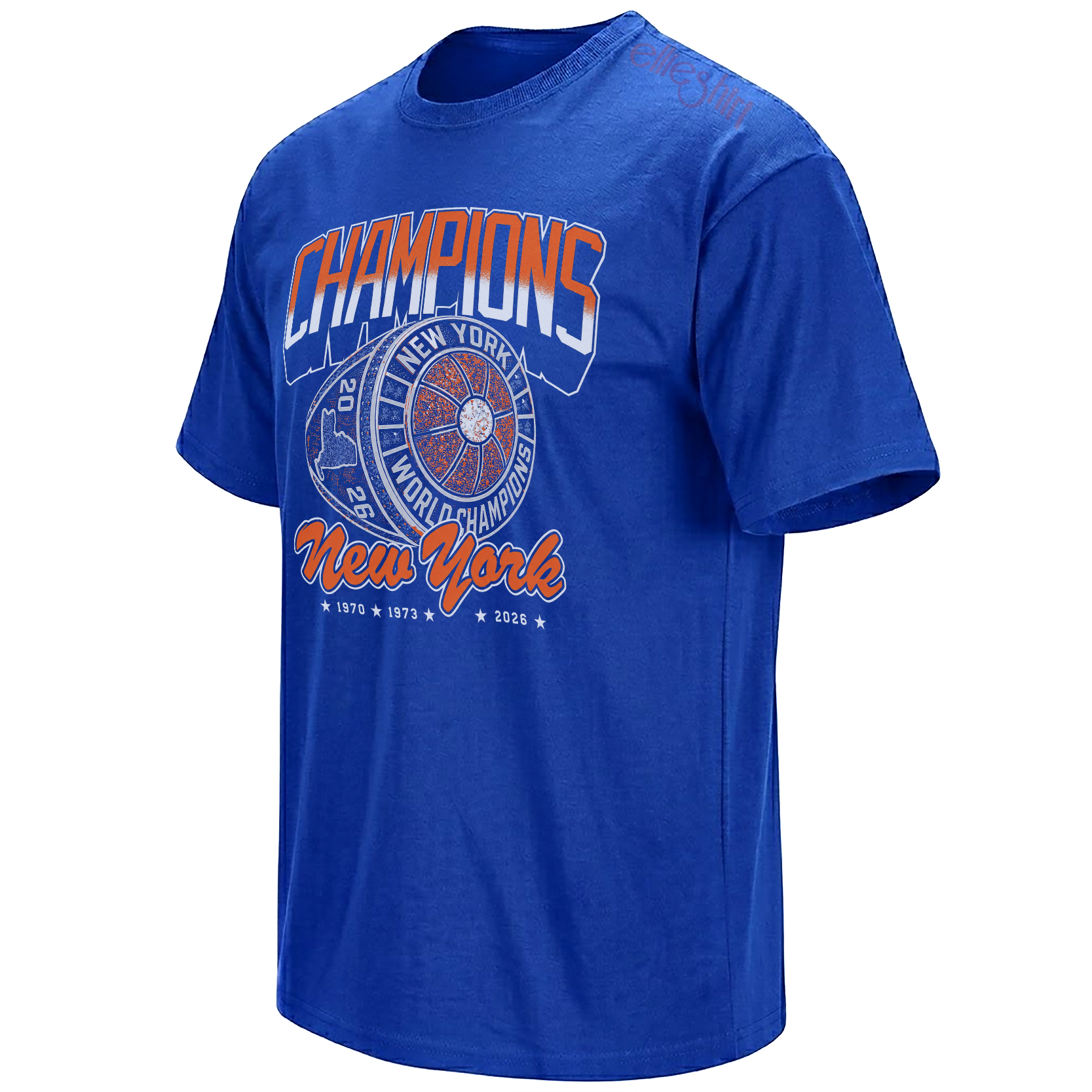
The visual works because championship rings are objects of permanence. Playoff slogans belong to anticipation; rings belong to completed history. Here, the oversized ring and the three dates function like a compact archive, connecting the newest celebration to the two teams that defined Knicks greatness for generations.
A long drought does not simply measure time without a trophy. It measures how many fans learned the franchise through someone else’s memories. The 2026 title gives parents, children and grandparents a championship image they can all recognize as their own.
Brunson Did Not Replace the Old Knicks — He Reopened the Lineage
The most emotionally powerful championship imagery does not erase the past to elevate the present. It creates continuity.
That is what makes the pairing of Walt Frazier and Jalen Brunson so effective. Frazier represents the last fully realized Knicks championship era. Brunson represents the player who carried the franchise through the final door in 2026. Showing them from behind, wearing Nos. 10 and 11 and holding trophies on opposite sides, turns the composition into a handoff between eras.
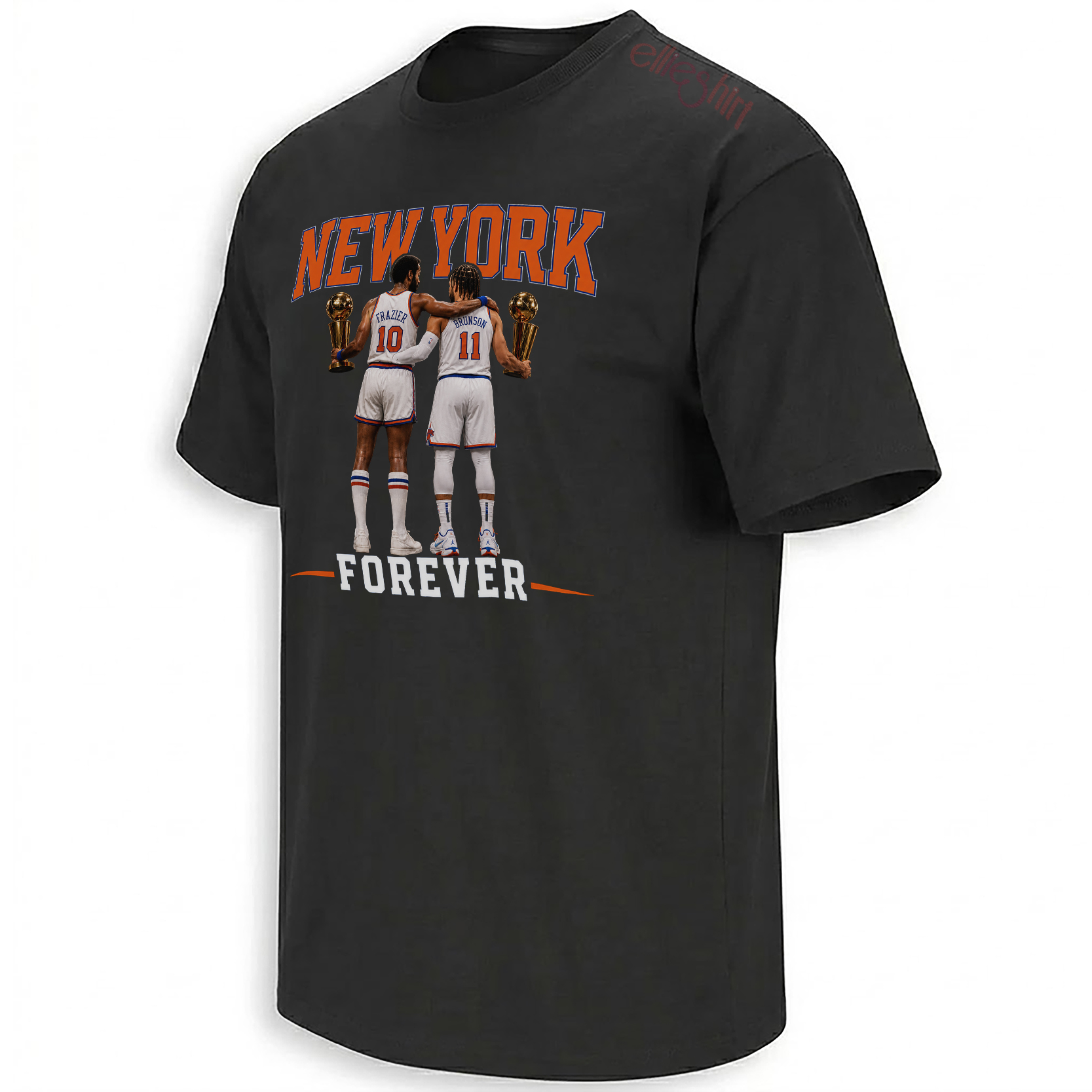
Frazier and Brunson stand as a bridge between the last championship generation and the team that finally created a new one.
Open the legacy graphic →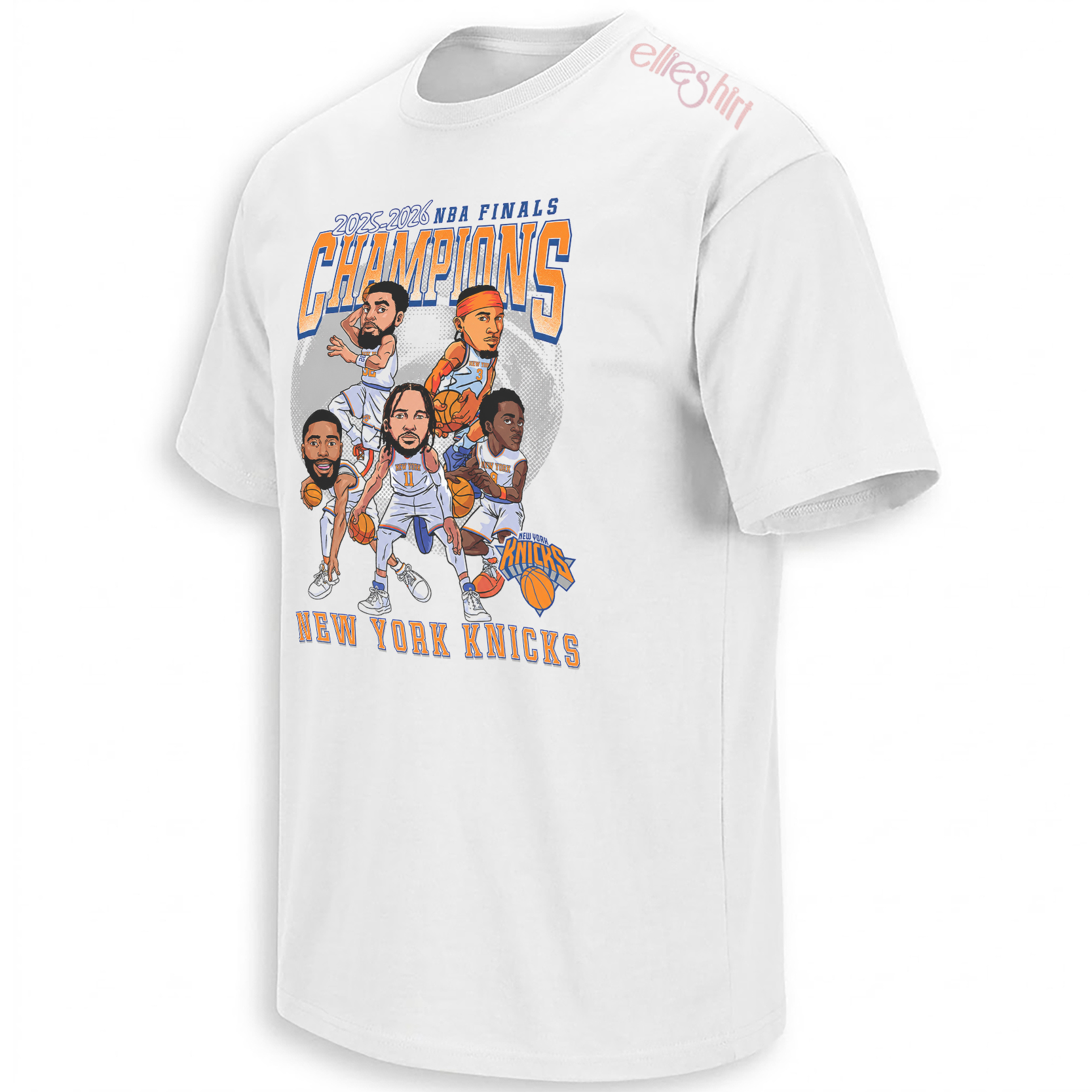
The caricature format shifts attention away from a single star and toward the personalities that made the title run feel communal.
See the roster piece →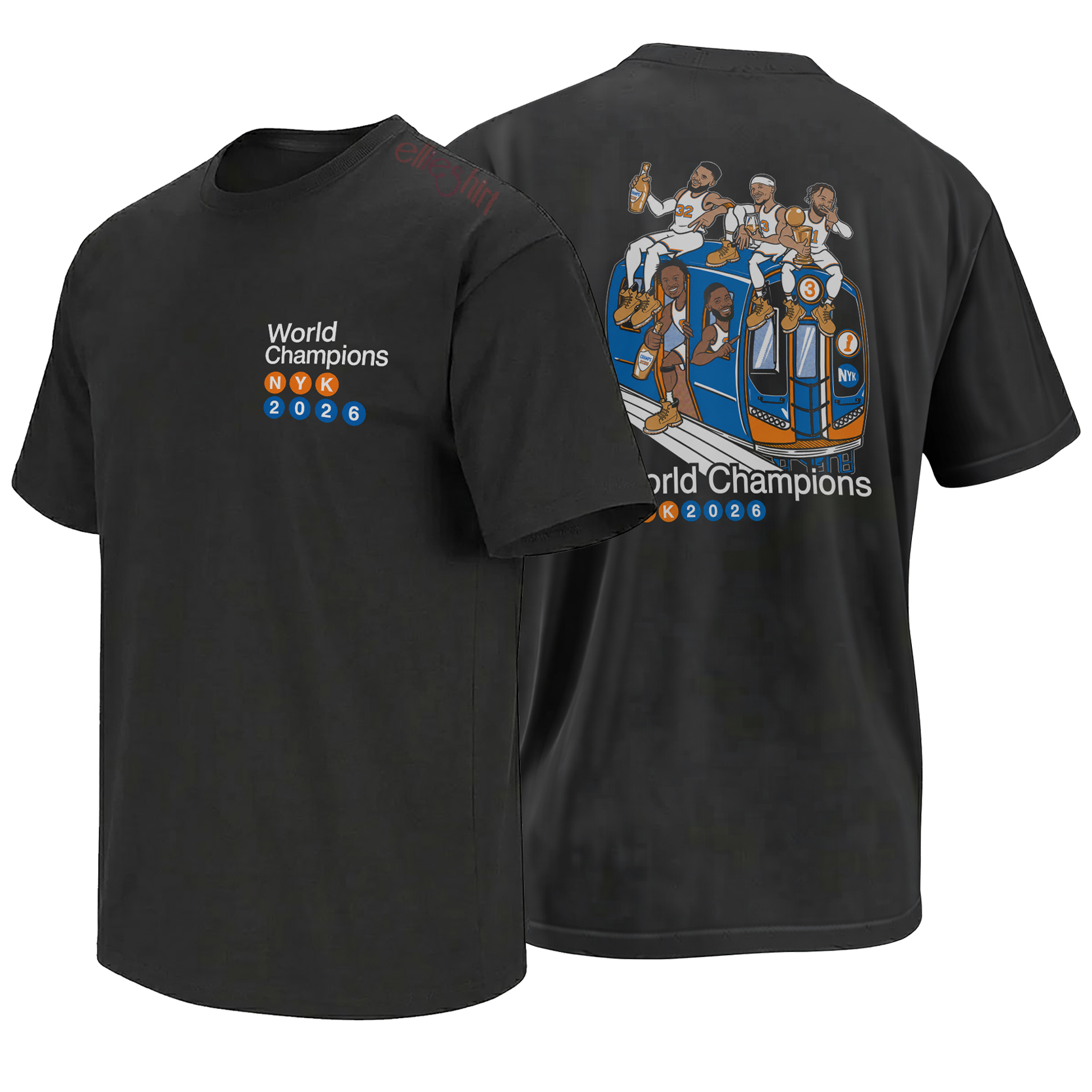
Transit imagery brings the championship out of the arena and into the everyday visual language of the five boroughs.
Explore the city graphic → The ring design treats 2026 as the missing third point in a title history that had remained frozen since 1973.
View the historical piece →These graphics tell different versions of the same story. One centers lineage. One records the roster. One translates the title through New York transit culture. One turns the franchise timeline into a ring. Together, they show how quickly a championship can produce its own visual language.
The City Became Part of the Championship Image
The Knicks have always been difficult to separate from New York itself. Madison Square Garden, subway signage, borough names, street celebrations and orange-and-blue typography carry meanings beyond basketball. They locate the team inside the city.
That relationship became especially visible after Game 5. Supporters gathered across Manhattan and around the Garden even though the deciding game was played in San Antonio. The distance did not matter. The title was completed on the road, but emotionally it arrived in New York at once.
This is why subway graphics, city lettering and “New York Forever” language belong naturally beside more traditional trophy designs. They describe the championship not as an isolated league result, but as a civic event. The train, the borough and the street become part of the memory alongside the basketball court.
In streetwear terms, that creates a wider design field. A standard champions logo announces the result. A city-coded graphic explains who absorbed it.
From Postgame Reaction to Visual Archive
Online reaction moved through several emotional layers at once. There was awe around Brunson’s closeout performance, relief after the repeated comeback tension, historical comparison with the 1970 and 1973 champions, and disbelief that a franchise associated with waiting had suddenly finished the job in five games.
The recurring images followed those emotions. Brunson became the face of completion. The trophy became proof. The dates became a timeline. Team portraits became a way to ensure that Josh Hart, Mikal Bridges, OG Anunoby, Karl-Anthony Towns, Mitchell Robinson and the rest of the rotation remained visible inside the larger story.
That is how championship merchandise becomes culturally interesting. The strongest pieces do not merely repeat “champions.” They preserve the exact argument fans were having with history: who carried the run, what the comeback identity meant, how the old teams connect to the new one and what New York looked like when the waiting stopped.
A score tells us who won. A visual archive tells us how the victory felt.
The cultural life of a championship begins after the buzzerA Living Knicks Championship Collection
The wider collection works best when read as a series of competing memories rather than a shelf of similar products. Some designs are built around Brunson. Others emphasize the complete roster, the ring, the trophy, the parade imagination or New York’s street and subway identity.
2026 NBA Finals Champions Visual Archive Explore championship rings, roster pieces, city graphics and designs drawn from the Knicks’ title run. → New York Knicks Collection A broader record of Finals moments, player stories, Garden culture and the language surrounding the team. → Broader NBA Culture Collection Playoff moments, championship graphics, rivalries and player-driven designs from across basketball culture. →Taken together, the New York Knicks collection and the broader NBA collection function as a running visual record of how basketball moments move from broadcasts into fan language.
Frequently Asked Questions
When did the New York Knicks win the 2026 NBA championship?
Why was the Knicks’ 2026 championship historically significant?
Why were the 2026 Knicks called the “Comeback Knicks”?
What did Jalen Brunson do in the championship-clinching game?
Why do Knicks championship designs feature 1970, 1973 and 2026?
Why does subway imagery fit the Knicks’ 2026 title?
Why pair Walt Frazier and Jalen Brunson in one Knicks design?
The complete 2026 NBA Finals Champions collection records the title through rings, roster portraits, city symbols and the new visual language of a championship New York had waited 53 years to claim.
The New York Knicks 2026 NBA Champions collection captures the end of a 53-year title drought through Jalen Brunson’s Finals MVP run, the Comeback Knicks identity, championship rings, roster artwork and New York city culture.