
The Knicks Won Together — and the Championship Roster Became the Story
New York’s 2026 title will always carry Jalen Brunson’s 45-point closeout, but the lasting image is larger than one performance: a full cast of personalities, roles and recognizable faces finally standing together as champions.
The defining number from Game 5 was 45. That was how many points Jalen Brunson scored as the New York Knicks defeated the San Antonio Spurs 94–90, finished the NBA Finals in five games and ended a championship wait that had stretched back to 1973.
Yet almost immediately after the final buzzer, the visual language of the title began moving away from one number and toward a group. The trophy photographs filled with arms, faces and bodies leaning into the same frame. Karl-Anthony Towns carried the Larry O’Brien Trophy through the locker room. OG Anunoby briefly and accidentally brought viewers inside the celebration through an Instagram Live stream. Teammates shouted over champagne, phones and the confusion of finally reaching the moment they had spent an entire season pursuing.
That is where the Knicks’ championship started becoming something more interesting than a conventional star-led story. Brunson supplied the closeout masterpiece and earned Finals MVP, but New York’s larger emotional attachment was to the roster itself — the specific collection of personalities that made the impossible feel sturdy enough to last through June.
Why this title belongs to a cast, not a single silhouette
Basketball naturally produces individual mythology. One player takes the final shot. One player holds the Finals MVP trophy. One face appears largest on the newspaper cover. The structure of sports media is built to compress complicated achievements into one recognizable hero.
The 2026 Knicks resist that compression. Brunson was the central force, but the team’s identity formed through contrast. Towns provided size, shooting and an emotional journey toward his first championship. Anunoby carried the quiet defensive seriousness that often made the loudest moments possible. Josh Hart gave the lineup its rebounding chaos and unfiltered personality. Mikal Bridges supplied wing length, movement and another connective thread from the Villanova core.
Around them, the roster’s supporting structure gave New York enough answers to survive different kinds of games. Some nights required scoring. Others required second possessions, difficult defensive assignments or the patience to remain composed while the entire emotional temperature of Madison Square Garden rose around them.
That is why a group portrait feels especially appropriate for this championship. It refuses to reduce the season to one pose. The figures overlap, interrupt one another and occupy different visual levels, much like a lineup in which each player’s job becomes meaningful because of how it connects to the others.
From championship result to illustrated team memory
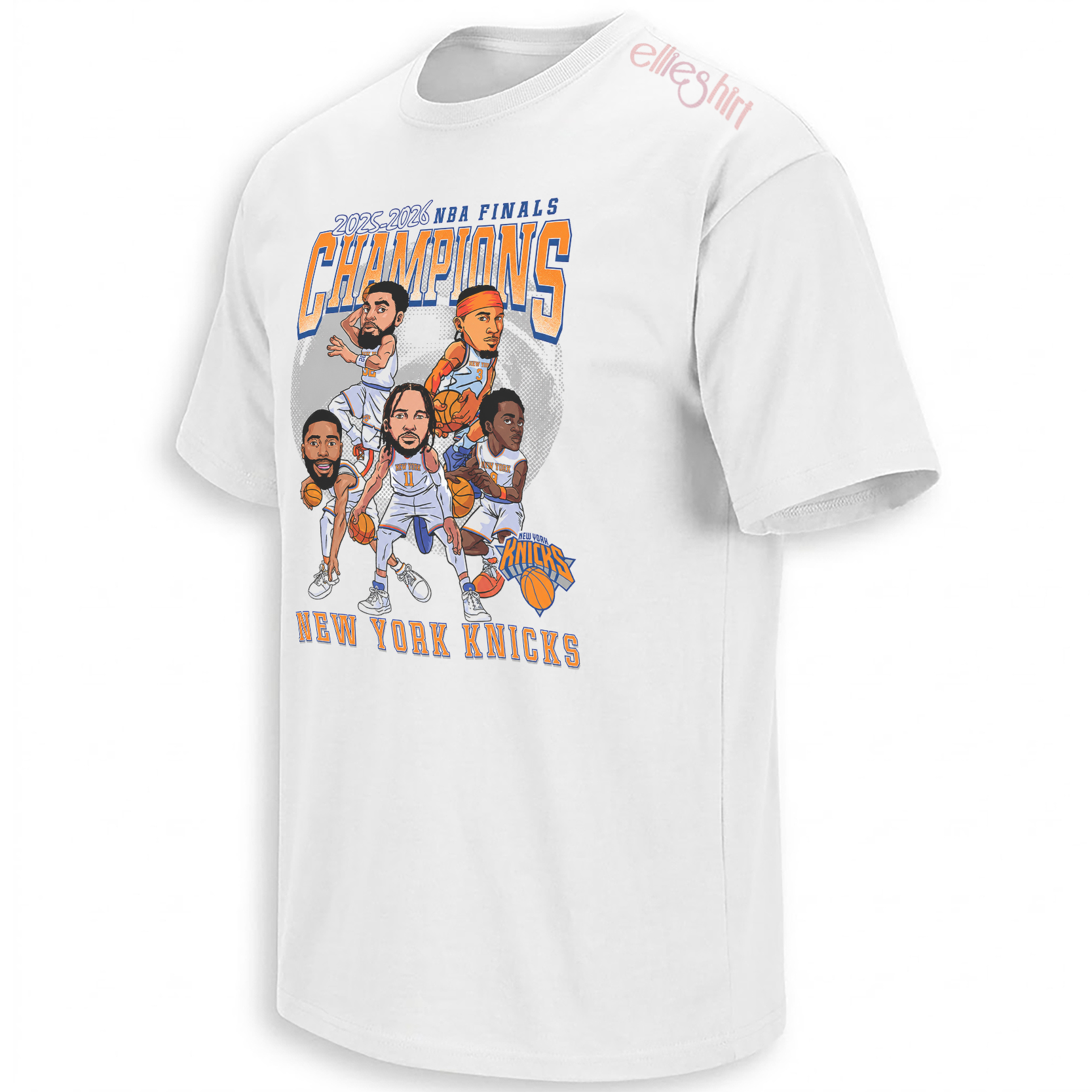
The 2025–2026 NBA Finals Champions Shirt enters the story through an entirely different door than a traditional trophy-centered graphic. Its main subject is not the Larry O’Brien Trophy, the final score or one famous pose. The center of the composition is a five-player caricature lineup.
That choice gives the design the energy of an illustrated season recap. The oversized heads, compact bodies and exaggerated gestures turn the players into recognizable characters inside a shared story. Instead of asking the viewer to remember only the result, the graphic asks them to remember the chemistry, roles and personalities that produced it.
Caricature is often treated as comic decoration, but in sports culture it can serve a deeper archival function. A realistic photograph captures one fraction of a second. An illustration can combine several personalities, gestures and emotional associations into one frame. It becomes less concerned with documentary accuracy and more concerned with how a team felt to its supporters.
Why the artwork feels like a championship comic cover
The design begins with a white field, an important choice because it allows the Knicks’ blue and orange to operate at full brightness. Where darker championship graphics often feel solemn or historical, this one feels immediate, animated and celebratory. It belongs to the first morning after the title, when the city is still processing the result through headlines, screenshots and repeated viewings of the final possessions.
At the top, “2025–2026 NBA Finals Champions” is arranged like a masthead. The word “Champions” dominates in tall orange block letters with a blue dimensional shadow, creating the visual force of a sports newspaper, vintage locker-room release and comic-book title at once.
Below it, the caricature group breaks the rigidity of the typography. The players lean, crouch, dribble and occupy different heights. The arrangement is intentionally crowded, giving the impression that everyone is trying to fit into the same celebration frame. That compactness is part of the emotional idea: the title was won by individuals whose identities became inseparable from the group.
Enlarged faces and expressive poses make the figures instantly readable as personalities rather than anonymous uniformed bodies.
The oversized “Champions” headline functions like a cover title, while the roster forms the central cast beneath it.
Bright orange and blue details pop against the white base, creating a celebratory rather than nostalgic visual mood.
The composition gives the people more space than the logo, making the championship roster the emotional subject of the piece.
The gray halftone circle behind the group acts like a printed spotlight. It anchors the figures without competing with the uniforms and adds the texture of old newspaper comics, souvenir programs and illustrated basketball cards.
Near the bottom, the Knicks mark and “New York Knicks” lettering stabilize the playful movement above. The result is a clear hierarchy: championship first, team second, city identity holding the entire composition together.
The caricature format turns roles into personalities
Supporters rarely remember championship teams as a clean list of statistics. They remember habits. They remember the player who calmed the game down, the player who chased an impossible rebound, the player whose defensive stop felt as loud as a dunk and the teammate whose reaction became part of the replay.
Caricature art is well suited to that kind of memory because it works through emphasis. A hairstyle becomes sharper. A stance becomes more dramatic. A facial expression becomes a clue. Each character can carry the emotional shorthand fans already associate with the player.
The central Brunson figure appears planted and controlled, visually matching the role he occupied throughout the run. The surrounding players create movement around him, reinforcing the balance between a clear leader and a roster that could not have reached the same destination without its collective structure.
This is the distinction between a “star shirt” and a “team shirt.” A star design asks the viewer to celebrate one great player. A caricature roster design asks the viewer to recognize the relationships that made the team memorable.
The internet wanted the unpolished celebration
The official trophy presentation gave the championship its formal image. The locker room gave it personality. In the hours after Game 5, fans were not only replaying Brunson’s scoring or examining the final box score. They were looking for the emotional evidence that the players themselves understood what had happened.
The brief accidental Instagram Live from Anunoby fit perfectly into that appetite. The clip was not staged as a championship documentary. It was confused, noisy and spontaneous, with champagne moving through the room and Anunoby trying to work out how to end the broadcast. Its imperfections made it feel closer to the celebration than a polished media package could.
That small moment also revealed why locker-room-inspired championship graphics matter. They occupy the same emotional territory: the minutes when public achievement is still colliding with private disbelief.
Why the roster became a New York character ensemble
New York sports culture has always been unusually attentive to personality. Winning matters, but the city also demands recognizable character: a way of speaking, moving, competing or reacting that supporters can place inside the larger mythology of the team.
This Knicks roster offered several different forms of identification. Brunson carried the discipline and repetition of a player who never seemed surprised by the responsibility placed on him. Hart played with the restless emotional energy of someone trying to affect every possession. Towns brought visible feeling to a journey that had followed him across teams and expectations. Anunoby’s understated personality made his biggest interventions feel even sharper. Bridges connected the group through familiarity, movement and adaptability.
Together they resembled an ensemble rather than five versions of the same archetype. That is one reason supporters could find so many different emotional entry points into the team. Some identified with Brunson’s control. Others loved Hart’s chaos, Towns’ release, Anunoby’s quiet or the shared history carried by the Villanova connections.
A team caricature does not flatten those differences. It uses them. The visual humor comes from allowing every figure to remain distinct while still fitting inside one composition.
One championship, several ways to remember it
The Knicks’ 2026 title has already produced several separate visual memories. There is Brunson’s Game 5 scoring performance. There is Anunoby’s Game 4 tip-in. There is the trophy on the court, the locker-room celebration, the city gathering around screens and the first wave of “Champions” graphics appearing across New York.
Each image preserves a different emotional layer. A trophy design marks the achievement. A player-specific design preserves an individual turning point. A city graphic connects the result to New York. The caricature version preserves the cast.
The broader New York Knicks Shirts collection functions as a running visual archive of those layers, moving between player moments, Game 4 drama, city references and completed championship imagery.
The 2026 NBA Finals Champions collection narrows that archive to the title itself, while the wider NBA Shirts collection places New York’s run inside the larger visual culture of playoff basketball, rivalry, slogans and fan memory.
Frequently asked questions
Why does the Knicks caricature championship design focus on five players?
The five-player group reflects the idea that New York’s championship identity was built around a recognizable core rather than only one individual. The lineup format turns the roster into an ensemble of distinct personalities inside the same title story.
Why did team chemistry become such an important part of the Knicks’ 2026 title narrative?
The Knicks combined Brunson’s leadership with Towns’ interior and scoring presence, Anunoby’s defense, Hart’s rebounding energy, Bridges’ versatility and contributions from the wider rotation. Fans experienced the championship as the result of complementary roles working together.
What makes caricature art effective for a championship roster?
Caricature emphasizes recognizable traits, gestures and personalities. It can place several players inside one energetic frame and preserve how supporters emotionally remember the group rather than reproducing one literal photograph.
Why does the design use a bright white base instead of a dark championship look?
The white base gives the Knicks’ blue and orange maximum contrast and makes the artwork feel immediate, playful and celebratory. It suits the energy of a team portrait rather than the solemn archival mood of a trophy-only design.
How is this different from a standard Knicks champions shirt?
A standard champions graphic usually centers on typography, a logo or the trophy. This design makes five illustrated players the main visual subject, placing roster identity and personality at the center of the championship memory.
The 2025–2026 NBA Finals Champions Shirt preserves the Knicks’ championship as a group portrait — five caricatured players beneath a bright blue-and-orange headline, capturing the roster personality that made New York’s long-awaited title feel alive.
2025–2026 NBA Finals Champions Shirt turns the New York Knicks’ title roster into a five-player caricature portrait, combining bold championship typography, bright team colors and the collective personality behind the 2026 NBA championship.