
Jacob Misiorowski No. 32: How Milwaukee’s Velocity Phenomenon Became Baseball’s New Power Image
At 6-foot-7, Jacob Misiorowski already appears to release the baseball from a different level than most starters. Add a 104.5 mph fastball, a 15-strikeout complete-game shutout and the confidence of Milwaukee’s No. 32 ace pose, and the result is one of baseball’s clearest new symbols of pitching power.
The final pitch of Jacob Misiorowski’s June 12 masterpiece arrived at 103.1 mph. Justin Crawford swung through it for strikeout number fifteen, completing a 6–0 shutout of Philadelphia and one of the defining pitching performances of the 2026 season.
The last pitch was extraordinary, but it was not the fastest ball Misiorowski threw that night. Earlier in the game, the Brewers right-hander reached 104.5 mph—the fastest pitch recorded by a starting pitcher in the Statcast era.
Those numbers changed the context around every image of Milwaukee’s No. 32. A folded-arm pose was no longer merely a player portrait. It became the visual front of a new Brewers pitching identity: towering release point, historic velocity and the increasingly credible belief that Milwaukee had developed its next true ace.
Velocity explains why hitters react late. The No. 32 ace pose explains why Milwaukee fans now expect the entire game to change when he takes the mound.
The Pose Works Because the Performance Now Supports It
Baseball portraits often ask a player to project certainty before the season has provided enough evidence. Arms folded, shoulders squared and eyes fixed toward the camera can create the visual language of an ace even when the title remains aspirational.
Misiorowski’s 2026 performances removed that distance. By mid-June, the pose no longer needed to predict what he might become. The season had already supplied historic velocity, an Opening Day assignment, dominant stretches and a complete-game shutout filled with fifteen strikeouts.
The design therefore reads like a confirmation rather than a campaign. Misiorowski stands as the central figure because the baseball conversation has already moved toward him.
Number 32 anchors the portrait to Milwaukee. The uniform, posture and large numerical treatment give the image the authority of a modern player poster while the Brewers color system keeps it connected to a longer local pitching tradition.
Misiorowski’s 6-foot-7 build gives the portrait unusual vertical force and mirrors the steep angle hitters experience from his release point.
No. 32 functions as a fast visual identifier, linking the new ace image directly to Milwaukee’s current rotation.
The composed pose contrasts with the violence of the fastball, presenting control rather than uncontrolled effort.
The Graphic Turns a Pitcher Into a Franchise Image
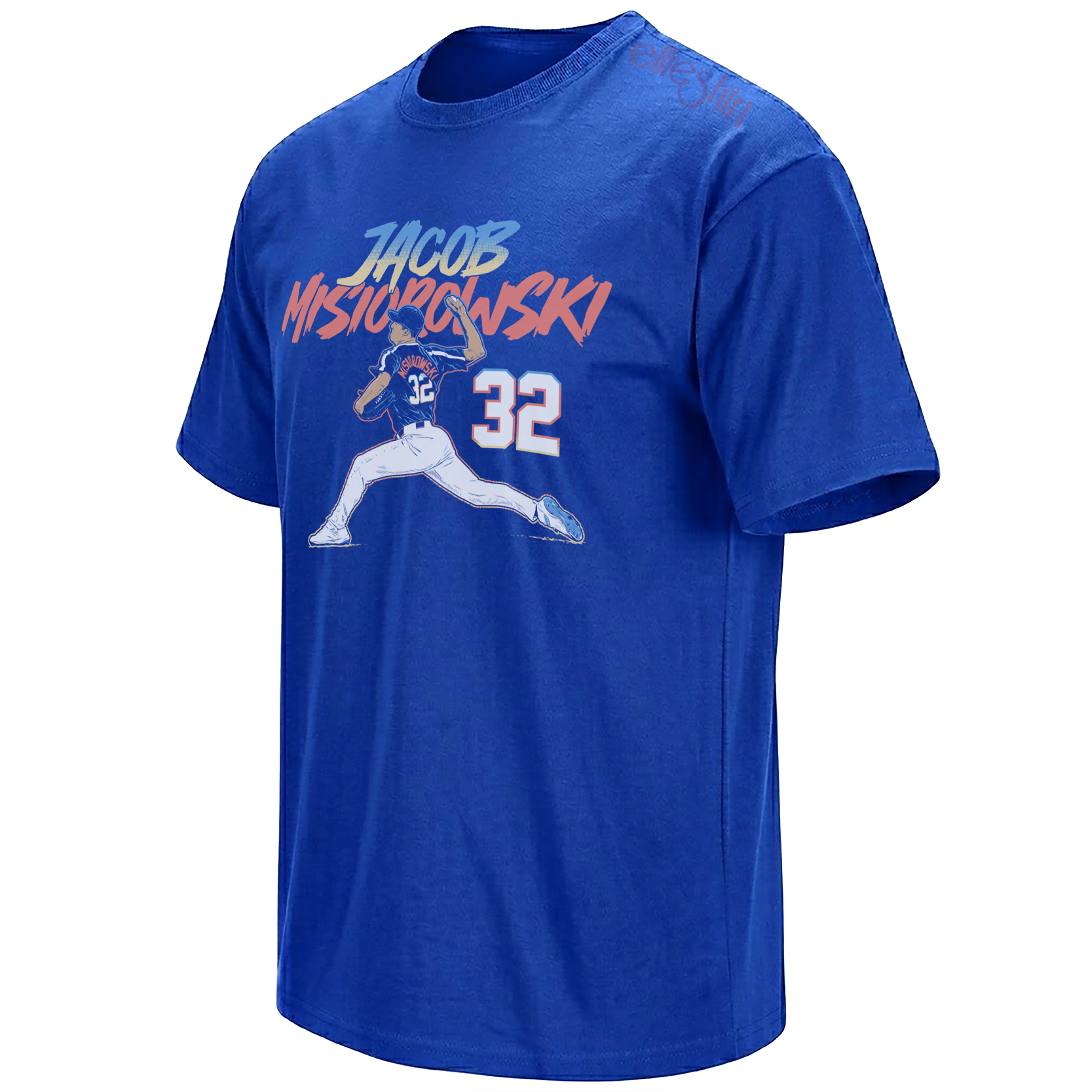
The Jacob Misiorowski No. 32 design does not attempt to reproduce one delivery frame. Instead, it uses an ace pose to communicate the identity developing around him.
Delivery photography captures motion: the leg lift, shoulder rotation and release. A standing portrait captures status. It asks the viewer to look at the pitcher not only as an athlete producing velocity, but as a figure capable of representing the franchise.
Milwaukee’s navy and gold create a strong contrast between modern athletic photography and the historical weight of the Brewers identity. The number provides scale, while Misiorowski’s height allows his figure to remain dominant inside the composition.
104.5 MPH Changed the Meaning of Starter Velocity
Triple-digit fastballs are no longer rare in major-league bullpens. Relievers can enter for one inning, release maximum effort and build an identity around a few explosive pitches.
A starting pitcher faces a different problem. He must preserve enough strength and command to navigate a lineup repeatedly. Velocity matters, but only if it survives the larger structure of the game.
Misiorowski’s 104.5 mph pitch mattered because it came from a starter operating inside a complete-game performance. The radar reading was not an isolated exhibition. It belonged to nine innings of control and fifteen strikeouts.
That combination made the performance historically distinctive. He did not simply throw the fastest pitch ever recorded by a starter in the pitch-tracking era. He maintained premium velocity deep enough into the game to finish the shutout with a 103.1 mph strikeout.
- The first visual shock is the radar reading. A 104.5 mph fastball sits beyond the normal expectations attached to a starting pitcher.
- The larger achievement is endurance. Misiorowski continued carrying elite velocity through the complete game rather than limiting it to one early inning.
- Fifteen strikeouts prove the speed produced results. The performance was not built from radar-gun spectacle alone.
- The final pitch restored the opening argument. At 103.1 mph, the last strikeout showed that the fastball remained a weapon after eight full innings.
The Complete-Game Shutout Made the Start Feel Old and New at Once
Complete games belong to baseball’s traditional image of the ace: one starter receiving the ball, controlling the entire night and leaving no final inning for the bullpen.
Misiorowski reached that old-fashioned result through a distinctly modern form of dominance. The radar readings, pitch tracking and velocity records belonged to Statcast-era baseball, while the nine-inning shutout belonged to a much older expectation of what a franchise starter should do.
That combination gave the performance unusual cultural power. Older pitching language and modern technology pointed toward the same conclusion. Milwaukee’s starter had owned the complete game.
The fifteen strikeouts also prevented the shutout from feeling like a quiet efficiency exercise. Misiorowski ended nearly half of the recorded outs himself, repeatedly removing the possibility of defensive error or productive contact.
His Height Changes What 100 MPH Looks Like to a Hitter
Pitch velocity is measured at release, but hitters experience more than a number. They see where the ball begins, how quickly it enters the hitting window and whether its movement matches the visual path their eyes predicted.
Misiorowski’s 6-foot-7 frame gives him a release geometry few starters can reproduce. The baseball appears from a high point and reaches the plate with the urgency already associated with triple-digit speed.
The height also contributes to his visual identity. Baseball uniforms can make players appear similar from a distance, but Misiorowski’s long frame remains recognizable before the viewer reads his number.
In a static graphic, that physical scale becomes part of the storytelling. The design does not need a radar display beside him. His proportions already suggest the steep, explosive pitching experience waiting for a hitter.
Hitters must make decisions at extreme speed, leaving less time to adjust when the pitch remains elevated or arrives above the expected plane.
Once the fastball forces an early commitment, breaking and off-speed movement can attack the space created by that urgency.
Why “The Miz” Fits Baseball’s New Highlight Economy
Misiorowski’s surname is visually and phonetically distinctive, but it is long enough that baseball culture naturally shortened it. “The Miz” gave broadcasts, social captions and fans a faster identity to attach to the velocity clips.
A nickname matters in the modern highlight cycle because extraordinary pitching moments move rapidly across platforms. The radar number appears first, the strikeout follows and the name must remain memorable after a short clip ends.
“The Miz” carries that efficiency. It also adds an edge that suits the performance style. The nickname sounds less like a developmental prospect label and more like an established attraction.
The No. 32 portrait belongs to the same transformation. It presents Misiorowski after the stage at which fans require a scouting report to understand why he matters.
The radar gun made viewers stop. The complete game made them stay. The No. 32 pose gave the performance a face Milwaukee could keep.
Opening Day Signaled That Milwaukee Was Ready to Hand Him the Rotation
The Brewers named Misiorowski their 2026 Opening Day starter after a rookie season that had already displayed the fastball’s ceiling. The assignment carried symbolic importance beyond one game.
Opening Day places one pitcher at the visible front of the rotation. It does not guarantee an ace season, but it communicates organizational trust and frames the pitcher as the first representative of the staff.
For Misiorowski, the assignment also marked how quickly his role had changed. He debuted in June 2025, experienced the adjustments and physical interruptions of a first major-league season, and entered the following spring as the pitcher Milwaukee selected to begin the schedule.
The dominant 2026 run made that decision look less like projection and more like early recognition.
Misiorowski entered the majors as a velocity prospect. The Opening Day assignment and complete-game dominance moved him into a different category: the starter around whom Milwaukee could organize its pitching identity.
The No. 32 Pose Balances Intimidation With Control
Pitching graphics often rely on aggression: open mouths, visible effort, flying dirt and the instant after release. Those images communicate intensity but can make every power pitcher appear emotionally similar.
The ace pose uses another kind of authority. Misiorowski is presented in control before the motion begins. The posture suggests that the speed is available without needing to advertise the physical strain required to create it.
That restraint is particularly effective for a pitcher known for historic radar readings. The viewer already understands the violence of the fastball. The graphic can therefore focus on composure.
Number 32 becomes the bridge between those two qualities. It identifies the player while functioning like a large structural element behind or around the portrait, giving the image the permanence of a stadium banner.
Milwaukee Has Always Understood the Value of Developing Pitching
The Brewers operate in a market where sustained success depends on developing talent, identifying undervalued skills and maintaining pitching depth. A homegrown starter with rare physical tools can therefore change more than one game every five days.
He can become the visible proof that the development system has produced another competitive advantage.
Misiorowski was selected by Milwaukee in the second round of the 2022 Draft and moved through the organization with elite velocity already central to his profile. The longer question concerned how that raw power would translate into a repeatable major-league role.
The 2026 season began answering that question through starts defined by both spectacle and length. The fastball remained extraordinary, but the larger story became his ability to build complete outings around it.
Why One Pitching Performance Can Redefine a Player Graphic
Before a signature performance, a player design often records potential. Afterward, the same pose becomes attached to a specific memory.
The Jacob Misiorowski No. 32 piece now carries the associations of June 12: fifteen strikeouts, no runs, nine innings and the fastest tracked pitch ever thrown by a starter.
Fans do not need every number printed inside the artwork. The portrait becomes a container for them. The pose recalls the performance, and the performance gives the pose authority.
This is how contemporary baseball imagery develops cultural weight. A design appears, one game changes the player’s status and the visual becomes a marker for the exact period when potential turned into evidence.
From Velocity Curiosity to Cy Young Conversation
Extreme velocity initially creates curiosity because it is easy to isolate and compare. A radar-gun number can be understood without knowing the count, opponent or game situation.
Award-level pitching requires more. A starter must prevent hard contact, navigate lineups repeatedly, manage workload and turn individual weapons into consistent run prevention.
Misiorowski’s 2026 rise became important because those larger indicators began accompanying the velocity. His early-season ERA moved among the league’s best, and the dominant outings were sustained long enough to create legitimate ace discussion.
The conversation therefore changed from “How hard can he throw?” to “How far can this season go?” That is the question surrounding every true breakout.
The Design Preserves Milwaukee’s New Pitching Era
The wider Milwaukee Brewers Shirts collection preserves the team through player nicknames, local baseball language and the figures shaping its current competitive identity.
Within the broader MLB Shirts collection , the No. 32 piece represents a specific type of modern baseball story: an elite physical tool becoming a complete player identity in real time.
Misiorowski’s rise is not memorable only because 104.5 mph is an extraordinary number. It is memorable because the pitch belonged to a starter capable of finishing the night himself.
The ace pose captures the conclusion Milwaukee fans were already reaching. The radar gun introduced Jacob Misiorowski. The complete game made No. 32 feel permanent.
Frequently Asked Questions
What number does Jacob Misiorowski wear for the Milwaukee Brewers?
Jacob Misiorowski wears jersey number 32 for the Milwaukee Brewers.
How tall is Jacob Misiorowski?
Misiorowski is listed at 6 feet 7 inches, giving him one of the most imposing frames and release profiles in Milwaukee’s rotation.
What is the fastest pitch Jacob Misiorowski has thrown?
He reached 104.5 mph against Philadelphia on June 12, 2026, setting the Statcast-era record for the fastest pitch thrown by a starting pitcher.
How many strikeouts did Misiorowski record in his complete-game shutout?
He struck out 15 Phillies while completing all nine innings of Milwaukee’s 6–0 shutout victory.
How fast was the final pitch of the shutout?
Misiorowski finished the game with a 103.1 mph fastball for his fifteenth strikeout.
Was Jacob Misiorowski Milwaukee’s 2026 Opening Day starter?
Yes. The Brewers selected Misiorowski to make the first Opening Day start of his major-league career in 2026.
Why is the No. 32 ace pose important to the design?
The composed standing pose turns Misiorowski from a pitcher captured during one delivery into a franchise figure, while the large number identifies Milwaukee’s emerging ace immediately.
The Jacob Misiorowski No. 32 piece preserves the moment Milwaukee’s towering velocity prospect became a complete-game force and one of baseball’s defining new pitching figures.
Jacob Misiorowski Shirt presents Milwaukee’s 6-foot-7 right-hander in a confident No. 32 ace pose after his historic 104.5 mph fastball and 15-strikeout complete-game shutout. The Brewers navy-and-gold graphic captures the velocity, control and emerging franchise identity behind one of baseball’s biggest 2026 breakouts.
Player number, measurements and roster status were checked through the official Milwaukee Brewers roster and MLB player profile. The 104.5 mph starter record, 15-strikeout shutout, final 103.1 mph pitch and Opening Day assignment were verified through MLB reporting and Statcast video records.