
Conn Staal: How Jordan Staal’s Historic Playoff Run Completed Carolina’s Championship Story
Jordan Staal spent years doing the difficult work that rarely becomes the headline. In the 2026 Stanley Cup Final, the goals finally arrived beside the defense, leadership and physical authority—turning Carolina’s captain into the oldest Conn Smythe Trophy winner in NHL history.
When NHL Commissioner Gary Bettman called Jordan Staal’s name after Game 6 in Las Vegas, the captain briefly stood between two trophies and two versions of his career. The Conn Smythe represented the extraordinary postseason he had just completed. The Stanley Cup represented the fourteen Carolina seasons required to reach that moment.
Staal had already been a champion. He won the Cup with Pittsburgh in 2009 as a 20-year-old, long before his career became inseparable from the Hurricanes. Seventeen years later, he lifted it again as Carolina’s captain after a 3–0 clinching victory over the Vegas Golden Knights.
The story became even larger because this was not a ceremonial lifetime-achievement award. Staal scored six goals in the Stanley Cup Final, found the net in each of the first five games and delivered the most productive championship series of his career when Carolina needed its captain most.
The trophy did not redefine Jordan Staal. It finally gave the rest of hockey a visible object for the value Carolina had been watching for years.
Why “Conn Staal” Became the Perfect Championship Pun
Championship nicknames work best when they communicate the result before the explanation is complete. “Conn Staal” changes only one sound in “Conn Smythe,” but that small change places the captain directly inside the name of the trophy he earned.
The phrase is playful without diminishing the accomplishment. It sounds like fan language created during the first rush of celebration: fast, obvious and immediately repeatable.
It also reflects how complete Staal’s ownership of the award felt by the end of the Final. The trophy did not appear attached to a single overtime goal or one spectacular highlight. It represented a series in which his scoring, matchups, defensive responsibility and leadership repeatedly shaped Carolina’s advantage.
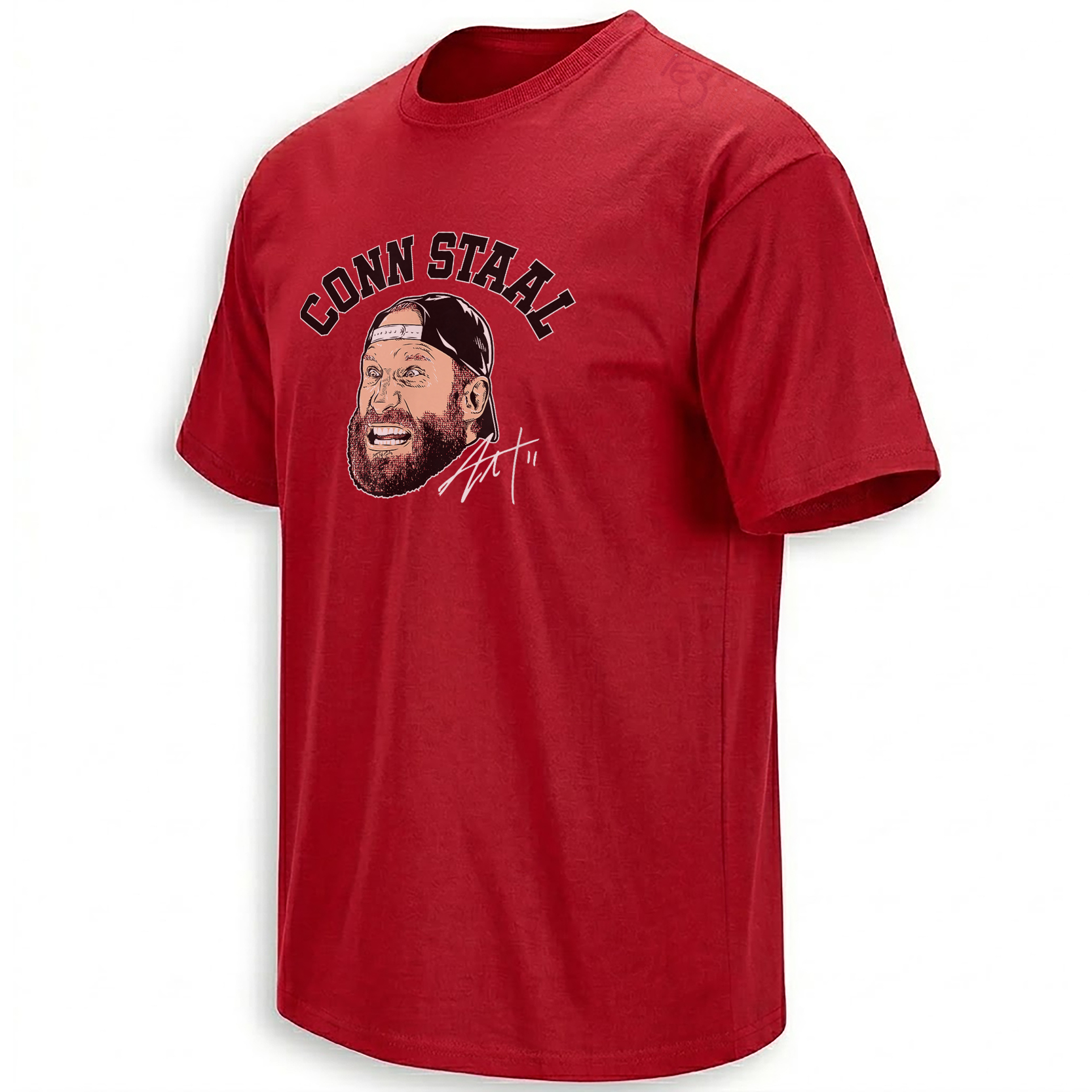
Printed above his portrait and the Conn Smythe Trophy, the phrase becomes both a joke and a title. The official award remains the Conn Smythe. The fan-era version belongs to Conn Staal.
Staal carried Carolina’s identity through difficult matchups, defensive assignments and years of postseason frustration before the championship arrived.
Six goals in the Final transformed a player known primarily for two-way impact into the series’ most persistent offensive force.
The Conn Smythe placed an individual trophy beside a career built around making the entire Carolina structure function.
The Graphic Freezes the Moment the Captain Became Playoff MVP
The Conn Staal design centers the award presentation rather than treating the Conn Smythe as a small championship detail. Staal’s portrait, the trophy and Carolina’s red-and-black identity occupy the same commemorative frame.
This visual hierarchy matters because the award altered the way the broader hockey world discussed him. For years, Staal’s value was explained through difficult assignments, faceoffs, defensive positioning and the ability to wear down opposing centers. Those qualities were essential but rarely produced one dominant poster image.
The Conn Smythe created that image. The trophy made invisible labor visible. It converted years of team-first contribution into one universally understood postseason symbol.
Five Straight Final Games Changed the Shape of His Legacy
Staal scored in each of the first five games against Vegas, tying the NHL record for the longest goal streak in a Stanley Cup Final. The run placed him beside names from several generations of championship history.
More importantly for Carolina, the goals kept arriving at moments when the series could have changed direction. Staal was not accumulating offense after games were decided. His net-front positioning, redirections and high-danger chances repeatedly affected the emotional balance of the Final.
The streak also complicated the familiar description of Staal as only a defensive center. His two-way work remained central, but the Final showed that the same size, patience and positioning used to suppress opponents could become dangerous offense near the crease.
By Game 5, the pattern had become one of the series’ defining narratives. Vegas knew where Staal wanted to operate. Carolina continued finding him there anyway.
- He scored in the first five games of the Stanley Cup Final. The streak tied the longest such run in league championship history.
- He finished the Final with six goals and one assist. His scoring production gave Carolina a reliable source of high-danger offense across the series.
- He continued handling difficult defensive matchups. The offense was added to his usual responsibility rather than replacing it.
- He accepted the Cup as captain. The individual award immediately gave way to the team trophy and the group he had led.
The Oldest Conn Smythe Winner Was Still Doing the Hardest Work
At 37 years and 277 days, Staal became the oldest player ever to win the Conn Smythe Trophy. The record is striking because the award usually follows the explosive production of a scorer or the sustained brilliance of a goaltender.
Staal’s postseason demanded a different kind of endurance. He played against top lines, absorbed physical contact, defended below the puck and continued driving toward the most crowded areas of the offensive zone.
Age did not turn him into a ceremonial veteran preserved for leadership moments. Carolina still depended on him for competitive work that younger players often struggle to perform consistently.
The historic age record therefore feels connected to the substance of the award. Staal did not become playoff MVP despite the role he was asked to play. He won because he performed that role while adding a level of scoring that transformed the Final.
Seventeen Years Between Cups Gave the Trophy a Different Weight
Staal’s first championship came in 2009 with the Pittsburgh Penguins. He was young, already trusted in major defensive situations and surrounded by a roster beginning its own championship era.
His second Cup required a completely different career. It followed a move to Carolina, years of organizational change, repeated playoff setbacks and the gradual construction of a Hurricanes identity strong enough to compete every spring.
Seventeen years between championships became the longest gap for an NHL player. The statistic measures time, but not the emotional difference between the two victories.
In Pittsburgh, Staal was a young contributor inside a star-filled team. In Carolina, he was the captain whose patience, credibility and daily standards had become part of the franchise’s foundation.
A 20-year-old Staal won the Stanley Cup early in his career, gaining championship experience before the longest and most defining chapter of his professional life.
Seventeen years later, he lifted the Cup after receiving the Conn Smythe, completing the journey as Carolina’s leader and central playoff figure.
Carolina’s Fourteen-Year Investment Finally Reached Its Ending
Staal arrived in Carolina in 2012. His tenure covered several versions of the organization: years outside the playoffs, the return of postseason hockey, repeated deep runs and the pressure that develops when a strong core keeps falling short.
He remained through those transitions. That continuity gave the championship a different emotional meaning from a veteran joining a finished contender for one final attempt.
Staal helped participate in the building. Teammates changed, management evolved and younger players grew into major roles, but the captain remained connected to the standards Carolina wanted its identity to represent.
After the Cup win, Staal spoke about believing in the culture and what the organization was trying to build. The Conn Smythe became the most visible reward for that belief, but the deeper achievement was seeing the project reach completion around him.
He did not arrive at the end of Carolina’s championship build. He lived through the years required to make the ending possible.
Rod Brind’Amour Understood the Value Before the Trophy Confirmed It
Rod Brind’Amour’s relationship with Staal gave the award another layer of meaning. As a former two-way center and championship captain, Brind’Amour understood the type of work that often disappears beneath more obvious statistics.
The coach repeatedly trusted Staal against opponents’ most dangerous players. That responsibility shaped Carolina’s lineup, allowing other combinations to attack more favorable situations.
When the goals arrived during the Final, Brind’Amour described them as an additional reward rather than the only reason Staal mattered. The championship did not suddenly reveal an entirely new player. It allowed the same player to receive broader recognition.
Brind’Amour’s own history also mirrored part of the story. He had lifted Carolina’s first Stanley Cup as captain in 2006 and coached the second team twenty years later. Staal became the bridge between those leadership traditions: a captain shaped by the coach who understood the role from inside it.
Carolina’s two championship captains occupy the same modern story: Rod Brind’Amour carried the Cup in 2006, then coached Jordan Staal through the years required to lift it again in 2026.
The Conn Smythe Did Not Come From Scoring Alone
Six Final goals gave Staal’s campaign a visible headline, but the trophy represented the complete performance surrounding them.
His size and defensive awareness remained essential against elite opposing centers. He helped protect dangerous areas, managed difficult shifts and gave Carolina a reliable possession structure when games became physically compressed.
The scoring emerged from those same habits. Staal attacked the interior, maintained position and forced defenders to handle him near the net. His offense was not disconnected from his identity; it was the aggressive extension of it.
That completeness explains why the award resonated beyond Carolina. Hockey audiences had long respected Staal as a difficult player to face. The 2026 postseason gave that respect a championship statistic, a scoring streak and an individual trophy.
Why the Award Presentation Became an Emotional Image
The Conn Smythe presentation occurs before the Stanley Cup is handed to the winning captain. That order briefly isolates the playoff MVP within a team celebration.
For Staal, the sequence created a visual summary of his career. He accepted the individual award, posed beside it and then moved toward the team trophy he had spent fourteen Carolina seasons pursuing.
The moment was powerful because the individual recognition did not appear to interrupt the team story. It completed it. Carolina’s captain had been the most valuable player during the run, and the first major object placed in his hands acknowledged that fact.
Seconds later, the Cup restored the collective frame. Staal raised it toward the teammates whose work had made the Conn Smythe possible.
From Captain Clutch to Conn Staal
Playoff culture produces names quickly. “Captain Clutch” described Staal’s ability to appear in important scoring moments during the run. “Conn Staal” arrived after the individual trophy made the postseason conclusion official.
The two phrases preserve different stages of the same transformation. One belongs to the games, when fans were still watching the captain build his case. The other belongs to the celebration, when the award had already confirmed it.
Together they show how fan language records an evolving story. A player begins the playoffs with an established reputation, creates new moments and eventually receives a nickname that could not have existed before that specific postseason.
The graphic therefore functions as a timestamp. It belongs to the exact moment when Jordan Staal stopped being only Carolina’s respected captain and became its Conn Smythe-winning champion.
Why the Design Uses a Portrait Instead of a Full Roster
Carolina’s championship was built through depth, but the Conn Smythe is intentionally individual. Its purpose is to identify the player judged most valuable across the postseason.
The design follows that logic by placing Staal at the center. His face, name and trophy occupy the primary hierarchy, while Hurricanes colors connect the achievement to the larger team context.
Red provides the urgency of the playoff run. Black gives the piece commemorative weight. Metallic grey and gold suggest the two trophies present at the end of the night: the silver Stanley Cup and the Conn Smythe’s historic sculptural form.
The result resembles an individual award poster created inside a team championship environment. It does not separate Staal from Carolina; it records the moment Carolina’s captain received recognition of his own.
A Career of Difficult Matchups Became a Public Celebration
Staal’s career has often been described through opposition. Which star center did he have to contain? Which faceoff had to be won? Which defensive shift began in the wrong end of the rink?
Those questions are essential to coaches and teammates but can remain less visible to casual viewers. A goal is easier to circulate than a correctly positioned stick. A trophy is easier to photograph than years of dependable matchup work.
The 2026 Final brought both sides together. Staal continued doing the difficult work while scoring enough to become impossible to overlook.
That is why the Conn Smythe celebration felt less like a sudden reinvention and more like accumulated recognition arriving all at once.
The Wider Carolina Championship Archive
Staal’s MVP story belongs inside a larger championship record that includes Brandon Bussi’s Game 6 shutout, Rod Brind’Amour’s return to the Cup, the 16–3 postseason mark and Raleigh’s twenty-year wait.
The wider Carolina Hurricanes collection preserves those different perspectives through player moments, roster graphics, championship slogans and Cup imagery.
The broader NHL Shirts collection places the Conn Staal piece inside hockey’s tradition of turning playoff performances, trophy presentations and fan-created names into lasting visual culture.
The Conn Smythe records the league’s official decision. “Conn Staal” records the way Hurricanes fans immediately made that decision part of their own championship language.
Frequently Asked Questions
Who won the 2026 Conn Smythe Trophy?
Carolina Hurricanes captain Jordan Staal won the Conn Smythe Trophy as the most valuable player of the 2026 Stanley Cup Playoffs.
What does “Conn Staal” mean?
“Conn Staal” is a fan-created pun combining Jordan Staal’s surname with the Conn Smythe Trophy he received after Carolina won the Stanley Cup.
How many goals did Jordan Staal score in the 2026 Stanley Cup Final?
Staal scored six goals in the six-game Final against the Vegas Golden Knights and added one assist.
What record did Staal tie during the Stanley Cup Final?
He scored in each of the first five games, tying the NHL record for the longest goal streak in a Stanley Cup Final.
How old was Jordan Staal when he won the Conn Smythe?
Staal was 37 years and 277 days old, making him the oldest Conn Smythe Trophy winner in NHL history.
Had Jordan Staal won the Stanley Cup before 2026?
Yes. He first won the Stanley Cup with the Pittsburgh Penguins in 2009, seventeen years before captaining Carolina to the 2026 championship.
Why was Staal’s Conn Smythe victory meaningful to Carolina fans?
He had spent fourteen seasons helping build Carolina’s culture through leadership, difficult defensive assignments and repeated playoff runs before finally lifting the Cup as captain.
The Conn Staal piece preserves the night Jordan Staal’s scoring streak, two-way authority and fourteen-year Carolina journey were recognized with hockey’s playoff MVP trophy.
Conn Staal Shirt celebrates Jordan Staal’s historic 2026 Conn Smythe Trophy after leading the Carolina Hurricanes to the Stanley Cup. The design captures the captain’s six-goal Final, record five-game scoring streak and emotional rise from longtime two-way leader to the oldest playoff MVP in NHL history.