
16–3: How Carolina’s Championship Roster Turned a Playoff Record Into Stanley Cup History
Sixteen victories were required to lift the Stanley Cup. Carolina collected them while losing only three times, transforming a roster built on pressure, depth and collective discipline into one of the defining championship teams of the modern playoff era.
By the time the Carolina Hurricanes completed a 3–0 shutout in Las Vegas on June 14, the final record looked almost too clean for the chaos required to produce it. Sixteen playoff wins. Three losses. Four rounds survived. One Stanley Cup returning to Raleigh twenty years after the franchise first raised it.
The championship number was not simply “2026.” It was 16–3—the compressed mathematical record of a postseason in which Carolina repeatedly controlled games, trusted its structure and found important contributions from nearly every part of the lineup.
That is why a roster design built around the number carries a different emotional weight from a conventional trophy graphic. The Cup records the destination. “16–3” records how forcefully the team reached it, while the names surrounding the number preserve the people responsible for every stage of the run.
Sixteen wins describe the requirement. Three losses reveal how rarely Carolina allowed the postseason to interrupt its plan.
Why 16–3 Became the Defining Number of the Run
Every Stanley Cup champion reaches sixteen victories, but the losses determine the shape of the journey. Some teams survive repeated elimination games, seven-game rounds and sudden momentum swings. Carolina’s path carried a different visual identity: compressed, controlled and unusually efficient.
A 16–3 record means the Hurricanes won more than five playoff games for every loss. It suggests not one fortunate series, but an approach that remained effective against changing opponents across four rounds.
The number also communicates faster than a detailed bracket. Fans do not need to reconstruct every score to understand the scale. “16” says the work was completed. “3” says the interruptions were rare.
Printed above a championship roster, the record becomes a headline and a verdict. The names explain who won. The number explains the level of control with which they did it.
Four playoff rounds demanded sixteen victories, turning the first half of the number into a complete map from opening night to the Cup lift.
Three losses across an entire postseason reveal how quickly Carolina responded when an opponent disrupted its structure.
The record matters because it ended with one trophy, one Raleigh celebration and the franchise’s second Stanley Cup championship.
The Roster Is the Real Subject of the Design
A championship roster graphic resists the idea that one portrait can explain an entire postseason. Carolina had recognizable leaders, major scorers and a playoff MVP, but the team’s identity depended on repeated contributions arriving from different places.
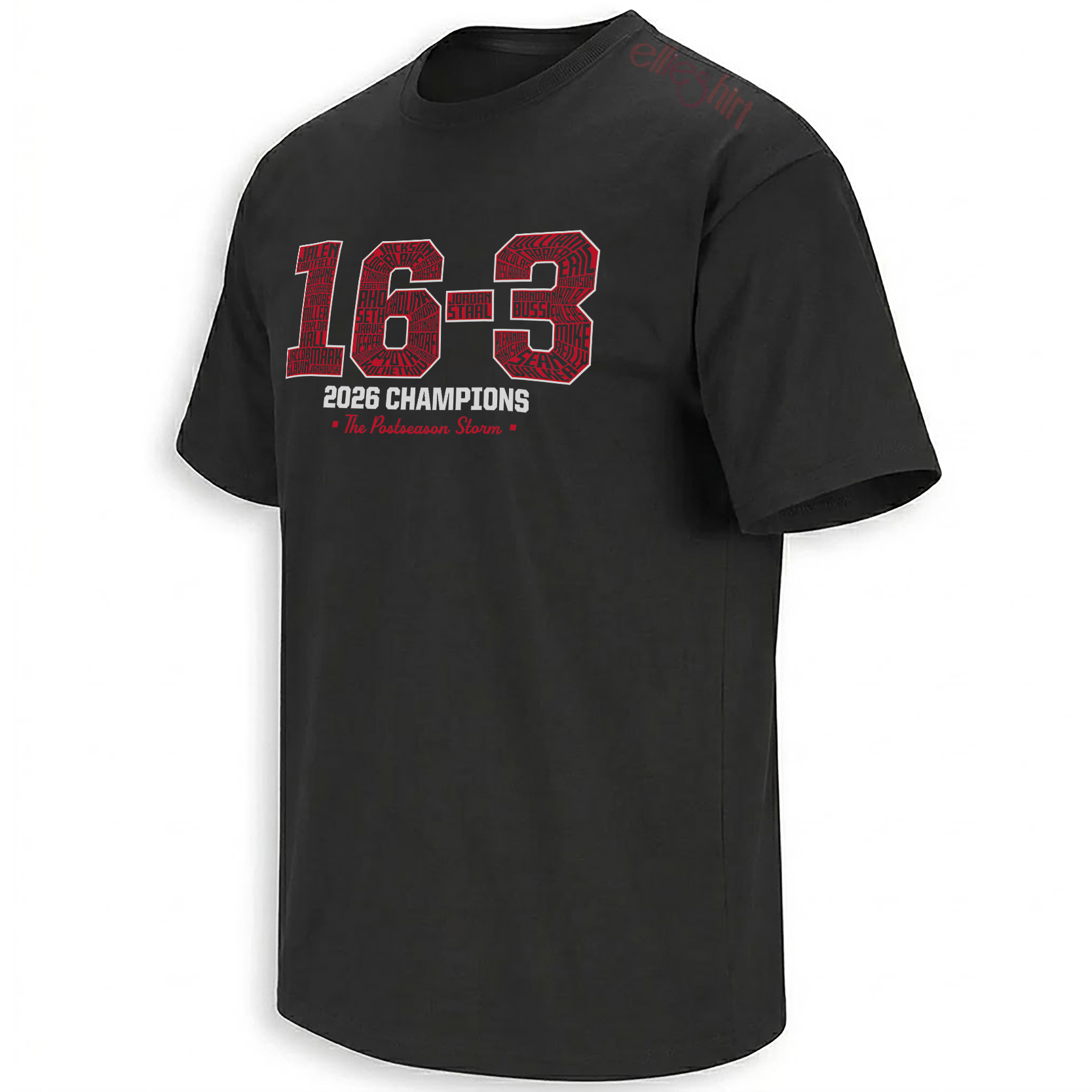
The 16–3 2026 Champs design builds the image around accumulation. Player names form the visual body of the championship, while the record acts as the organizing statement.
This structure mirrors how Carolina played. The lineup was not organized around waiting for one superstar to rescue every difficult night. Forwards applied pressure in waves, defensemen controlled space and goaltending provided stability when the game tightened.
The roster therefore functions as more than documentation. It is an argument about why the Hurricanes were difficult to stop: every name belonged to the system, and the system remained recognizable regardless of which line was producing the decisive moment.
A Championship Built Through Depth Rather Than Isolation
The Hurricanes’ strongest stretches were rarely about waiting for one line to dominate every shift. Their pressure came through repetition: one unit establishing possession, another forcing a turnover and the next continuing the attack before the opponent could reset.
That style makes depth visible even when it does not appear in a single highlight. A successful forecheck may begin several touches before the eventual goal. A defensive recovery can prevent the chance that would otherwise change the game. A fourth-line shift can force an exhausted opponent into a poor matchup.
Carolina’s roster design reflects that interconnected logic. Names are not separated into one hero and a collection of supporting figures. They form one championship field.
The visual effect resembles a team photograph translated into typography. Instead of asking every player to occupy the same physical frame, the graphic allows every name to occupy the same historical statement.
Carolina’s forecheck and puck pursuit depended on coordinated movement. The effect was created by the next player arriving as reliably as the first.
The roster typography gives multiple contributors equal archival space, matching a postseason remembered for collective execution rather than one isolated storyline.
Jordan Staal Gave the Championship Its Emotional Center
Every collective team still develops a figure who comes to represent its emotional character. For Carolina, captain Jordan Staal occupied that role throughout the Final.
His scoring, defensive work and physical presence connected the Hurricanes’ daily structure to the larger emotional stakes of the series. When the championship was secured, the Conn Smythe Trophy recognized the value of a performance that was never limited to one statistical category.
Staal’s presence also gave the title generational depth. A veteran captain who had already spent years carrying Carolina through postseason disappointment became the player lifting individual playoff recognition beside the team’s ultimate prize.
On a roster piece, his name does not need to dominate the layout. Fans bring the emotional meaning with them. The typography places the captain back where the team’s culture always placed him: inside the group he led.
Brandon Bussi’s Shutout Completed the Record
The final entry in a 16–3 run was written through silence on the scoreboard. Brandon Bussi stopped all 22 shots he faced in Game 6, allowing Carolina to close the Final with a 3–0 victory.
A shutout gave the championship a fitting ending because control had been central to Carolina’s identity. The Hurricanes did not need a final overtime scramble or a desperate last-minute comeback. They protected the lead, restricted the opponent and allowed the final seconds to disappear without surrendering the moment.
Goaltending narratives can dominate playoff hockey because one position is asked to carry the consequences of every defensive mistake. Carolina’s run instead presented Bussi’s work as part of a larger structure.
The goalie delivered the final save, but the championship image includes the defenders clearing space, the forwards tracking back and the bench waiting for the horn. The roster graphic preserves that complete chain.
- The team reached sixteen before the postseason could reach four losses. That imbalance gives the record its immediate visual force.
- Game 6 ended with a shutout. Carolina’s final victory emphasized defensive control rather than late-game survival.
- The roster supplied scoring from multiple layers. Different lines and defensive pairings contributed as opponents changed across the tournament.
- The captain became playoff MVP. Jordan Staal represented the two-way, team-first identity surrounding the run.
- The Cup returned after twenty years. The record connected the 2026 team to the franchise’s first championship in 2006.
Rod Brind’Amour Connected the Two Carolina Championships
No name links the Hurricanes’ Stanley Cup history more directly than Rod Brind’Amour. He lifted the trophy as Carolina’s captain in 2006 and guided the 2026 roster as head coach.
That transition—from the player at the front of the celebration to the coach shaping the system behind it—gave the second title an unusual sense of continuity.
The championships were separated by twenty years, different rosters and different versions of the league. Yet Brind’Amour’s presence prevented them from feeling like unrelated historical accidents.
The 2026 team did not attempt to imitate the earlier champions. It extended their story through a coach whose demands for conditioning, pressure and collective responsibility had become part of Carolina’s modern identity.
In 2006, Brind’Amour stood inside the roster that won. In 2026, his system became the structure holding the new roster together.
Why Names Matter More After the Celebration Ends
During the playoffs, fans rarely need help remembering who is involved. Line combinations are discussed daily. Injuries alter every conversation. Goals, saves and press conferences create new associations after each game.
Time changes that familiarity. A championship year becomes a handful of dominant images, and some contributors gradually disappear from the shortest version of the story.
Roster graphics resist that compression. They preserve the complete group before memory reduces the team to its captain, leading scorer and final trophy lift.
The names also allow future fans to rediscover the roster. A player who appeared secondary in the broad historical narrative may have been central to one round, one penalty kill or one shift remembered vividly by the people who watched it live.
A trophy graphic remembers what the team achieved. A roster graphic remembers who occupied the room, wore the uniform and contributed to the sixteen victories required to finish the journey.
The Typography Recreates the Logic of the Team
The visual strength of the design comes from the relationship between scale and repetition. “16–3” must remain readable from a distance, while the names reward closer inspection.
This produces two viewing experiences. First, the audience sees dominance: one large record, one championship year and one unmistakable team-color system. Then the viewer moves inward and discovers the individual players constructing the larger shape.
Red supplies the emotional impact of Carolina hockey. Black adds weight and gives the roster the authority of a commemorative poster. White and grey prevent the names from merging into one unreadable mass.
The result feels modern without losing the density associated with vintage championship roster pieces. It can be read quickly as a statement and slowly as an archive.
From Playoff Statistic to Raleigh Memory
A record becomes culturally meaningful when fans can connect it to physical places. “16–3” belongs to arena entrances, downtown watch parties, red jerseys across the Triangle and the moment the Cup returned to North Carolina.
Raleigh’s championship celebration completed that transition. The number no longer existed only inside standings, broadcasts or postseason graphics. It belonged to the community that had followed repeated playoff runs and waited for one to finish differently.
The wider Carolina Hurricanes collection preserves that community’s season through player references, Cup imagery, Raleigh language and the slogans that developed around the run.
Inside the broader NHL Shirts collection , the 16–3 piece documents one of hockey’s defining championship ideas: the Stanley Cup requires a complete roster, even when history eventually tries to tell the story through only a few names.
Frequently Asked Questions
What does 16–3 mean for the 2026 Carolina Hurricanes?
It represents Carolina’s complete postseason record: sixteen victories and only three losses across four playoff rounds on the way to the Stanley Cup.
Who did Carolina defeat in the 2026 Stanley Cup Final?
The Hurricanes defeated the Vegas Golden Knights in six games, winning the best-of-seven championship series 4–2.
What was the score of the Stanley Cup-clinching game?
Carolina won Game 6 by a 3–0 score at T-Mobile Arena in Las Vegas, completing the franchise’s second Stanley Cup championship.
Why is the roster included in the 16–3 design?
The names preserve the complete championship group and show that the dominant postseason record was produced through collective depth rather than one player alone.
Who won the 2026 Conn Smythe Trophy?
Carolina captain Jordan Staal received the Conn Smythe Trophy as the most valuable player of the 2026 Stanley Cup Playoffs.
How long had it been since Carolina’s previous Stanley Cup?
The Hurricanes’ previous championship came in 2006, making the 2026 victory a twenty-year return to the top of the NHL.
Why is Rod Brind’Amour important to both Carolina championships?
Brind’Amour captained the Hurricanes to the Stanley Cup in 2006 and coached the franchise to its second championship in 2026.
The 16–3 2026 Champs roster piece turns Carolina’s complete postseason group into a visual record of the depth, discipline and collective pressure that returned the Stanley Cup to Raleigh.
16–3 2026 Champs Shirt preserves the Carolina Hurricanes’ dominant Stanley Cup postseason through a full roster composition and the record that defined the run. The graphic connects Carolina’s championship players, red-and-black identity and historic twenty-year return to the Cup.