Dunkin’ Knicks: How Donuts, Subways and Streetwear Built a New York Championship Graphic
A donut-shop wordmark on the front, a subway-and-basketball city collage on the back and one simple piece of wordplay turn the Knicks’ 2026 championship energy into a graphic built from everyday New York movement.
New York’s championship celebration did not remain inside Madison Square Garden. It moved through subway cars, bodegas, coffee counters, sidewalks and the daily routes people use to cross the city.
After the Knicks completed their 53-year journey back to the title, fans lined up around Midtown blocks for championship apparel. They sang underground, celebrated above subway entrances and carried orange-and-blue gear into the same morning routines that existed before the Finals began.
“Dunkin’ Knicks” belongs to that environment. The design does not treat New York as a skyline viewed from far away. It builds the city from a donut, a train platform, basketball typography and the kind of streetwear joke that becomes understandable during one crowded commute.
The design feels New York because it combines the championship with the ordinary trip people make while carrying it through the city.
The artwork is analyzed as an independently created fan-culture parody and New York streetwear concept. It is not presented as an official collaboration with Dunkin’, the New York Knicks, Madison Square Garden, the NBA or the Metropolitan Transportation Authority.
Why the Wordplay Works Before the Viewer Finishes Reading
“Dunkin’ Knicks” succeeds because the two words already share a similar rhythm. The familiar “Dunkin’” construction expects an activity or object to follow it, while “Knicks” supplies a team name with enough sound and cultural recognition to complete the joke instantly.
The lettering does much of the work. Rounded, thick typography recalls coffee-cup and donut-box branding without requiring a detailed illustration. Orange and pink establish food-shop recognition, while Knicks blue reconnects the phrase to basketball.
This is an important feature of streetwear parody. The best designs do not require a paragraph of explanation. They create a small moment of delayed recognition: the viewer first identifies a familiar commercial style, then notices that the expected word has been replaced.
That replacement changes the message from food advertising into fan identity. The phrase no longer means stopping for breakfast. It means being immersed in the Knicks.
A Coffee-and-Donut Reference That Already Belonged Near the Garden
The relationship between Dunkin’ imagery and Knicks culture is not entirely invented by the design. Dunkin’ previously became the official coffee, baked goods and breakfast-sandwich partner of Madison Square Garden and the Knicks, with locations operating inside the arena.
That history matters because it moves the wordplay beyond a random brand parody. Coffee and donuts have physically existed inside the Knicks game-day environment.
During the 2026 season, Knicks-related Dunkin’ promotions also reached fans outside the Garden. Metro-area supporters pursued limited collaborative items, while a Knicks-inspired donut with orange-and-blue sprinkles and “WE ARE BACK!” lettering circulated during the Finals.
The food image therefore entered championship conversation before the title was clinched. A donut became another small, edible surface onto which New York projected the team’s return.
“Dunkin’ Knicks” takes that existing connection and converts it into independent streetwear language.
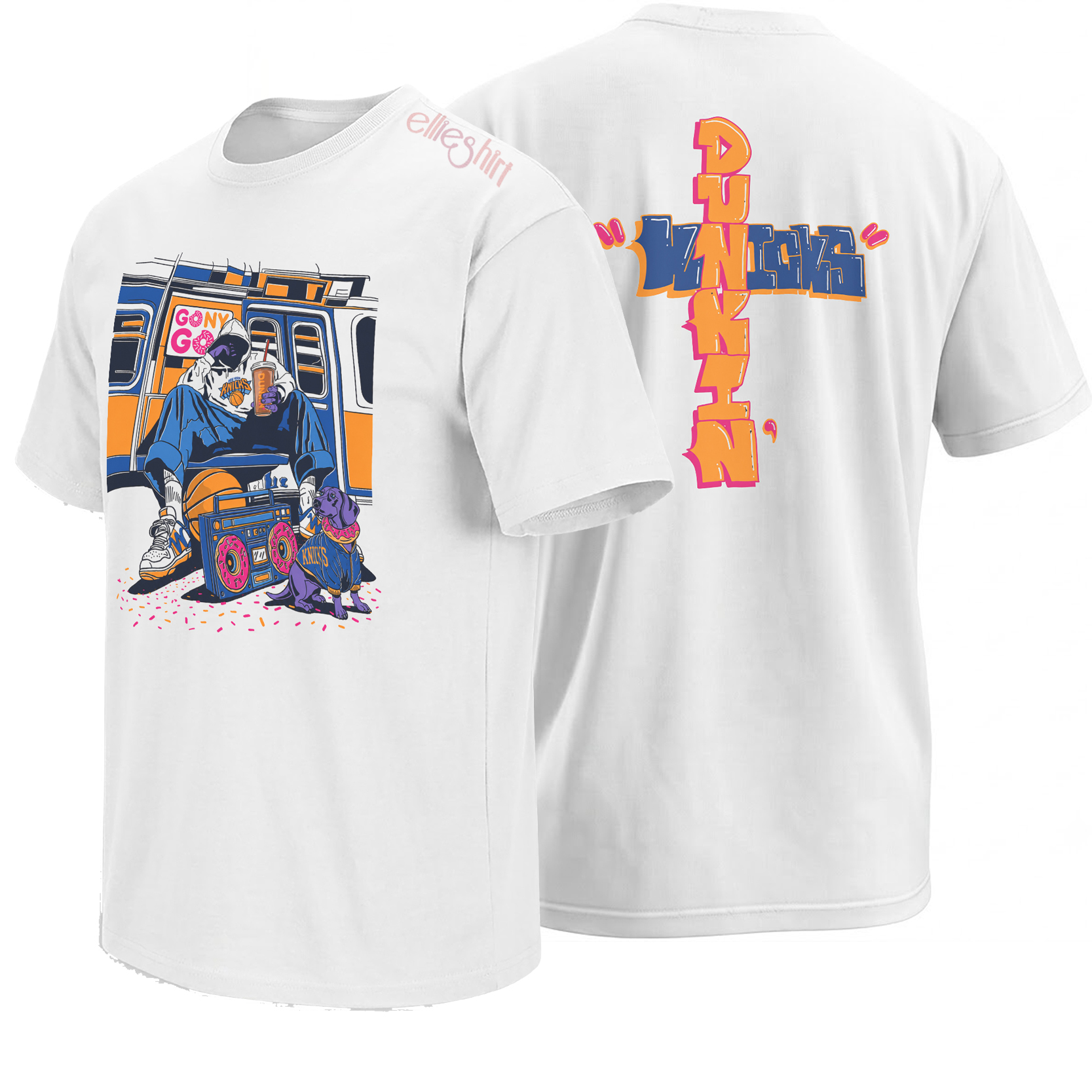
The Front Is the Joke; the Back Is the City
The two-sided structure creates a sequence rather than repeating one logo twice.
The front works like an introduction. “Dunkin’ Knicks” appears in compact, highly recognizable lettering that can be understood from a short distance. It carries the friendliness and immediacy of a storefront sign or takeaway cup.
The back changes scale. Instead of presenting only the phrase, it gives the viewer the environment responsible for it: New York transportation, basketball references, donut imagery and the layered arrangement associated with street posters and souvenir graphics.
This difference makes the shirt more effective in motion. Someone approaching from the front sees a clean joke. After the wearer turns or passes, the back reveals the larger cultural explanation.
The compact wordmark behaves like a storefront logo, using commercial familiarity to create immediate Knicks wordplay.
The larger composition turns the slogan into a streetwear scene where subway culture, donuts and basketball occupy the same New York map.
Why the Subway Is More Important Than the Skyline
New York graphics frequently rely on the Empire State Building, Statue of Liberty or Manhattan skyline. Those images identify the city globally, but they can keep the viewer outside it.
The subway creates a more intimate form of identification. It represents how people actually experience distance inside New York: platforms, transfers, delays, crowded cars and the shared movement of strangers wearing different versions of the same team colors.
Knicks fandom became especially visible underground during the Finals. Fans sang, chanted and carried the emotion of Madison Square Garden into transit spaces that were never designed as arenas.
That cultural spillover is central to the design. The subway is not a decorative symbol placed behind the basketball. It is the mechanism through which the celebration traveled.
Fans moved toward the Garden, back into borough neighborhoods and eventually toward public celebrations using the same transit system that carries ordinary New York life. The subway turns the design from a generic team parody into a city-specific memory.
The Knicks Championship Made Everyday New York Objects Feel Historic
A championship changes the emotional value of ordinary places. The deli where fans watched Game 4 becomes part of the story. The subway platform where strangers chanted becomes a memory site. The coffee purchased before work becomes attached to the morning after the title.
New York’s 2026 celebration was distributed across exactly these spaces. Fans flooded bars, bodegas and streets after the historic comeback, then returned in even greater numbers when the championship became official.
Merchandise lines formed around Midtown, with supporters waiting for hours to obtain clothing that could mark the season. This demand showed that fans were not satisfied with remembering the title privately. They wanted visible objects capable of carrying it into everyday life.
The Dunkin’ Knicks design operates inside that desire. It transforms familiar city routine into championship memory without requiring a trophy or player portrait.
A Donut Is the Right Symbol for This Kind of Streetwear
Donuts work visually because they are already graphic objects. Their circular shape echoes basketballs, subway tokens and round transit markers. Frosting creates a surface for team color. Sprinkles create immediate celebration.
The food also carries an accessible tone. Championship imagery can become grand and ceremonial, filled with gold trophies, laurel wreaths and formal team portraits. A donut brings the event back toward the sidewalk.
That humility suits the design. It celebrates the city through something affordable, portable and consumed during a commute rather than through an exclusive courtside experience.
The contrast is part of the New York story. The Knicks’ private victory party included luxury hospitality and celebrity access, while the public celebration unfolded through crowded streets, subway cars and retail lines. The donut belongs to the second world.
The 1973 Connection Hidden Inside the Visual Language
Dunkin’s modern identity retained a familiar orange-and-pink palette and an iconic rounded font introduced in 1973.
That year carries an accidental but resonant connection to Knicks history. Before 2026, 1973 was the date of New York’s most recent NBA championship.
The design does not need to state this relationship directly for it to enrich the concept. A type style associated with 1973 is being used to celebrate the team that finally ended a title drought beginning in 1973.
The result links the old championship era and the new one through typography rather than a conventional anniversary timeline.
It is exactly the kind of hidden cultural symmetry that makes a parody graphic more interesting after the initial joke has been understood.
Streetwear Works Best When It Feels Discovered
Official championship merchandise usually announces its purpose clearly. It identifies the league, year, team and trophy in a format designed for immediate legitimacy.
Streetwear operates differently. It often rewards recognition rather than explanation. The viewer is expected to understand the reference, identify the visual theft and appreciate how unrelated cultural systems have been forced into one composition.
Dunkin’ Knicks follows that logic. It does not begin with “2026 NBA Champions.” It begins with a familiar wordmark that appears slightly wrong.
The incorrectness is what creates belonging. People who understand the Knicks, the city and the brand reference recognize the joke before anyone else.
That small act of recognition turns the graphic into a social signal.
The Back Graphic Resembles a Subway Poster Wall
New York subway environments are rarely visually empty. Advertisements, route information, stickers, safety notices, graffiti traces and old tile surfaces compete for attention.
The back design borrows that density. Instead of isolating one perfect logo against large negative space, it collects several recognizable objects into a layered urban composition.
This collage approach makes sense for the subject. New York identity is not generated by one landmark. It emerges from overlap: food, transit, sports, language and people occupying the same limited space.
The design’s visual busyness therefore carries meaning. It recreates the experience of finding championship culture distributed across the city rather than displayed in one official frame.
Rounded orange-and-pink lettering establishes the donut-shop parody, Knicks blue supplies basketball identity and subway-inspired black, steel and cream create the city infrastructure around it. The restrained front and dense back reproduce the difference between a quick storefront sign and a layered transit poster wall.
Why This Is a New York Piece Before It Is a Food Joke
Donuts alone do not make the design New York. Coffee alone does not make it New York. Even the Knicks wordplay would remain relatively shallow without the subway and streetwear context.
The city emerges from how the elements relate.
A fan sees the front while waiting for a train. The back appears when the wearer moves down the platform. The donut recalls the stop made before work. The Knicks colors recall the championship that turned strangers into temporary friends.
That sequence gives the design a lived geography. It belongs to the space between home, work, Madison Square Garden and whatever neighborhood bar became the local watch party.
The graphic does not present New York as tourism. It presents New York as routine interrupted by victory.
The Championship Parade Will Complete the Transit Story
New York’s planned championship parade adds another layer to the design’s relevance. Fans traveling toward Lower Manhattan are being advised to prepare for congestion, restricted subway access and altered movement around the parade route.
Once again, the Knicks celebration depends on the transit system that connects the boroughs to a shared public event.
Parade day will produce formal images of floats, trophies and team speeches. It will also produce less official memories: coffee carried on crowded platforms, donuts eaten while waiting, improvised chants and shirts read over the shoulders of strangers.
The Dunkin’ Knicks piece is designed for that second archive.
A Front-and-Back Design for a City That Never Stands Still
Single-sided graphics assume the viewer will stop and study one surface. New York rarely provides that kind of time.
A front-and-back layout works because it distributes information across movement. The wordmark can be read quickly. The larger collage can be discovered later.
This also mirrors the structure of the city itself. New York presents an immediate identity—noise, scale, speed—before revealing smaller local details through repetition.
The front is the first impression. The back is the neighborhood knowledge.
Together they turn a simple pun into a complete streetwear narrative.
Where Dunkin’ Knicks Fits Inside the Championship Archive
The 2026 title generated serious historical imagery: Brunson holding Finals MVP trophies, OG Anunoby completing the Game 4 comeback, Lady Liberty wearing a championship ring and the starting five arranged as a team portrait.
Dunkin’ Knicks preserves another part of the season—the ordinary city culture that formed around the basketball.
It remembers the subway rides, food stops, visual jokes and commercial signs that continued to exist while New York experienced an extraordinary sporting moment.
The design belongs inside Ellie Shirt’s New York Knicks Shirts collection , where player tributes, championship imagery and city-specific crossovers form a visual record of the 2026 title.
The broader NBA Shirts collection follows the larger process through which basketball leaves the arena and enters food culture, transportation, music, television and everyday streetwear.
Frequently Asked Questions
What does “Dunkin’ Knicks” mean?
It is a fan-culture wordplay that replaces the expected second half of a familiar donut-and-coffee brand phrase with the New York Knicks team name.
Why does the design use orange and pink?
Orange and pink create immediate recognition of donut-shop branding, while royal blue and additional orange reconnect the graphic to New York basketball culture.
What does the subway imagery represent?
The subway represents the daily movement of New York fans and the way Knicks championship energy traveled beyond Madison Square Garden into boroughs, platforms and public celebrations.
Why does the shirt have different front and back graphics?
The front delivers the compact Dunkin’ Knicks wordplay, while the back expands the idea into a larger streetwear collage of donuts, basketball and New York subway culture.
Did Dunkin’ have a real connection to the Knicks?
Dunkin’ previously served as an official coffee and food partner of Madison Square Garden and the Knicks, and Knicks-themed promotional items and donuts also appeared around the 2026 season.
Why is 1973 culturally relevant to this design?
Dunkin’s recognizable rounded font was introduced in 1973, the same year the Knicks won their previous NBA championship before ending the 53-year drought in 2026.
Is the Dunkin’ Knicks design an official collaboration?
No. It is an independently created parody and fan-culture streetwear graphic and is not an official product of Dunkin’, the New York Knicks, Madison Square Garden, the NBA or the MTA.
The Dunkin’ Knicks front-and-back graphic connects donut-shop wordplay with subway movement and New York streetwear, while the wider Knicks championship archive follows the players, city landmarks and everyday cultural details surrounding the 2026 title.
Dunkin’ Knicks Shirt combines donut-shop typography on the front with a New York subway and basketball collage on the back, turning everyday city routine into Knicks championship streetwear.