Detroit Superman: How Jay Towers Turned Hero Fandom Into Motor City Hope
Superman flies above the Detroit skyline, but the deeper story remains on the ground: a local broadcaster, a lifelong Christopher Reeve obsession and a charitable mission built around children and families confronting life-changing illness.
Detroit has never needed another city to explain resilience. Its industrial rise, painful contractions and repeated reinventions have already made endurance part of the Motor City’s public identity.
That is why Superman looks unexpectedly natural above the Detroit skyline. The character traditionally belongs to Metropolis, but the visual language of hope, recovery and using extraordinary strength in service of others fits a city that has spent generations rebuilding itself.
For Jay Towers, the connection is even more personal. The FOX 2 Detroit anchor and radio host has spent decades publicly celebrating Superman, especially Christopher Reeve’s portrayal, while using his local platform to support children and families through Jay’s Juniors.
The figure in the sky supplies the mythology. The families supported on the ground give the Detroit Superman idea its heart.
Jay Towers Was a Superman Fan Long Before the Design
Jay Towers’ Superman connection was not created for a merchandise launch. He has openly described himself as a “Superman maniac,” built a collection around the character and spoken extensively about the emotional importance of Christopher Reeve’s films.
That fandom became visible enough to cross into the film world. When Zack Snyder’s Batman v Superman was produced in Detroit, Towers appeared in the movie as a television reporter—a fitting role for a real Detroit broadcaster whose office and public identity were already filled with Superman history.
He later co-hosted The Caped Wonder Superman Podcast, continuing to explore Reeve’s legacy, the classic films and the creative history surrounding the character.
The result is a rare form of local fandom. Towers is not simply a celebrity wearing a recognizable shield. His connection has developed across broadcasting, collecting, podcasting, interviews and a literal appearance inside a Superman film.
Towers is known across Metro Detroit through FOX 2 and morning radio, making the Superman reference immediately local rather than generic.
Christopher Reeve’s version of the character became a lasting personal inspiration that Towers continued carrying into adult life and media work.
Why Superman’s Hope Fits Detroit
Superman stories frequently begin with displacement and reinvention. Kal-El loses one world, arrives in another and turns survival into responsibility.
Detroit’s history is not a superhero origin story, but its cultural self-image has also been shaped by survival, transformation and the refusal to accept that decline must become a permanent identity.
The city’s skyline carries those eras visibly. Historic towers stand beside modern glass, riverfront infrastructure and buildings associated with automobile power, industrial ambition and redevelopment.
Placing Superman above that skyline turns Detroit into a version of Metropolis without erasing its actual identity. The hero is not flying over an anonymous city. He is flying over the Motor City.
The skyline changes the artwork from broad superhero nostalgia into a local statement about resilience, civic pride and the belief that hope can belong to a real city.
The Skyline Is the Real Main Character
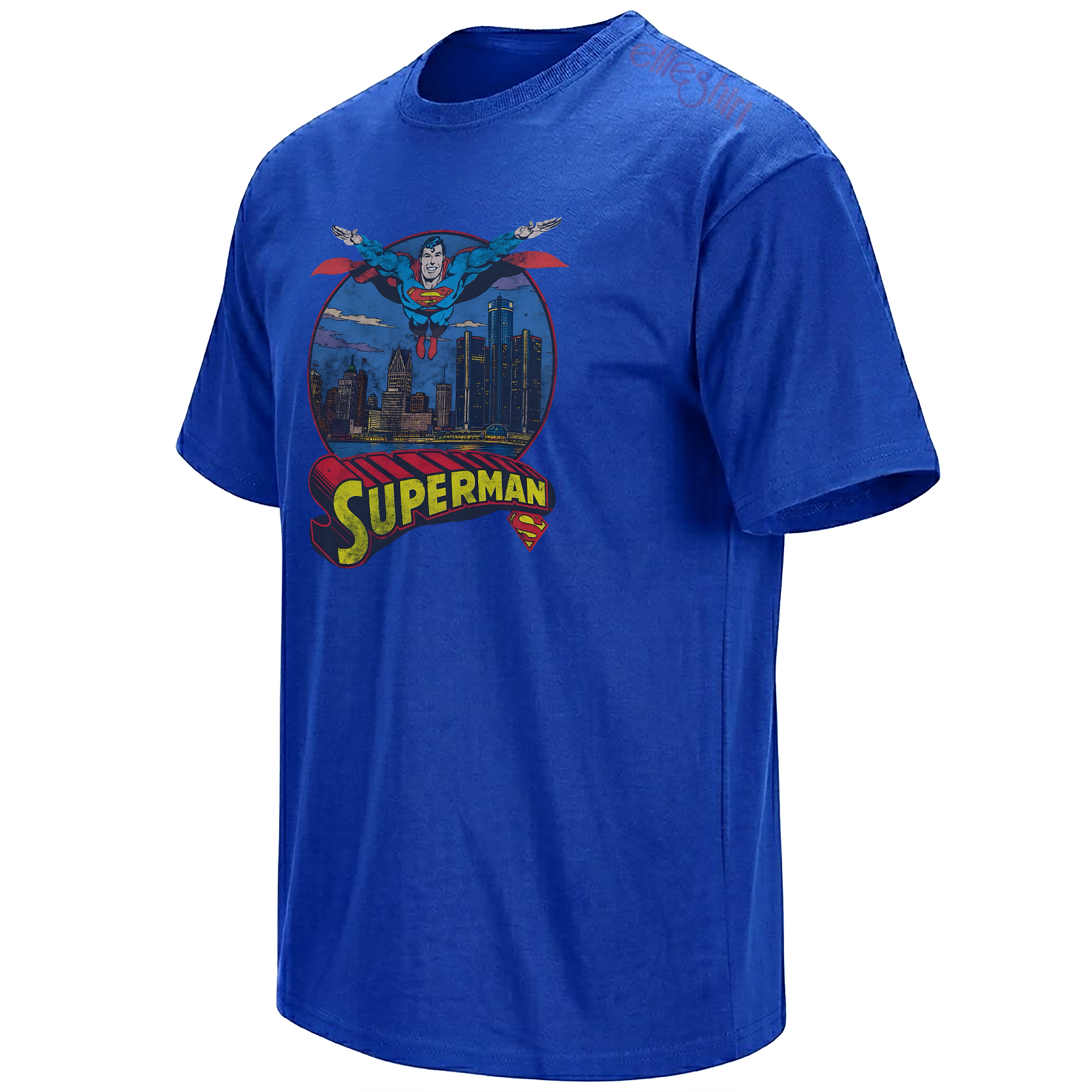
Superman occupies the top of the composition and naturally receives the first glance. Yet the skyline determines what the design actually means.
Without Detroit beneath him, the figure would remain a broad piece of comic nostalgia. With the city filling the circular frame, the flight becomes local protection, local optimism and local ownership.
The skyline also creates historical scale. Superman is temporary movement above buildings that represent decades of Detroit ambition. The image captures a hero passing over a city that has already survived more than any single fictional threat could summarize.
The large distressed SUPERMAN lettering beneath the skyline gives the piece the feel of vintage licensed comic merchandise, while the cityscape prevents it from becoming merely retro.
Classic red, blue and yellow establish immediate superhero recognition. Distressed lettering introduces vintage comic texture, while the dark Detroit skyline and waterfront imagery transform the familiar flying pose into a Motor City tribute.
Jay’s Juniors Gives the Heroism a Human Scale
The strongest connection between Superman and Jay Towers is not the collection, the podcast or the cameo. It is the idea that strength becomes meaningful when directed toward someone else.
Towers founded Jay’s Juniors in 2014 to support children in Metro Detroit facing chronic, life-altering or life-threatening illnesses and the families navigating those realities beside them.
The program became known for creating all-expenses-paid holiday experiences and helping families step temporarily outside the schedules of treatment, appointments and uncertainty.
This changes how the Detroit Superman image can be read. The flying figure still represents fantasy, but the charitable context directs the viewer back toward real people whose courage does not require a cape.
Children confronting serious illness, siblings adapting around medical routines and parents carrying emotional and financial strain already understand forms of bravery that superhero fiction can only symbolize.
The Children Are Not Side Characters
Charity storytelling can sometimes position recipients as background figures inside a celebrity’s heroic narrative. The more respectful interpretation reverses that structure.
Towers helps create access, visibility and memorable experiences. The children and families remain the people performing the difficult work.
In that sense, the Superman image does not need to identify one individual hero. It can represent a shared vocabulary of courage: the broadcaster using his platform, the volunteers organizing support and the families moving through circumstances they never selected.
Detroit’s role is equally important. The initiative grew through local media, local sponsors and a community willing to turn recognition into participation.
Christopher Reeve Changed What Superman Could Represent
Towers’ attachment to Christopher Reeve matters because Reeve’s cultural legacy extends beyond the performance itself.
In Superman: The Movie, Reeve balanced strength with gentleness. His version of the character did not appear heroic only because he could lift impossible weight. He appeared heroic because he made power feel safe.
After the accident that paralyzed him, Reeve’s public advocacy introduced another dimension to the symbol. Courage became connected to disability awareness, medical research and continuing to build purpose after life changed completely.
That legacy makes the Detroit charity connection emotionally coherent. The Superman reference is not limited to muscles, flight or invulnerability. It can also carry hope through vulnerability.
Royal Blue and Black Tell Two Different Detroit Stories
The royal-blue version creates the most direct comic-book energy. The suit, cape and yellow lettering separate clearly from the background, producing a brighter and more optimistic presentation.
It also gives the design the feel of classic superhero merchandise—the kind of shirt that could have existed beside vintage movie posters and comic-store displays.
The black version shifts the emphasis toward the city at night. The skyline becomes more dramatic, the red cape appears stronger and the composition resembles a worn collectible poster.
Royal blue emphasizes hope in flight. Black emphasizes protection after dark.
Why the Design Feels Specifically Motor City
Detroit’s identity has always involved machines, movement and the ability to build objects larger than the people operating them.
Superman introduces a different kind of power into that environment. He is not a car, engine or factory product, yet his presence still feels compatible with a city that understands torque, speed and industrial scale.
The contrast is useful. Motor City mythology frequently centers steel and mechanical strength. Superman adds moral responsibility to the visual vocabulary of power.
The skyline beneath him reminds the viewer that strength exists to serve a place and its people.
A Local Broadcaster Can Become Part of City Mythology
Local media figures occupy an unusual cultural role. They enter homes repeatedly, report crises, participate in celebrations and become familiar without necessarily becoming distant national celebrities.
Towers’ long career across television and radio allowed his interests to become part of his public identity. Detroit audiences did not encounter Superman as a marketing persona introduced overnight. They watched the fandom accumulate over years.
That familiarity helps explain why the Jay Towers connection matters to the design. It links the global icon to a voice already associated with the local morning routine.
Superman comes from another planet. Jay Towers comes through Detroit television and radio. The skyline brings them into the same frame.
The Difference Between a Hero Graphic and a Community Artifact
A standard superhero shirt celebrates a character. A community artifact also records why that character mattered in one place at one time.
The Detroit Superman image contains several layers at once: Christopher Reeve nostalgia, local broadcasting history, the Batman v Superman connection, Motor City pride and the charitable work associated with Jay’s Juniors.
Those layers give the graphic relevance beyond film promotion. It becomes a piece of Detroit cultural memory shaped by the relationship between fandom and service.
The strongest reading is therefore not “Jay Towers is literally Superman.” It is that Superman supplied Towers with a lasting moral and visual language—one he carried into broadcasting, collecting and community work.
Where Detroit Superman Fits Inside Ellie Shirt
The design belongs naturally inside Ellie Shirt’s Movies Shirts collection , where film nostalgia, recognizable characters and culturally specific reinterpretations move beyond standard poster reproductions.
Fans exploring more classic hero imagery can also continue through Ellie Shirt’s Superman-inspired collection point , while the Detroit piece remains distinct because the Motor City skyline and Jay Towers story provide its local identity.
The product itself is available through the Detroit Superman Shirt page in royal blue and black presentations.
Frequently Asked Questions
Who is Jay Towers?
Jay Towers is a Detroit television anchor and radio host known for his work with FOX 2 Detroit and Jay Towers in the Morning, as well as his lifelong enthusiasm for Superman.
Why is Jay Towers connected to Superman?
Towers is a longtime collector and admirer of Christopher Reeve’s Superman, co-hosted a Superman podcast and appeared as a television reporter in Batman v Superman.
What is Jay’s Juniors?
Jay’s Juniors is a Metro Detroit initiative founded by Towers to create support and memorable experiences for children facing serious illnesses and their families.
Why does the design show the Detroit skyline?
The skyline localizes the Superman imagery, transforming the artwork from a generic comic tribute into a statement about Detroit identity, resilience and community pride.
What is the difference between the royal-blue and black versions?
Royal blue emphasizes the bright classic superhero palette, while black gives the design a darker, more vintage and poster-like Motor City atmosphere.
Was Batman v Superman filmed in Detroit?
Significant production took place in and around Detroit, and Jay Towers appeared in the film as a television reporter.
Is this an official DC or Jay Towers product?
No. This Ellie Shirt version is independently created fan-inspired artwork and is not presented as an official product of DC, Warner Bros., Jay Towers or Jay’s Juniors.
The Detroit Superman skyline graphic connects classic superhero hope with Jay Towers’ local legacy and the community spirit surrounding Jay’s Juniors.
Detroit Superman Shirt features the classic hero flying above the Motor City skyline in a vintage comic composition inspired by Jay Towers, Christopher Reeve nostalgia and Detroit’s culture of resilience and community care.