
Brunson Between Jordan and Kobe: What the NBA GOATS Image Really Means
The graphic does not need to argue that Jalen Brunson has already matched Michael Jordan’s or Kobe Bryant’s complete career. Its power comes from placing New York’s new champion inside a visual lineage of pressure, willpower and Finals-stage authority.
The championship changed which comparisons New York was willing to make out loud. Before June 2026, Jalen Brunson was celebrated as the guard who revived the Knicks, outperformed expectations and restored late-game belief inside Madison Square Garden.
After 45 points in the title-clinching Game 5, a Bill Russell Finals MVP Trophy and the franchise’s first championship since 1973, the language expanded. Brunson was no longer discussed only beside modern Knicks stars. Fans began placing him inside the visual vocabulary reserved for basketball icons.
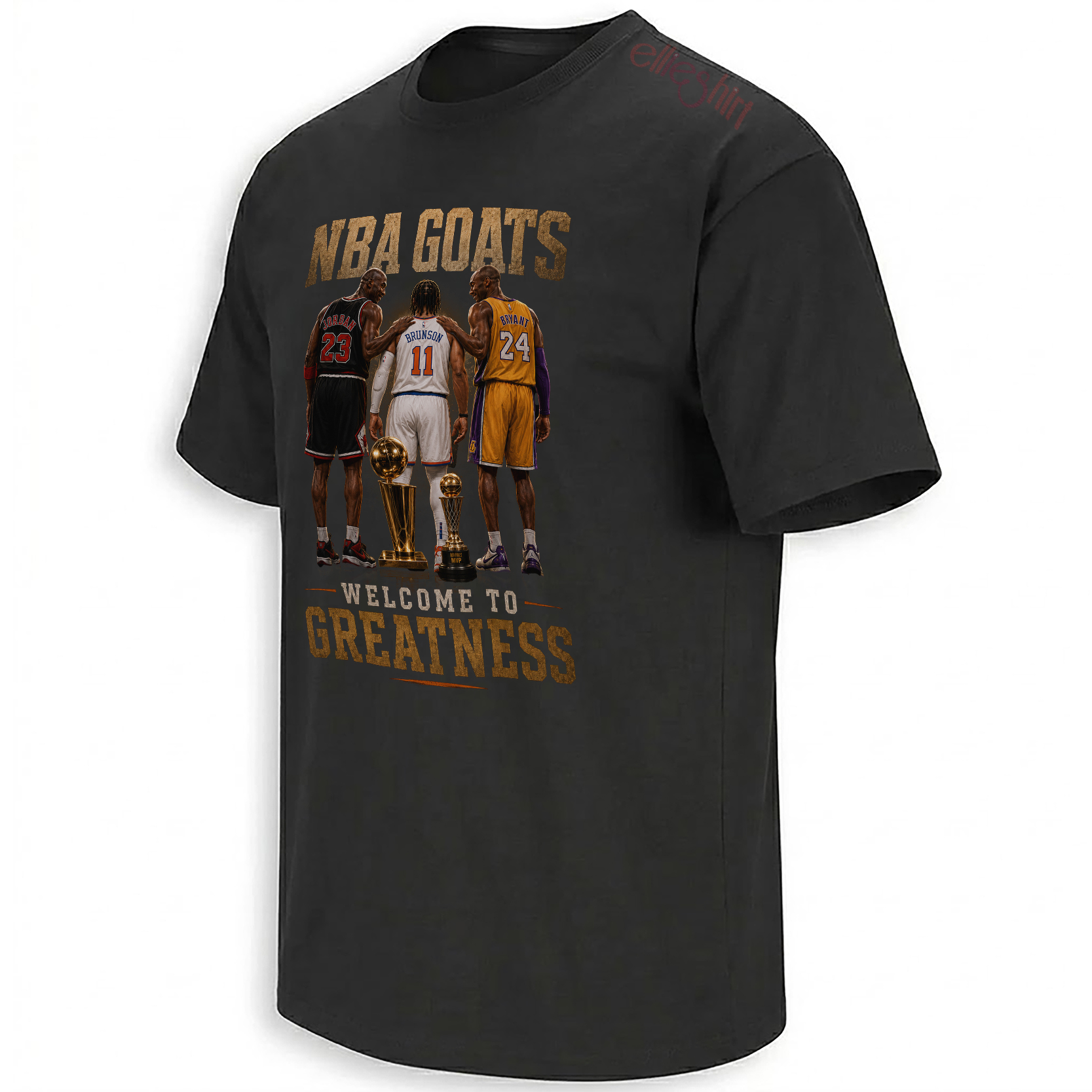
The NBA GOATS graphic makes that expansion literal. Michael Jordan stands on one side, Kobe Bryant on the other and Brunson occupies the center with the championship and Finals MVP trophies that changed his place in New York history.
The design is not a finished all-time ranking. It is a fan’s declaration that Brunson has entered the championship conversation where basketball mentality becomes mythology.
Jordan and Bryant built multi-decade careers with eleven combined NBA championships and eight combined Finals MVP awards. Brunson’s placement between them should be understood as symbolic fan art centered on mentality and his 2026 breakthrough—not as a statistical claim that their complete résumés are already equal.
The Comparison Began With Mental Toughness
The most credible connection between the three players was articulated before Brunson won the Finals. Longtime Knicks broadcaster Mike Breen praised Brunson’s “iron will” and described him as one of the mentally strongest players he had encountered.
Breen then invoked Jordan and Bryant specifically. He was not arguing that Brunson had already accumulated the same rings, scoring records or global influence. He was identifying a quality that can exist before the résumé becomes complete: the ability to remain psychologically stable while the stakes become increasingly hostile.
That distinction fits Brunson’s entire postseason. He did not resemble Jordan or Bryant physically. He lacked their height, explosive elevation and defensive reach. His championship game was built from balance, footwork, pace manipulation, strength and the refusal to appear hurried by the scoreboard.
Brunson’s resemblance therefore exists in competitive behavior rather than body type. He continued asking for the ball. He accepted the late possession. He treated pressure as a place to work rather than something to escape.
Game 5 Gave the Artwork Its Evidence
Fan mythology becomes stronger when it can attach itself to one undeniable night. For Brunson, that night arrived in San Antonio.
The Knicks entered Game 5 one victory from the championship but quickly found themselves inside another difficult comeback. San Antonio led by double digits, New York’s offense struggled and the possibility of extending the series remained alive.
Brunson responded with 45 points—nearly half of the Knicks’ 94-point total. He scored 15 in the fourth quarter and produced 13 consecutive New York points during the sequence that moved the title within reach.
The performance established a Knicks record for points in an NBA Finals game. More importantly, it gave the championship a central author. New York did not merely survive the closeout. Its captain controlled it.
The image of Brunson holding the Finals MVP trophy therefore belongs at the center of the design. It is the object that allows the fan comparison to move beyond admiration and into championship symbolism.
Brunson’s title, 45-point closeout and Finals MVP award do not complete a Jordan- or Kobe-level career. They create the first championship chapter substantial enough for fans to place his image beside theirs.
Why Brunson Stands in the Middle
The center position carries the design’s argument. Brunson is not placed behind the two retired legends as a student looking upward. He stands between them as the contemporary figure through whom the older ideas are being reactivated.
Jordan represents the championship standard. Bryant represents inherited obsession and the continuation of that standard into another generation. Brunson represents a current player whose 2026 run reminded viewers that competitive mythology is continually rebuilt.
His placement also reflects the present tense of fandom. Jordan and Bryant already exist as settled historical icons. Brunson’s story is still moving. The design therefore places the active figure at the center because his meaning is being negotiated now.
That choice creates tension. Some viewers will reject the word “GOATS” as premature. Others will understand it as emotional rather than statistical language. The debate is part of the design’s function.
Jordan Set the Championship Image
Michael Jordan remains inseparable from the modern idea of the basketball GOAT. Six championships, six Finals MVP awards, scoring dominance and a global cultural impact made him the reference point against which nearly every later perimeter superstar is measured.
Jordan’s influence extends beyond accomplishments. He established a visual language of competitive finality: the isolated scorer, the decisive possession, the suspended jump shot and the belief that the game’s largest moment should narrow toward one player.
Brunson’s 2026 Finals did not reproduce Jordan’s athletic style. It did reproduce part of the narrative structure. When New York needed the championship possession stabilized, the ball moved toward its captain.
The comparison is therefore about responsibility. Jordan became the symbol of a team’s confidence that one player could carry the final decision. Brunson earned a similar role for the Knicks, even though the scale and duration of their careers remain dramatically different.
Kobe Turned the Standard Into a Mentality
Kobe Bryant openly studied Jordan. His footwork, shot creation and approach to competitive preparation became one of basketball’s clearest examples of a player attempting to inherit greatness consciously.
“Mamba Mentality” eventually became larger than any single performance. It described relentless repetition, uncomfortable goals and a willingness to pursue difficult mastery even when failure remained visible.
That language connects naturally to Brunson because his game also looks built rather than granted. He is not celebrated primarily for overwhelming natural dimensions. Fans see hours of repetition inside the pivots, balance, deceleration and finishes over larger defenders.
Brunson’s relationship to Bryant also carries direct inspirational meaning. Stories about Bryant challenging younger players to want to become the best fit the ethic Brunson later displayed through his own preparation.
The visual pairing therefore does not suggest imitation. It suggests transmission: Jordan helped define the standard, Bryant turned it into a named mentality and Brunson carries a version of that competitive discipline into a new team and era.
Black and Navy Change the Tone of the Same Legacy
Both versions use darkness to create distance from ordinary team merchandise. The composition is intended to feel like a shrine, poster or imagined Hall of Fame wall rather than a bright celebration graphic.
On black, the figures appear almost suspended outside time. The shadows flatten team distinctions and allow skin tones, trophy highlights and the “NBA GOATS” typography to carry the composition. This version feels universal and cinematic.
Navy introduces a quieter connection to Brunson’s New York identity. It remains dark enough to preserve the legacy mood, but the blue ground pulls the central figure closer to the Knicks without forcing the entire graphic into orange-and-blue team branding.
The restrained palette is important because the three men belong to different franchises and eras. A fully Knicks-colored design would make Jordan and Bryant feel absorbed into Brunson’s team identity. Black and navy allow the common idea—basketball greatness—to sit above franchise color.
The deepest, most monument-like treatment, emphasizing silhouette, trophies and the separation between legend and ordinary time.
See the black presentation →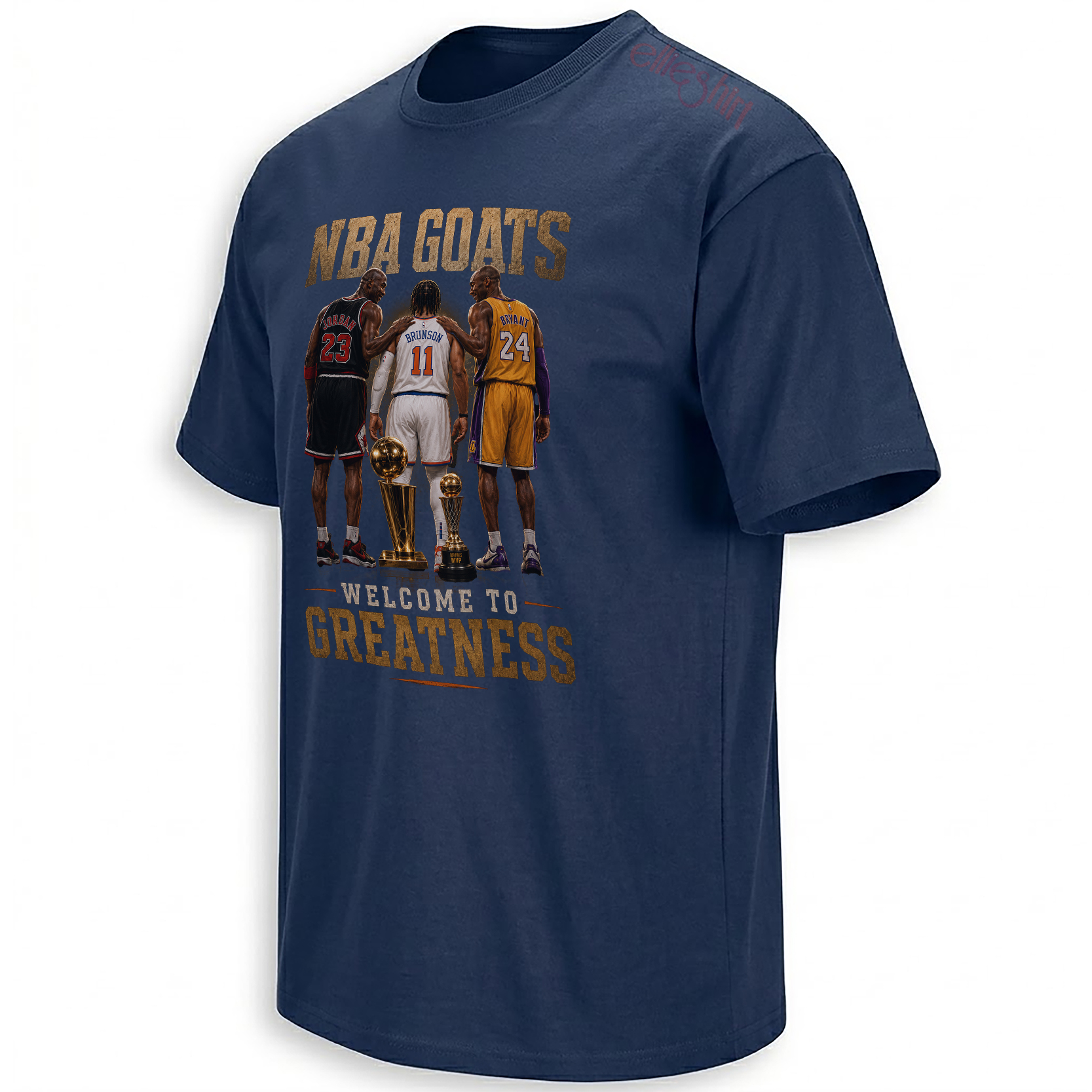
A dark-blue version that preserves the historical tone while subtly drawing the center figure back toward New York basketball.
Explore the navy presentation →The Word “GOATS” Is Fan Language, Not a Court Ruling
Greatest-of-all-time debates are rarely resolved by one universal formula. Some fans prioritize championships. Others focus on peak performance, longevity, statistics, influence, defense or the quality of competition.
The plural “GOATS” accepts that instability. It does not attempt to remove Jordan and crown one replacement. It creates a group of figures who represent different versions of greatness.
That flexibility makes room for Brunson without requiring the viewer to believe he has already surpassed decades of history. He can be included as New York’s championship GOAT, the defining Knicks player of this era or a symbol of elite competitive mentality.
Fan apparel often uses language at the speed of emotion. A city waits fifty-three years, its captain scores 45 points to end the wait and “great Finals performance” suddenly feels insufficient. The vocabulary escalates because the feeling has escalated.
The shirt records that escalation.
Brunson’s Greatness Looks Different
Jordan and Bryant were visually built for basketball mythology. Their height, elevation, footwork and shot-making created iconic frames even when the viewer removed the context of the game.
Brunson’s greatness often reveals itself through sequence rather than spectacle. A shoulder angle creates space. A pivot changes the defender’s balance. A deceleration opens a lane that did not appear available. The finish arrives after the defense has been manipulated rather than physically overwhelmed.
That difference strengthens the fan connection. Brunson’s game appears learnable enough to understand but difficult enough to remain elite. Viewers can see the logic, even when they cannot reproduce the execution.
His rise also challenges the standard visual profile of a championship centerpiece. He is smaller than most players assigned that role and does not rely on the above-the-rim dominance associated with many historic Finals stars.
By winning without changing that identity, Brunson expanded the range of bodies and styles fans can imagine at the center of a championship.
One Championship Changes a Career, Not the Entire Ranking
Brunson’s title should be celebrated without requiring historical exaggeration. The championship permanently changes his career. It does not instantly complete every argument.
He is now a Finals MVP, the central player on a championship team and the author of one of the greatest games in Knicks history. Those facts are substantial enough without inventing additional accomplishments.
Jordan’s six-title résumé and Bryant’s five championships were constructed over many seasons. Brunson’s future remains open. He may add more titles, awards and iconic performances, or the 2026 run may remain the defining peak of his career.
The design lives in that uncertainty. It shows how fans feel immediately after the breakthrough, before historical distance has simplified the story.
New York Needed Its Own Figure in the National Pantheon
Knicks history contains Hall of Famers, champions and beloved cultural figures, but modern NBA greatness has often been narrated through stars wearing other uniforms.
Jordan dominated New York as an opponent. Bryant brought Lakers celebrity into Madison Square Garden and treated the arena as one of basketball’s largest stages. Knicks fans admired both while waiting for a contemporary player capable of producing equivalent emotional authority for their own team.
Brunson supplied that figure.
His place between Jordan and Bryant is therefore also a New York correction. The city no longer has to participate in greatness only by hosting visiting legends. It has a current Finals MVP whose championship image belongs at the center of its own basketball culture.
The dark palette removes the three players from ordinary game photography and places them inside a shared legacy space. Jordan’s No. 23 and Bryant’s No. 24 frame Brunson’s No. 11, while the championship and Finals MVP trophies explain why the current Knicks captain has been invited into the image.
A Legacy Graphic Is Really About Transmission
Basketball culture continually passes ideas from one generation to another. Younger players borrow footwork, study film, adopt training habits and inherit language created by older stars.
Jordan influenced Bryant. Bryant influenced a generation that treated preparation as identity. Brunson belongs to that later generation, but he adapted the inherited mentality to a different physical and tactical profile.
The design compresses that process into three figures. It does not show a literal meeting or claim an official succession. It shows how fans understand basketball history: through visual chains of influence.
Brunson stands in the present, but the image around him is built from the past.
Where the NBA GOATS Piece Fits Inside the Knicks Championship Archive
Most Knicks championship graphics preserve a specific event: Brunson’s Finals MVP award, Anunoby’s tip-in, the starting five or the final score.
The NBA GOATS design performs a different task. It places the event inside league history.
The artwork asks how Brunson’s 2026 breakthrough should be interpreted beyond New York. Its answer is deliberately ambitious: not simply as a great Knicks season, but as a performance associated with basketball’s most demanding competitive lineage.
That piece belongs inside Ellie Shirt’s New York Knicks Shirts collection , where Brunson’s championship, Finals MVP performance and transformation into a city icon form the central narrative of the 2026 title.
The wider NBA Shirts collection follows the larger league mythology in which numbers, trophies, historic players and fan debates become a visual language extending far beyond one game.
Frequently Asked Questions
Why does the NBA GOATS design place Brunson between Jordan and Kobe?
The composition connects Brunson’s 2026 championship mentality with two historic perimeter stars strongly associated with competitive will, late-game responsibility and Finals success.
Does the design claim Brunson already has a better career than Jordan or Bryant?
No. The placement is symbolic fan art centered on mentality and Brunson’s championship breakthrough. Jordan and Bryant still hold much larger career résumés.
What did Mike Breen say about Brunson’s mentality?
Breen praised Brunson’s iron will and said that, in terms of mental toughness, he would place him in rare company with players such as Michael Jordan and Kobe Bryant.
What did Brunson accomplish in the 2026 NBA Finals?
Brunson led the Knicks to a 4–1 victory over San Antonio, scored 45 points in the title-clinching Game 5 and received the Bill Russell NBA Finals MVP Trophy.
How many Finals MVP awards did Jordan and Bryant win?
Michael Jordan won six Finals MVP awards, while Kobe Bryant won two. Brunson won his first in 2026.
Why are the black and navy versions so dark?
The dark backgrounds create a legacy-poster atmosphere, allow the figures and trophies to dominate and avoid tying all three players to one franchise color palette.
Is the NBA GOATS design officially affiliated with the players or NBA?
No. It is an independently created fan-culture artwork and is not an official product of Jalen Brunson, Michael Jordan, Kobe Bryant’s estate, the Knicks, Bulls, Lakers or NBA.
The NBA GOATS Brunson, Jordan and Kobe graphic places New York’s Finals MVP inside a symbolic lineage of championship mentality, while the wider Knicks championship archive follows the performances and citywide moments that earned Brunson his place at the center.
NBA GOATS Shirt places Jalen Brunson and his 2026 championship trophies between Michael Jordan and Kobe Bryant, framing his Finals MVP breakthrough through the visual language of competitive mentality and basketball legacy.