
Jesus Is King: How Faith Entered New York’s Championship Celebration
The Knicks’ 2026 title belonged to basketball, but the language surrounding it also included prayer, gratitude and public declarations of Christian faith. “Jesus Is King” places that spiritual message inside the orange-and-blue visual identity of New York’s championship season.
When the final horn sounded in San Antonio, New York responded with every language available to it. There were chants, tears, fireworks, car horns, subway celebrations and decades of basketball frustration released into the streets.
For some Knicks players and supporters, there was another language inside that celebration: faith. Championship interviews and social posts included gratitude to God, while churches and faith communities across the region had already been following the Finals through prayer, watch parties and their own interpretations of what fifty-three years of waiting meant.
The phrase “Jesus Is King” enters that moment without claiming that basketball success proves divine preference. It makes a different statement. Championships change, teams rise and fall, and even the most historic sports victory remains temporary. For Christian fans, the sovereignty expressed in the slogan exists above the scoreboard.
The Knicks could become champions for one season. “Jesus Is King” points toward an authority Christian fans understand as permanent.
This design expresses a Christian belief through New York basketball colors. It should not be read as claiming that every Knicks player or supporter shares the same religion, or that the championship represents proof of divine favoritism toward one team.
The Championship Produced More Than One Kind of Testimony
Sports celebrations often reveal what athletes consider larger than the performance itself. Some players thank family, coaches and teammates. Others speak about sacrifice, adversity or the communities that shaped them. Christian athletes may also direct attention toward God.
Josh Hart had publicly identified himself as a follower of Christ before the Finals. After the Knicks completed the championship, his response continued that pattern by giving glory to God rather than treating the trophy as the final source of meaning.
That testimony fit naturally with Hart’s public basketball identity. His game is built around service inside the lineup: rebounding, transition work, loose balls and possessions that do not always produce individual recognition. Faith language can frame that labor as stewardship rather than status.
The design does not need to place Hart’s name on the graphic to belong inside the same cultural environment. “Jesus Is King” represents the wider Christian vocabulary present whenever athletes and fans interpret success through gratitude rather than ownership.
Why “Jesus Is King” Is Different From “Knicks Are Champions”
Championship language is intentionally absolute. Teams print “World Champions,” cities declare themselves the center of basketball and fans temporarily organize the world around one trophy.
The Christian phrase introduces another hierarchy.
“Knicks are champions” describes an achievement earned during the 2025–26 NBA season. “Jesus Is King” expresses a theological belief that does not depend on the result of Game 5, Jalen Brunson’s 45 points or the end of New York’s title drought.
Placing the two visual worlds together creates productive tension. The design uses the excitement and colors of the championship while refusing to make basketball the highest object of devotion.
For Christian Knicks fans, that distinction is the point. They can celebrate the title intensely while maintaining that sports remain beneath faith.
Knicks orange and royal blue establish the basketball moment. The cross-centered Christian message changes the hierarchy, making the season a setting for faith rather than the source of faith.
A Christian Message Written in New York Basketball Type
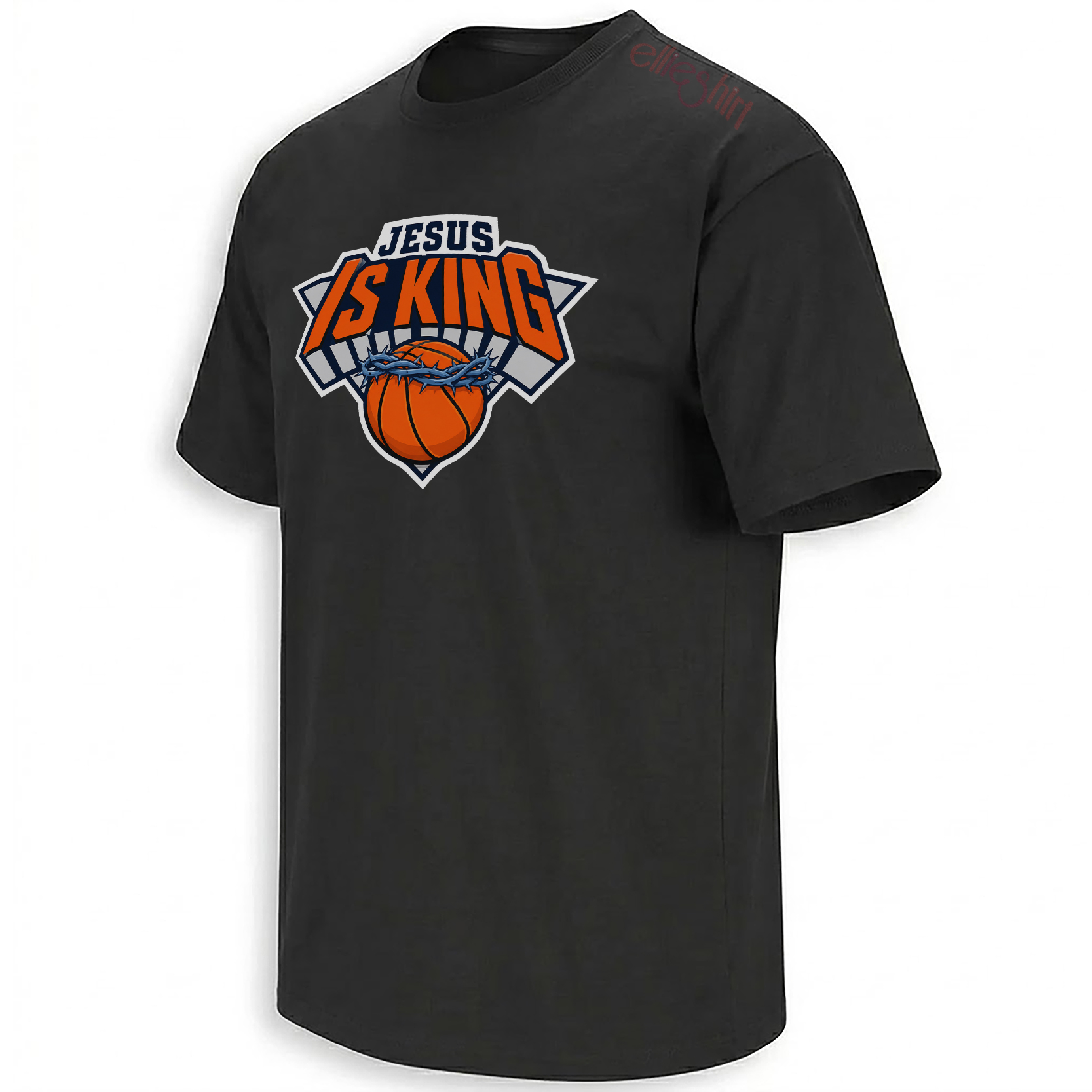
The design’s strength comes from immediate visual recognition. The viewer first encounters a bold sports composition: stacked lettering, thick outlines, high contrast and the orange-and-blue palette associated with the Knicks.
Only then does the full message settle into place.
“JESUS” receives the visual weight usually reserved for a team name or championship headline. “IS KING” operates as the title statement beneath it, transforming the familiar shape of arena apparel into a declaration of faith.
The result is neither conventional church typography nor an ordinary basketball logo. It sits between the two worlds. Athletic lettering gives the Christian statement public energy, while the religious message gives the sports palette a purpose beyond team identification.
Black and Blue Create Two Different Emotional Readings
The two versions preserve the same message but change the atmosphere surrounding it.
On black, the graphic feels like a proclamation under arena lights. The darker ground removes distraction and allows the outlined letters to appear illuminated. Orange becomes warmer, royal blue becomes deeper and white works almost like a spotlight around the central words.
On blue, the piece feels more directly connected to New York basketball identity. The background becomes part of the team palette, making the message read like a fan emblem rather than a detached slogan placed over a neutral surface.
Neither version changes the theology. The difference is cultural tone. Black emphasizes declaration. Blue emphasizes belonging.
A high-contrast version that reads like a Christian proclamation illuminated inside a championship arena.
See the black presentation →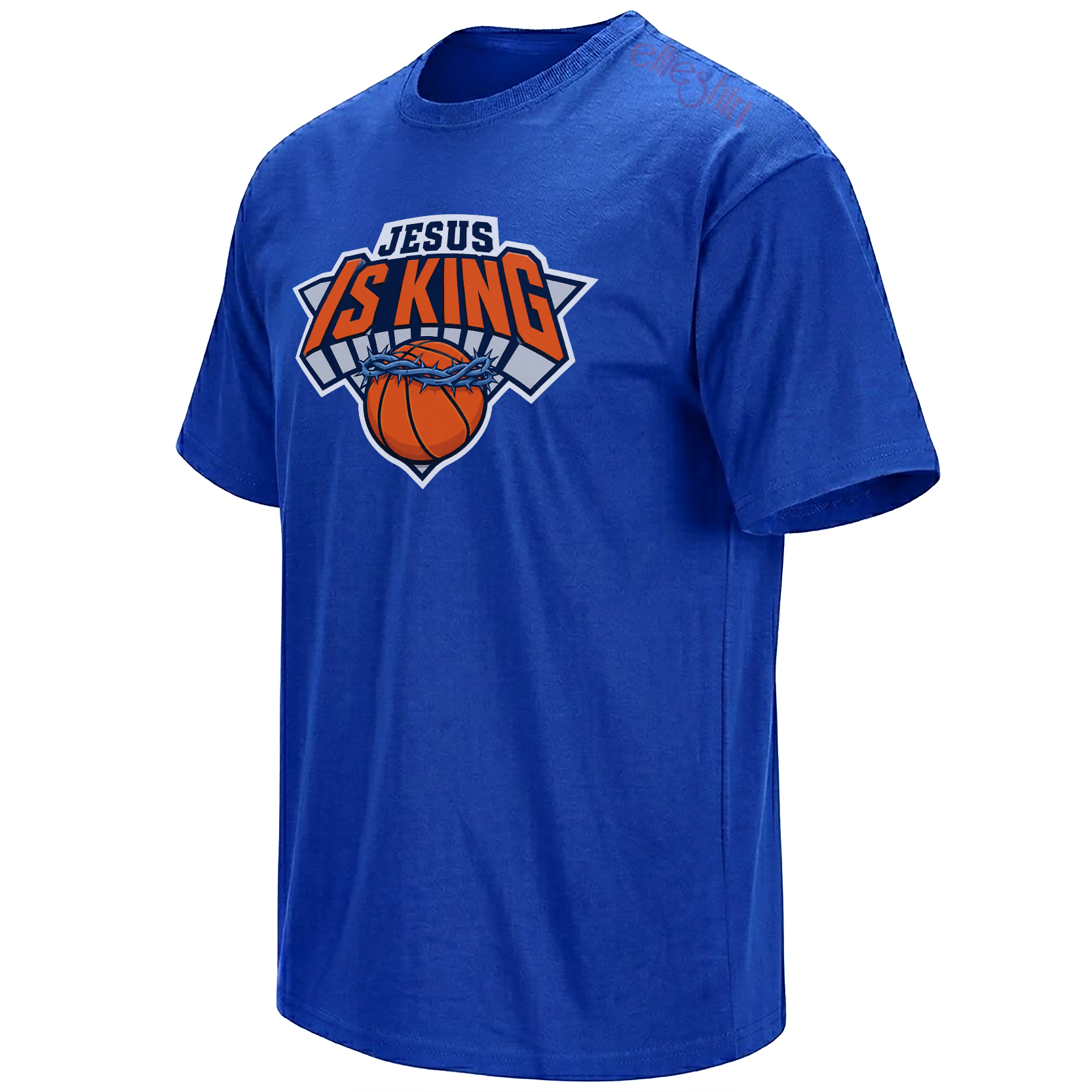
A team-color treatment that places Christian identity directly inside New York’s orange-and-blue basketball culture.
Explore the blue presentation →Faith Was Already Present Around the 2026 Finals
Religion entered the Finals conversation through several different routes. Three central Knicks—Brunson, Hart and Mikal Bridges—shared a Villanova background, connecting the roster to an Augustinian Catholic university with its own language of community, service and formation.
Villanova’s connection to Pope Leo XIV added another layer to the public discussion. Spike Lee had received a signed Knicks jersey from the pope and wore it during the Finals, turning the courtside garment into one of the postseason’s most unusual faith-and-fandom images.
Outside the arena, churches and clergy across the New York area incorporated Knicks watch parties, prayers and championship hope into community gatherings. The Finals became part of weekly life rather than something sealed off from religious identity.
San Antonio brought its own visible faith story through the Catholic nuns whose support became part of Spurs fan culture. The result was a championship series in which religious symbolism appeared on both sides without determining what happened on the floor.
Faith did not replace basketball analysis. It gave some fans another framework through which to experience the anxiety, hope and gratitude surrounding the series.
Why Sports and Faith Continue to Overlap
Sports place people inside conditions that naturally produce spiritual language. Outcomes remain uncertain. Control is limited. Preparation matters, yet preparation does not guarantee success. Bodies fail, careers change and a single bounce can alter years of work.
Faith offers some athletes a way to live inside that uncertainty without pretending to control it.
A Christian player may pray for strength, peace or the ability to compete well rather than asking for God to choose one team over another. A fan may pray through anxiety while still understanding that the final score is not a theological verdict.
That distinction protects faith from becoming superstition. God is not reduced to a lucky charm, and a championship is not treated as evidence that one group is more righteous than its opponent.
The “Jesus Is King” message is strongest when understood in that way. It is not a prediction that the Knicks will win because Christian language appears near the team. It is a statement meant to remain true for the believer whether the team wins or loses.
Josh Hart’s Faith Fits the Way He Plays
Hart’s public Christian identity became particularly meaningful because his role rarely depended on conventional star treatment.
He rebounded against larger players, ran the floor, defended multiple positions and continued possessions after the first plan had failed. His value often appeared in work that could be overlooked when attention moved toward scoring totals.
Christian sports language frequently emphasizes service, humility and using individual gifts for a collective purpose. Hart’s game gives those ideas a visible basketball form.
None of that means every rebound should be turned into a sermon. It means fans who know Hart’s faith can understand why giving glory to God after the championship did not appear suddenly or opportunistically.
The statement continued a public identity already visible before the trophy ceremony.
The Design Does Not Need a Player’s Face
Many championship graphics depend on portraits. Brunson represents the Finals MVP story. OG Anunoby represents the Game 4 comeback. Starting-five artwork represents the completed lineup.
This design deliberately removes the athlete.
That absence keeps the declaration universal. The message does not belong exclusively to Hart, Brunson, Towns or any other member of the roster. It belongs to the wearer expressing Christian faith through the visual culture of New York basketball.
The lack of a portrait also prevents the shirt from implying that a specific player endorsed the exact design. It references a cultural environment without putting words into an athlete’s mouth.
In that sense, the artwork is closer to a fan testimony than a player tribute.
Championship Euphoria and the Christian Idea of Kingship
New York’s championship celebration repeatedly used royal language. Brunson was called the “King of New York.” The Knicks were described as rulers of basketball. Parade plans and trophy images turned the roster into civic royalty.
Christian kingship language functions differently.
“Jesus Is King” does not describe popularity, statistical dominance or civic affection. It expresses authority grounded in Christian belief about Christ’s identity, sacrifice and resurrection.
The phrase therefore both participates in and challenges championship language. It uses the emotional force of the word “King” while redirecting the title away from athletes.
A Christian fan can call Brunson the king of New York as sports hyperbole while understanding that the word carries a separate and more serious meaning in faith.
Why the Orange-and-Blue Palette Matters
Without Knicks colors, “Jesus Is King” would remain a broad Christian phrase found across music, streetwear, church culture and contemporary faith apparel.
Orange and blue give it a place and a moment.
They connect the declaration to Madison Square Garden, the championship streets of New York and the emotional atmosphere created when the Knicks ended a fifty-three-year drought.
The color treatment also reflects how identity works in fan culture. People often combine affiliations rather than separating them. A person can be Christian and a Knicks supporter, a New Yorker and a basketball fan, a member of a church and part of an arena crowd.
The design does not force those identities to compete. It arranges them in order.
Bold athletic type gives the Christian phrase the scale of a championship headline. Orange and royal blue establish Knicks-era energy, while white and gold accents introduce clarity, light and a restrained sacred tone without turning the artwork into a conventional church graphic.
Faith Apparel as Public but Personal Language
Religious clothing functions differently from ordinary team apparel because the message is both public and personal.
A team logo says which group someone supports. A Christian declaration communicates something about how the wearer understands identity, authority and meaning.
Combining the two can create conversation. Some viewers will first recognize the Knicks palette. Others will read the faith statement before noticing the basketball reference.
The design succeeds because neither layer disappears. It remains recognizably Christian and recognizably New York basketball.
That makes it a cultural crossover rather than a generic slogan recolored in team tones.
Where “Jesus Is King” Fits Inside the Knicks Championship Archive
The 2026 Knicks title generated graphics built around scores, trophies, comebacks, player portraits and New York landmarks. Each records a different part of the season.
“Jesus Is King” records the spiritual language some fans and players carried into the celebration.
It does not attempt to summarize every game or identify the entire roster. Its purpose is to preserve the intersection between Christian identity and a historic New York basketball moment.
That design belongs inside Ellie Shirt’s New York Knicks Shirts collection , where championship images, player stories, city language and cultural crossovers form a running record of the 2026 season.
The broader NBA Shirts collection follows the wider visual culture of basketball, including the beliefs, communities and identities fans bring with them into arenas and championship celebrations.
Frequently Asked Questions
What does “Jesus Is King” mean in Christian belief?
The phrase expresses the Christian belief that Jesus Christ holds ultimate spiritual authority. It is not dependent on a sports result, political office or temporary cultural status.
Why does the design use Knicks-inspired colors?
Orange, royal blue and white connect the Christian declaration to New York basketball culture and the emotional atmosphere surrounding the Knicks’ 2026 championship.
Is the design based on a direct Jalen Brunson quote?
No. The design is a broader Christian basketball statement and should not be interpreted as placing the exact phrase in Brunson’s mouth.
Which Knicks player publicly discussed Christian faith during the championship run?
Josh Hart has publicly described himself as a follower of Christ and gave glory to God after the Knicks won the 2026 NBA championship.
Does the message suggest God favored the Knicks over the Spurs?
No. The design expresses Christian faith through basketball culture. It does not claim that a championship result proves divine preference for one team.
What is the difference between the black and blue versions?
The black version creates stronger contrast and a proclamation-like arena mood, while the blue version places the message more directly inside New York’s basketball color identity.
Is the Jesus Is King design officially affiliated with the Knicks or NBA?
No. It is an independently created Christian fan-culture design and is not an official product of the New York Knicks, the NBA or any individual player.
The Jesus Is King basketball graphic places Christian faith inside New York’s orange-and-blue championship culture, while the wider Knicks championship archive follows the players, city moments and cultural language surrounding the 2026 title.
Jesus Is King Shirt combines a Christian declaration of faith with New York basketball colors, connecting gratitude, Josh Hart’s public testimony and the spiritual side of the Knicks’ 2026 championship celebration.