Why Not Oklahoma? How the Sooners Turned an Unlikely Omaha Run Into a Rally Cry
Oklahoma entered the NCAA Tournament without the profile of an obvious national finalist. Then the Sooners began winning, freshman arms grew fearless, the lineup discovered another level of power and “Why Not Oklahoma?” became less of a question than a postseason identity.
On the eve of the 2026 Men’s College World Series championship series, Oklahoma stood three wins from a national title and still carried the language of an underdog. The Sooners had gone unbeaten through their Omaha bracket, defeated Alabama 9–0 and beaten Georgia twice to reach a best-of-three final against North Carolina.
Their most recent victory was the loudest. Oklahoma hit five home runs in an 11–4 semifinal win over a Georgia team that had entered Omaha with one of college baseball’s most dangerous offenses. The Sooners were no longer surviving the bracket. They were controlling it.
That is the precise moment when “Why Not Oklahoma?” becomes powerful. It remembers the doubt without allowing the doubt to define the team. The question invites every earlier prediction, every uneven stretch and every reason the run seemed unlikely—then answers them with another victory.
“Why not?” is what a team asks when the résumé says surprise but the baseball being played says contender.
The Phrase Begins With Doubt—and Turns It Into Fuel
Most championship slogans speak from certainty. They promise victory, declare dominance or present a team as the inevitable center of the event.
“Why Not Oklahoma?” begins from another emotional position. It acknowledges that the Sooners were not the tournament’s simplest prediction and that their regular season had not followed a clean path toward the finals.
Oklahoma finished 14–16 during its second SEC regular season and entered the NCAA field as an at-large team. The Sooners had enough talent to belong in the bracket, but not the smooth record that normally protects a contender from doubt.
The question converts that doubt into permission. A team does not need to explain why every earlier game looked uneven. It only needs to ask why the next win cannot belong to Oklahoma.
A difficult SEC schedule and an uneven finish kept Oklahoma outside the most obvious group of national-title favorites.
Once tournament play began, stronger pitching and sudden power changed the Sooners from a bracket participant into a postseason problem.
Every win made the question easier to answer: there was no remaining reason Oklahoma could not finish the run.
The Artwork Treats the Question Like a Stadium Chant
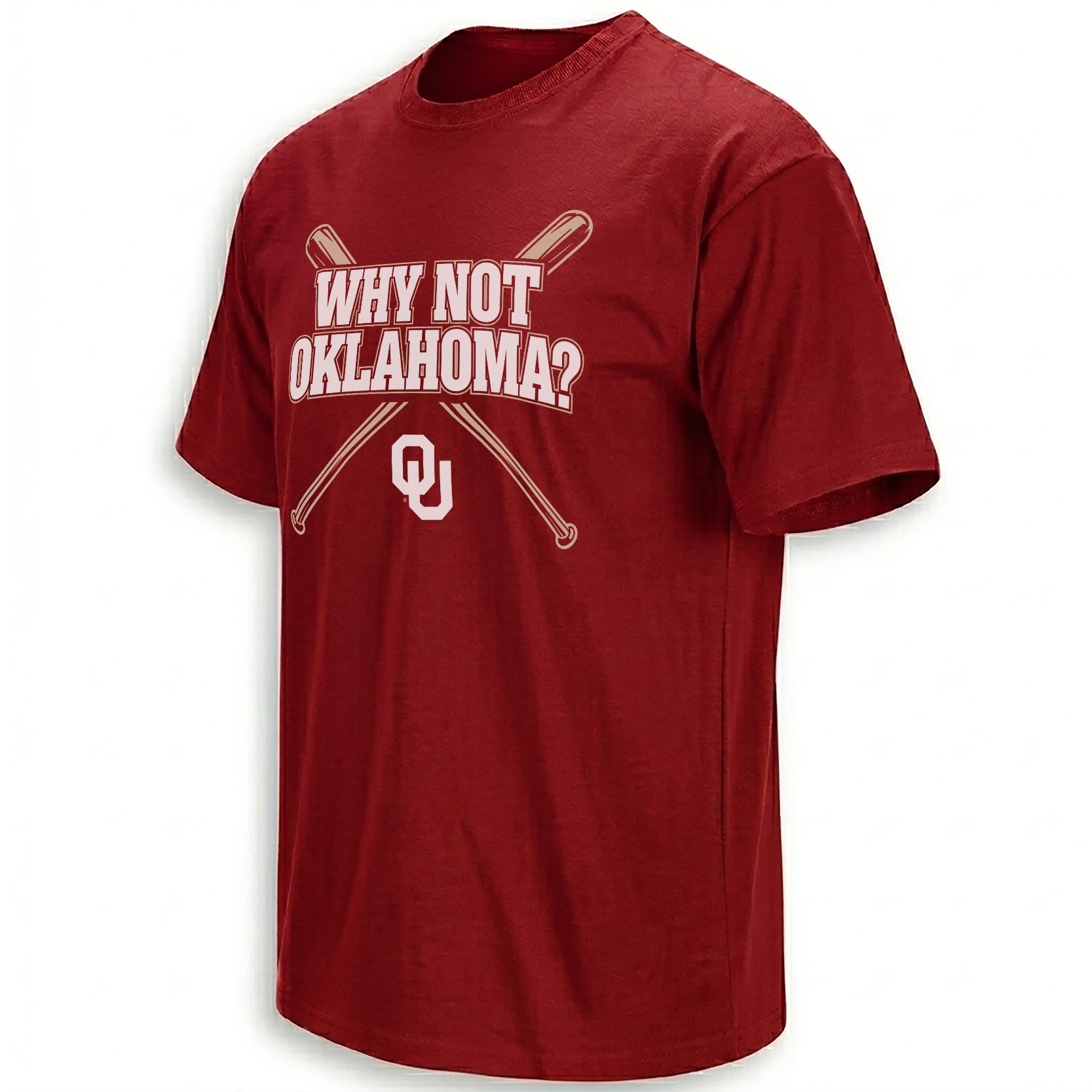
The Why Not Oklahoma design does not present the slogan as a cautious thought. The typography is oversized, stacked and built to be read like a chant passing through a section of crimson-clad supporters.
“Why Not” creates the invitation. “Oklahoma” supplies the answer through scale, color and school identity.
The composition works because the slogan does not require one player to carry the entire meaning. This is a team-era statement rather than an individual portrait. It belongs to the freshman pitchers, veteran hitters, coaching staff and fans traveling toward Omaha with increasing confidence.
The Sooners Did Not Reach Omaha Through One Kind of Win
Tournament teams reveal themselves through variety. A roster that can win only when the offense explodes becomes vulnerable when the wind changes, a pitcher dominates or one defensive mistake decides the night.
Oklahoma’s Omaha path included several different versions of control.
Against Alabama, the Sooners won 9–0 behind seven shutout innings from freshman left-hander Cord Rager. The lineup produced eleven hits, but the game’s emotional center was the absence of Alabama offense.
Against Georgia in the winners’ bracket, Oklahoma protected an early advantage and survived a late push for a 4–3 victory. The margin was narrow, the pressure remained active and the Sooners demonstrated that their run did not require a comfortable lead.
In the semifinal rematch, the offense changed the scale completely. Five home runs powered an 11–4 win and sent Oklahoma into the championship series without a loss in Omaha.
- 9–0 over Alabama: Cord Rager delivered seven shutout innings, and Oklahoma opened its Omaha stay with complete control.
- 4–3 over Georgia: The Sooners protected an early lead and proved they could survive a close game against elite power.
- 11–4 over Georgia: Five home runs transformed the semifinal into a statement and completed an unbeaten bracket.
- North Carolina next: The question now moves into a best-of-three championship series with the national title directly ahead.
Freshman Pitching Changed Oklahoma’s Postseason Ceiling
College baseball often asks young pitchers to become older immediately. The postseason removes the gradual rhythm of development and places every mistake inside an elimination structure.
Oklahoma’s freshmen responded by making the stage appear smaller than it was.
Rager’s Omaha opener became the clearest example. He allowed only three hits across seven shutout innings, struck out eight and did not issue a walk against Alabama.
Xander Mercurius brought another young arm into the center of the run, giving Oklahoma a second freshman capable of handling meaningful innings against national-level lineups.
Their calm changed the entire roster’s possibilities. When young starters provide length, the bullpen remains flexible and the offense can play without feeling that every early opportunity must produce a run.
Power Arrived at the Exact Moment Oklahoma Needed It
During the regular season, Oklahoma’s offense did not look like the obvious source of a historic postseason power surge.
Tournament baseball changed the pattern. The Sooners hit 26 home runs across their first ten NCAA Tournament games, creating a radically different offensive identity from the team that had moved through the SEC schedule.
The semifinal against Georgia made the shift impossible to dismiss. Five different long-ball moments turned one of the most important games in program history into a display of controlled aggression.
Power matters differently in Omaha because the ballpark can suppress easy home runs. When a team begins clearing the fences repeatedly at Charles Schwab Field, the lineup feels larger than the environment designed to contain it.
Competitive but inconsistent, tested by the SEC and not immediately identified as the tournament’s most explosive offense.
Confident, dangerous and increasingly capable of turning one early mistake into a multi-run swing before an opponent can settle.
The Rally Cry Belongs to a Team That Learned to Peak Late
Baseball seasons are often judged as though teams remain emotionally and competitively identical from February through June. The postseason exposes why that assumption fails.
A roster can struggle with roles, injuries, conference pressure and inconsistent execution before discovering the version of itself best suited for tournament baseball.
Oklahoma’s late rise does not erase its regular season. It gives those difficulties a different meaning. The Sooners were forced to locate solutions before reaching the games where those solutions mattered most.
“Why Not Oklahoma?” therefore carries a sense of earned surprise. It does not claim the path was obvious. It celebrates that the path remained available.
The Sooners did not need February to predict June. They only needed June to reveal who they had become.
Skip Johnson’s Experience Gave the Run a Steady Center
College World Series momentum can make every decision feel larger than the game itself. Pitching changes, defensive alignments and lineup choices become national conversations almost immediately.
Head coach Skip Johnson has guided Oklahoma through enough postseason baseball to understand that urgency and panic are not the same thing.
His willingness to trust freshmen became one of the defining choices of the tournament. The coaching staff did not treat youth as something that needed to be hidden. It placed young pitchers directly inside the games that would determine the season.
That trust spread through the roster. Veterans could see that roles were being assigned according to current performance rather than reputation alone.
A rally slogan depends on belief, but belief becomes credible when the decisions beneath it continue producing outs and runs.
Oklahoma’s run combines experienced postseason leadership with young pitchers performing ahead of schedule—one of the clearest reasons the Sooners have looked both calm and newly dangerous in Omaha.
Why Omaha Gives “Why Not?” a Different Emotional Weight
The phrase could exist during any postseason round, but Omaha changes its meaning.
Reaching the College World Series removes the abstraction from a national-title chase. The remaining teams occupy the same stadium, the bracket becomes visible in real time and every win narrows the distance to a championship.
Oklahoma arrived at Charles Schwab Field as one of eight teams. It enters the final weekend as one of two.
At that stage, “Why not?” is no longer motivational speculation. The field itself has nearly completed the answer.
The Sooners have already defeated teams with stronger regular-season rankings, deeper preseason expectations and more obvious paths toward the final. The remaining obstacle is North Carolina and a best-of-three series.
The school color gives the rally phrase immediate Oklahoma recognition and connects baseball’s current run to the university’s broader visual tradition.
The slogan arrives when Oklahoma is already in the championship series, making the question urgent rather than hypothetical.
The phrase preserves the year when a difficult SEC season transformed into an unbeaten Omaha bracket and national-title opportunity.
North Carolina Presents the Final Test
The championship series places two unbeaten Omaha bracket winners against one another. North Carolina reached the final after victories over Ole Miss and West Virginia, combining strong pitching with an offense capable of responding when games changed direction.
Oklahoma brings a different recent rhythm: freshman pitching, rapid home-run growth and the confidence created by defeating Georgia twice.
A best-of-three final removes the protection of one great night. Both teams must manage pitching, respond to adjustments and carry emotional control across multiple games.
That format makes “Why Not Oklahoma?” even more appropriate. The Sooners do not need to claim inevitability. They need to win two games before North Carolina does.
Why the Design Works Without a Player Portrait
Some postseason stories develop around one star. Oklahoma’s run has been too distributed for one face to explain it completely.
Rager represents the freshman pitching surge. Xander Mercurius represents young depth. Deiten LaChance, Trey Gambill, Jaxon Willits, Jason Walk and Dayton Tockey represent different layers of the offense.
A slogan design allows those contributions to remain inside one shared identity.
The question belongs to anyone connected to the run: players, coaches, alumni and supporters watching Oklahoma turn each stage of the tournament into another reason to believe.
That collective quality gives the artwork greater life beyond one game. It can remain attached to the entire journey rather than only one highlight.
Crimson Typography Makes the Piece Feel Like a Vintage Rally Poster
The design uses collegiate lettering because the phrase needs to feel larger than contemporary social-media language.
Crimson establishes the Oklahoma identity immediately. Cream and white provide the aged contrast of a campus poster, while distressed texture gives the slogan the appearance of something carried through multiple rounds.
The letter hierarchy matters. “Why Not” needs enough emphasis to create the question, but “Oklahoma” must dominate the answer.
That structure allows the design to work from a distance. The emotional idea arrives first; the detailed postseason context follows when the viewer recognizes the school and the year.
The Phrase Extends Beyond the Championship Result
Rally graphics are sometimes judged only by whether the team ultimately wins the title. That interpretation is too narrow.
“Why Not Oklahoma?” already records a real transformation: an at-large team entered the tournament, survived regionals and super regionals, went unbeaten through its Omaha bracket and reached the national championship series.
A title would provide the final answer. The journey has already made the question culturally meaningful.
This is why postseason phrases remain valuable even after the last pitch. They preserve what fans believed while the outcome was still open and every possibility remained emotionally active.
A championship slogan remembers the answer. A rally cry remembers the moment when an entire fan base was brave enough to keep asking the question.
The Wider Oklahoma and College Baseball Archive
The NCAA collection preserves the phrases, player moments and tournament identities that make college sports feel connected to campuses and fan communities rather than only final scores.
Oklahoma’s 2026 run belongs inside that tradition because its rally cry developed from a specific competitive situation: a talented team whose most complete baseball appeared after the bracket had already formed.
The Why Not Oklahoma piece records the Sooners at the most emotionally open point of the season—already in the championship series, still chasing the last two wins and carrying an unbeaten Omaha record into the final weekend.
Frequently Asked Questions
What does “Why Not Oklahoma?” mean?
It is a postseason rally cry expressing belief that the Sooners can complete an unexpected run and win the 2026 national championship despite entering the tournament outside the most obvious group of favorites.
Did Oklahoma reach the 2026 College World Series championship series?
Yes. Oklahoma advanced to the best-of-three championship series against North Carolina after going unbeaten in its Omaha bracket.
Who did Oklahoma defeat in Omaha?
The Sooners defeated Alabama 9–0 and Georgia twice, 4–3 and 11–4, to win their side of the College World Series bracket.
Why was Oklahoma considered an underdog?
Oklahoma finished 14–16 in SEC regular-season play and entered the NCAA Tournament as an at-large team rather than one of the highest national seeds.
Which young pitchers helped Oklahoma’s postseason run?
Freshmen Cord Rager and Xander Mercurius played major roles, with Rager throwing seven shutout innings in the College World Series opener against Alabama.
How powerful has Oklahoma’s postseason offense been?
The Sooners hit 26 home runs through their first ten NCAA Tournament games and added five in the semifinal victory over Georgia.
Why does the design focus on a slogan instead of one player?
Oklahoma’s run has depended on freshman pitching, veteran offense and contributions across the roster, making a collective rally phrase more representative than one individual portrait.
The Why Not Oklahoma rally piece preserves the moment Oklahoma turned an uneven regular season into an unbeaten Omaha bracket, a championship-series berth and one final question for college baseball.
Why Not Oklahoma Shirt captures the Sooners’ unexpected 2026 College World Series surge through bold crimson collegiate typography and an Omaha-ready rally message. The design celebrates Oklahoma’s unbeaten bracket run, fearless freshman pitching, postseason home-run explosion and championship-series belief.