GDTBATH: How “Great Day to Be a Tar Heel” Became North Carolina Baseball’s Omaha Rally Cry
Four letters compress an entire fan emotion: another Carolina win, another postseason breakthrough and another morning when Chapel Hill can look toward Omaha and say that it is a great day to be a Tar Heel.
North Carolina entered the 2026 Men’s College World Series carrying both expectation and unfinished history. The Tar Heels were making their thirteenth trip to Omaha, yet the program was still pursuing the national championship that had remained beyond reach through generations of elite teams.
By June 17, Carolina had turned that pursuit into a place in the championship series. Wins over Ole Miss and West Virginia pushed the Diamond Heels through their side of the bracket without a loss, ending with a 12–7 victory that sent UNC back to the final round for the first time since 2007.
That is the cultural space occupied by “GDTBATH.” The abbreviation is playful, compact and unmistakably collegiate, but its emotional meaning is larger than one social caption. “Great Day to Be a Tar Heel” is the kind of phrase that can follow a dominant pitching performance, a late comeback, a ticket punched to Omaha or simply another shared reason to wear Carolina blue.
GDTBATH is not a prediction. It is the feeling that follows when Carolina baseball gives its fans another reason to believe the day belongs to them.
The Abbreviation Sounds Like Something Fans Already Know
College sports language often develops through compression. Long traditions become initials, rivalry phrases become hashtags and complete sentences shrink until they can fit naturally inside a text message, stadium sign or social caption.
GDTBATH follows that tradition. The letters stand for “Great Day to Be a Tar Heel,” but the abbreviation creates a second layer of belonging. People unfamiliar with the program may need the phrase explained. Carolina fans understand it immediately.
That insider quality is part of the appeal. The design does not simply tell the world that UNC won. It allows supporters to speak to one another through a phrase shaped by shared identity.
The expression is also flexible enough to survive beyond one score. It can appear after a baseball victory, a basketball milestone, an academic achievement or any moment when Carolina pride becomes the central emotion of the day.
The phrase begins with celebration rather than analysis, capturing the emotional result before anyone debates how the game was won.
These words turn the slogan into identity. The subject is not only a team victory, but the experience of belonging to Carolina.
The ending connects baseball’s current run to the university’s broader traditions, alumni network and Carolina-blue culture.
The Artwork Turns Campus Language Into a Baseball Rally Mark
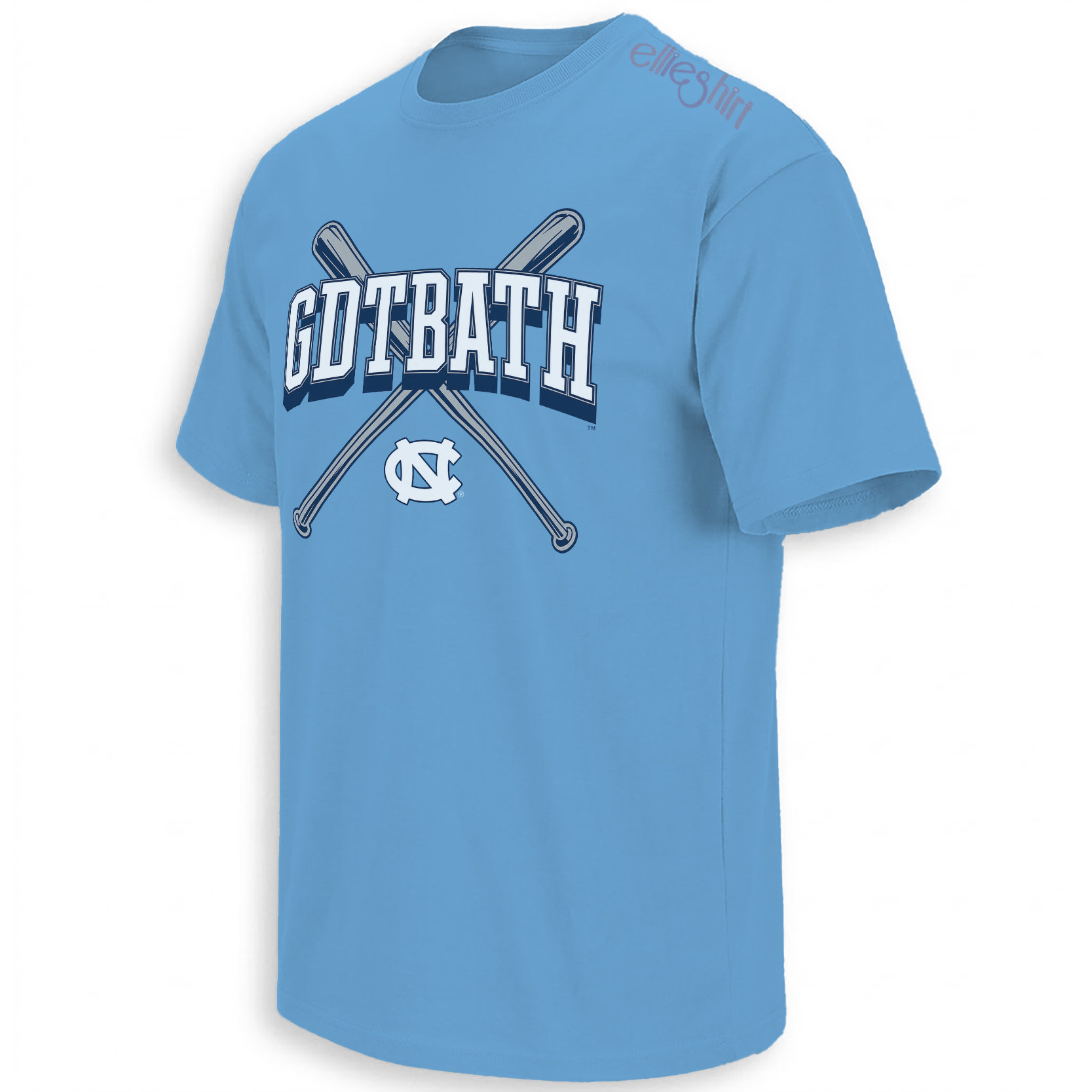
The GDTBATH design gives the abbreviation the scale of a postseason headline. Large block lettering creates immediate recognition, while the full phrase beneath it makes the meaning accessible beyond the most dedicated Carolina audience.
Carolina blue provides the identity before the letters are completely read. Navy adds enough weight to prevent the design from feeling overly soft, while the neutral shirt base gives the typography the clarity of a vintage campus athletic print.
The design does not require one player portrait because the phrase belongs to the entire program. Pitchers, hitters, coaches, students, alumni and supporters can all occupy the same message.
Carolina Reached the Final Through More Than One Kind of Game
Strong tournament teams rarely depend on one repeatable script. They must survive pitching duels, respond to scoring bursts and remain composed when a game changes shape in the middle innings.
North Carolina’s Omaha bracket displayed that variety.
The Tar Heels opened with a 6–2 victory over Ole Miss, establishing themselves immediately against another major-conference opponent. Jason DeCaro continued a remarkable postseason stretch on the mound, giving the lineup enough stability to control the game without chasing every run at once.
Carolina then defeated West Virginia 5–2, handling a Mountaineers team that had entered the matchup with one of the tournament’s most productive offenses.
The bracket-clinching rematch became a different kind of contest. UNC’s 12–7 win required the offense to answer pressure with pressure, turning the final innings into proof that the Tar Heels could win even when complete run prevention was no longer available.
- 6–2 over Ole Miss: Carolina opened Omaha with controlled pitching and enough offense to establish the rhythm of its bracket run.
- 5–2 over West Virginia: The Tar Heels limited a dangerous lineup and moved within one victory of the championship series.
- 12–7 over West Virginia: UNC answered an offensive game with its own depth and secured a return to the national final.
- Oklahoma next: The phrase now travels into a best-of-three championship series against another unbeaten Omaha bracket winner.
Jason DeCaro Gave the Run Its Pitching Foundation
College baseball’s postseason can transform one pitcher into the emotional center of an entire month. For Carolina, Jason DeCaro’s work helped create the calm beneath the celebration.
Across two major postseason appearances leading into the championship round, DeCaro produced 15⅔ innings with only two earned runs, seven hits allowed, four walks and seventeen strikeouts.
Those numbers mattered because they reduced the number of emergencies Carolina had to solve. The offense did not need to behave as though every inning might be its final opportunity.
DeCaro’s command also supported the larger team identity. UNC could defend aggressively, manage the bullpen with greater control and allow the lineup to build pressure rather than force it.
“Great Day to Be a Tar Heel” sounds joyful, but many of those joyful days begin with the quiet work of a starter repeatedly putting the team in favorable counts.
The Team’s Best Asset Has Been the Team
Carolina arrived in Omaha with recognizable stars, award winners and professional prospects. Yet the strongest description of the run has remained collective.
Different players have supplied different games. One night belongs to a starting pitcher. Another turns on a defensive play, a middle-order swing or production from the bottom of the lineup.
That distribution prevents opponents from solving the Tar Heels by removing one source of offense. A quiet game from one hitter does not automatically produce a quiet team.
It also explains why GDTBATH is a stronger fit than a single-player slogan. The phrase celebrates the result without narrowing the story.
DeCaro’s pitching, major offensive performances and All-America recognition give Carolina the high-level talent required to survive Omaha.
Depth allows the Tar Heels to respond when one area of the game changes, preserving a path to victory across different tournament conditions.
Nineteen Years Made the Championship-Series Return Feel Larger
North Carolina had not returned to the final round of the Men’s College World Series since 2007.
The gap is significant because the program had remained nationally relevant throughout much of that period. Carolina continued reaching regionals, hosting super regionals and appearing in Omaha, yet the championship series remained just beyond the final turn.
That history gives the 2026 return emotional depth. It is not the sudden arrival of a program unfamiliar with the stage. It is the latest attempt by a program that has repeatedly belonged in the national conversation without completing the last step.
Older supporters remember the heartbreak of the 2006 and 2007 championship series. Younger fans have inherited those stories while watching newer Carolina teams create their own Omaha moments.
GDTBATH connects those generations without requiring a complete history lesson. The phrase describes the present while carrying the weight of every earlier day that ended one victory too soon.
Carolina did not return to the championship series because the old disappointments disappeared. It returned carrying them forward as part of the reason this moment matters.
The Super Regional Already Proved Carolina Could Recover
The Tar Heels’ road to Omaha did not follow a perfect sequence. USC won the opening game of the Chapel Hill Super Regional 9–5, placing Carolina one loss from elimination on its home field.
UNC responded with a 4–0 shutout and then won the deciding game 4–3.
That recovery became an important preview of the mentality required in Omaha. The Tar Heels had already experienced the pressure of a series turning against them and had learned how to reset without allowing one defeat to define the next day.
The phrase “Great Day to Be a Tar Heel” gains extra meaning after that kind of reversal. It is easy to celebrate a team that never experiences danger. It is more powerful to celebrate one that reaches the edge of elimination and returns stronger.
Carolina’s season could have ended after the Super Regional opener. Back-to-back wins over USC transformed that pressure into a thirteenth Omaha appearance and prepared the team for the emotional demands ahead.
Why Carolina Blue Carries So Much Cultural Weight
Few school colors are as immediately recognizable as Carolina blue. It identifies the university before a logo, mascot or complete wordmark becomes visible.
In baseball, the color softens the sport’s traditional navy-and-red visual language while remaining strong enough to dominate a stadium section.
The design uses that familiarity as its first communication tool. A viewer sees the blue, reads the large initials and then discovers the complete phrase beneath them.
This sequence mirrors the way fan identity operates. Color creates recognition. Language supplies meaning. The current baseball run gives both a specific moment in time.
The color connects the baseball program to the university’s broader athletic identity and decades of Tar Heel memory.
Collegiate block lettering and the Omaha-era timing give the phrase a Diamond Heels meaning rather than a generic campus treatment.
The design belongs to the season when UNC won its Omaha bracket and returned to the championship series after nineteen years.
The Initials Make the Design Feel Like an Inside Joke
Written in full, “Great Day to Be a Tar Heel” sounds like a traditional campus slogan. Reduced to GDTBATH, it gains the energy of modern fan language.
The abbreviation invites recognition. Fans mentally expand the letters before reading the smaller line, creating a brief moment of participation.
That makes the graphic more personal than a direct statement. It does not merely deliver a message to the viewer. It asks whether the viewer already belongs to the group that knows what the letters mean.
The full phrase remains present, preventing the design from becoming inaccessible. The initials reward insiders; the supporting line welcomes everyone else.
From Social Caption to Wearable Postseason Memory
A phrase repeated after victories can disappear quickly into a timeline. Placed inside a strong visual composition, it becomes attached to a specific season.
The GDTBATH piece preserves the words at the moment North Carolina baseball reached the national championship series.
The design does not depend on the final score of one future game. It already records a completed achievement: a thirteenth Omaha trip, an unbeaten bracket and a return to the final stage for the first time since 2007.
That is why rally graphics can remain culturally valuable beyond the postseason. They preserve what supporters were saying while the outcome remained open and belief was still active.
Oklahoma Creates a Championship Matchup Between Two Hot Teams
The final series places North Carolina against an Oklahoma team that also went unbeaten through its side of the Omaha bracket.
The Sooners reached the final through dominant freshman pitching and a postseason power surge, including five home runs in an 11–4 semifinal victory over Georgia.
Carolina arrives with its own balance of pitching, lineup depth and resilience. Both teams have demonstrated that they can win through control or through offense.
A best-of-three championship series will test more than one starting pitcher or one lineup card. It will reward the team capable of adjusting after the first game reveals what the other side intends to attack.
For UNC supporters, the assignment remains emotionally simple even when the baseball becomes complex: wake up, wear Carolina blue and believe it can be another great day to be a Tar Heel.
The Phrase Belongs Beyond Omaha
GDTBATH carries current baseball meaning, but its structure allows it to move through the wider Carolina community.
Alumni can use it far from Chapel Hill. Students can repeat it after a campus milestone. Families can pass it between generations without needing the same favorite sport.
That flexibility gives the phrase more durability than a score-specific design. Omaha supplies the immediate emotional setting, but Tar Heel identity keeps the message alive after the tournament ends.
The wider NCAA collection preserves similar campus phrases, tournament memories and school-specific visual languages from across college sports.
The GDTBATH design belongs to that tradition because it captures both a baseball moment and a complete university identity in one compact set of letters.
Frequently Asked Questions
What does GDTBATH mean?
GDTBATH stands for “Great Day to Be a Tar Heel,” a compact Carolina pride phrase used to celebrate UNC victories, achievements and shared campus identity.
Did North Carolina reach the 2026 College World Series championship series?
Yes. UNC advanced to the best-of-three championship series after winning all three of its Omaha bracket games.
Who did North Carolina defeat in Omaha?
The Tar Heels defeated Ole Miss 6–2 and West Virginia twice, 5–2 and 12–7, to win their College World Series bracket.
When had UNC last played in the College World Series final?
North Carolina’s previous appearance in the championship series came in 2007, making the 2026 return its first in nineteen years.
How many times has North Carolina reached the College World Series?
The 2026 trip is the thirteenth Men’s College World Series appearance in North Carolina baseball history.
Why does the design use initials instead of only the full phrase?
The initials create recognizable insider language for Carolina fans, while the full “Great Day to Be a Tar Heel” line keeps the message understandable to a wider audience.
Why is the GDTBATH design connected to UNC baseball?
The design arrived during Carolina’s 2026 Omaha run, when the Tar Heels went unbeaten through bracket play and returned to the national championship series.
The GDTBATH rally piece preserves North Carolina’s 2026 Omaha run through a compact fan expression shaped by Carolina blue, championship-series belief and the enduring joy of being a Tar Heel.
GDTBATH Shirt turns “Great Day to Be a Tar Heel” into a bold UNC baseball rally design in Carolina blue collegiate typography. The piece celebrates North Carolina’s unbeaten 2026 Omaha bracket, championship-series return and the shared pride connecting Diamond Heels players, students, alumni and fans.