Who the Fuck Asked You? Why a Cheerful Girl With a Telescope Makes the Comeback Funnier
A sweet-looking vintage illustration meets one of the internet’s bluntest replies to unsolicited opinions. The joke begins with a search that nobody expects to succeed.
Imagine someone volunteering an opinion nobody requested. They interrupt an enjoyable conversation, criticize a harmless choice or offer an unsolicited evaluation of another person’s life.
Most people might respond with silence, an awkward smile or a change of subject.
But in one wonderfully excessive version of the Who Asked? meme, a cheerful little girl has decided that answering the question requires actual optical equipment.
She stands behind a telescope, scanning the horizon with the apparent enthusiasm of an explorer. Her mission is written above and below her in bold lettering: Me, Looking for Who the Fuck Asked You.
The joke is simple. The girl is searching for someone who requested the unwanted opinion. Naturally, the assumption is that she will never find that person.
Where did the Who Asked meme come from?
The phrases Who asked? and Nobody asked existed in everyday conversation long before social media. They are rhetorical ways of suggesting that someone’s contribution was unwanted or irrelevant.
As online conversation developed, these expressions became particularly convenient as short dismissive replies.
According to the internet culture archive Know Your Meme, Who Asked and Nobody Asked gained popularity in reaction images during 2019 and 2020, although documented uses of similar expressions date back much earlier.
The subreddit r/NobodyAsked had already been created in September 2017, collecting examples of unsolicited or excessively detailed commentary.
Over time, the question developed into a familiar internet comeback. Its effectiveness came from refusing to engage with the actual argument.
Instead of answering an opinion, the speaker challenges the assumption that the opinion needed to be offered in the first place.
Why add a telescope to Who the Fuck Asked You?
A telescope is designed to help a viewer observe something far away. In the meme, that practical function becomes part of an absurd argument.
The person supposedly responsible for asking the question is so difficult to locate that an ordinary look around the room will not be enough. Perhaps the search requires a distant horizon, a specialized instrument and considerable determination.
The exaggeration transforms an aggressive dismissal into a visual scenario.
Somebody offers advice, criticism or an opinion nobody requested.
The cartoon girl begins an elaborate search for the person who asked.
The absence of a requester becomes the answer to the unwanted comment.
The image is especially funny because it pretends to take the rhetorical question literally. A person cannot reasonably expect to find the answer with a telescope, but the exaggerated effort makes the insult more memorable.
This also gives the phrase a storytelling structure absent from ordinary text-only replies. There is a protagonist, a mission, a visual object and an implied ending.
Why the vintage cartoon girl changes the joke
The artwork could have used an angry person pointing at the viewer. Instead, it shows a smiling girl with bright eyes, curled hair and an old-fashioned outfit.
That decision creates an immediate contradiction.
The character belongs to a visual world associated with innocent adventure, illustrated children’s stories and nostalgic advertising. Her cheerful expression suggests curiosity rather than confrontation.
But the lettering is unmistakably rude.
The illustration says wholesome childhood adventure. The caption delivers an absolutely unwholesome comeback.
That mismatch creates two distinct moments of recognition. First, viewers see a charming retro scene. Then they read the profanity and realize the apparent adventure is actually a sarcastic dismissal.
In visual comedy, such reversals can be more engaging than a straightforward insult because the setup briefly encourages a completely different expectation.
Is this based on an actual vintage illustration?
The design draws on the visual vocabulary of older printed illustrations: bright clothing, rosy faces, decorative borders and an enthusiastic child engaged in an innocent activity.
Children using telescopes have appeared in illustrated material for generations. An 1882 print preserved through Wikimedia Commons, for example, depicts girls looking through a telescope, emphasizing the curiosity and sense of discovery associated with the instrument.

This antique illustration shows girls examining a distant scene through a telescope. It illustrates the much older imagery that makes the modern cartoon’s innocent exploration theme recognizable.
Source: Wikimedia Commons, public-domain illustration, original author unknown. It is not claimed as the direct source of the EllieShirt artwork.The relationship here is stylistic, not documentary. There is no verified evidence that the modern meme design was directly adapted from this specific 1882 image.
What carries across the two images is a familiar visual idea: an enthusiastic young observer using a telescope to investigate something beyond ordinary sight.
In the modern joke, that innocent activity becomes absurdly sarcastic.
How the EllieShirt artwork builds the punchline
The black-shirt version turns the concept into a densely colored retro poster, using several design elements that reinforce the contrast between cheerful imagery and adult language.
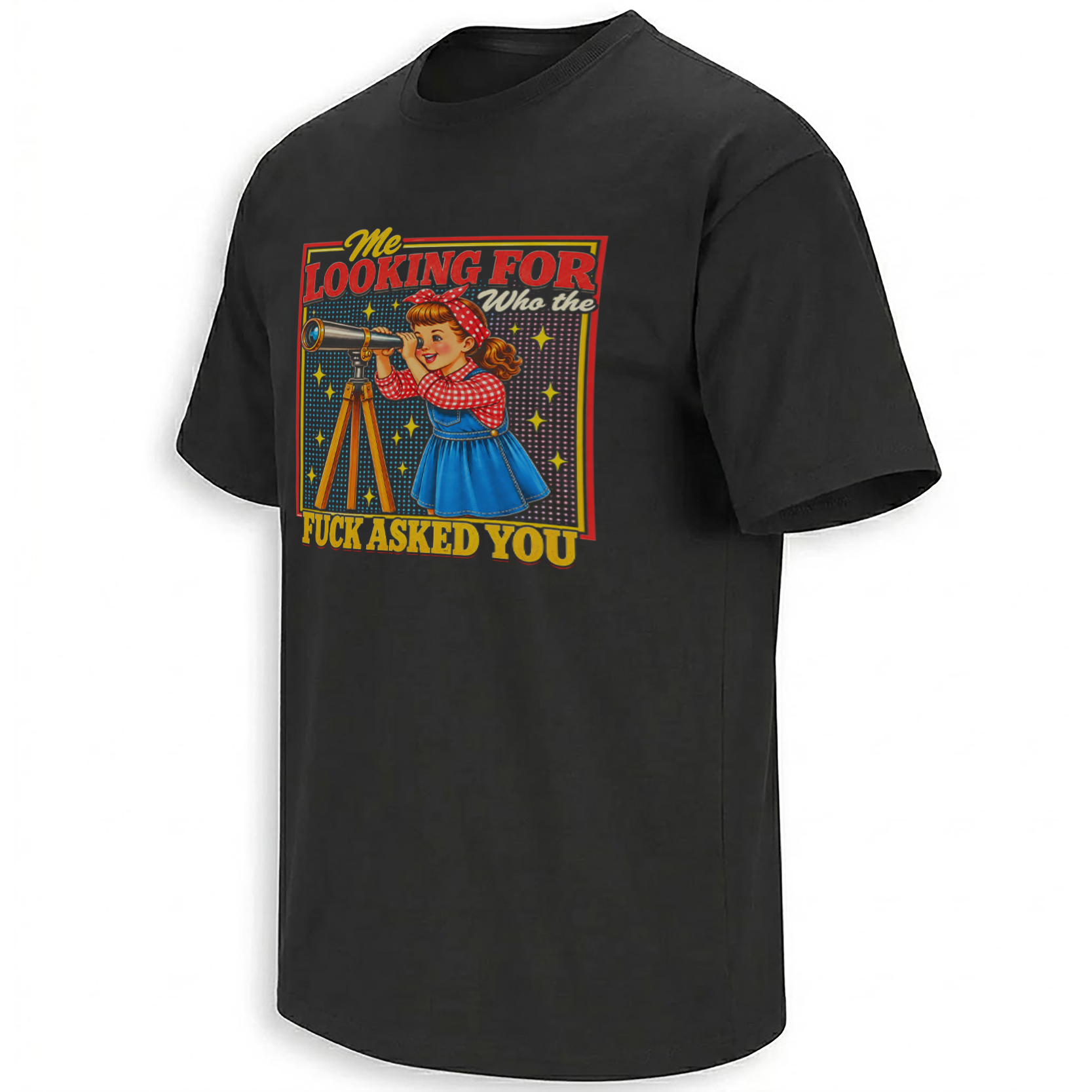
A colorful cartoon girl, telescope and vintage halftone background give a familiar internet comeback its own visual punchline.
View the artwork →The girl wears a red-and-white polka-dot headscarf, a matching checkered blouse and a vivid blue pinafore-style dress. She smiles as she looks through a long telescope mounted on a wooden tripod.
The scene sits inside a rectangular red-and-yellow border, with halftone dots and decorative stars suggesting old comic-book printing.
The upper text mixes flowing yellow script with bold red letters. Smaller white cursive lettering introduces the last portion of the sentence before the bottom line delivers the profane punchline in large yellow type.
That hierarchy matters: the viewer sees the search, understands the character’s apparent mission and finally encounters the actual target of the sarcasm.
The black background intensifies the saturated colors without introducing unnecessary distractions. The design is also offered in navy, but the black edition gives the illustrated colors especially strong contrast.
Why unsolicited-opinion memes remain relatable
Online platforms make it easy for strangers to comment on personal choices, entertainment, appearances, achievements and nearly every other subject.
Sometimes unsolicited input is useful. Sometimes it is thoughtful. But it can also arrive in situations where no advice was requested.
The Who Asked comeback channels frustration with that second category. Its tone can be rude and dismissive, which is part of the intended humor rather than something the design attempts to conceal.
Still, the telescope version is less dependent on direct confrontation. Instead of depicting an argument, it stages a playful, impossible investigation.
No single verified original creator or first viral post has been established for this particular colorful girl-and-telescope interpretation. Its relationship to the broader Who Asked meme is clearer than its exact publication history.
Why retro sarcasm works on graphic shirts
Retro illustration provides an additional layer of storytelling. By borrowing the warm colors and friendly character design associated with older printed art, the graphic makes its unexpected language even more conspicuous.
It can be understood as a modern meme wearing the visual costume of a much earlier era.
Related humor concepts appear across EllieShirt’s Newest collection, while sarcastic product designs offer other expressions of dry humor and unexpected punchlines.
The My Face Has Said Things design handles social frustration differently, focusing on the opinions a person is trying not to express rather than comments they never wanted to receive.
Frequently Asked Questions
What does Me Looking for Who the Fuck Asked You mean?
It is a sarcastic way of saying nobody requested someone’s opinion, illustrated as an exaggerated search for the person who supposedly asked.
Where did the Who Asked meme originate?
The expression predates the internet, while Who Asked and Nobody Asked became especially recognizable in reaction-image culture around 2019 and 2020.
Why does the girl use a telescope?
The telescope exaggerates how difficult it would be to find anyone who requested the unwanted opinion.
Is the vintage telescope girl based on a famous character?
No specific named fictional character or verified original illustration has been established for this design.
Why does the artwork use such cheerful colors?
The wholesome retro illustration contrasts with the profane punchline, creating the central visual joke.
What is the relationship between Who Asked and Nobody Asked?
Both expressions dismiss an unsolicited statement by implying that nobody requested it or wanted the information.
A very thorough search for absolutely nobody
The brilliance of the telescope joke is its unnecessary effort. Instead of merely rejecting an unwanted opinion, the character appears determined to investigate the entire visible horizon.
Her cheerful face makes the process seem innocent. Her vintage clothing makes it nostalgic. The lettering reveals that the mission is anything but polite.
The search is imaginary, and the answer is already implied. That is what makes this version of Who the Fuck Asked You such an effective combination of retro illustration and internet sarcasm.
Me Looking for Who the Fuck Asked You combines a cheerful vintage girl, telescope and colorful retro typography with a brutally sarcastic internet comeback. The black-background graphic turns the familiar Who Asked meme into a playful visual search.