My Face Has Said Things: Why Some Expressions Need a Lawyer Before the Mouth Even Opens
A single eyebrow can deliver an entire argument. This sarcastic quote turns everyday facial reactions into a fictional legal emergency.
Someone has just suggested another unnecessary meeting. You have decided to remain professional. You will not sigh, interrupt, argue or say anything that could possibly be repeated to your manager.
Unfortunately, your eyebrows were not included in that decision.
Before you manage to arrange a polite response, your face has already communicated disbelief, disappointment and several opinions that you would rather keep private.
That familiar social failure is the premise behind a gloriously exaggerated line: My Face Has Said Things That My Mouth Would’ve Needed a Lawyer to Explain.
It is a joke about people who can control their words considerably better than they can control their expressions. And the lawyer reference turns a simple side-eye into the kind of incident that supposedly requires professional legal representation.
What does My Face Has Said Things actually mean?
The quote describes a mismatch between verbal restraint and visible emotion.
Someone may carefully avoid saying something rude, sarcastic or confrontational, yet still communicate annoyance through a stare, tightened mouth, raised eyebrow or sudden change in expression.
The phrase does not mean a face can literally make a legally actionable statement. It uses absurd exaggeration to express how much meaning a nonverbal reaction can carry.
That is what makes the setup so recognizable. Most people have experienced a moment when a facial expression seemed to reveal their private thoughts before they had decided whether sharing those thoughts was wise.
But the funniest part is the imagined consequence. The joke suggests the reaction was so devastating that an attorney would be needed to explain it afterward.
The mouth exercised its right to remain silent. The face immediately disregarded legal advice.
Why do facial expressions communicate without words?
Human communication depends on much more than sentences. Faces, gestures, vocal tone, posture and conversational context all influence how a message is understood.
A raised eyebrow might signal surprise, skepticism, amusement or confusion, depending on the interaction. A brief stare can mean anything from concentration to irritation.
That ambiguity matters. People sometimes feel certain they know what someone else’s expression means, but facial cues do not provide a perfect window into another person’s thoughts.
Still, the relationship between expression and sarcasm is supported by communication research.
In a 2001 study published in Perceptual and Motor Skills, researcher Patricia Rockwell examined facial behavior accompanying sarcastic and nonsarcastic responses. Among the features analyzed, mouth movements significantly distinguished the two categories in that particular sample.
Later research by Gina Caucci and Roger Kreuz found that sarcasm can be accompanied by cues involving the head, eyes and mouth, with conversational familiarity influencing how such signals are used.
The research does not prove the slogan literally true. It helps explain why a joke about the face speaking independently of the mouth feels intuitively understandable.
Why sarcastic humor loves the uncontrolled face
The joke belongs to the same cultural neighborhood as the expressions resting bitch face, my face has no filter and if my mouth doesn’t say it, my face will.
Each refers to a perceived gap between what a person chooses to communicate and what others believe the person’s expression reveals.
There is also a self-deprecating element. Rather than insisting their behavior is perfectly diplomatic, the speaker admits that they have an extremely expressive face.
That admission makes the humor less aggressive than an insult aimed directly at another person. It is essentially a comic confession about one’s own lack of a convincing poker face.
The funniest versions tend to occur in situations where social expectations demand politeness.
Someone repeats an idea that was rejected five minutes earlier.
A relative asks a question that clearly has no comfortable answer.
One message produces a facial reaction no text response could improve.
In each example, the comedy comes from the attempted contrast between a controlled spoken response and an involuntary-looking facial reaction.
What makes the lawyer punchline distinctive?
Without the final legal reference, the phrase would still communicate an ordinary truth: facial expressions can seem more candid than spoken language.
Adding the lawyer transforms the situation into imaginary courtroom drama.
A glance becomes testimony. An eye roll becomes evidence. A disappointed stare becomes a statement that someone might need to explain under questioning.
This is the same structure used in many successful exaggeration jokes. An everyday experience is treated as though it has consequences wildly disproportionate to the actual event.
The phrase does not promote a legal theory, claim that facial expressions are criminal or identify any real case. The courtroom imagery is entirely metaphorical.
The long visual history of reading faces
People were fascinated by the communicative possibilities of facial expressions long before the internet developed modern reaction memes.
In 1872, Charles Darwin published The Expression of the Emotions in Man and Animals, examining how emotional states are represented through bodily and facial behaviors.
The book included photographic illustrations created with Oscar Gustave Rejlander, showing expressions associated with contempt, disgust and other emotional reactions.

Rejlander’s historical photographic plate documents expressions of disdain and disgust in Darwin’s 1872 study. It is historical context, not the origin of the shirt’s modern joke.
Wellcome Collection / Wikimedia Commons, source and attribution, CC BY 4.0; image unmodified.Modern reaction images operate in a very different environment, but they rely on a similar basic premise: viewers can recognize an emotional attitude in a face even when no dialogue accompanies it.
That visual shortcut makes expressive faces especially useful in everyday digital humor.
Why the red typography is the right visual approach
The EllieShirt design makes an unusual but effective choice. Rather than illustrate an eye roll or a disapproving stare, it lets the exact sentence become the graphic.
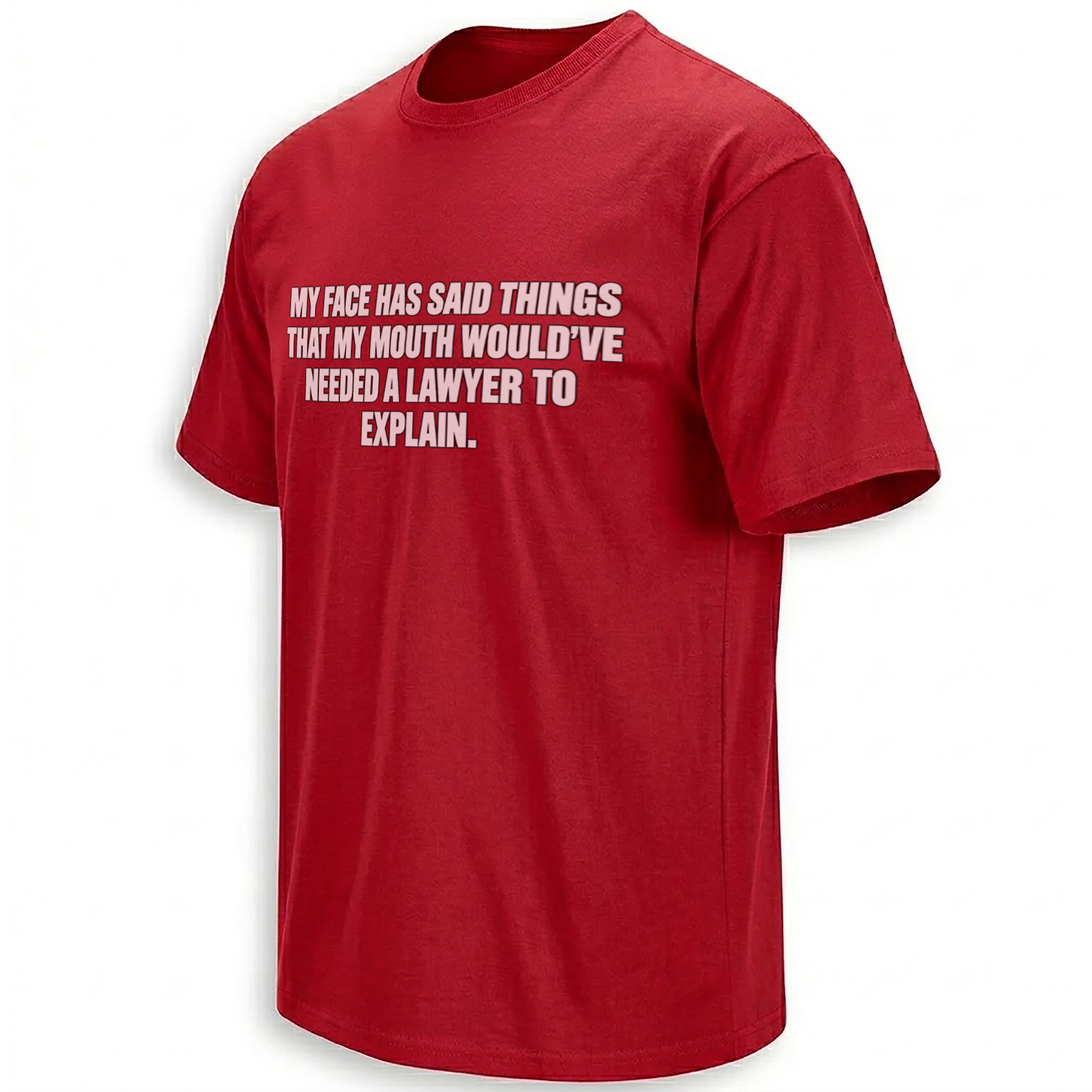
Large white lettering on a bright red background makes a long sarcastic confession the immediate focus of the design.
View the graphic →The artwork uses a vivid red background and bold white uppercase lettering arranged in four centered lines. The opening words receive an immediate visual emphasis, and the line breaks create a steady rhythm toward the final punchline.
The typography has a slightly distressed appearance, providing texture without distracting from the message. No courtroom scales, lawyer portrait or cartoon face competes for attention.
That restraint is important. The shirt asks the reader to picture their own expressive face rather than supplying a fictional character to represent it.
Why this quote works beyond a single internet trend
The exact wording does not have a reliably established original author or a verified single viral moment. It is better understood as a contemporary sarcastic saying built on a familiar social experience.
Its relevance does not depend on one platform, celebrity or news event. People will continue confronting awkward conversations, unnecessary questions and situations where diplomacy requires substantial effort.
That is why the phrase fits naturally among EllieShirt’s Newest humor designs and other sarcasm-themed graphics.
A sharper variation on unwanted commentary appears in the vintage telescope “Who Asked?” design, although that joke directs the sarcasm outward rather than making fun of the wearer’s own expressions.
Both demonstrate how everyday conversational frustrations become instantly recognizable graphic humor.
Frequently Asked Questions
What does My Face Has Said Things mean?
It jokes that a person’s facial expressions communicate opinions they have deliberately avoided saying aloud.
Why does the quote mention needing a lawyer?
The lawyer reference is comic exaggeration, suggesting the unspoken opinion was so blunt it would be difficult to explain afterward.
Is this saying connected to an actual legal case?
No. It uses imaginary legal consequences as a humorous way to describe an expressive face.
Can facial expressions communicate sarcasm?
Yes. Communication research has examined how movements of the face, head and eyes can contribute to communicating sarcasm.
Does the design feature a lawyer illustration?
No. It is a text-focused graphic with a full white uppercase quote on a red background.
Who originally said My Face Has Said Things?
No reliably verified single author or original viral post has been established for this version of the saying.
The face has entered its statement into evidence
The enduring appeal of this joke is the recognition that silence and discretion are not always the same thing.
Someone may successfully keep a thought to themselves while their expression seems to announce it to everyone nearby.
The lawyer metaphor gives that ordinary embarrassment an absurdly dramatic conclusion. The mouth behaved. The face allegedly caused the entire incident.
My Face Has Said Things That My Mouth Would’ve Needed a Lawyer to Explain is a sarcastic quote about expressive faces and unspoken opinions. Its bold white typography on red transforms everyday social discomfort into a mock legal confession.