Los Angeles and San Diego Are Not a Small Price to Pay
A few seconds from a Nebraska rally turned two Southern California cities into the center of a national political argument. Within hours, the response stopped being only about Donald Trump and became something more local: LA, San Diego and the refusal to describe American communities as expendable.
The controversy began during President Donald Trump’s October 5 rally in Grand Island, Nebraska, as he defended the economic costs of the continuing conflict with Iran and argued that those costs were justified by national and global security.
Then the speech moved from prices to cities. Trump said Iran could potentially “take out” a city and specifically named Los Angeles and San Diego before returning to the idea that the broader cost was small compared with keeping the United States safe.
The wording landed immediately because Los Angeles and San Diego were no longer hypothetical dots in a geopolitical argument. They are two of the country’s largest urban regions, home to millions of people, major ports, military installations, families, businesses and communities whose daily lives have nothing abstract about them.
The political argument was national. The counter-message became geographic: Los Angeles and San Diego are places full of people, not an acceptable cost in someone else’s rhetorical equation.
What Did Trump Actually Say About Los Angeles and San Diego?
The wording matters because the controversy has produced competing interpretations. During the rally, Trump was discussing the Iran conflict, rising prices and his argument that preventing a larger security threat justified current economic pain.
He then said: “Let ’em take out Los Angeles. Let ’em take out San Diego. This is a very small price to pay.”
California officials interpreted the passage as dangerously casual language about American cities. The White House pushed back on that interpretation. Communications director Steven Cheung said Trump was not calling for attacks and argued that the president was describing what a nuclear-capable Iran might be able to threaten — and why his administration believed preventing such a scenario mattered.
The response graphics in this article react to the words that were publicly spoken. They should not be read as evidence that an attack on Los Angeles or San Diego is imminent, nor as proof that Trump was literally requesting one. The dispute is over the meaning, framing and appropriateness of the remarks.

Why “Not a Small Price to Pay” Became the Natural Response
The phrase moved quickly because it did not require a new political vocabulary. The response simply reversed the wording already driving the headlines.
“Los Angeles and San Diego are not a small price to pay” changes the grammatical center of the story. Instead of Trump, Iran or the war occupying the visual foreground, the cities themselves become the subjects.
That is why the strongest designs in this set avoid a politician’s portrait. One uses a California silhouette with LA and SD marked by stars. Another fills the oversized city abbreviations with skyline, palms, sunset and coastal scenery. A third strips the concept back to distressed civic-poster typography.
The message is political, but the imagery is regional. California does most of the talking.
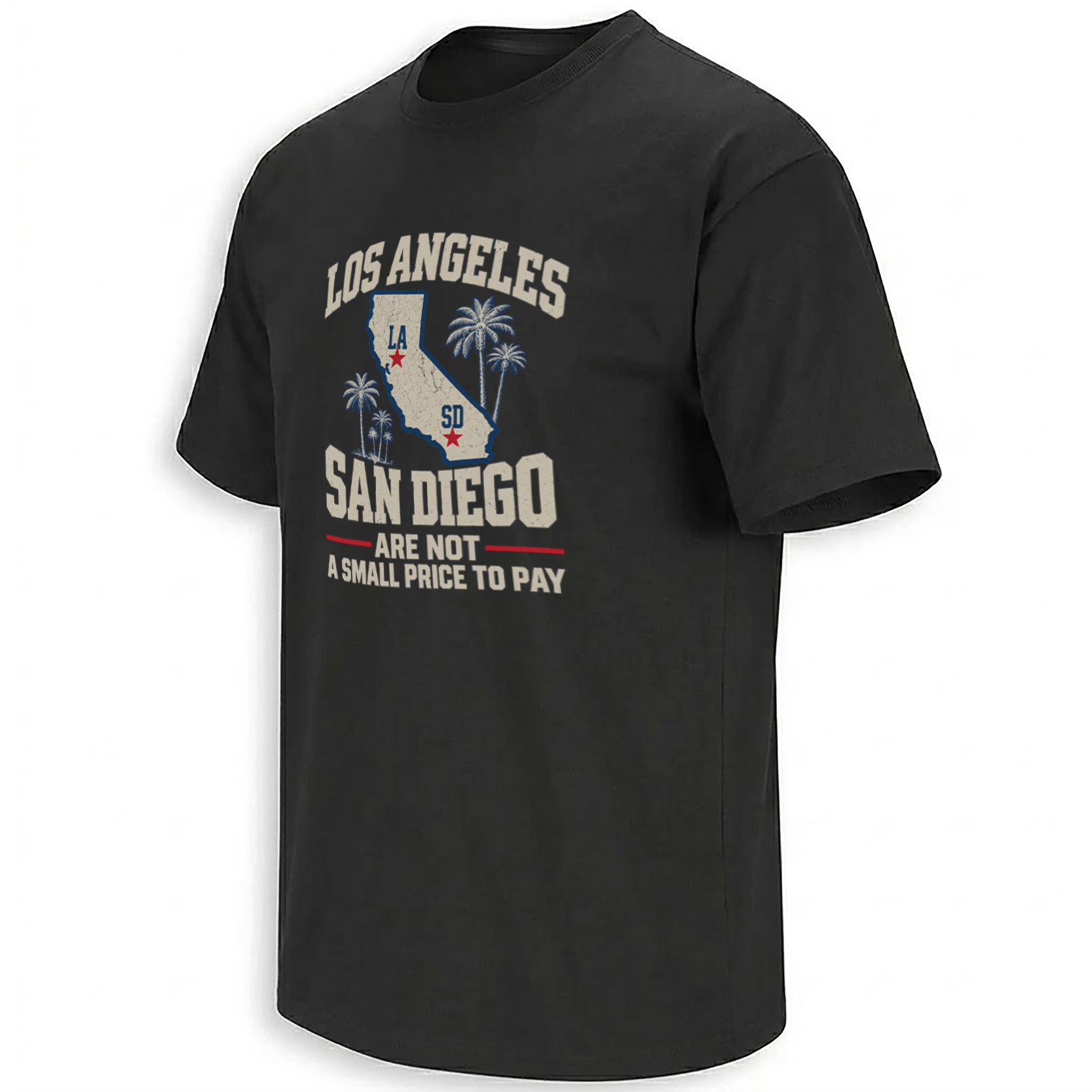
A vintage state-pride composition places the California silhouette, LA and SD markers and palm trees ahead of the political response.
View the California piece →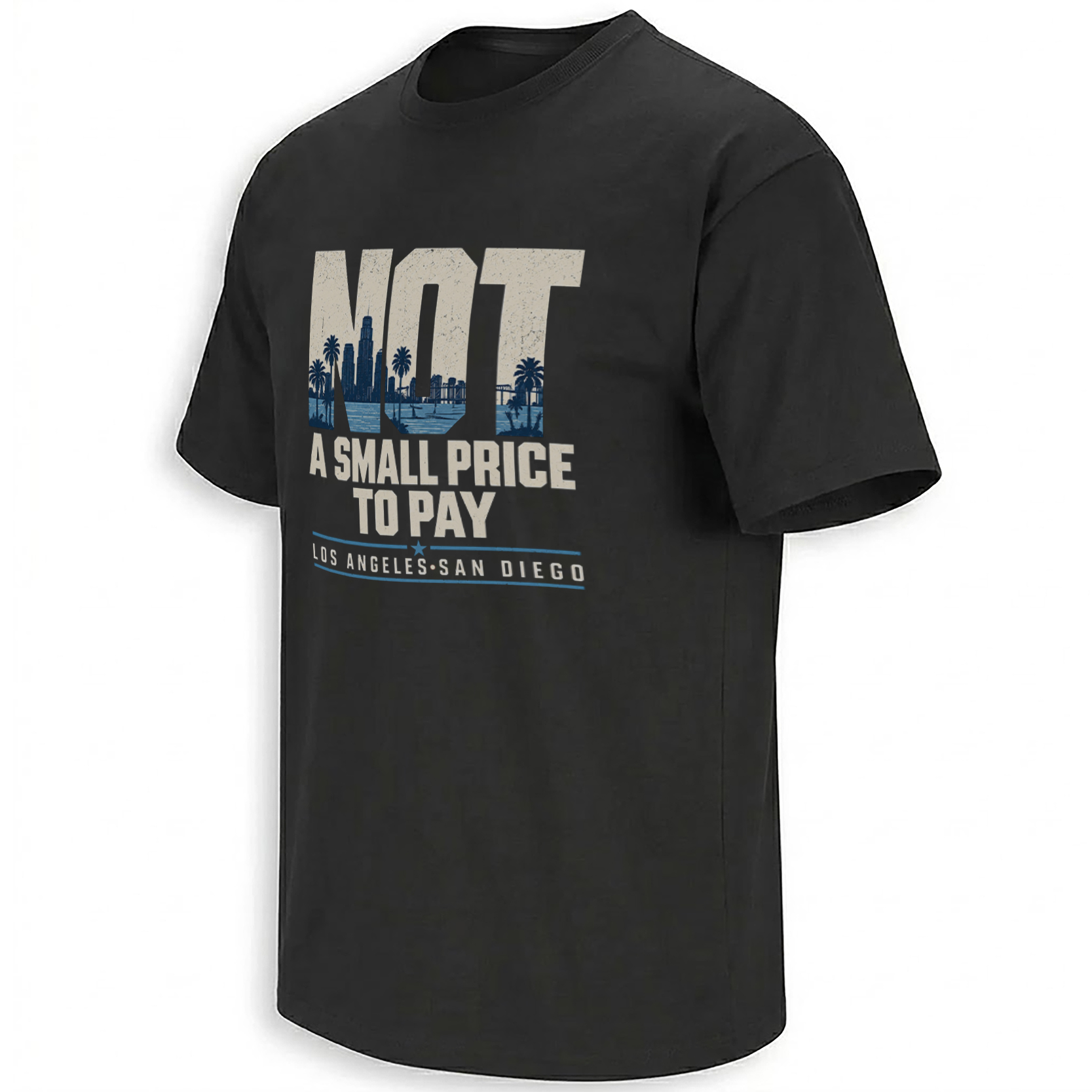
Los Angeles skyline, palms, sunset, San Diego water and a sailboat turn the city initials into a retro Southern California travel poster.
Explore the LA + SD visual →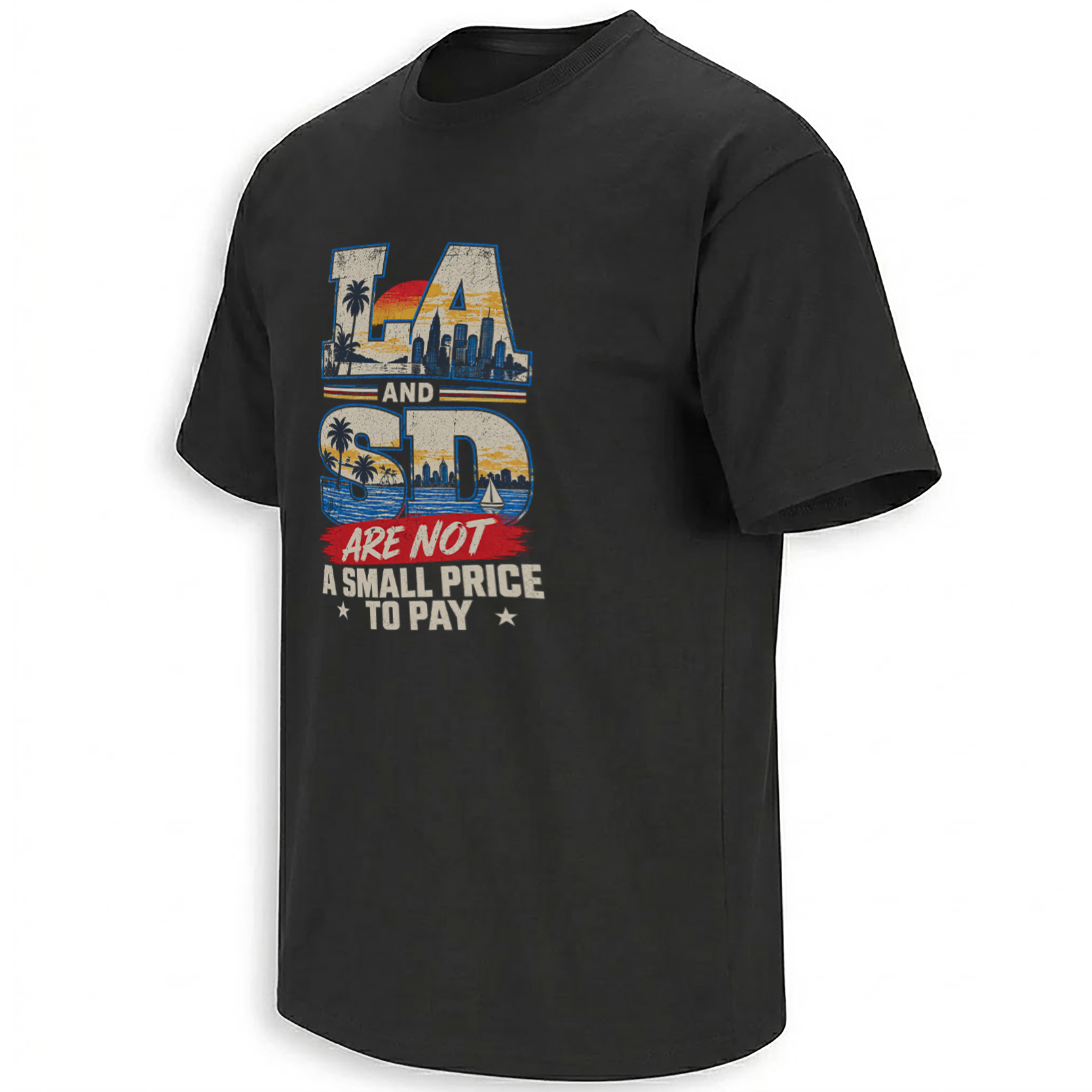
Distressed navy, cream and red typography pushes the concept toward old civic posters and political ephemera rather than candidate merchandise.
View the solidarity piece →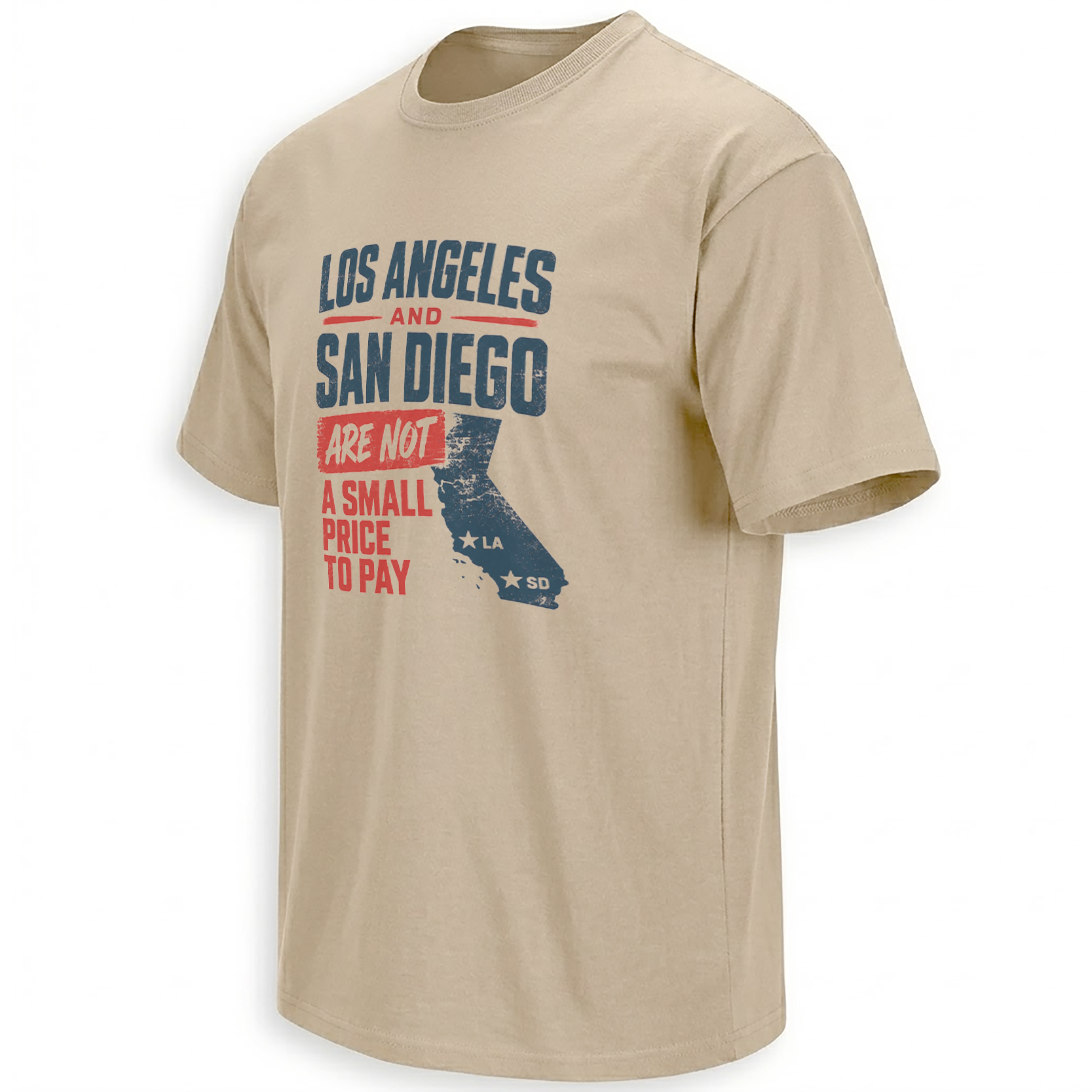
The same response is reduced further into city names, California geography and direct visual emphasis on “ARE NOT.”
See the map variation →“San Diego Is Not Collateral Damage” Changed the Language Again
San Diego Mayor Todd Gloria’s response supplied a second phrase with even more emotional weight. Instead of debating what counts as a “small price,” his statement rejected the idea that a city could be framed as collateral at all.
Los Angeles Mayor Karen Bass also condemned the remarks, emphasizing that a president’s role is to protect American cities and residents. The pushback was not exclusively Democratic: Republican San Diego County political figure Jim Desmond also rejected treating American cities or families as expendable.
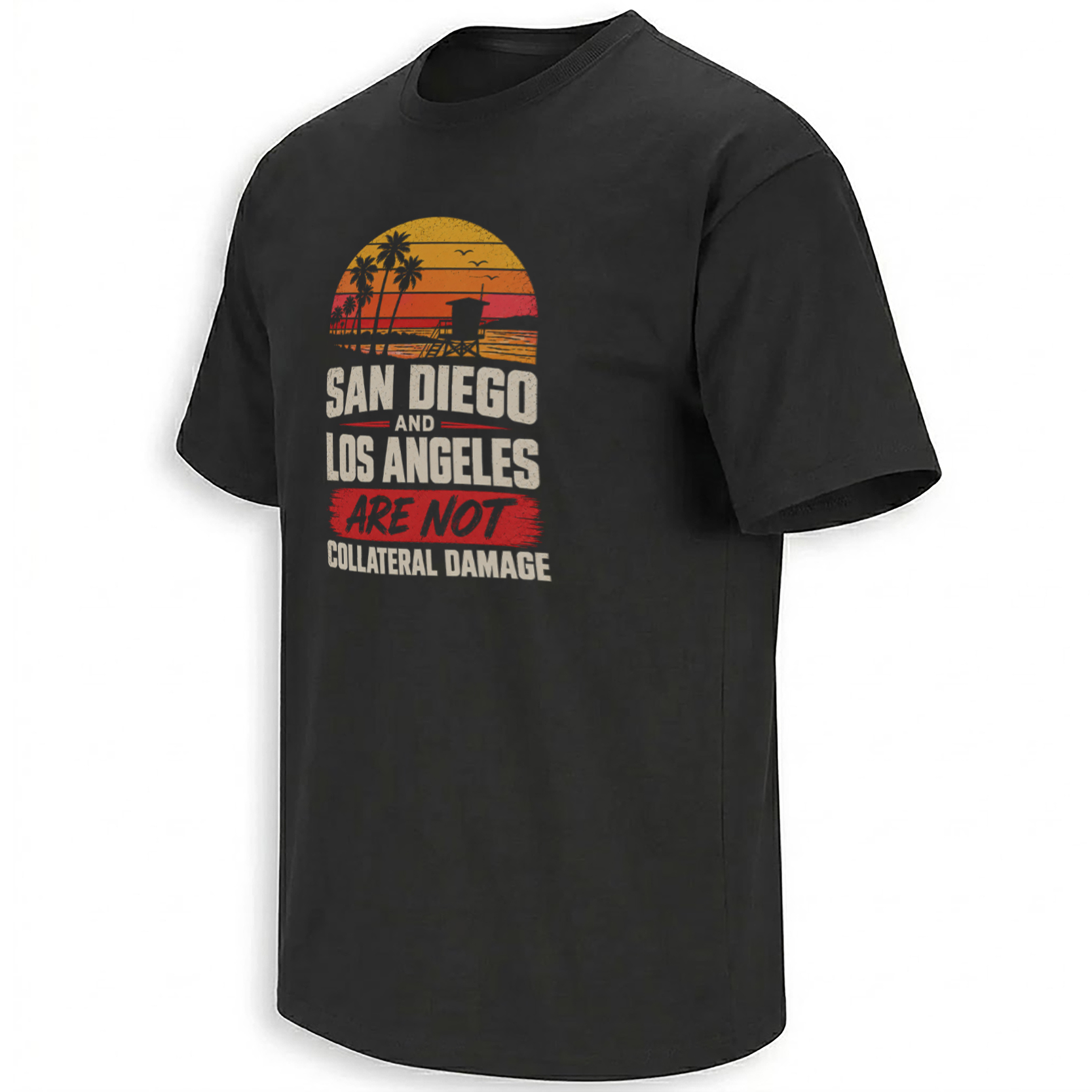
A yellow-orange coastal sunset, palm silhouettes, ocean horizon and lifeguard tower make the piece look like nostalgic Southern California beach art until the final line changes its meaning.
View the Not Collateral Damage piece →Why the California Imagery Matters More Than Trump’s Face
Political merchandise often centers the politician. These graphics make the opposite choice.
That decision is not cosmetic. It changes what readers are being asked to remember. The visual archive is not primarily a portrait of the person who caused the news cycle; it is a map of the communities reacting to it.
Los Angeles becomes skyline and palms. San Diego becomes water, sailboats, beach towers and sunset. California becomes the shape connecting both places. Red “ARE NOT” treatments repeatedly interrupt otherwise nostalgic layouts, turning tourism aesthetics into protest language.
Across the five visuals, LA, San Diego and California remain the largest entities. Trump is essential to the context, but he is deliberately absent from the artwork itself. That makes the collection read as regional response rather than conventional campaign merchandise.
Why “LA and SD” Became Search Language Overnight
Breaking political moments often produce strange search behavior. Someone who sees “LA and SD” trending may not know whether the initials refer to sports, weather, travel or politics. Someone searching “small price to pay Los Angeles San Diego” is probably trying to reconstruct what was said. Someone searching “San Diego collateral damage” may be looking for Gloria’s response.
These designs sit directly at the intersection of those searches because they preserve the entities and language without requiring the viewer to know the entire speech first.
For Ellie Shirt’s wider political-response archive, the confirmed Anti-Trump collection provides the strongest topical link. New breaking-event graphics can also be followed through the Newest collection.
Because Donald Trump is the specific public figure behind the original remarks, readers can also move directly into Ellie Shirt’s Donald Trump product search without forcing his image into designs that intentionally center California instead.
Frequently Asked Questions
Why are Los Angeles and San Diego being discussed together?
President Trump named both cities during an October 5, 2026 rally in Nebraska while discussing the Iran conflict and what he described as costs associated with keeping the country safe.
Did Trump call Los Angeles and San Diego a “small price to pay”?
His remarks placed the two cities directly next to “small price to pay” language, prompting widespread criticism. The White House later argued he was describing a threat his Iran policy was intended to prevent, not advocating attacks on the cities.
Who said “San Diego is not collateral damage”?
San Diego Mayor Todd Gloria used that wording in his public response to the controversy.
Is “Los Angeles and San Diego are not a small price to pay” a direct Trump quote?
No. It is a counter-message that reverses the wording associated with his remarks and rejects treating the two cities as expendable.
Why do the shirts use California maps, palms and beaches?
Those elements keep Southern California and the people who live there at the center of the visual story instead of turning the designs into portrait-based political merchandise.
Explore the different Not a Small Price to Pay treatments, the Not Collateral Damage design, or the wider Anti-Trump cultural archive.
Los Angeles and San Diego Are Not A Small Price To Pay designs respond to the October 2026 Trump controversy through California maps, city markers, Southern California scenery and “Not Collateral Damage” language centered on LA and San Diego rather than a politician’s portrait.