
“Better Worry About Your Own Sins”: Why This Anti-Judgment Quote Keeps Coming Back
It sounds religious enough to stop the scroll, sarcastic enough to become a meme and direct enough to function as a boundary: whatever mistakes I have made, spending your time cataloguing them will not settle your own account.
“Better worry about your own sins, because God ain’t gonna ask you about mine” is one of those sentences that feels ancient and modern at the same time.
The setup sounds almost devotional. There is God, sin, accountability and the language of moral responsibility. Then the sentence swerves into conversational sarcasm. “God ain’t gonna ask you about mine” is not pulpit language. It sounds like the reply someone gives after one too many opinions about a life that does not belong to the person offering them.
That mixture explains the phrase’s staying power. It can be read as Christian humor, an anti-hypocrisy message, a response to gossip, a personal-boundary statement or simply a more theological version of “mind your own business.”
The sentence does not claim you have no sins. The joke is that somebody else is wasting an impressive amount of energy keeping score of them.
Is “God Ain’t Gonna Ask You About Mine” a Bible Verse?
No. That distinction matters.
The wording itself is conversational modern English and should not be presented as direct scripture. There is no verse that reads “Better worry about your own sins because God ain’t gonna ask you about mine.”
What the phrase does share with biblical teaching is the theme of self-examination before criticism. Matthew 7:3–5 asks why someone notices the speck in another person’s eye while failing to recognize the plank in their own. Luke 6:41–42 uses the same imagery.
The modern phrase translates an old anti-hypocrisy idea into contemporary attitude: examine yourself before becoming consumed by somebody else’s failures.
That difference protects the meaning rather than weakening it. The shirt is not pretending to display scripture. It is using faith vocabulary to deliver an everyday boundary with humor.
The Quote Has Been Circulating for Years
This is not a phrase that suddenly appeared in October 2026. One useful piece of documented pop-culture history comes from May 2020, when E! reported that reality-TV personality Josh McKee posted the wording to Instagram during a period of intense public criticism.
That does not establish him as the creator of the quote. It does something more useful editorially: it proves the phrase was already functioning as social-media comeback language years ago.
Because that historical example involves a named public figure, Ellie Shirt’s internal Josh McKee product search provides the person-level route required when readers want to check whether any related designs currently exist.
Why the Phrase Survived Beyond One Social-Media Moment
The answer is portability. The sentence does not require knowledge of a reality show, celebrity controversy or one specific argument. Anyone who has been judged by family, friends, coworkers, strangers online or a particularly opinionated church acquaintance can understand it instantly.
Its structure is also unusually efficient. “Better worry about your own sins” begins as advice. “God ain’t gonna ask you about mine” turns that advice into dismissal.
That second half is what keeps it from becoming a generic inspirational saying. There is enough edge to make it feel spoken rather than printed.
The Ellie Shirt Design Removes Everything Except the Message
The Better Worry About Your Own Sins Shirt takes a very different approach from many older decorative treatments of the line.
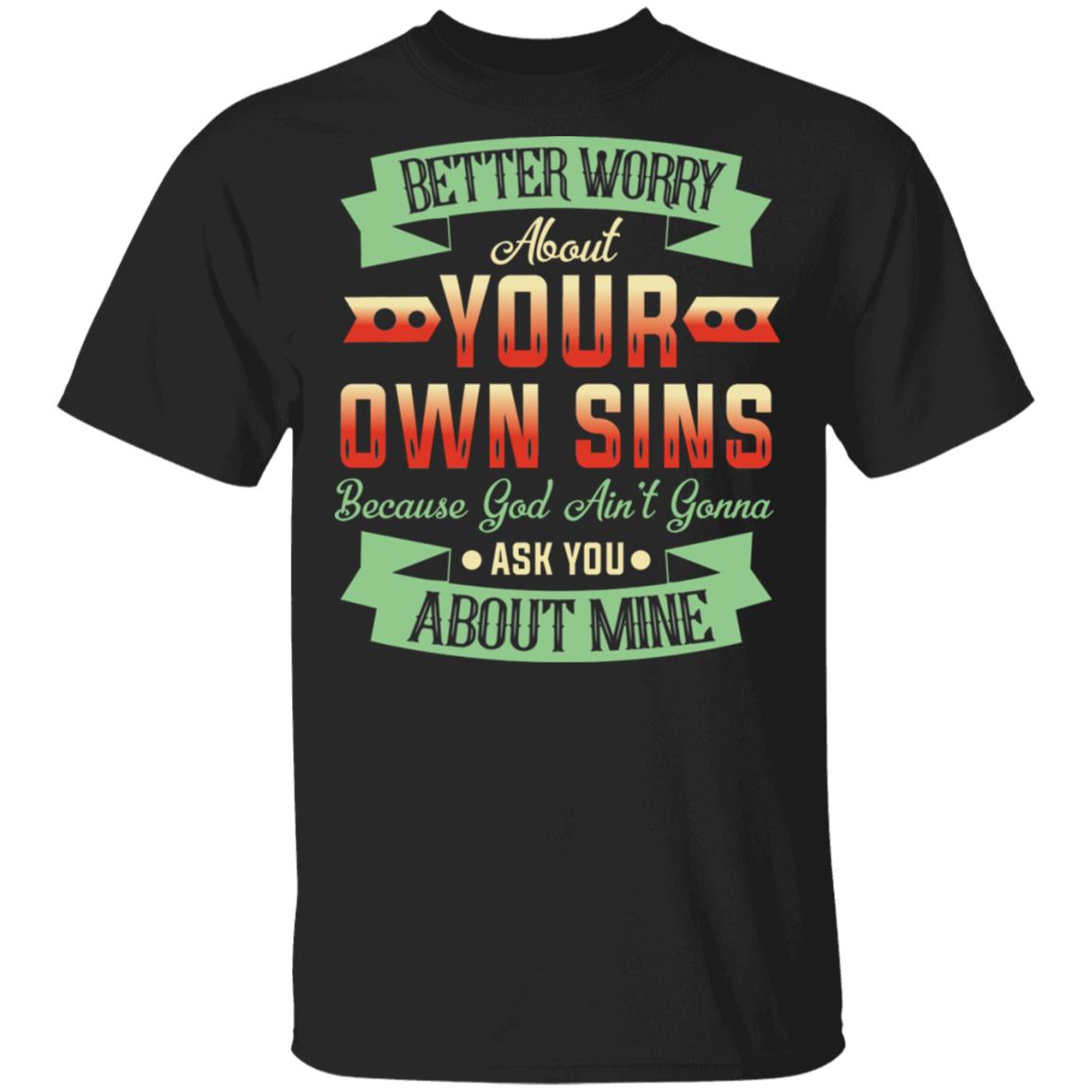
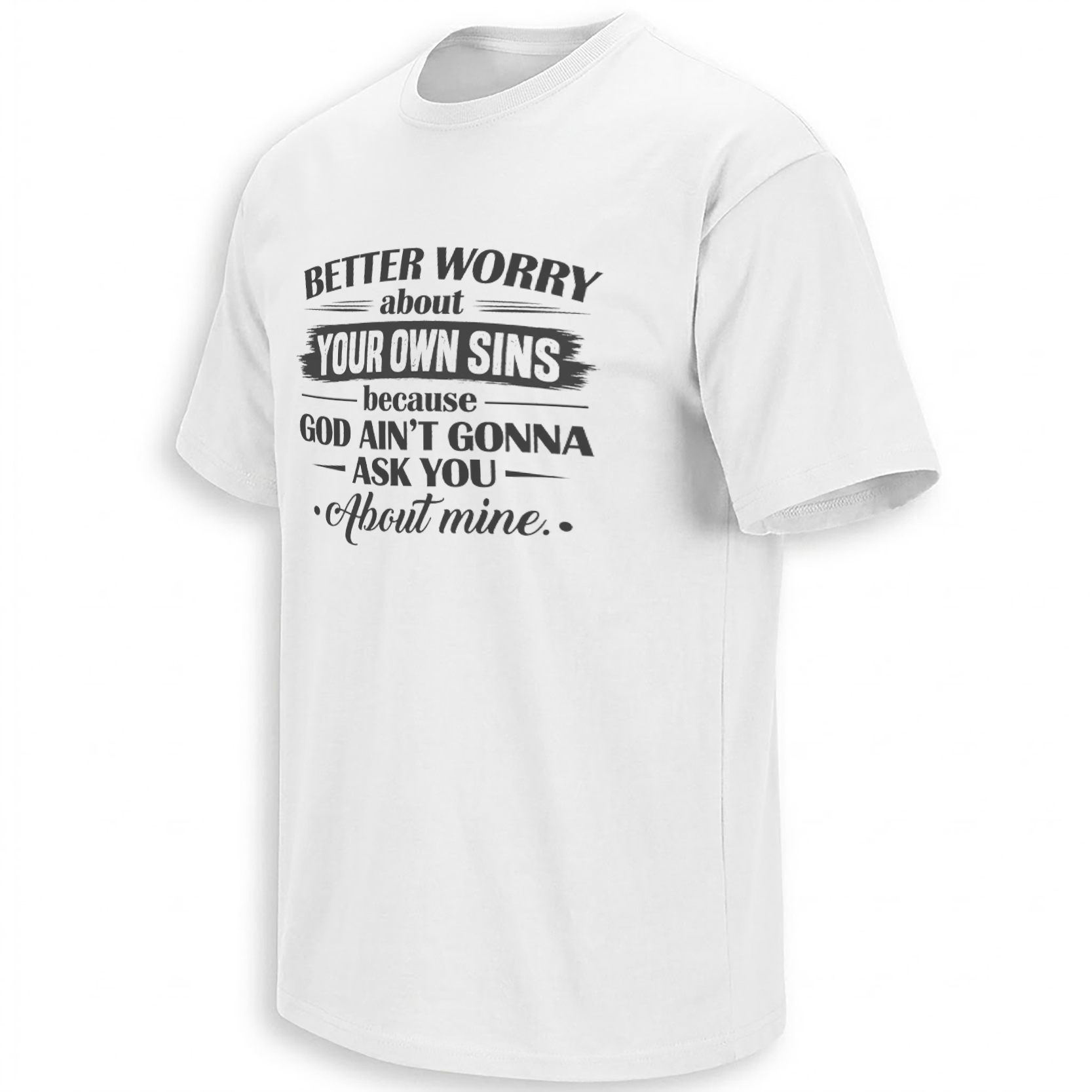
There is no church illustration, no cross dominating the composition and no faux-vintage banner system. The artwork is black typography on a white base. That choice makes the sentence feel less like devotional merchandise and more like a statement someone could actually say during an argument.
The hierarchy does the work. “BETTER WORRY,” “YOUR OWN SINS” and “GOD AIN’T GONNA ASK” create the rhythm. The reader moves through the sentence almost as if hearing it spoken aloud, with each block increasing the attitude before the final “about mine” closes the door.
Why This Is Faith Humor Rather Than a Sermon
The humor depends on tension between serious vocabulary and casual delivery. “Sin” is heavy. “God” is heavy. “Ain’t gonna ask you about mine” is not.
Put together, they create a sentence that can communicate a real belief about personal accountability without demanding that the wearer sound solemn.
That is also why the design can cross audiences. Some readers will connect it directly with Christian teachings about judgment. Others will hear only the broader message: stop policing people and handle your own business.
Calling this a “Bible verse shirt” would be inaccurate. Calling it faith-adjacent anti-judgment humor is much more precise: the phrase borrows theological vocabulary while expressing the idea in modern conversational language.
Why It Still Works in Internet Culture
Modern social platforms reward sentences that can stand alone. A quote needs to communicate its conflict without requiring an essay beneath it. This one identifies the critic, establishes a moral frame and delivers the comeback in a single line.
Its anti-judgment angle also remains relevant because social media has made observation nearly frictionless. People can watch, comment on and dissect somebody else’s choices without leaving their phone. A phrase telling them to redirect that attention toward themselves fits that environment almost too well.
Because Ellie Shirt does not currently have a confirmed dedicated faith-humor collection URL, the accurate broader internal path is the Newest collection. Readers looking specifically for similar themes can also use the Christian product search or faith search without inventing a collection that may not exist.
Frequently Asked Questions
What does “Better worry about your own sins because God ain’t gonna ask you about mine” mean?
It tells critics to focus on their own behavior instead of becoming overly invested in judging somebody else’s mistakes or moral choices.
Is “God ain’t gonna ask you about mine” a Bible verse?
No. The wording is a modern conversational quote, not a direct Bible verse.
Does the quote have a biblical idea behind it?
Yes. Its emphasis on self-examination before judging others overlaps thematically with passages such as Matthew 7:3–5 and Luke 6:41–42.
Where did the quote come from?
No reliable single origin has been established. The phrase has circulated for years across social posts, quote graphics and apparel; E! documented one public Instagram use in 2020.
Why does the phrase work as humor?
The opening sounds like serious moral advice, while “God ain’t gonna ask you about mine” abruptly turns the message into a sarcastic boundary-setting comeback.
The Better Worry About Your Own Sins design preserves the line in its bluntest form, while Ellie Shirt’s Newest archive tracks other current quote, meme and culture-driven graphics.
Better Worry About Your Own Sins Shirt turns “God ain’t gonna ask you about mine” into a sharp black-and-white anti-judgment statement blending faith language, sarcasm, personal boundaries and internet quote culture.