
The Boys From Norman How Oklahoma carried home into Omaha and left with a national championship
Oklahoma did not enter June as college baseball’s most obvious champion. By the end of June 22, the Sooners had beaten North Carolina 13–2, completed one of the tournament’s most forceful postseason surges and given Norman a new championship phrase: OklaOmaha.
When the final out settled into an Oklahoma glove at Charles Schwab Field, the championship no longer belonged only to the scoreboard in Omaha. It immediately began traveling south through every crimson watch party, group chat and living room that had followed the Sooners from an at-large postseason bid to the last game of the college baseball season.
The final was decisive. Oklahoma defeated North Carolina 13–2 in the winner-take-all third game of the championship series, finished the season 43–23 and secured the third NCAA Division I baseball title in program history. It was the Sooners’ first national championship since 1994, ending a thirty-two-year wait with an evening that never felt interested in suspense.
Yet the emotional center of the celebration was not only the margin. It was the route. This was a team that had finished 14–16 in SEC play, exited the conference tournament in its opening game and entered the NCAA field without the clean inevitability attached to the sport’s highest seeds. Oklahoma then kept eliminating them anyway, turning a complicated regular season into an almost defiant month of baseball.
Norman was where the team learned how to survive the season. Omaha was where survival became history.
The journey behind the sloganThe Run Was More Powerful Because It Was Not Supposed to Look This Easy
Championship stories become cleaner with time. The losses disappear from the retelling, uncertainty is replaced by destiny and every early obstacle begins to look like deliberate foreshadowing. Oklahoma’s actual path was messier and therefore more compelling.
The Sooners entered the NCAA Tournament as an at-large team and were sent to the Atlanta Regional hosted by national No. 2 seed Georgia Tech. They survived that assignment, advanced through the Lawrence Super Regional against Kansas and then arrived in Omaha with a lineup that had suddenly found a different level of power.
Once there, Oklahoma beat Alabama and Georgia to move through its bracket without a loss. The 11–4 elimination of Georgia was especially revealing: five home runs, another freshman starter answering the moment and a lineup behaving as though the postseason had removed every limitation the regular season had placed upon it.
North Carolina interrupted the championship series with a Game 2 victory, forcing the decisive Monday night finale. Oklahoma answered by turning the last game into its strongest declaration. Rather than allowing the pressure of a winner-take-all game to narrow the offense, the Sooners kept expanding the score until the result felt unmistakable.
Why “The Boys From Norman” Became the Right Championship Language
Official championship language usually begins with the institution, the trophy and the year. Fan language begins somewhere closer to home. “The Boys From Norman” works because it strips away the formal distance between a university program and the people who followed it.
The phrase sounds like something that could be shouted from a bus, painted across a handmade sign or printed above a celebratory newspaper photograph. It identifies the players through the place that formed the group rather than through a corporate tournament label. These were not abstract bracket winners. They were Norman’s team, carrying the city’s name into college baseball’s most recognizable destination.
That hometown framing became even stronger because Oklahoma’s path was not built around one protected home-field route. The Sooners traveled through Atlanta and Lawrence before reaching Nebraska, defeating a sequence of nationally seeded opponents along the way. Every stop moved the team farther from Norman geographically while making Norman more central symbolically.
By the championship game, the hometown had become portable. It existed in the crimson sections of Charles Schwab Field, in the “Boomer Sooner” noise following each offensive surge and in the online language that began treating Omaha as temporarily occupied territory.
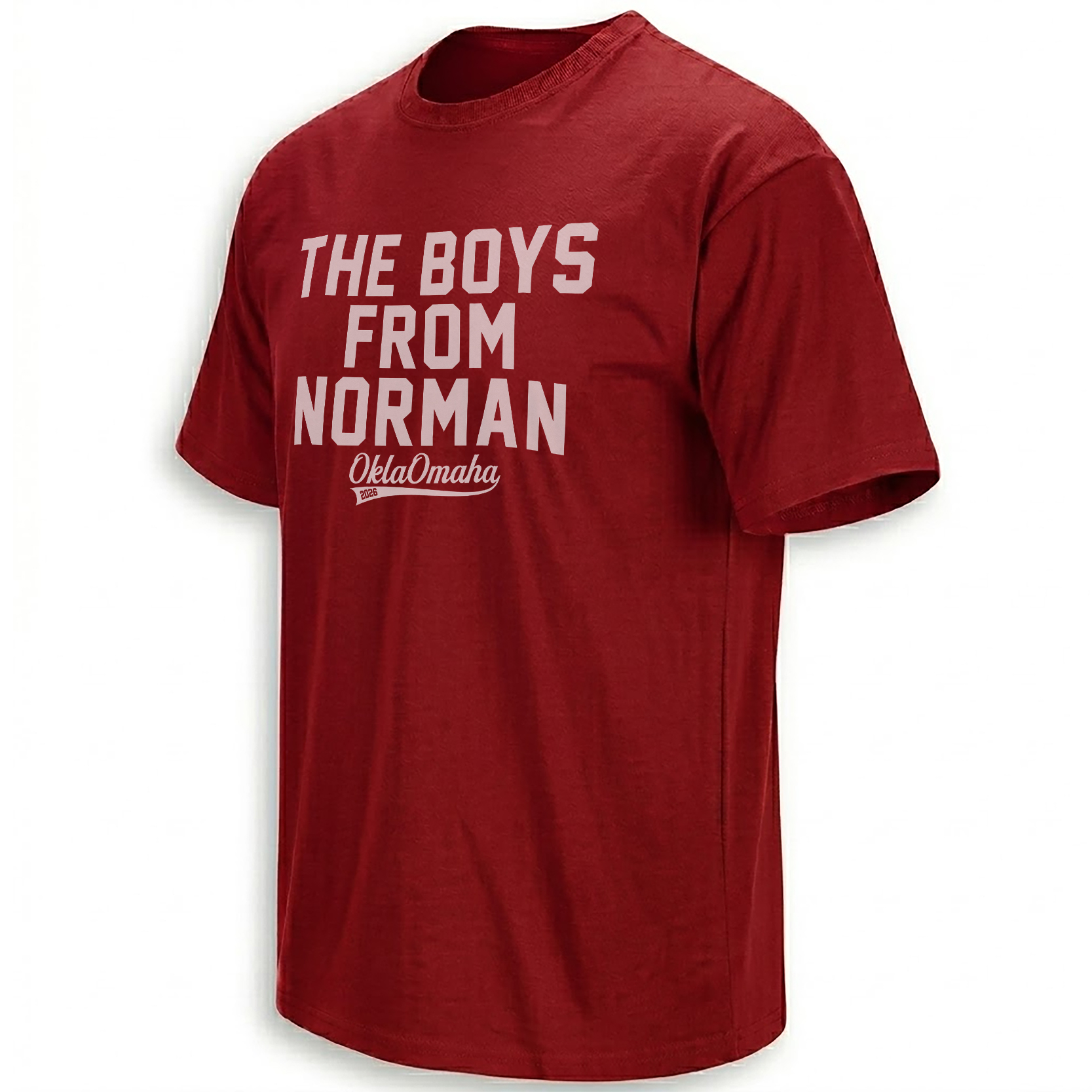
OklaOmaha Turned a Destination Into Claimed Territory
Omaha occupies a special place in college baseball language. Programs do not merely qualify for another neutral-site tournament. They make it to Omaha. The city functions as both location and achievement, a word that can summarize an entire season before the first pitch of the Men’s College World Series is thrown.
“OklaOmaha” reshapes that shared destination around one team. The blended word joins Oklahoma and Omaha without requiring a long explanation. It suggests arrival, ownership and transformation: Oklahoma did not simply visit the championship stage; the Sooners brought enough identity with them to rename it.
That is the kind of phrase that thrives in fan culture because it can operate in several spaces at once. It is a travel slogan for supporters making the trip north. It is a celebratory caption after a home run. It is a shorthand for the entire postseason path. After the final out, it becomes a permanent reference to the championship itself.
The timing also matters. Had Oklahoma fallen short, OklaOmaha would have remained a clever tournament phrase. Winning changed its tense. It now refers to a completed event—the summer when the Sooners reached Nebraska, survived the championship series and returned to Oklahoma with the program’s third title.
“The Boys From Norman” identifies the people and the hometown. “OklaOmaha” identifies the journey and the destination. Placed together, the two phrases tell the entire championship story without reproducing a bracket, final score or trophy illustration.
The Typography Feels Like a Locker-Room Message, Not an Official Crest
The visual strength of the design comes from restraint. There is no player collage, ballpark scene or oversized trophy competing with the language. The composition trusts the words to carry the emotion.
“The Boys,” “From” and “Norman” are stacked in condensed block capitals, with the hometown receiving the broadest and most emphatic line. The letters feel closer to an old athletic department poster or a message taped inside a clubhouse than to a polished commemorative emblem. Their narrow proportions create urgency, while the cream-on-crimson contrast makes the statement readable almost immediately.
The script beneath changes the rhythm. Where the primary slogan is rigid and declarative, “OklaOmaha” appears handwritten, underlined and personal. It behaves like a signature placed beneath the larger statement—the cultural mark left after the boys from Norman completed the trip.
Gives the main phrase the force of a rally poster, dugout message or headline printed immediately after the final out.
Keeps the design rooted in Oklahoma identity while producing the softened look of a piece meant to age with the memory.
Makes the hometown—not the tournament logo or championship trophy—the emotional center of the composition.
Works as a handwritten destination stamp, joining the team’s origin with the city where the title was secured.
A Championship Built by a Roster, Remembered Through Individual Moments
Every team-centered slogan eventually opens into individual memories. Jaxon Willits became the Most Outstanding Player of the 2026 Men’s College World Series after batting .500 across six games, producing thirteen hits, five doubles and seven runs batted in. His tournament became one of the clearest expressions of Oklahoma’s offensive transformation.
In the deciding game, L.J. Mercurius controlled North Carolina for 5.2 innings and allowed only one earned run. Kyle Branch supplied the late exclamation point with a three-run home run in the eighth. The final score became a team statistic, but moments such as those give fans the smaller images through which the larger result will be replayed.
The championship also reflected the depth of Oklahoma’s pitching response throughout the tournament. Freshmen were repeatedly asked to start in elimination-level environments, while the offense kept creating enough margin to make pressure feel temporary. Skip Johnson’s team did not reach the title through one dominant formula. It kept finding a new contributor for the next version of the problem.
That collective quality is another reason “The Boys From Norman” fits. The slogan does not isolate a single star or reduce the run to one highlight. It remembers the roster as a group—a team that passed responsibility from one hitter or pitcher to another until there were no games left to win.
From 1951 and 1994 to a New Oklahoma Baseball Generation
Oklahoma’s first two baseball national championships belonged to 1951 and 1994. The distance between those years already made the program’s title history feel generational. The thirty-two years between 1994 and 2026 deepened that effect.
For older supporters, the new championship reopened memories of a previous Oklahoma team finishing its season in Omaha. For younger fans, 2026 became the first title they could claim as lived experience rather than inherited history. A program’s championship count may rise by one, but the emotional change is larger: an entire generation gains its own final out.
That is why championship graphics often outlast the immediate celebration. Their purpose is not simply to announce what happened to people who already know. They preserve the language, color and mood through which the event was first understood.
The broader Oklahoma Sooners collection now reads like a developing visual archive of the 2026 run—from traditional national-championship emblems to hometown phrases and OklaOmaha references. The College Baseball Shirts collection places that Oklahoma story beside the slogans, destinations and postseason rituals that define the sport, while the wider NCAA collection follows how college identities become graphic culture beyond a single championship.
Why This Run Will Be Remembered as a Journey, Not Just a Final Score
A 13–2 championship victory invites a simple memory: Oklahoma dominated the final game. The deeper story begins before that night. The Sooners had to reach the postseason without the comfort of an elite seed, win in hostile regional environments and rediscover an offense capable of overwhelming some of the strongest teams in the field.
That sequence gives the title its narrative shape. Atlanta made the possibility real. Lawrence moved Oklahoma one step from Omaha. The victories over Alabama and Georgia proved the Sooners belonged in the championship series. North Carolina forced a decisive third game. Then Oklahoma produced the kind of performance that makes every earlier complication feel like part of the route.
Years from now, supporters may remember the home runs, the Most Outstanding Player performance or the final margin first. Yet “The Boys From Norman” preserves something broader. It remembers where the team came from before the postseason changed what the group meant.
The phrase is therefore less a product slogan than a hometown caption beneath a championship photograph. Norman supplied the identity. Omaha supplied the stage. Oklahoma baseball connected the two.
Frequently Asked Questions
Who won the 2026 NCAA Division I baseball championship?
The Oklahoma Sooners won the 2026 NCAA Division I baseball championship by defeating North Carolina 13–2 in the deciding third game of the Men’s College World Series championship series.
Why is the phrase “The Boys From Norman” meaningful?
The phrase identifies Oklahoma’s players through the program’s home in Norman and frames the championship as a hometown group carrying its community onto college baseball’s biggest stage.
What does “OklaOmaha” mean in Oklahoma baseball culture?
“OklaOmaha” blends Oklahoma with Omaha, the home of the Men’s College World Series. It became a compact way to describe the Sooners bringing their crimson identity to the championship destination.
How many baseball national championships has Oklahoma won?
Oklahoma has won three NCAA Division I baseball national championships, with titles in 1951, 1994 and 2026.
Why was Oklahoma’s 2026 championship run considered unexpected?
Oklahoma entered the NCAA Tournament as an at-large selection after a 14–16 SEC regular-season record, then defeated a series of highly seeded opponents and surged through Omaha to win the title.
Who was named Most Outstanding Player of the 2026 Men’s College World Series?
Oklahoma infielder Jaxon Willits received the award after batting .500 with thirteen hits, five doubles and seven RBI across six games in Omaha.
Why does the design use typography instead of a trophy illustration?
The text-first layout makes hometown identity the central image. The athletic block lettering presents “The Boys From Norman” as the declaration, while the handwritten OklaOmaha mark records the championship journey.
The The Boys From Norman design preserves the direct language of the run, while Ellie Shirt’s wider Oklahoma Sooners archive follows the championship through its trophy graphics, OklaOmaha wordplay and fan-made memory of the road to Omaha.
The Boys From Norman Shirt records Oklahoma baseball’s 2026 national championship through bold hometown typography and the OklaOmaha signature, connecting the team’s roots in Norman with the Omaha stage where the Sooners completed their historic run.