Three Oklahoma Championships One Crimson Baseball Memory
Oklahoma’s 13–2 victory over North Carolina on June 22 did not simply complete the Sooners’ 2026 postseason run. It connected a modern Omaha celebration to the championship teams of 1951 and 1994, turning three distant seasons into one living program history.
When Jackson Cleveland struck out the final North Carolina batter at Charles Schwab Field, the immediate image belonged to 2026: Oklahoma players rushing toward the mound, crimson spilling across the infield and a scoreboard fixed at 13–2. Within seconds, however, the celebration began reaching backward.
The Sooners had become national champions for the third time in program history. The newest title joined 1951 and 1994, three seasons separated by seventy-five years but now presented together every time Oklahoma baseball history is summarized. The championship count changed from a pair of inherited memories into a three-part lineage with a living modern chapter.
That distinction is why “3X” carries a different emotional weight from an ordinary 2026 champions graphic. The newest team earned the night, but the number belongs to everyone who helped build the program’s championship identity: the players who established it in 1951, the generation that revived it in 1994 and the roster that brought the trophy back to Norman thirty-two years later.
A championship year records who won. Three championship years reveal what a program has carried across generations.
Oklahoma baseball: 1951 • 1994 • 2026The Third Title Changed the Shape of Oklahoma Baseball History
Before Monday night, Oklahoma’s championship history could be described through two distant landmarks. The first title belonged to 1951, only a few years after the NCAA tournament began. The second arrived in 1994, creating a new championship generation and proving that the earliest success was not an isolated historical achievement.
The 2026 team added something structurally different. It created a sequence. Three championship seasons can be read as a timeline rather than a pairing: the origin, the revival and the modern continuation. Each title remains distinct, but the program now has enough championship history for fans to see recurring identity across eras.
That continuity became especially powerful because the newest championship did not arrive through a protected or predictable route. Oklahoma finished 43–23 and entered the NCAA Tournament as an at-large selection after going 14–16 in SEC play. The Sooners then defeated nationally seeded opponents throughout the postseason, reached Omaha and won a decisive third game against No. 5 North Carolina.
The championship did not feel prewritten. It felt discovered during the run itself. A team that had lost its final four regular-season series transformed into the tournament’s most dangerous offense, hitting with a freedom and force that made the earlier uncertainty seem increasingly distant.
“3X” is both a count and a compression device. It reduces seventy-five years of Oklahoma baseball history into one immediate symbol while leaving every championship season visible inside the number.
1951: The Season That Established the Possibility
The first championship in a program’s history always occupies a special cultural position. Before it happens, national success exists as ambition. Afterward, it becomes evidence. The 1951 Oklahoma team gave every later Sooners roster a historical reference point: this had been done before, in this uniform, under this university’s name.
That earliest title came from a different college baseball world. The tournament was smaller, media coverage moved at another speed and the College World Series had only recently established Omaha as its permanent home. Yet the essential championship language would be recognizable to any modern supporter: survive the field, win the final game and return home carrying proof that Oklahoma baseball belonged at the national level.
For decades, 1951 functioned as the foundation. It appeared in media guides, stadium displays and family recollections, becoming less a collection of individual clips than a program myth inherited by supporters who had never witnessed the games themselves.
Historical championships often survive through fragments. A photograph. A roster. A trophy case. A date printed beneath a stadium banner. Their emotional force depends on later generations continuing to repeat them. Every time “1951” appears beside a newer title, the first team is returned to the current conversation.
1994: When Oklahoma Built a Second Championship Generation
The 1994 title changed the meaning of the first. Oklahoma was no longer a program with one distant championship. It had returned to the top, forty-three years later, and created a second community of supporters who could remember the final out as something they had personally experienced.
For fans who grew up around that team, 1994 became the modern reference point. It was the championship replayed through old broadcasts, newspaper pages and conversations between parents and children. The year became a compact way to describe an entire baseball summer.
The value of a second title is not merely arithmetic. It allows a program to compare eras without forcing one to replace the other. The 1951 team remained the origin. The 1994 team became the return. Together, they formed a story about Oklahoma baseball reaching the same destination through different generations.
Yet as the years accumulated, 1994 gradually moved from recent memory into history itself. Players who once represented the present became alumni. Supporters who celebrated as children became parents. The program returned to the championship series in 2022 but fell short, extending the wait and making the distance from 1994 feel sharper.
Oklahoma’s first national championship created the original proof that the Sooners could finish a season at the top of college baseball.
The second title gave Oklahoma a new championship generation and transformed the program’s earliest success into an enduring tradition.
Thirty-two years later, the Sooners brought the trophy back to Norman and gave contemporary supporters a championship memory of their own.
2026: The Title That Made the Archive Feel Alive
The newest championship began as a postseason reversal. Oklahoma entered the national tournament without the profile of an inevitable winner, then eliminated the No. 2, No. 3, No. 5, No. 7 and No. 15 national seeds during its run.
Once the Sooners reached Omaha, the offense became the visual signature of the team. Oklahoma defeated Alabama 9–0, beat Georgia twice to reach the championship series and opened the final against North Carolina with a 9–3 victory. After the Tar Heels forced a decisive third game, Oklahoma responded with its most complete offensive statement.
The Sooners scored in five consecutive innings, produced fourteen hits and built a 13–2 final margin. Kyle Branch drove in six runs and punctuated the night with a three-run home run in the eighth. Dayton Tockey also homered, while Jaxon Willits reached base five times and completed a College World Series performance that earned him Most Outstanding Player honors.
Willits finished the event batting .500 with thirteen hits, the most by an Oklahoma player in a College World Series. LJ Mercurius steadied the decisive game with 5.2 innings of relief, and Cleveland ended the season by striking out three consecutive batters in the ninth.
Those details will remain attached to 2026 because championship memories need individual images. Branch’s final swing. Willits consistently reaching base. Mercurius controlling the middle innings. Cleveland’s last strike. The dogpile. Each scene becomes an entry point into the larger meaning of the year.
Why the Design Leads With “3X” Instead of Only “2026”
A conventional championship graphic would allow 2026 to dominate the composition. This design takes a broader editorial position. The newest title matters because it completed a three-title history, so the number of championships becomes the headline.
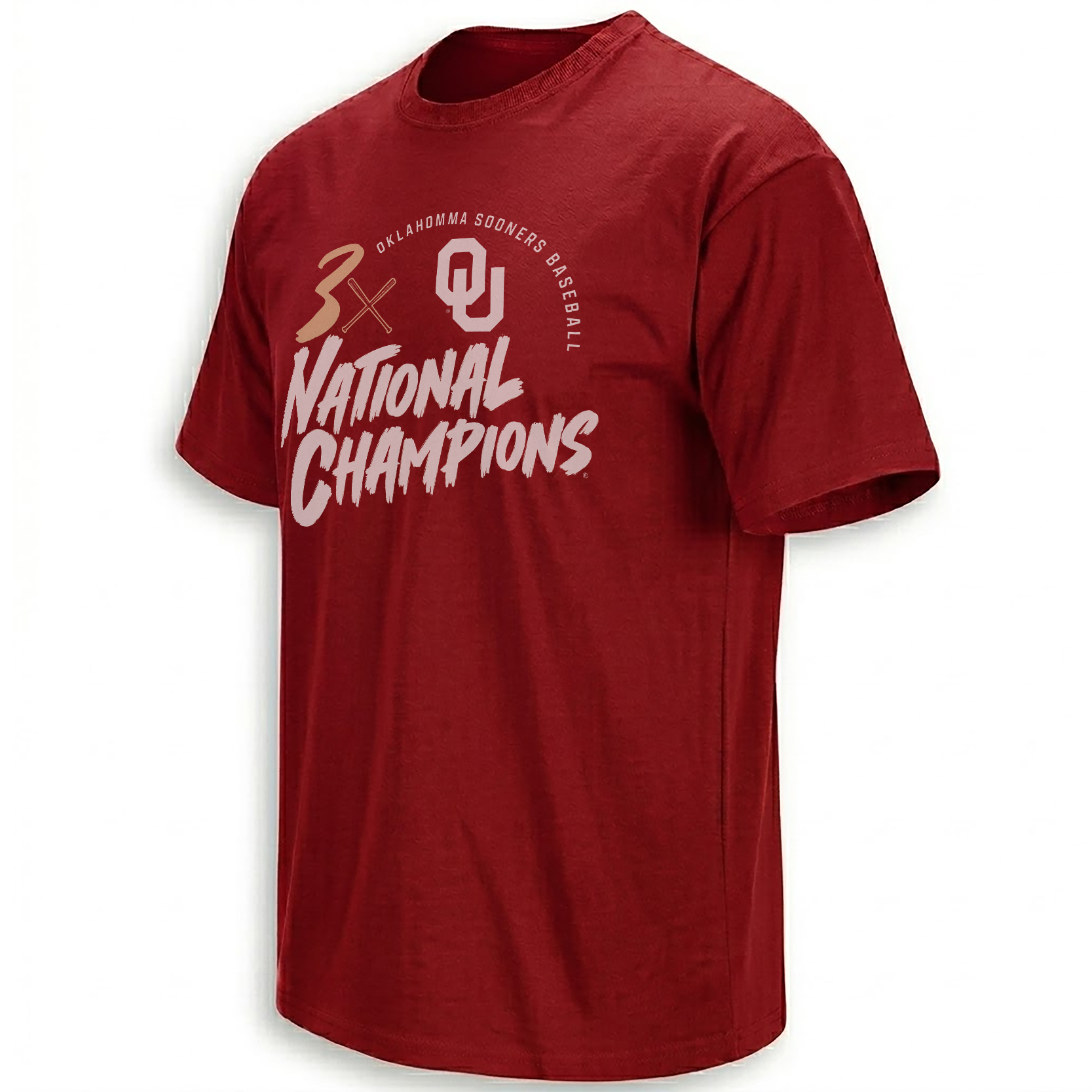
The oversized “3” appears in muted gold beside a compact crossed-line “X.” Together they form a mark that reads immediately from a distance. The interlocking OU emblem occupies the upper center, surrounded by curved Oklahoma Sooners Baseball lettering that gives the arrangement the structure of a contemporary athletic seal.
Beneath that controlled upper emblem, the visual language changes. “National Champions” spreads across the graphic in broad cream brush strokes. The rough edges feel less institutional and more emotional, resembling a rally sign, painted clubhouse message or celebratory headline created before the sound of the final out has disappeared.
That contrast gives the artwork its energy. The top half organizes the legacy: the count, the school and the sport. The lower half releases the celebration. One section behaves like an archive stamp; the other behaves like a shout.
The large 3 explains the historical angle before any supporting text is read, presenting Oklahoma as a three-time national champion rather than only the newest winner.
The interlocking OU mark anchors the composition, ensuring the three-title message remains unmistakably connected to Sooners baseball.
The small crossed X works like a visual notation—simple, modern and capable of compressing three complete championship seasons into one mark.
The irregular cream lettering breaks away from formal collegiate typography and gives the graphic the urgency of an immediate championship celebration.
Crimson Turns Three Different Eras Into One Visual Family
The championship teams of 1951, 1994 and 2026 played in different uniforms, under different tournament structures and within different versions of college baseball. Crimson is the visual thread that allows those eras to be placed beside one another without losing their individual character.
On the graphic, the deep crimson base does more than identify Oklahoma. It behaves like the background of a historical exhibit, allowing the warm gold, cream and white elements to appear as layers added over time. The color palette avoids the polished metallic excess often associated with championship imagery. Instead, it feels grounded, archival and closely tied to the everyday visual identity of the university.
The muted gold “3” adds a ceremonial note without turning the piece into a trophy illustration. Cream lettering softens the contrast and creates the appearance of ink or paint that has already begun aging into memory. The graphic can therefore belong to the immediate 2026 celebration while still looking comfortable beside references to 1951 and 1994.
This is important because multi-era designs can easily become crowded timelines. By avoiding player portraits, scores and detailed brackets, the composition allows all three championship seasons to remain emotionally present without attempting to summarize each one visually.
The artwork does not reconstruct three championship games. It gives fans a compact visual structure through which the years can be remembered together: one crimson field, one Oklahoma identity and one count that now reaches three.
The Distance Between Titles Is Part of the Emotion
Championship histories are often presented as uninterrupted dominance, but Oklahoma’s three baseball titles tell a different story. Forty-three years separated 1951 from 1994. Another thirty-two years passed before the 2026 team finished the journey.
Those gaps do not weaken the legacy. They explain why each return matters. A long wait allows championship memory to change form. What begins as a live event becomes family history, then program mythology, then a reference revived whenever a new roster approaches the same stage.
By 2026, many supporters knew 1951 only through official records and inherited stories. The 1994 title remained more accessible, but it too belonged to an earlier generation. The newest championship restored immediacy. Oklahoma baseball history was no longer something fans encountered only through banners and anniversary features. It was happening in front of them again.
That is why the three years work so powerfully when printed together. They represent three different relationships to memory. 1951 is the foundation. 1994 is the inherited reference point. 2026 is the fresh image still circulating through highlights, photographs and celebration plans in Norman.
From an Omaha Dogpile to a Celebration Back in Norman
The final scoreboard fixed the result, but championship culture continued after the team left the field. Oklahoma scheduled a public celebration at Kimrey Family Stadium for June 24, bringing the national title back to the place where the roster had trained, struggled and rebuilt its season.
That return completes the emotional geography of a College World Series run. Omaha provides the national stage, but the home stadium gives the championship its local meaning. The trophy becomes real in a different way when it enters the community that followed every difficult series before the postseason surge.
In Norman, the title can be placed beside the earlier years without the formality of a record book. Supporters can see current players, hear the championship retold and recognize that the third entry in the program’s history now belongs to their own time.
The 2026 championship also adds a new layer to Ellie Shirt’s wider Oklahoma Sooners collection. Hometown slogans, OklaOmaha wordplay, trophy graphics and three-title legacy pieces now function as different visual records of the same postseason. The broader College Baseball Shirts collection follows how Omaha, regional identity and championship language move across programs, while the NCAA collection places those baseball moments inside the larger visual culture of college athletics.
Why Fans Preserve Championships Through Objects
A final score is exact, but it is emotionally incomplete. It can confirm that Oklahoma defeated North Carolina 13–2, yet it cannot preserve the nervousness before the first pitch, the accelerating confidence as the lead grew or the feeling of watching thirty-two years collapse into a final strike.
Supporters use objects to hold what numbers cannot. Ticket stubs, newspaper pages, photographs, stadium cups and championship graphics become physical shortcuts back to the experience. Their value comes from association rather than explanation.
A three-title graphic performs that function across multiple generations. For one supporter, 1994 may be the central memory and 2026 the long-awaited continuation. For another, both older titles may have been inherited through family stories, making the newest victory the first one personally witnessed.
The same “3X” mark can therefore carry different emotional timelines. It does not tell every fan what to remember. It gives them a structure in which their own connection to Oklahoma baseball can live.
Three Teams, Three Eras, One Program Story
Comparing championship teams across seventy-five years will always be imperfect. The sport changes. Training changes. Tournament formats, equipment, travel and media environments change. The purpose of placing 1951, 1994 and 2026 together is not to decide which roster was greatest.
The deeper connection is that each team reached the same final status for a different generation of Oklahoma supporters. Each one transformed a season into a permanent historical reference. Each gave later players evidence that the program could reach the top again.
The 2026 team did not replace the first two championship stories. It activated them. The new title encouraged old photographs to resurface, prompted the earlier years to appear in current headlines and gave fans a reason to understand the program’s history as one continuous narrative.
That is the strongest meaning of three-time champion. It is not simply the number of trophies in a case. It is the number of times Oklahoma baseball has created a final out powerful enough to become part of the institution’s permanent memory.
Frequently Asked Questions
How many NCAA baseball national championships has Oklahoma won?
Oklahoma has won three NCAA Division I baseball national championships, with title seasons in 1951, 1994 and 2026.
Who did Oklahoma defeat to win the 2026 national championship?
Oklahoma defeated North Carolina 13–2 in the deciding third game of the 2026 Men’s College World Series championship series.
How long had Oklahoma waited since its previous baseball title?
Oklahoma’s previous national championship came in 1994, so the 2026 victory ended a thirty-two-year wait between baseball titles.
What does the 3X represent on the Oklahoma championship design?
The 3X represents the Sooners’ three national championship seasons and connects the 2026 team directly to the championship teams of 1951 and 1994.
Why is the 2026 title important to Oklahoma baseball history?
The victory gave Oklahoma its third national championship, restored the program to the top of college baseball for the first time since 1994 and created a new championship memory for modern Sooners supporters.
Who was the Most Outstanding Player of the 2026 Men’s College World Series?
Oklahoma shortstop Jaxon Willits earned Most Outstanding Player honors after batting .500 with thirteen hits, five doubles and seven RBI across six games in Omaha.
Why does the artwork use brush-style National Champions lettering?
The broad, rough-edged lettering gives the championship message the emotional energy of a hand-painted rally sign while contrasting with the more structured 3X and OU emblem above it.
The 3X National Champions design preserves Oklahoma baseball’s complete title history in one immediate graphic, while the broader Oklahoma Sooners archive follows the hometown phrases, Omaha references and championship images created around the 2026 run.
3X National Champions Shirt connects Oklahoma baseball’s 1951, 1994 and 2026 NCAA titles through a bold championship count, centered OU identity and hand-painted lettering that turns three generations into one Sooners legacy.