South Philly Names Turns the 2026 Phillies Roster Into a Living Roll Call
Harper, Schwarber, Turner, Bohm, Stott, Realmuto and a changing collection of arms make this Phillies season feel less like one fixed lineup and more like a South Philadelphia chorus rewritten every night.
By July 2026, the Phillies’ identity was visible in two places at once. It remained attached to the familiar names at the center of the roster, but it also lived inside the constant revisions required by injuries, lineup changes and the physical cost of a full baseball season.
Kyle Schwarber entered the summer as Philadelphia’s clearest home-run force. Bryce Harper remained the emotional center of the lineup. Trea Turner, Alec Bohm, Bryson Stott and J.T. Realmuto supplied the structure supporters recognized, even when individual numbers rose and fell.
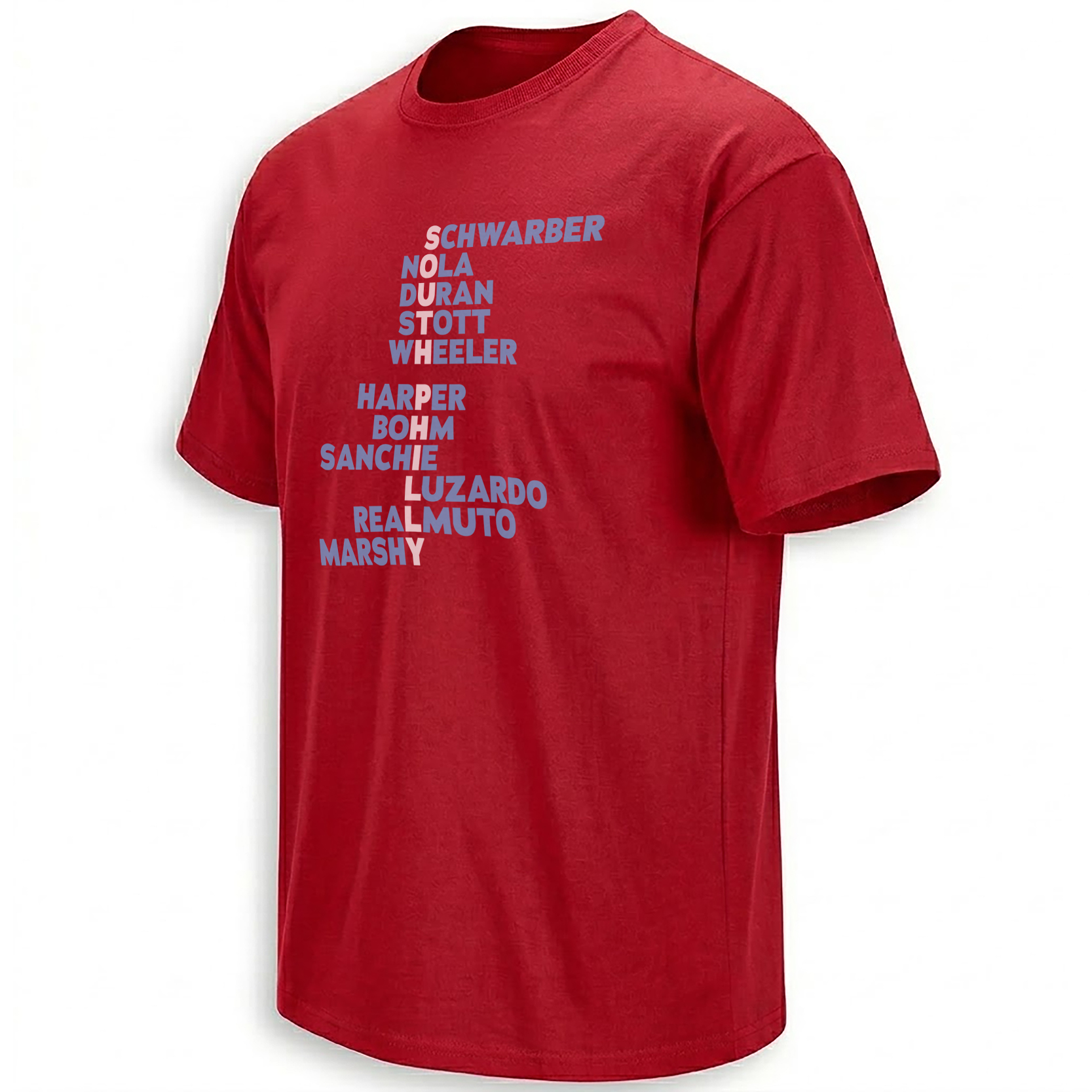
The South Philly Names design does not ask one player to summarize that environment. It turns the roster itself into the subject. Every surname becomes part of a dense verbal map connecting Citizens Bank Park, the clubhouse and the city surrounding both.
A roster graphic remembers what a normal highlight cannot: not only who became the hero, but which names filled the city’s baseball language that year.
Why South Philly Is More Than a Location
Citizens Bank Park is geographically located in South Philadelphia, but the phrase “South Philly” carries a larger emotional meaning. It suggests parking-lot rituals, summer heat, blunt expectations and a crowd that rarely disguises its opinion of the game.
Phillies players do not enter a neutral stadium environment. They enter a culture where effort, decision-making and visible urgency are constantly evaluated. The relationship can become affectionate or confrontational within the same series.
That intensity makes the neighborhood a natural anchor for a roster design. Players change, but South Philadelphia remains the stage where their names acquire local meaning.
Typography Can Show a Team Better Than One Portrait
A single-player design creates a clear hierarchy. Roster typography intentionally disrupts that hierarchy. Harper may carry the largest cultural reputation, but one night can belong to Schwarber, another to Sánchez and another to a bench player whose name was not central to the season a week earlier.
Different letter sizes and placements allow those roles to coexist without pretending they remain equal or permanent. A name can dominate one part of the composition and disappear behind another, much like responsibility shifts during a season.
This makes the artwork feel closer to a lineup card, newspaper page and neighborhood mural at the same time. The subject is not one perfect roster. It is the collective vocabulary fans currently use to discuss the Phillies.
Dense typography creates the sensation of crowd noise translated into print. Phillies red supplies urgency, navy creates structure and the packed arrangement reflects how individual names overlap inside one long season.
The Power Names Shape the Top of the Story
Schwarber’s home-run total gives him an immediate place near the center of any 2026 Phillies memory map. His at-bats create a particular form of anticipation because the possible outcome can change the scoreboard without requiring a sequence of smaller events.
Harper carries a different emotional function. Even when another player leads a statistical category, his presence still organizes the attention of the ballpark. His plate appearances feel like events because fans have accumulated years of postseason swings, visible intensity and franchise-defining images around him.
Turner adds speed and movement, while Bohm and Stott represent the infield core that has remained recognizable across multiple competitive seasons. Together, these names give the typography its primary structure.
The Pitching Names Tell Another Version of Philadelphia
A roster design centered only on hitters would miss half the season’s emotional rhythm. The Phillies’ pitching identity includes both established rotation authority and newer sources of momentum.
Zack Wheeler and Aaron Nola carry years of Philadelphia expectations. Cristopher Sánchez and Jesús Luzardo represent a rotation whose identity has continued evolving, while Jhoan Duran provides the compressed drama of late innings.
Pitching names occupy a different part of fan memory. Hitters are recalled through swings and celebrations. Starters are recalled through entire nights, sequences of scoreless innings and the gradual realization that an opposing lineup is running out of time.
Harper, Schwarber and Turner remain the names most likely to organize national attention around Philadelphia’s lineup.
Wheeler, Nola, Sánchez, Luzardo and Duran give the team multiple forms of run prevention and late-game authority.
Injuries, call-ups and lineup adjustments ensure that the supporting names continue changing around the core.
Injuries Turn Every Roster Into a Temporary Document
No roster graphic should be read as a permanent official list. Active rosters change through injured-list placements, rehabilitation assignments, options and returns.
Philadelphia’s 2026 season has required exactly that kind of revision. Realmuto returned from back spasms in May. Other pitchers and position players moved on and off the injured list as the summer progressed.
That instability does not weaken the cultural value of the design. It explains it. The graphic preserves one recognizable stage of the roster rather than claiming to document every transaction.
Why Familiar Names Still Need to Be Seen Together
Fans know Harper, Schwarber and Turner individually. Placing their names beside the rest of the roster changes the meaning. The stars become members of a specific collective rather than isolated brands.
This is particularly important in baseball, where no hitter can control the entire game. A home run may decide the result, but the opportunity is created by innings, baserunners, defensive plays and pitching work accumulated around it.
Roster typography restores some of that collective structure. The famous names remain visible, but they are surrounded by the team required to make the season possible.
The Graphic Works Like a South Philadelphia Newspaper Page
The dense arrangement recalls old sports sections where names competed for space beneath one large result. It also resembles a neighborhood poster assembled from the language people repeated during the week.
That visual direction fits Philadelphia because the city’s sports culture has always been verbal. Players are discussed through nicknames, radio arguments, chants and blunt assessments that can quickly become shared language.
South Philly Names turns that language into a physical composition. The roster becomes something to scan rather than read in a fixed order.
Why Roster Pieces Become More Emotional Later
During the season, every name feels current. Years later, the same names create distance. Some players remain with the club. Others leave, retire or become attached to completely different teams.
That is when roster typography changes from current design into memory object. It preserves not only the players remembered immediately, but also the contributors who might otherwise disappear from the simplified historical version.
The South Philly Names piece therefore functions as a timestamp of 2026: one neighborhood, one roster and one stage of a team still trying to determine what kind of season it will become.
The Wider MLB Roster Archive
Every club produces its own temporary language of names. Some seasons are remembered through one superstar. Others survive as a collective because the roster itself became the story.
The South Philly Names design preserves Philadelphia’s 2026 roll call, while the broader MLB Shirts collection follows the players, roster changes and local baseball identities shaping the season.
Frequently Asked Questions
What does the South Philly Names design represent?
It presents selected names associated with the Philadelphia Phillies’ 2026 roster as a collective typography graphic rather than focusing on one player.
Why does the design use South Philly instead of only Philadelphia?
Citizens Bank Park is located in South Philadelphia, and the neighborhood name carries the crowd culture, rituals and local identity surrounding Phillies baseball.
Is the artwork an official complete Phillies roster?
No. It functions as a fan-facing memory map of recognizable 2026 names rather than a complete official transaction or active-roster record.
Why can the Phillies roster change throughout the season?
Injuries, rehabilitation assignments, call-ups, options and transactions continually alter the active roster during a baseball season.
Why do roster typography designs become nostalgic?
They preserve both major stars and supporting players from one specific season, creating a compact record of the names fans heard and discussed at that time.
The South Philly Names piece preserves the collective language of the 2026 Phillies, while the broader MLB visual archive follows the changing rosters and local baseball cultures defining each year.
South Philly Names Shirt turns the Philadelphia Phillies’ shifting 2026 roster into a dense typography archive of stars, pitchers and supporting names connected to one season at Citizens Bank Park.