
Pokémon Is 30. Of Course Three Decades of Fandom Eventually Produced “Smokémon.”
Pokémon’s official anniversary campaign is celebrating friendship, favorite characters and thirty years of Trainers. Internet parody culture has its own archive—and this sleepy, dreadlocked Pikachu belongs firmly inside it.
Thirty years creates more than nostalgia. It creates layers. There is the original game memory, the anime memory, trading cards, Pokémon GO, convention culture, collectors, parents introducing children to old favorites—and underneath all of that, decades of unauthorized jokes that grew around characters recognizable enough to survive almost any remix.
That is the territory of the Smokémon Shirt. Pikachu remains yellow, red-cheeked and lightning-tailed. Then the expression collapses into half-lidded sleepiness, black lock-like hair appears over the forehead and a smoking joint sends a cloud across the face.
The altered title above completes everything: “SMOKÉMON.” One word transforms a thirty-year family gaming institution into old-school stoner parody.
Pikachu has become so visually durable that parody can change the personality completely without losing the character for even a second.
The official 30th anniversary proves how much cultural weight Pikachu carries
The Pokémon Company began 2026 explicitly around the thirty-year milestone. Pokémon Asia announced that February 27 marked thirty years since the original release of Pokémon Red and Green, and the official Pokémon 30 campaign has continued through events, wallpapers, merchandise and public activations.
Pikachu remains everywhere inside that anniversary language. Even the official “What’s Your Favorite?” campaign uses a Pikachu-shaped anniversary icon, while Pokémon GO lets participants build #Pokemon30 snapshots around more than a thousand possible creatures.
That scale makes parody easier rather than harder. The more culturally stable the original becomes, the less explanation a joke needs.
Smokémon is not a new kind of internet joke
Cannabis parodies of famous cartoon and gaming characters have circulated for years because the mechanism is easy to read: take an energetic or wholesome figure and replace their original “power” with exaggerated stoner behavior.
Pikachu may be the most obvious target possible. The original character stores electricity in cheek sacs and releases energy through electric attacks. “Smokémon” flips energy into lethargy.
The red cheeks remain. The ears remain. The lightning tail remains. But the eyes droop, smoke obscures the lower face and the new hair treatment pushes the personality into an entirely different subculture.
The title typography does almost as much work as Pikachu
“SMOKÉMON” arches above the character in bright yellow letters with warm red-orange outlining and dark shadow. Even without reading the word closely, the visual rhythm recalls classic Pokémon-inspired title treatments.
Then the eye notices the first four letters have changed.
Keeping the accented É is a useful small detail because it helps preserve the shape of the familiar name while making the altered word feel even more intentional. It is not simply “Pikachu smoking.” It is a full franchise-name parody.
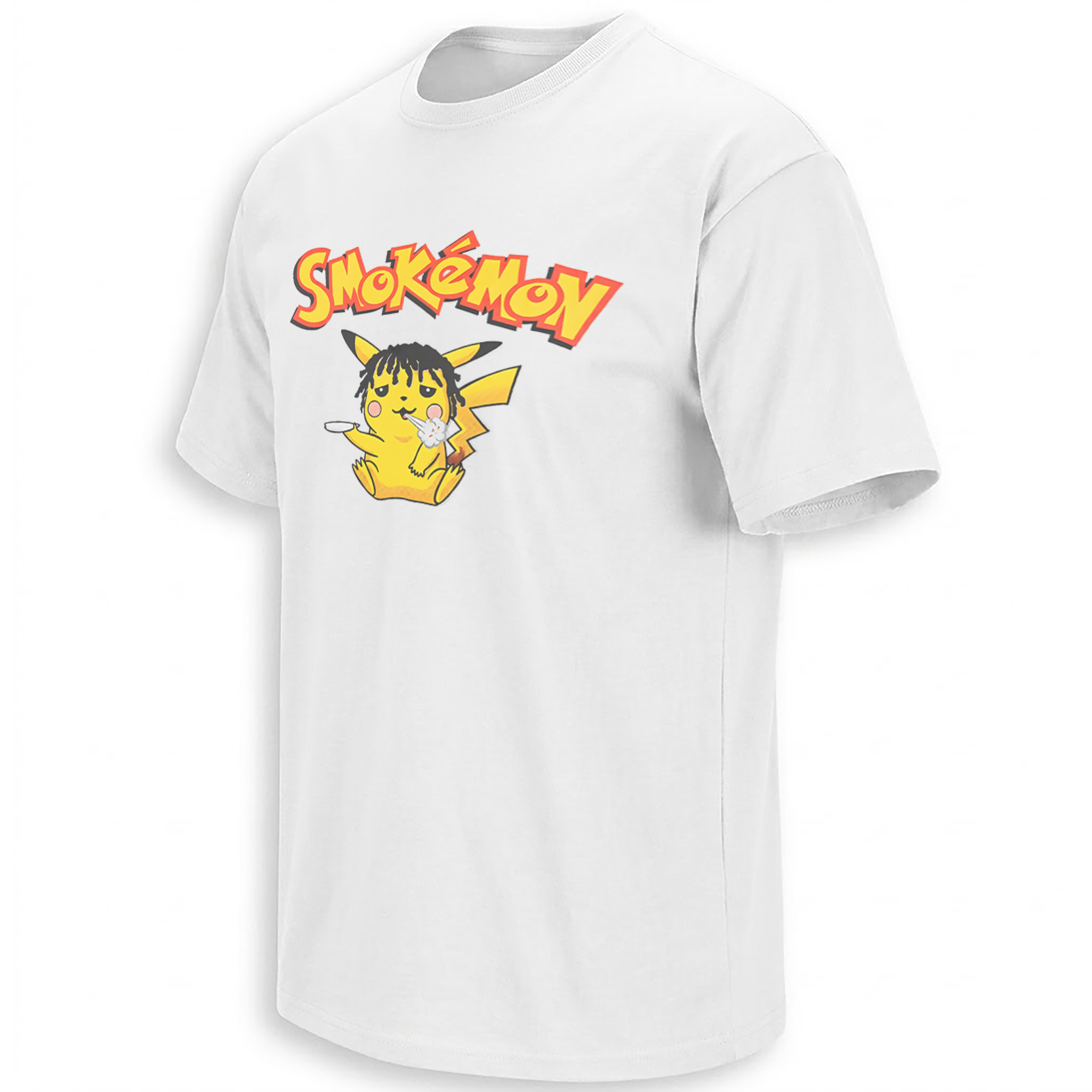
Pikachu keeps the yellow body, red cheeks, pointed ears and lightning tail while black lock-like hair, a joint, smoke and half-lidded eyes completely rewrite the personality.
View the piece →2026 gives old parody culture a new search window
Anniversaries pull old audiences back toward a franchise while giving newer audiences a reason to investigate its history. Pokémon’s official schedule makes that especially obvious this year.
Summer Pokémon Day Out events have already taken the anniversary to New York and several international cities. The official campaign continues into autumn with Pokémon Night Out events scheduled for Los Angeles and London, combining the franchise with EDM and large-scale live production.
That makes September a useful middle point. Pokémon is not simply remembering 1996 for one day; the anniversary is operating as a year-long cultural program.
Against that polished celebration, an old-school bootleg joke provides the opposite aesthetic: messy, irreverent, fan-made and intentionally outside official character behavior.
The design currently sits within Ellie Shirt’s Newest collection, while the verified Game & Gamers collection provides a broader gaming-culture destination. Character-specific discovery can continue through the Pikachu search.
FAQ: Smokémon and Pokémon’s 30th anniversary
What does Smokémon mean?
It is a weed-culture parody of the Pokémon name, replacing the opening sound with “smoke.”
Which character is shown?
The artwork parodies Pikachu, preserving his yellow body, red cheeks, pointed ears and lightning-shaped tail.
How old is Pokémon in 2026?
The franchise is celebrating its 30th anniversary.
When did the original games launch?
Pokémon Red and Green were first released in Japan in 1996.
Is Smokémon official Pokémon merchandise?
No. The graphic is fan parody rather than an official Pokémon character portrayal.
The Smokémon graphic captures that parallel fan-history at exactly the moment Pokémon is officially looking back across three decades.
Smokémon Shirt turns Pikachu into a sleepy stoner parody with black lock-like hair, a joint, smoke and altered Pokémon-style lettering—landing during the franchise’s official 30th-anniversary year in 2026.