“I Killed Laura Palmer.” The Most Suspicious Twin Peaks Shirt Is Also the Simplest
Twin Peaks once turned an entire audience into amateur detectives by asking one question. This design answers it in the least trustworthy way possible: whoever is wearing the shirt did it.
Before the Red Room, before the owls, before cherry pie became fan shorthand and before Agent Cooper’s mythology expanded into something almost impossible to summarize, there was a dead homecoming queen wrapped in plastic.
That image created the engine for Twin Peaks. Paramount’s current episode guide still introduces the pilot through the discovery of Laura Palmer’s body along a riverbank and the arrival of FBI Special Agent Dale Cooper to investigate.
The I Killed Laura Palmer Shirt takes the defining question of the series and performs an absurd reversal. Instead of “Who killed Laura Palmer?” the wearer offers a confession nobody asked for.
The shirt works because every fan knows the wearer is not solving the mystery. They are volunteering to become one more impossible suspect.
“Who killed Laura Palmer?” became bigger than an episode plot
The original series did something rare: it converted a television murder investigation into mass cultural participation. Laura’s death was not simply the first story beat. It became the marketing hook, the conversation starter and the question that organized the audience’s week-to-week experience.
Cooper investigated. The sheriff’s department investigated. Viewers investigated from their couches. Every strange relationship and every contradiction in Laura’s public life could become evidence.
That made the question portable. It could appear in conversation, on bumper stickers and in parody because people no longer needed the show title attached to understand what it referenced.
The confession is funny because fans know the real answer
Anyone avoiding a decades-old spoiler should stop here.
The original series ultimately reveals that Laura’s father, Leland Palmer, killed her while under the supernatural influence and possession of BOB. The revelation does not make Laura disappear from the story; it makes her tragedy even more central.
That knowledge creates the second layer of the shirt. The sentence “I Killed Laura Palmer!” is obviously wrong inside the canon, which is exactly why anybody can wear it. The graphic does not identify the killer. It deliberately inserts a random new suspect after the case has already been solved.
Laura’s portrait makes the joke less comfortable
The design could have been pure text. Instead, Laura’s monochrome portrait sits to the right, calm and almost formal. It resembles a reproduced school photograph, a newspaper clipping or a copied image from a case file.
That quiet face changes the tone. The words are outrageous, but the image beside them is solemn. Twin Peaks often operated inside exactly that discomfort—mundane Americana placed beside something wrong enough that the viewer does not know whether to laugh.
The gothic lettering intensifies that contradiction. “I Killed,” “Laura” and “Palmer” stack vertically with irregular sharp forms, while an oversized exclamation mark turns the confession into something between a horror poster and a handmade note.
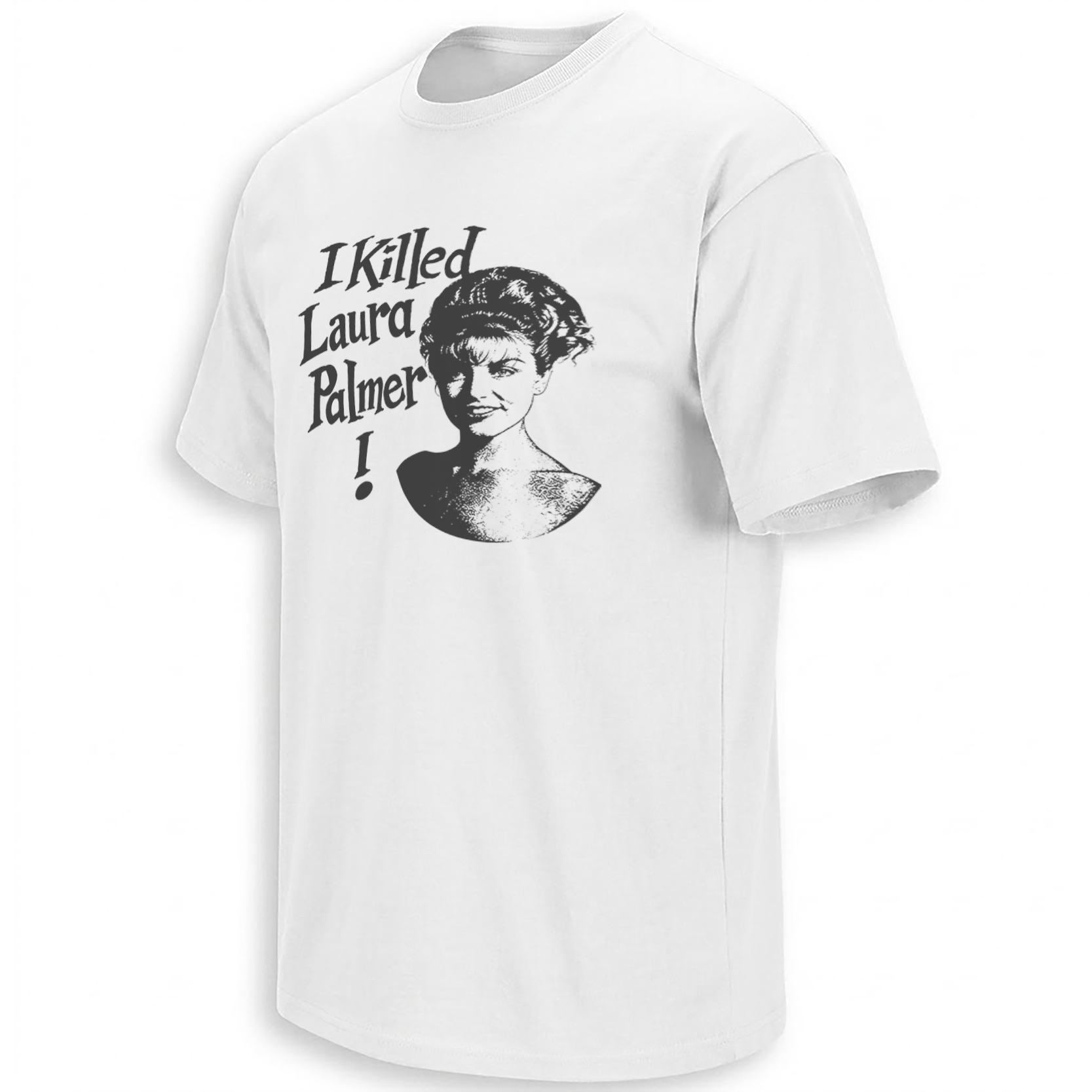
A stark white-base design using a high-contrast Laura Palmer portrait and warped black confession lettering instead of the usual Red Room, coffee or owl references.
View the piece →Twin Peaks never actually escaped Laura Palmer
The series expanded far beyond the original investigation, but its later life kept circling back. Paramount currently summarizes Twin Peaks: The Return by saying the story continues twenty-five years after Laura Palmer’s murder.
That is an extraordinary amount of narrative gravity for a character introduced to the audience through her death. Laura becomes victim, mystery, symbol and eventually something much harder to categorize inside Lynch and Mark Frost’s mythology.
It also explains why a minimalist Laura shirt can be more recognizably Twin Peaks than a crowded composition full of series icons. She is the original center of the maze.
Why black and white is the correct choice
Twin Peaks is visually famous for deep reds, forest greens, neon, wood interiors and the Red Room. The shirt rejects all of them.
That restraint makes it feel more like evidence. Pure black ink on a white base removes the cinematic beauty and leaves only face plus accusation. The result resembles something photocopied, handed around or taped to a wall.
For internal discovery, the verified Movies Shirts collection already contains Twin Peaks-related material, while the Twin Peaks search is the more precise route for Laura, Cooper and David Lynch-related designs.
FAQ: Laura Palmer and the Twin Peaks mystery
Who is Laura Palmer?
Laura Palmer is the Twin Peaks homecoming queen whose murder launches the central investigation of the original series.
Who investigates her death?
FBI Special Agent Dale Cooper works with local law enforcement in Twin Peaks.
Who actually killed Laura Palmer?
The series reveals that her father, Leland Palmer, killed her while under the supernatural influence and possession of BOB.
Does the shirt claim the wearer is the real killer?
No. The false confession is the joke; it turns the wearer into an impossible fictional suspect.
Why is Laura still important after the mystery is solved?
Her death remains the emotional and symbolic center of the wider Twin Peaks mythology, including the story that continues in The Return.
The I Killed Laura Palmer graphic turns the original mystery into deadpan participation: every wearer gets to become the suspect for a day.
I Killed Laura Palmer Shirt turns Twin Peaks’ defining murder mystery into a stark black-and-white confession joke, pairing Laura Palmer’s iconic portrait with gothic typography and cult-TV deadpan humor.