What Is the Abu Obeida Shirt Worn in Montreal Court?
A single T-shirt became one of the most talked-about visual details surrounding Frédéric Biron Carmel’s Montreal court appearance. Here is what the shirt showed, why it drew attention, and why the distinction between political expression and militant imagery matters.
Sometimes the smallest detail in a news photograph becomes the part people remember. In Montreal this week, it was a shirt.
Frédéric Biron Carmel, the Montreal man whose court proceedings are connected to the burning of Israeli flags outside Hampstead Town Hall in August 2025, appeared in court wearing a dark graphic T-shirt beneath a jacket. According to reporting on the hearing, the image on that shirt depicted Abu Obeida, the longtime masked military spokesman associated with Hamas’ al-Qassam Brigades.
That wardrobe choice immediately added a new visual dimension to an already politically charged case. For people encountering photographs or headlines online, it also created a very specific question: what exactly was the Abu Obeida shirt being worn in Montreal court?

What Was on the Shirt?
The graphic reportedly showed Abu Obeida, a figure who became internationally recognizable through his appearances as spokesman for the al-Qassam Brigades. That distinction is important because this was not simply a shirt displaying a Palestinian flag, a general ceasefire slogan, or criticism of the Israeli government.
Canada continues to list Hamas as a terrorist organization under the Criminal Code. That legal and political context is a major reason an image associated with a Hamas military spokesman carries a different meaning from ordinary pro-Palestinian political expression.
Why Did the Shirt Become Part of the Story?
Political clothing works because it compresses an argument into an image. A slogan, portrait, color combination or symbol can communicate a position before the wearer says a word.
That effect becomes even stronger inside a courthouse. Clothing that might blend into a demonstration or social-media photograph can appear much more deliberate when worn during a legal proceeding connected to politically charged allegations.
Reporting on the Montreal proceedings says Biron Carmel stated publicly that he had previously appeared before multiple judges wearing the same shirt. That detail moves the garment beyond an accidental wardrobe choice and helps explain why journalists focused on it.
At the same time, the episode illustrates why political imagery should be described carefully. Supporting Palestinian civilians, criticizing Israeli policy, calling for peace, supporting Israel, opposing antisemitism and displaying the portrait of a figure associated with a militant organization are not interchangeable positions.
When Clothing Becomes a Public Statement
Statement shirts have existed for decades because clothing is unusually effective political media. It moves through streets, photographs, stadiums, protests and social feeds without requiring a formal platform.
But the strongest statement designs are not necessarily the most extreme ones. A shirt can reject violence just as visibly as another shirt celebrates confrontation. That contrast is particularly relevant when a controversial piece of clothing becomes the visual center of a news story.
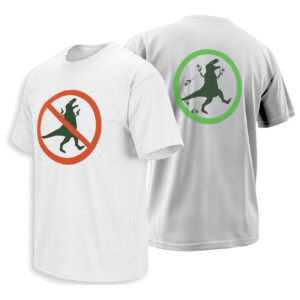
No Guns Yes Flowers Shirt
Ellie Shirt’s Peace Dinosaur design uses a simple visual reversal: weapons are crossed out on the front, while the dinosaur returns with flowers on the back. It turns statement apparel toward an unmistakably anti-violence message without tying the design to one political faction.
Explore the Peace Dinosaur ShirtWhy the Montreal Story Is Larger Than One T-Shirt
The reason this image is likely to remain searchable is that it sits at the intersection of several subjects people routinely investigate separately: Montreal, the Hampstead flag-burning case, political speech, Hamas, Abu Obeida and the limits of provocative symbols in public institutions.
For readers who first encounter only a photograph, the T-shirt can become the entry point into the entire story. Understanding it therefore requires more than identifying the person printed on the fabric. It requires understanding why that particular portrait carried such weight in Canada and why its appearance at a courthouse attracted attention.
Canadian Identity Can Be Worn in Very Different Ways
Not every Canadian political shirt depends on international conflict. Some designs work through national identity, regional pride or satire instead.
Still Lake Ontario — Not For Sale, Not For Change
Built around distressed red-and-navy typography and maple-leaf imagery, this Canadian statement design takes a completely different route: identity and regional defiance rather than militant symbolism.
View the Still Lake Ontario ShirtThe Bottom Line
The Abu Obeida shirt attracted attention because context changed the meaning of the image. A portrait associated with the military wing of an organization Canada lists as terrorist was worn inside a Montreal courthouse during proceedings arising from an intensely political case.
That does not make every Palestinian symbol equivalent to Hamas imagery, nor does a controversial shirt alone resolve the legal questions before the court. What it does show is how quickly clothing can become part of the public record of a cultural moment. In an era when a courtroom photograph can circulate globally within hours, what someone wears can become a search term, a political signal and a story of its own.