
“Slamsby Swanson” Turned a Cubs Hot Streak Into Wrigley Meme Language
Dansby Swanson’s sudden power surge gave Chicago fans a nickname that sounded like it had already been waiting in the bleachers: Slamsby Swanson, a playful Cubs phrase built for home runs, grand slams and scoreboard disbelief.
The nickname only works because the swing started making it unavoidable. After a difficult first half of the season at the plate, Dansby Swanson erupted into one of the loudest Cubs offensive stories of late June and early July 2026, turning a stretch of Wrigley power into the kind of fan language that spreads because it is simple, funny and immediately readable.
The headline moment came on July 1 at Wrigley Field, when Swanson hit three home runs and drove in eight runs as Chicago overwhelmed San Diego, 23–3. It was the sort of game that makes normal baseball vocabulary feel too small: eight Cubs homers as a team, a historic offensive outburst, and Swanson completing his first career three-homer game with a grand slam in the eighth inning.
But “Slamsby” did not appear out of nowhere. It followed a week where Swanson had already slammed the Mets with two homers and seven RBIs in a doubleheader opener at Citi Field, including a 418-foot grand slam. In a sport that loves wordplay almost as much as box scores, the nickname felt less like a forced pun and more like the natural sound of a heater becoming communal property.
A hot streak becomes culture when the numbers are loud enough for fans to rename the player in real time.
Why “Slamsby” Hit So Cleanly
Baseball nicknames survive when they do two things at once: they sound like the player, and they explain the moment without needing a full recap. “Slamsby Swanson” does exactly that. It keeps Dansby’s name intact while tilting it toward power, grand slams and the sudden feeling that every big spot might become another ball in the seats.
The timing made the phrase even sharper. Swanson had been publicly working through a brutal offensive stretch earlier in the season, so the reversal carried emotional weight. This was not just a good player having a good week. It was the visual flip from frustration to force, from questions about the bat to a scoreboard that could barely keep up.
That is the kind of turn fans remember. A player does not need to stay hot forever for a nickname to matter. The phrase belongs to the week when the bat sounded different, the bleachers had a reason to roar, and the Cubs offense briefly felt like it had discovered a trapdoor underneath the opposing pitching staff.
The Shirt as a Wrigley Power Artifact
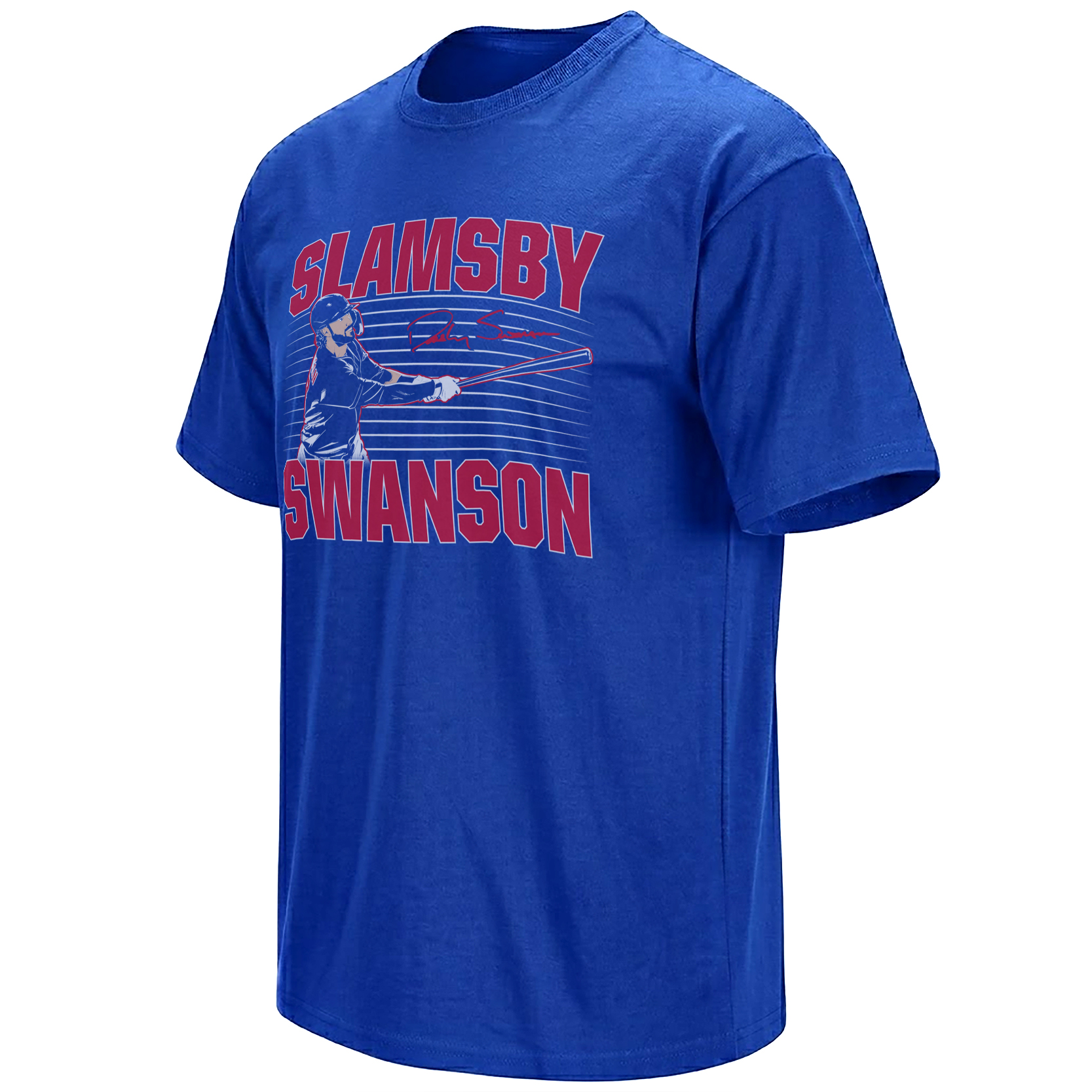
The Slamsby Swanson Shirt fits into that conversation because it captures the nickname at the point where performance becomes fan shorthand. The graphic does not need to retell every inning of the Padres rout or the Mets doubleheader. Its job is to preserve the phrase, the Cubs identity and the feeling of a power surge turning into something people could repeat.
Visually, the artwork leans into the language of impact. The name-play is the hook, but the Cubs color world gives it the local frame: blue, red and baseball energy tied to Chicago’s North Side. It reads like a bleacher sign that escaped the ballpark and became a graphic.
From Slump Story to Scoreboard Story
The best baseball arcs are rarely clean. Swanson’s hot stretch worked because it came after the uncomfortable part of the season had already been visible. Fans had seen the struggles. They had watched the lineup absorb the quiet at-bats. They understood why the breakout carried relief as well as excitement.
That context matters because a three-homer game is spectacular on its own, but a three-homer game after weeks of searching feels different. It becomes a release valve. Every swing carries the memory of the previous outs. Every RBI feels like the season arguing back.
Manager Craig Counsell’s postgame framing captured the baseball logic of it: the sport refuses to be fully solved. A rough patch can become the best stretch of a player’s career almost before anyone has finished diagnosing the problem. That uncertainty is cruel when a player is cold and almost magical when the same player suddenly turns into the loudest bat in the park.
“Slamsby” works like a hand-painted bleacher nickname: short, chantable and tied to an immediate visual. The shirt’s baseball graphic energy gives the pun a home-run frame instead of treating it like a generic player name.
Why Cubs Fans Love This Kind of Phrase
Cubs culture has always been unusually good at turning small bits of language into identity. Wrigley Field already comes with its own visual vocabulary: ivy, rooftops, day-game light, the old scoreboard, neighborhood noise and the feeling that even a random summer afternoon can become a memory if the right swing happens.
“Slamsby Swanson” belongs to that environment. It is not formal. It is not polished into broadcast-brand language. It feels like something a fan says after the second homer, then says louder after the third, then sees on a shirt because the moment became too fun to leave inside one box score.
That is why the phrase naturally sits inside the wider Chicago Cubs collection. Cubs graphics often work best when they feel like snapshots of a specific mood: a comeback, a player heater, a summer joke, a rivalry week, a Wrigley roar. The broader MLB Shirts collection does the same across baseball, preserving the way numbers and nicknames become fan memory.
The Grand Slam Matters
Not every homer produces a nickname. The grand slam component gives “Slamsby” its extra force. A solo shot can be stylish. A two-run homer can be decisive. But a grand slam changes the whole emotional temperature of a game in one swing, and the word “slam” already belongs to baseball’s most dramatic offensive punctuation mark.
Swanson’s June 24 grand slam against the Mets and the July 1 grand slam against the Padres gave the nickname a factual spine. It was not simply a rhyme. It pointed to what fans had just watched: bases full, loud contact, instant scoreboard damage.
That is the difference between a pun that fades and a pun that sticks. “Slamsby” connects to an actual run of swings. It sounds playful, but it is anchored in production.
A Nickname for the Week the Bat Got Loud
The long season will keep moving. Swanson’s numbers will change, the Cubs will move through new series, and the conversation will inevitably shift to standings, injuries, trades, pitching and the next player who heats up. Baseball is ruthless that way. It gives every story a short shelf life until the next game extends or replaces it.
But that is exactly why these graphics matter. They catch a moment while it still has its original temperature. The Slamsby Swanson Shirt is not trying to summarize Swanson’s entire career or define the Cubs’ whole season. It keeps the memory of one loud stretch: the week the bat woke up, the nickname wrote itself, and Wrigley had a new word for power.
Frequently Asked Questions
What does “Slamsby Swanson” mean?
“Slamsby Swanson” is a playful nickname built from Dansby Swanson’s name and his recent Cubs power surge, especially the grand slam and multi-homer energy that made the phrase feel natural.
What game inspired the Slamsby Swanson moment?
The phrase connects strongly to Swanson’s July 1, 2026 performance at Wrigley Field, when he hit three home runs and drove in eight runs in the Cubs’ 23–3 win over the Padres.
Why did the nickname resonate with Cubs fans?
It matched the timing of Swanson’s breakout. After a difficult stretch at the plate, his sudden run of homers and RBIs gave fans a funny, chantable phrase for the turnaround.
How does the shirt fit the Cubs moment?
The shirt preserves the nickname as a Wrigley-style artifact, using Cubs visual energy to turn a short-term hot streak into a memorable fan graphic.
Why are baseball nicknames so tied to hot streaks?
Baseball fans often use nicknames to make a streak easier to remember. When a player’s performance becomes loud enough, a phrase can turn stats into shared fan language.
The Slamsby Swanson Shirt keeps that phrase attached to the week Dansby’s bat changed the conversation, while the broader Chicago Cubs archive and MLB culture collection track the player moments, jokes and home-run graphics that make baseball feel alive in real time.
Slamsby Swanson Shirt captures Dansby Swanson’s Cubs power surge through a playful Wrigley-ready nickname, connecting his multi-homer breakout, grand slam energy and Chicago baseball fan language.