
Shohei Ohtani’s 300th Homer Turned Another Dodgers Night Into a Baseball Time Stamp
Shohei Ohtani reached 300 career home runs at Dodger Stadium against the Colorado Rockies, adding another clean milestone to a career that keeps making baseball history feel current, collectible and almost impossible to normalize.
The swing arrived before the night had time to settle. On July 7, 2026, in the bottom of the first inning at Dodger Stadium, Shohei Ohtani drove career home run No. 300 to left-center field against the Colorado Rockies. It was also his 20th homer of the 2026 season, the kind of early-game jolt that made a regular-season box score feel like a historical marker.
The Dodgers did not get the storybook ending. Colorado came back to win 4–3, turning the game itself into a reminder that baseball rarely arranges its milestones neatly. But that almost made the moment feel more authentically Ohtani: a huge personal number, an immediate stadium reaction, and a larger conversation that continued even after the final score moved in another direction.
For fans, 300 home runs is not just a counting stat. It is a doorway number. It asks where a player has been, how fast he arrived, and what the next layer of the career might look like. With Ohtani, the number carries extra electricity because the baseball public is never tracking only one career. It is tracking the hitter, the pitcher, the global star, the Dodgers centerpiece and the living argument that some players require their own category.
Three hundred home runs is a statistic. With Ohtani, it also becomes a way to measure how quickly the impossible starts feeling routine.
Why 300 Feels Different With Ohtani
Baseball has always been built around numbers that turn into language. Forty homers becomes a power season. Fifty becomes a chase. Five hundred becomes a legacy threshold. Three hundred sits in a different place: not the end of the road, but the moment when a career’s shape becomes undeniable.
Ohtani reaching that number as a Dodger adds another layer because Los Angeles is not a quiet backdrop. Dodger Stadium turns individual milestones into city visuals: the scoreboard, the roar, the broadcast replay, the blue crowd rising in one motion. A swing that would matter anywhere becomes larger when it happens in a venue already trained to preserve baseball memory.
The milestone also lands inside a fan culture that has spent years trying to explain Ohtani without flattening him. Every new number becomes proof and puzzle at the same time. Fans can celebrate the homer, compare the pace, argue about historical context, and still return to the same basic feeling: the career is moving faster than ordinary vocabulary can keep up with.
The Shirt as a Milestone Artifact
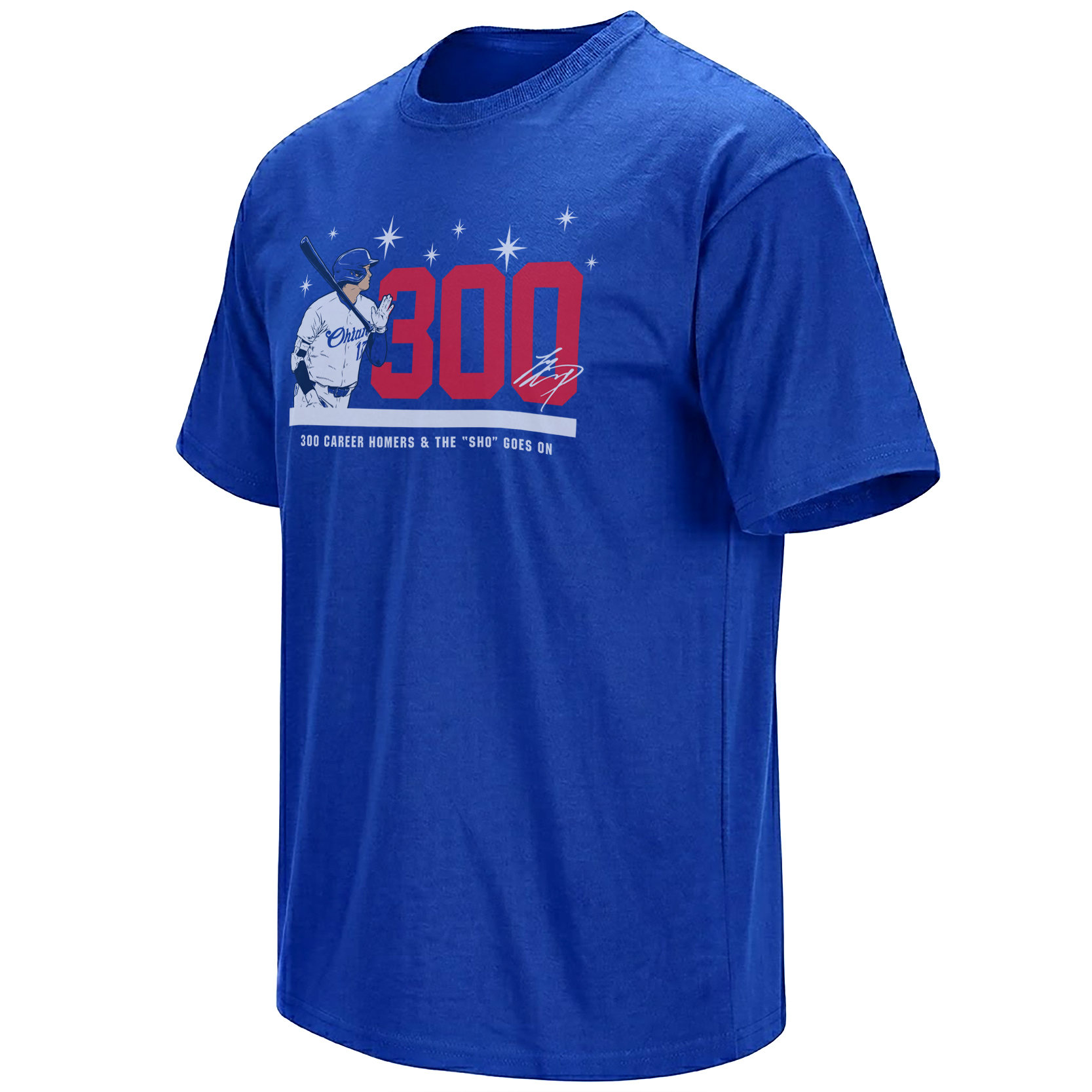
That is where the 300 Career Homers Shirt fits naturally into the conversation. The design does not need to recreate the entire game or explain every statistical detail. Its job is cleaner: preserve the number, the player, the Dodgers setting and the feeling of watching another Ohtani benchmark appear in real time.
The artwork centers the milestone language first. “300 Career Homers” reads like the headline on a commemorative scorecard, while Ohtani’s Dodgers identity gives the graphic its current-tense charge. The blue-and-white visual system keeps the piece tied to Los Angeles baseball, and the milestone framing makes the shirt feel closer to a dated archive than ordinary fan apparel.
A Regular-Season Moment With Postcard Energy
One reason this milestone travels well is that it did not require a postseason stage. It happened in July, inside the long daily rhythm of baseball, against a division opponent, in a game the Dodgers ultimately lost. That ordinary setting makes the historic number feel even stranger. Baseball can hide a legacy marker inside a Tuesday night.
The contrast matters. Ohtani’s 300th homer was not packaged as a final chapter. It was another marker on a path that still feels open. The next at-bat, the next start, the next replay and the next number all remain part of the same moving story. Fans are not only looking backward at the first 300. They are immediately asking what the next 100 might mean.
That forward motion is central to Ohtani culture. The internet rarely lets one achievement sit still. A milestone becomes a comparison chart, a broadcast clip, a pace debate, a collectible image and a reason to revisit older Angels and Dodgers highlights. The conversation is never just “he did it.” It is “how is he still doing this?”
The strongest milestone graphics work like baseball cards enlarged into streetwear: one number, one player, one moment. This design follows that rhythm, using clean Dodgers-era visual cues so the 300 number stays instantly readable.
Dodgers Blue Makes the Number Feel Current
Ohtani’s career did not begin in Los Angeles, but the Dodgers chapter changed the visual atmosphere around his milestones. The number 300 contains his full major-league journey, yet the way fans are receiving it now is deeply tied to Dodger blue, Chavez Ravine and the championship-sized expectations that follow every Los Angeles season.
That is why the broader Los Angeles Dodgers collection matters in this context. It works like a running visual archive of the team’s current era: star turns, postseason language, rivalry moments, player jokes and the kinds of milestone graphics that help fans remember when a season changed shape.
The wider MLB Shirts collection places the Ohtani piece inside baseball’s larger culture of numbers and memory. In MLB, a single swing can become a stat line, a broadcast clip, a clubhouse note and a fan object before the next game even begins.
Why Fans Keep Turning Ohtani Numbers Into Culture
Ohtani’s milestones spread differently because they are never only about hitting. Even when the achievement is a home run number, the background story includes two-way greatness, international visibility, Dodgers pressure and the sense that baseball is watching a once-in-a-generation career unfold while still trying to find the right frame for it.
Fan reaction around moments like this usually moves in several directions at once. Some fans focus on the pace. Some focus on the swing. Some compare eras. Dodgers fans fold it into the present season. Japanese baseball fans read it through a longer international lens. Neutral fans may simply treat it as another reminder that Ohtani has made statistical amazement part of the weekly baseball schedule.
That layered reaction is exactly why milestone apparel can feel meaningful when handled with restraint. The piece is not trying to declare the career complete. It captures one verified point on the map: Ohtani, 300 homers, Dodgers uniform, July baseball, another number that will follow him into every future conversation.
The Number That Points Forward
Three hundred home runs would be a defining achievement for most players. For Ohtani, it feels like both a celebration and a comma. The public has learned not to treat his records as isolated events, because each one quickly becomes connected to another chase: the next home run tier, another pitching return, another MVP argument, another postseason expectation.
That is the rare tension the design preserves. It marks a finished number while the career still feels unfinished in the most dramatic way. The 300 Career Homers Shirt belongs to the moment because it does what a good baseball artifact should do: it gives fans a fixed image for a moving story.
Frequently Asked Questions
When did Shohei Ohtani hit his 300th career home run?
Shohei Ohtani hit his 300th career home run on July 7, 2026, during a Dodgers game against the Colorado Rockies at Dodger Stadium.
Why does Ohtani’s 300th home run matter culturally?
The milestone matters because Ohtani is not viewed only as a power hitter. Fans connect every major number to his larger two-way legacy, global visibility and ongoing Dodgers era.
What does the 300 Career Homers Shirt represent?
The design represents Ohtani’s 300-home-run milestone as a visual timestamp, connecting the number, the Dodgers setting and the ongoing story of his career.
Why does the Dodgers setting change the feel of the milestone?
Dodger Stadium gives the milestone a major baseball stage, turning the swing into a Los Angeles visual tied to scoreboard memory, crowd reaction and the current Dodgers era.
How does this design fit into baseball milestone culture?
Baseball fans have long turned numbers into memory objects. A clean 300-homer graphic works like a modern scorecard or baseball-card marker for a specific achievement.
The 300 Career Homers Shirt records Ohtani’s milestone in Dodgers blue, while the wider Dodgers archive and MLB culture collection keep tracking the moments that turn a season into shared baseball memory.
300 Career Homers Shirt captures Shohei Ohtani’s Dodgers milestone through a clean baseball-card style graphic, turning his July 2026 home run landmark into a visual timestamp of the current Los Angeles era.