
Sho Time Became an Era Back-to-Back Titles Changed the Meaning of the Show
One Shohei Ohtani graphic presents the nightly attraction — marquee lights, a violent swing and the expectation that something extraordinary may happen. The other looks backward at two completed Octobers and asks how quickly one superstar became the defining face of a Dodgers championship period.
Los Angeles understood the performance before it understood the full historical scale. Every Shohei Ohtani plate appearance already felt like an event, but championships changed the emotional meaning of the spectacle.
“Sho Time” originally described anticipation. It was the moment the lineup returned to Ohtani, the stadium lifted its phones and an ordinary inning suddenly felt capable of becoming a clip replayed around the world.
After consecutive Dodgers championships in 2024 and 2025, the phrase carries more weight. The show is no longer separate from October history. Ohtani’s star aura, his left-handed swing and his return as a two-way contributor now sit inside a Los Angeles story measured in flags, trophy lifts and the pressure of attempting another title run.
“Sho Time” describes what fans expect to see tonight. “Back 2 Back” records what Los Angeles has already lived through.
From Baseball Star to Los Angeles Main Event
Ohtani arrived in Los Angeles with a level of attention few baseball players have ever carried. The Dodgers did not need to invent his star image; they placed it inside a city already fluent in premieres, marquees and the language of spectacle.
That is why the Sho Time Shirt feels natural rather than exaggerated. Its theater-sign typography connects the player to Hollywood presentation, but the graphic still allows baseball movement to remain the central event.
Ohtani is not posed like a celebrity waiting on a red carpet. He is captured in a full left-handed follow-through, body rotated through the swing and bat extended behind him. The marquee creates expectation; the motion supplies the payoff.
Two Designs, Two Different Kinds of Memory
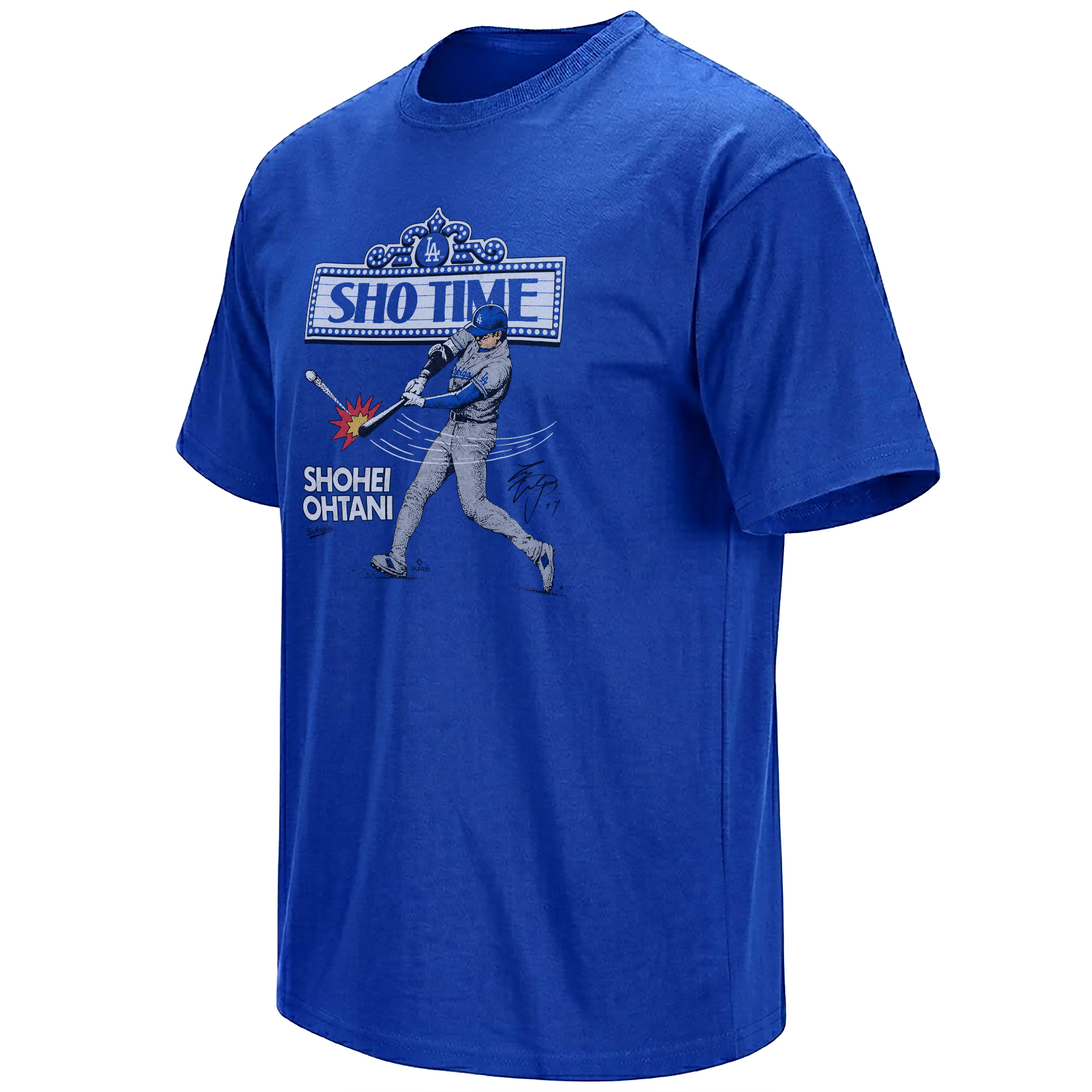
A royal-blue performance poster built around the anticipation, impact and theatrical energy of an Ohtani at-bat.
View the Sho Time piece →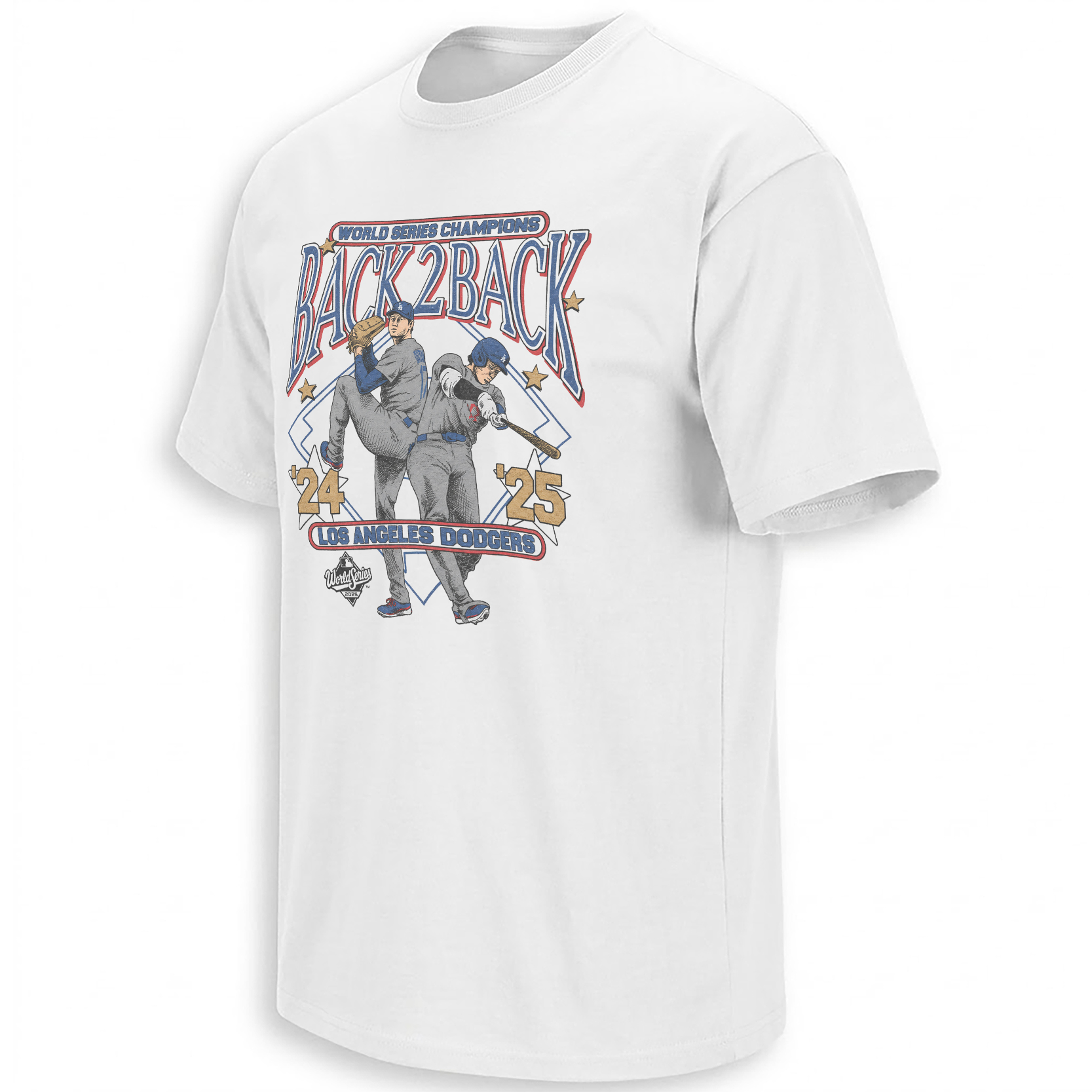
A vintage championship composition that places Ohtani’s pitching and hitting identities between Los Angeles’ 2024 and 2025 titles.
Open the championship poster →The difference between the two designs is temporal. Sho Time exists in the present tense. Its question is always immediate: what might happen during the next pitch?
Back 2 Back operates like an archive page. Its years are fixed, its championships are completed and its dual illustrations explain why Ohtani belongs at the center of the composition.
The Marquee Design Understands Ohtani as Spectacle
The upper section of the Sho Time artwork resembles a theater façade or illuminated stadium sign. The lettering does not simply identify the player. It announces him.
Beneath it, curved motion lines sweep behind the body and a red-and-yellow contact burst interrupts the cooler blue palette. That small impact graphic matters because it creates a visual sound effect. The viewer can almost hear the bat at the instant of contact.
The signature-style mark completes the player-poster language. It gives the composition the feeling of something connected to an individual performance rather than a generic Dodgers team graphic.
Marquee lettering, swing motion and a contact burst transform an Ohtani at-bat into a visual event unfolding in real time.
Championship dates, dual pitching-and-hitting poses and retro poster typography turn two seasons into one Dodgers memory map.
Why Ohtani Appears Twice in the Championship Graphic
Most player graphics use multiple images to create scale. In the Back 2 Back design, the duplication carries specific meaning. The Ohtani on the left is a pitcher, balanced through a high leg kick with his glove set near his chest. The Ohtani on the right is a hitter finishing the swing.
Those are not simply two attractive action poses. They summarize the central reason his Dodgers story feels historically unusual. Los Angeles has one player occupying two traditional baseball identities, and the championship poster allows both to share the same frame.
The gold ’24 and ’25 markers sit on opposite sides like chapter labels. Between them, the two Ohtani figures act as a visual bridge connecting one title to the next.
How One Championship Became an Era
The Dodgers’ 2024 title gave Ohtani a championship in his first season with Los Angeles. That alone would have been enough to permanently connect his arrival with a successful October.
Repeating in 2025 changed the narrative. One championship can be remembered as the ending of a great season. Consecutive championships invite a larger question about eras, dynasty language and how future fans will divide Dodgers history.
The Back 2 Back design captures that transition without trying to narrate every game. Oversized lettering, championship stars, the two years and the Dodgers banner give it the visual authority of a commemorative newspaper front page or parade poster.
The slightly faded reds, blues, cream and metallic-style gold make the championship graphic feel as though it already belongs to Dodgers history. It does not look like a prediction. It looks like a page saved after the final out.
Why the 2026 Season Changes How Fans Read Both Pieces
The present season places these designs beside each other in a particularly interesting way. Ohtani is once again performing as both hitter and pitcher, making the dual imagery in the championship design part of current baseball rather than a symbolic reference to distant potential.
At the same time, the Dodgers are trying to extend a two-year championship run. That pursuit gives “Back 2 Back” the feeling of a completed foundation rather than a finished story.
The Sho Time design remains open-ended. Every return to the lineup, every pitching start and every second-half appearance can add another visual memory to the larger Ohtani spectacle.
The Internet Reads Ohtani as an Event, Not Just a Player
Fan conversation around Ohtani rarely remains confined to one statistical category. A pitching performance becomes connected to his batting line. A home run is discussed beside his next start. An injury update carries unusual weight because it can affect two different jobs.
That constant overlap is why “Sho Time” travels so easily across broadcasts, captions and fan graphics. It compresses a complicated baseball identity into two instantly recognizable words.
The championship design performs a similar compression with dates. “’24” and “’25” allow fans to retrieve two entire postseasons without requiring the shirt to list every opponent, score or series.
A Dodgers Collection Built Around Moments, Not Just Names
These two graphics belong naturally inside the wider Los Angeles Dodgers collection , where Ohtani performances, championship memories, current players and October language form a running visual archive of this version of the franchise.
The broader MLB collection gives the designs another layer of context. Ohtani’s story is simultaneously a Dodgers story and a league-wide baseball story about how one player can reshape ideas of roster construction, star power and the modern two-way game.
Frequently Asked Questions
What does “Sho Time” mean for Shohei Ohtani?
“Sho Time” is a play on Ohtani’s first name and describes the anticipation surrounding his plate appearances, pitching starts and status as one of baseball’s central attractions.
Why does the Sho Time design use marquee lettering?
The marquee presentation connects Ohtani’s baseball performances with Los Angeles entertainment culture and frames each appearance as a main-event moment.
What do the ’24 and ’25 numbers represent?
The gold numbers represent the Dodgers’ consecutive World Series championship seasons in 2024 and 2025.
Why is Ohtani shown as both a pitcher and hitter?
The two illustrations represent his two-way identity and show why his role in the Dodgers era cannot be summarized through only batting or pitching.
How are the Sho Time and Back 2 Back designs different?
Sho Time focuses on the immediate spectacle of an Ohtani performance, while Back 2 Back records the completed 2024 and 2025 championship run through a retro historical composition.
Why does the Back 2 Back design feel like a vintage poster?
Layered serif typography, faded team colors, gold championship markers, stars and dual player illustrations give it the visual character of a commemorative sports program or parade poster.
The Sho Time graphic frames Ohtani as Los Angeles’ nightly baseball attraction, while the Back 2 Back championship piece records how quickly the show became part of Dodgers history.
Shohei Ohtani Dodgers designs connect the nightly spectacle of Sho Time with Los Angeles’ 2024–2025 back-to-back championship era through marquee swing artwork, two-way pitcher-hitter symbolism and vintage World Series poster language.