Two Aces Opened the Night Philadelphia Turned Their Contrast Into an All-Star Frame
Dylan Cease and Cristopher Sánchez entered the 2026 MLB All-Star Game from opposite dugouts, opposite arms and different emotional positions — one representing the American League for the first time, the other carrying the National League into the first inning before his home crowd.
The first pitch of an All-Star Game is never only the beginning of an exhibition. It is a league-wide introduction, a declaration that two seasons of individual pitching work have earned the right to frame baseball’s biggest midsummer stage.
In Philadelphia on July 14, that introduction belonged to Dylan Cease and Cristopher Sánchez. Cease arrived as a first-time All-Star and the American League’s strikeout-heavy right-handed starter. Sánchez took the ball for the National League inside Citizens Bank Park, where his own city could respond to each warmup pitch before the rest of baseball had fully settled into the broadcast.
Their pairing immediately gave the night a clean visual structure: Blue Jays blue against Phillies red, right-hander against left-hander, visiting ace against hometown ace. Before the lineups turned the game into a rotating gallery of stars, the opening belonged to two pitchers and the different kinds of pressure carried to the mound.
All-Star starting honors preserve the season that came before the game, even when the first inning refuses to follow the script.
Why the Starting-Pitcher Announcement Mattered
All-Star rosters contain elite players at every position, but naming the two starters creates a special category of recognition. The choice tells fans which pitchers best represent the first half of each league’s season — not through a trophy vote completed months later, but through the immediate judgment of the baseball people managing the game.
Cease entered with a 2.56 ERA and 148 strikeouts, numbers that made his first All-Star selection feel less like a delayed ceremonial reward than recognition of one of the loudest swing-and-miss performances in the sport. His delivery, slider and strikeout volume gave the American League a starter built for a short showcase inning.
Sánchez arrived with an 11–4 record, a 2.62 ERA and 144 strikeouts. He had also constructed a 50 2/3-inning stretch without allowing an earned run earlier in the season, giving Philadelphia fans a deeper emotional reason to view the assignment as something earned over months rather than granted because the game happened to be local.
A right-handed, strikeout-centered ace entering his first Midsummer Classic in Toronto colors.
A left-handed hometown starter carrying an elite first half onto Philadelphia’s national stage.
The First Inning Split Their Stories Apart
The design presents Cease and Sánchez in balance, but the game itself immediately created contrast. Cease opened the bottom of the first by striking out Kyle Schwarber, Juan Soto and CJ Abrams, working around a walk to Freddie Freeman and leaving the inning without allowing a run.
The live microphone added another layer to the performance. Viewers could hear Cease and catcher Shea Langeliers discuss pitch selection as the inning developed, turning elite execution into something closer to a brief pitching seminar delivered in real time.
Sánchez experienced the opposite version of All-Star exposure. The American League produced three runs in the top of the first, with Cody Bellinger and Ben Rice delivering the decisive hits after traffic accumulated on the bases.
That inning did not erase why Sánchez started. It demonstrated the strange compression of an All-Star appearance: months of dominance earn the assignment, then a few batters determine how the televised inning feels. The honor belongs to the season. The box score belongs to the night.
The Graphic Preserves the Matchup Before the Result
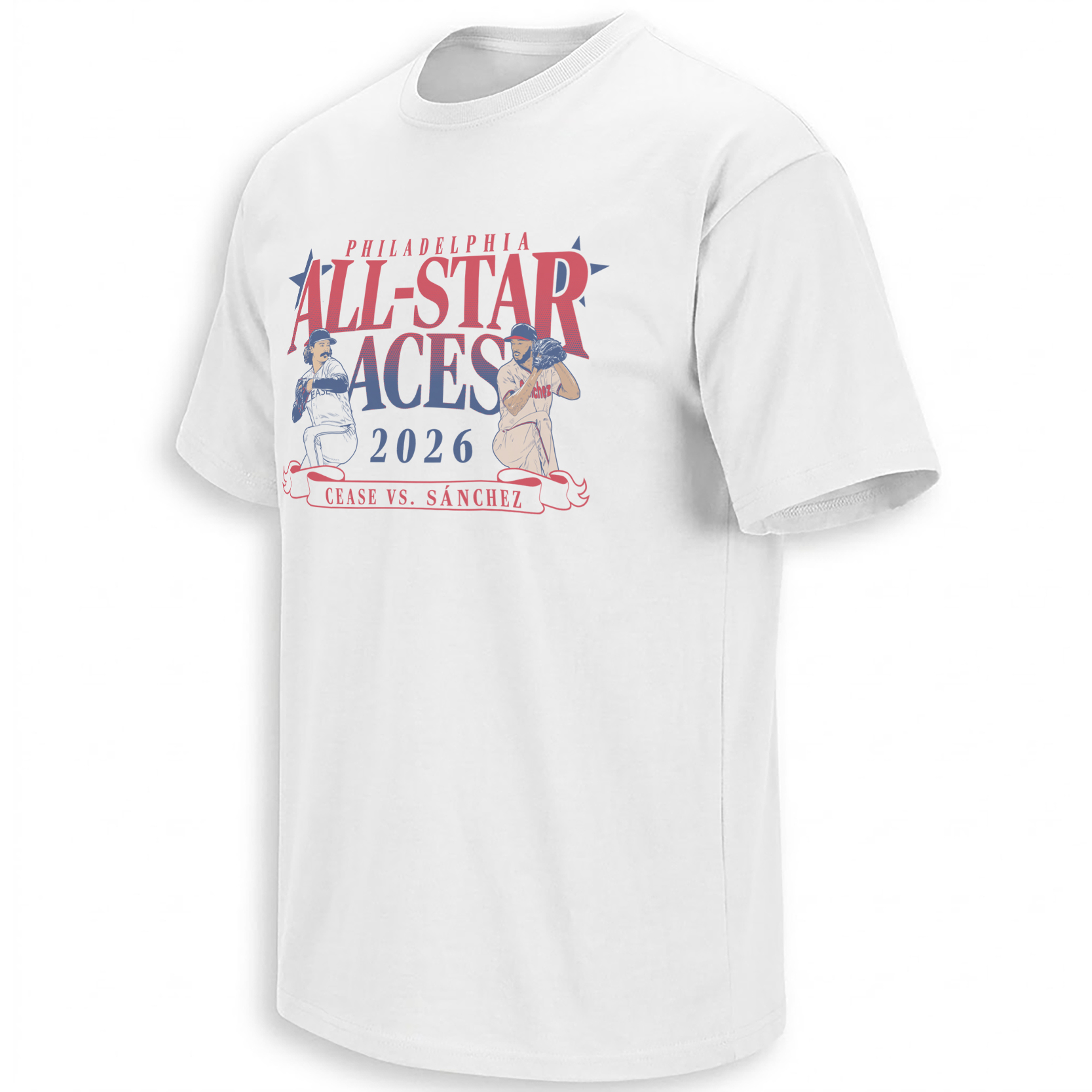
The All-Star Aces Shirt treats the two pitchers as co-headliners rather than turning the final score into the central subject. That distinction gives the artwork the feeling of a game-day program created before either ace knew how the opening inning would unfold.
“Philadelphia” appears above the oversized “All-Star Aces” title, grounding the entire composition in the host city. Cease and Sánchez occupy opposite sides beneath the lettering, each frozen in his delivery and visually aimed toward the same central stage.
A Retro Program Look for a One-Night Matchup
The typography borrows from vintage baseball programs, pennants and commemorative game graphics rather than modern digital scoreboards. Tall serif letters make “All-Star Aces” feel ceremonial, while the slightly irregular angles keep the title from becoming too formal or static.
Red and navy perform several jobs at once. They reference the host city’s baseball palette, preserve the traditional National League and American League contrast, and create enough separation for the two illustrated pitchers to remain individually readable.
The ribbon beneath the figures gives “Cease vs. Sánchez” the visual importance of a classic marquee matchup. It does not suggest rivalry in the ordinary divisional sense. Instead, it records the rare night when two pitchers from different leagues became the paired opening image of the sport.
Tall vintage lettering, Philadelphia red, league-style navy, small star accents and a matchup ribbon make the artwork resemble a commemorative program cover — the kind of visual fans might associate with a ticket stub, scorecard or midsummer souvenir saved long after the broadcast ends.
Philadelphia Was More Than a Neutral Backdrop
Citizens Bank Park hosting its first All-Star Game gave the event a clear local personality. Philadelphia had not hosted the Midsummer Classic since 1996, when the game was played at Veterans Stadium, so the return arrived with three decades of stadium history, roster change and civic baseball memory behind it.
Sánchez starting in his own ballpark concentrated that history into one introduction. He became the first Phillies pitcher to start an All-Star Game since Roy Halladay in 2011 and one of the relatively small group of pitchers asked to open the event in their home park.
The crowd’s investment therefore existed before the result. Philadelphia was not simply hosting an MLB production decorated with local imagery. It had one of its own rotation leaders standing at the center of the opening ceremony.
That hometown context runs throughout the wider Philadelphia Phillies collection , where Sánchez’s starting assignment sits beside player moments, All-Star references and other pieces documenting the city’s current baseball identity.
The Roy Halladay Connection Between Both Starters
An unexpected historical thread connected Cease and Sánchez before the first pitch. Roy Halladay had previously started an All-Star Game for Toronto in 2009 and for Philadelphia in 2011.
In 2026, Cease became the latest Blue Jays pitcher to receive the American League assignment, while Sánchez became the first Phillies pitcher since Halladay to start for the National League.
The connection does not make the two careers equivalent, and the graphic does not need to force that comparison. It simply gives the matchup an elegant piece of baseball symmetry: Toronto and Philadelphia, once linked through Halladay’s All-Star history, appeared again through the two pitchers opening the same game.
Why the Shutout Made Cease’s Inning Feel Larger
Cease’s three-strikeout first inning did not remain an isolated highlight. It became the opening movement of a full American League pitching performance that held the National League to three hits and prevented any runner from reaching second base.
The 4–0 result produced only the tenth shutout in All-Star Game history and the first since the American League blanked the National League at Citi Field in 2013. That larger outcome gave Cease’s inning retrospective weight: he did not merely survive his assignment; he established the tone of the entire game.
Sánchez’s appearance carries a different kind of memory. The first inning was difficult, but the starting honor remains part of his season and Philadelphia’s All-Star history. Baseball can hold both ideas at once because selection and performance answer different questions.
All-Star Graphics Work Like Scorecards for Memory
Most regular-season games become fragments within a 162-game schedule. The All-Star Game is different because its combinations may never occur again. A specific host city, two starting pitchers and two league rosters are assembled for one night, then immediately separated.
That impermanence is why matchup graphics carry archival value. The artwork does not need to explain every pitch or list the final line. It preserves the original headline: Cease versus Sánchez, American League versus National League, Philadelphia in 2026.
Inside the broader MLB collection , the piece belongs to a visual tradition built from one-night pitching assignments, All-Star selections, historic venues and the moments when baseball briefly rearranges familiar team identities into a league-wide event.
Frequently Asked Questions
Who started the 2026 MLB All-Star Game?
Dylan Cease of the Toronto Blue Jays started for the American League, while Philadelphia Phillies left-hander Cristopher Sánchez started for the National League.
Where was the 2026 MLB All-Star Game played?
The game was played at Citizens Bank Park in Philadelphia on July 14, 2026, marking the ballpark’s first time hosting the Midsummer Classic.
How did Dylan Cease perform in the All-Star Game?
Cease pitched a scoreless first inning, striking out Kyle Schwarber, Juan Soto and CJ Abrams while allowing one walk.
Why was Cristopher Sánchez starting at home significant?
Sánchez became the first Phillies pitcher since Roy Halladay in 2011 to start an All-Star Game and received the honor in front of his home crowd at Citizens Bank Park.
What does the All-Star Aces design represent?
The artwork preserves Cease and Sánchez as the two starting pitchers of the 2026 All-Star Game through vintage program typography, Philadelphia colors and a classic versus-style composition.
Who won the 2026 MLB All-Star Game?
The American League defeated the National League 4–0 behind three first-inning runs and a pitching staff that allowed only three hits.
The All-Star Aces graphic preserves Cease and Sánchez as the paired opening image of Philadelphia’s 2026 Midsummer Classic, while the wider Phillies visual archive follows the hometown players and moments surrounding the event.
All-Star Aces Shirt captures Dylan Cease and Cristopher Sánchez as the starting pitchers of the 2026 MLB All-Star Game through vintage Philadelphia typography, red-and-navy artwork and a classic Cease vs. Sánchez matchup layout.